" The World 'Is' Full Of Cravens Who 'Pretend' To Be Heroes, It 'Takes' A Queer Sort Of Courage To Admit To Cowardice ". A Game Of Thrones Page 179 - Jon Snow
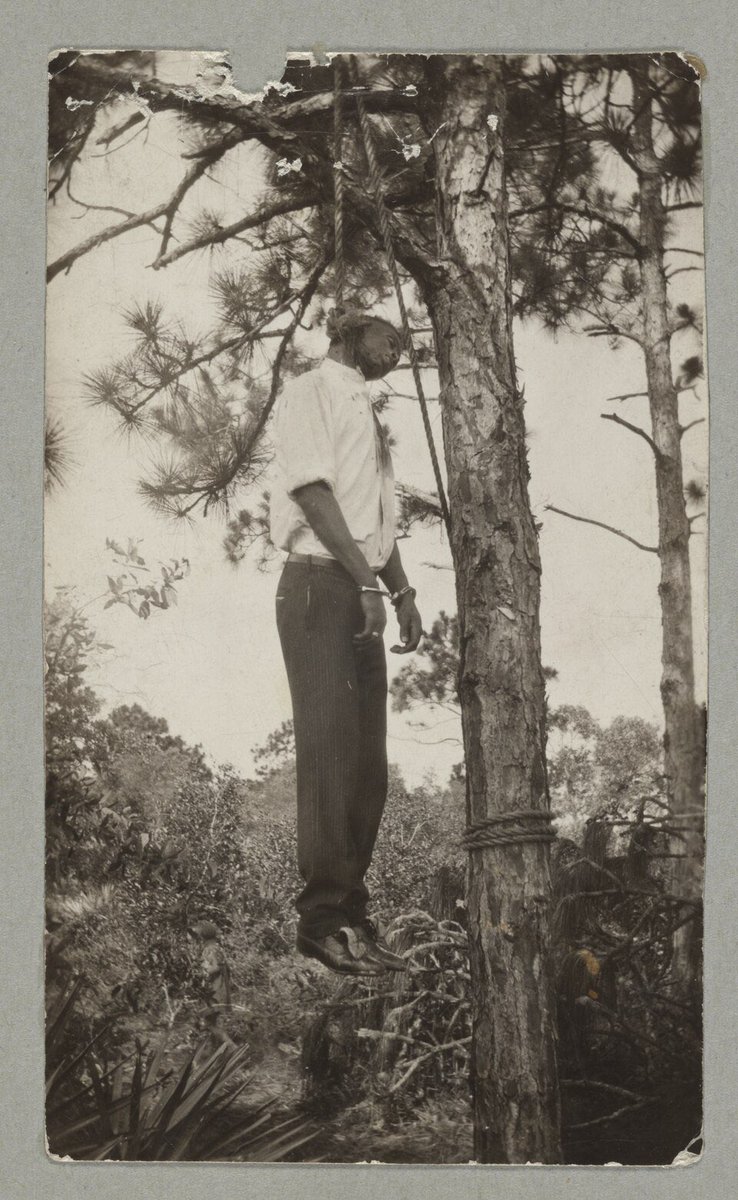
James Clark, a black chauffeur in Eau Gallie, Florida, is lynched after being accused of having sexual intercourse with a white girl.
Clark’s body is left hanging, as pictured. Local officials say they will not make an attempt to find the killers.
The wait is over.
We have 2 golds: Chimdiebube Onwubiko and Don Anele Munachimso.
We are the best in the world!
Egejurum Onyedikachi’s name was omitted. He should have a gold.
@aushamaki She was not being honest, she was playing dumb. Playing dumb is a part of their strategy - the idea is to obliterate your hope, zero your mind from expecting any form of good governance from them.
It is pure evil!
2 years ago today, WAEC deleted this 2016 video confirming that Peter Obi moved Anambra State from 27th to 1st in WAEC rankings, all because of that guy in Aso Rock.
Me dijo "desnudate" y yo le mostré este video del cucho Hernández peleando por el balón en el momento más tenso del partido. Me puse a llorar y ella se burló. Quería ver la desnudez de mi cuerpo; yo, tonto, le mostré la desnudez de mi alma.
Let me tell you something, my friend.
The North’s problem is real. Nobody serious should deny it. The poverty is real. The out-of-school children are real. The insecurity is real. The failure of leadership is real.
But if you want to understand the North, you cannot start the story from “they have had presidents.”
That is too shallow for a region with this much history, geography, trauma, religion, power politics, colonial distortion, elite failure, and security pressure.
The North did not wake up one morning and decide to hate education. There is a history behind that suspicion.
When the British entered Northern Nigeria, they met an already established Islamic political order. There were emirates, courts, scholars, taxation systems, trade routes, Islamic schools, judges, administrators, and a ruling class that already had its own idea of civilization.
Then colonial rule came with Western education, missionary activity, new courts, new administrative structures, and new incentives.
In many parts of the South, Western education entered through mission schools and became a ladder into the colonial economy. In much of the Muslim North, it carried a different meaning. It was not just “school.” It was seen by many as a vehicle for Christian influence, colonial loyalty, cultural erosion, and the weakening of existing Islamic authority.
That stigma did not come from the sky. It came from conquest, mistrust, and the way Western education arrived.
This is why the North’s education problem cannot be reduced to stupidity or laziness. It began partly as a defensive reaction to a real historical threat.
But here is the hard truth: the suspicion has outlived the threat.
A reaction that may have made sense under colonial pressure became destructive when the modern state began rewarding literacy, science, bureaucracy, technology, engineering, and formal administration.
At some point, protecting identity became indistinguishable from trapping children outside the future.
That is where Northern leadership failed badly.
The old Northern elite understood the danger earlier than people admit. Sir Ahmadu Bello did not sit down and say, “Let the North remain backward.” His Northernization agenda was a deliberate attempt to produce Northern teachers, administrators, civil servants, professionals, and political leadership quickly enough to prevent the region from being swallowed inside a new Nigerian state dominated by the already Western-educated South.
That agenda had flaws, but it worked in one important sense: it created a Northern administrative class.
The problem is that later leaders inherited the power but not the developmental seriousness.
They inherited the slogans, the emirates, the titles, the political machinery, and the federal access, but not the discipline of mass education, industrial policy, rural development, teacher training, agricultural modernization, and serious security planning.
So yes, the North has produced presidents.
But producing presidents is not the same as producing development.
Power without developmental discipline becomes distribution. It becomes appointments, contracts, pilgrim boards, federal slots, elite bargaining, and recycled patronage.
And geography also matters.
The North is not sitting beside the Atlantic like Lagos or Port Harcourt. It is tied to the Sahel. It shares long and porous borders with Niger, Chad, Cameroon, and Benin. When Libya collapsed, when weapons spread across the Sahel, when jihadist networks expanded, when climate stress hit pastoral routes, when Lake Chad communities were weakened, when Niger and Mali became unstable, the North inherited those shocks directly.
A farmer in Zamfara, a trader in Maiduguri, a herder around Sokoto, or a community in Katsina is not dealing only with “Nigerian leadership failure.” They are living inside a regional security crisis.
That does not excuse bad leadership. It explains why lazy comparisons are weak.
The North also suffered from the Nigerian resource curse in a particular way. Once oil money became the centre of the Nigerian state, productive regional economies were weakened. Groundnut pyramids, cotton, hides and skins, textiles, agriculture, local industry, and regional planning lost importance. Politics became a struggle for federal allocation instead of a competition to build productive capacity.
The North had land. It had people. It had agriculture. It had trade routes. But the oil state taught every region to look toward Abuja.
That destroyed initiative everywhere, but it damaged the North deeply because its strongest assets required long-term planning: irrigation, agro-processing, education, rural roads, livestock systems, border trade, and security coordination.
Now, after saying all that, responsibility must be accepted.
Northern leaders failed their own people.
They allowed almajiri children to become political decoration instead of a national emergency. They allowed banditry to grow from local criminality into a parallel economy. They allowed schools to decay. They allowed girls’ education to become negotiable. They allowed clerics and politicians to play games with reform. They used poverty as an election structure. They built loyalty through dependence.
That part is true.
But the answer is not to mock the North. The answer is to study what worked before and update it.
Ahmadu Bello’s Northernization agenda can be reimagined for the 21st century.
Not as ethnic exclusion or nostalgia. But as a serious regional human-capital project.
Mass teacher training. Boarding schools in secure zones. Integrated Qur’anic and formal education. Technical colleges tied to agriculture, energy, construction, mining, and logistics. Girls’ education backed by stipends and community negotiation. Agro-industrial clusters around Kano, Kaduna, Katsina, Sokoto, Bauchi, Gombe, Niger, and Borno. Livestock modernization instead of pretending open grazing can survive modern population pressure. Border security tied to trade, not just soldiers and checkpoints.
Other societies have faced versions of this problem.
Bangladesh attacked female education with stipends, community-level incentives, and a clear national push. Indonesia did not abolish its Islamic schools; it integrated many of them into a modern education pathway. Malaysia used state policy to expand opportunities for historically disadvantaged Malay communities, though with its own flaws. China took poor inland regions seriously through infrastructure, rural industry, technical training, and state coordination.
The lesson is simple: you do not fix historic backwardness by insults. You fix it with policy, discipline, and elite seriousness.
So yes, my friend, criticize Northern leadership. I do it too.
But do not flatten a whole region into “they had presidents and still failed.”
That is lazy analysis.
The North’s crisis is a product of bad leadership, colonial disruption, educational mistrust, Sahelian geography, oil-state laziness, elite capture, and security collapse.
And the way forward is also clear.
The North must stop hiding behind history.
The South must stop pretending history does not matter.
And Nigeria must understand that if the North remains broken, the country will not be stable, no matter how much one region mocks another online.
If Mikel Arteta wins the Champions League with Arsenal… It would be one of the greatest achievements in the club’s modern history.
But no, that still doesn’t make him bigger than Arsène Wenger.
I don’t think you fully understand how massive Wenger’s legacy actually is.
Wenger didn’t just win trophies, he transformed Arsenal Football Club forever and even Premier League at large.
He arrived in 1996 and changed English football culturally, tactically, nutritionally, structurally, everything. At a time when the Premier League was still deeply rooted in old-school methods, Wenger modernised the game. Sports science, diet, technical football, player development, he pushed England forward.
Then you look at the football itself.
Three Premier League titles.
Seven FA Cups.
An Invincibles season nobody has replicated.
Competing against Sir Alex Ferguson’s Manchester United, Mourinho’s Chelsea, Abramovich money, and still building elite sides consistently for over a decade.
And don’t forget the context of the Emirates era too.
Arsenal moved stadiums and financially handicapped themselves for years. Most clubs collapse during transitions like that. Wenger somehow kept Arsenal in the Champions League every single season while operating on tighter budgets than his rivals. He kept the club elite during its most vulnerable period.
That matters.
Arteta has done an unbelievable job rebuilding Arsenal. He restored standards, rebuilt the culture, made Arsenal feared again, and tactically elevated the team back to Europe’s elite. Winning a Champions League would cement him as one of Arsenal’s greatest managers instantly.
But overtaking Wenger? That requires more than one historic moment. It will take a lot more than that.
Wenger gave Arsenal an identity the modern club still lives off today. He gave them longevity, dominance, innovation, iconic football, legendary players, and an era people still talk about nearly 30 years later.
To surpass Wenger, Arteta would probably need sustained dominance:
multiple league titles,
continued European success,
longevity,
and an era that genuinely eclipses Wenger’s cultural impact on the club.
Because Wenger is not just Arsenal’s greatest manager due to trophies.
He is Arsenal.