@Web3stunner_@axisrobotics Filtering human corrections down to the ones that actually improve recovery makes Axis Robotics’ training approach much more efficient.
Your old account got suspended, but you’re back and still giving back to the community. ����🖤
I’ve been showing up, supporting, participating and trying again and again for a long time. Still waiting for my lucky moment. 👀
Maybe this time that “Tipped 😎” notification finally finds me. 🥹
🆔️ ShadeXBTC
@pp_privatejet_2 #SHUFFLE 😎🫡
Been waiting for my turn. 🖤
I’ve caught myself doing this more lately: before I trust an account, I check what it has actually done, not how human its replies sound.
That old signal is getting weaker. A machine can be funny, confident, helpful and even remember the way you talk.
So my rule now is simple: check the history, check the claims, and look for people who can vouch for the person behind the account.
And this gets even more important when agents start doing things for us. @GenLayer makes sense to me here because when two agents disagree, “who sounded more convincing” shouldn’t decide the outcome.
David Riudor is right about one thing that stuck with me: online, trust is becoming something you verify, not something you assume.
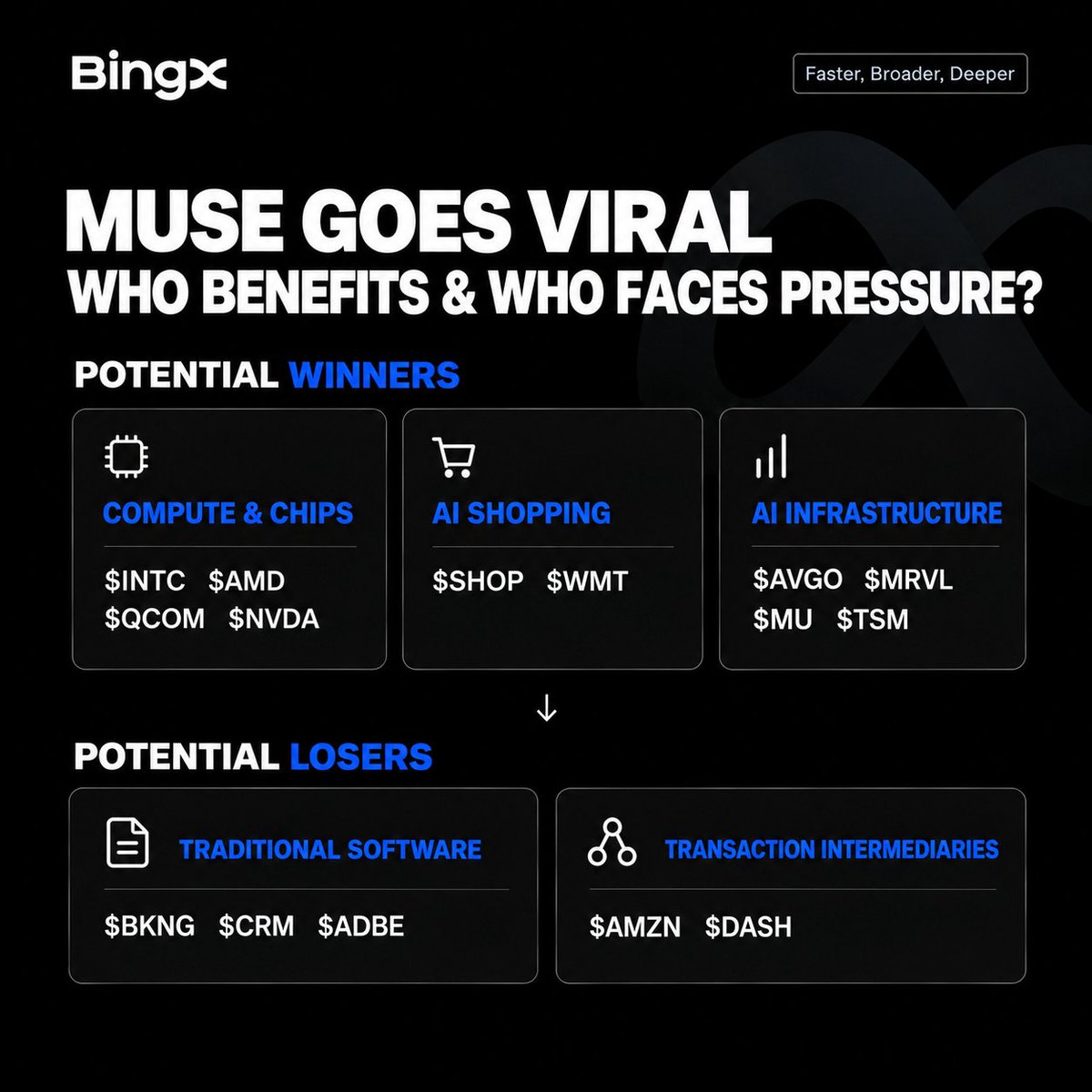
Meta’s Muse is making me look at the AI trade a little differently.
For years, the conversation was mostly:
Who has the best model?
Who has the most powerful GPU?
Who can generate the best answers?
Now the next phase looks more like:
What happens when AI starts doing things for you?
Muse can already handle tasks like browsing, bookings, shopping and working across connected apps, with users approving certain actions.
That sounds like a product story on the surface.
But underneath it is an infrastructure story.
Every time an agent performs a task, there’s compute happening somewhere.
More agents → more usage.
More usage → more inference.
More inference → more demand for chips, networking, memory and data centers.
Meta is already expanding its AI infrastructure with AMD across CPUs, GPUs and networking, while also developing custom silicon with Broadcom.
So I’m watching the AI names from a slightly different angle now.
$META for the agent itself.
$AMD and $INTC for compute.
$AVGO for the infrastructure and networking side.
The interesting question isn’t just whether AI agents become popular.
It’s how much infrastructure gets built if they actually become part of everyday computing.