We have some of the finest universities in the world. Their reputation, academic excellence and the prestige attached to a British education attract students from across the globe. Those who come here to benefit from that privilege should be paying the full cost of their education. Ideally, the revenue generated from international students would help subsidise places for our own young people, making higher education as accessible as possible to them.
Yet we seem to be having precisely the opposite conversation: one in which British students are left carrying an ever increasing burden of debt, potentially subsidising a system that should be working to make their education more affordable.
Education should be treated as an investment in our young people, not a luxury reserved for those who can afford it. A highly educated population produces a more skilled workforce, but also a more cultured, intellectually confident and capable society. Building that society should be an explicit ambition of government.
We should not be stripping our higher education institutions bare, leaving them struggling to sustain the very standards that made them internationally renowned. The ambition should be to invest in them, strengthen their academic excellence and build upon the extraordinary global reputation of a British university education.
That reputation is an asset. We should be doing far more to promote it, attract the world's brightest students and allow international demand to generate the revenue that helps our universities flourish and makes education more accessible at home.
Let the world buy into the prestige of a British education, and use the returns to invest in the next generation here. Reduce the crushing burden of student debt, widen access for British students and give our universities the resources to compete and excel.
We are entering a period of profound economic and technological change. The countries that thrive will be those that invest in knowledge, cultivate intellectual ambition and build a society in which higher education is valued and accessible. We should ensure we remain one of them.
Look no further than Sophy Ridge’s post this morning to see how easily the Westminster lobby is taken for a ride on Net Zero. Sky’s lead presenter breathlessly announces £12bn for two offshore wind projects "off the east coast of Scotland". They aren’t in Scotland. They are Norfolk Vanguard East and West—50km off East Anglia. No 10 slipped "Scotland" into a press release, and the lobby typed it out without checking a map.
If they won’t check which country a £12bn project is in, they certainly won’t check the balance sheet.
Strip away the slogans from Ed Miliband’s zealots and look at the financial engineering. We are told this is "homegrown British energy." In reality, it is a 50:50 joint venture between German giant RWE and New York private equity firm KKR. Taxpayers are handing over £1bn from the National Wealth Fund to de-risk their equity, while locking households into a 20-year inflation-linked Contract for Difference at £91.20/MWh in 2024 prices—well over £100/MWh today. For two decades, your energy bill will legally underwrite the guaranteed yield of a Wall Street fund.
Where do the industrial jobs go? Not here. The 184 turbines come from Denmark’s Vestas, backed by Danish export finance. Worse, the steel monopile foundations were promised to the SeAH factory at Teesworks in Redcar. In April, RWE pulled the plug on the Teesside contract for Vanguard West—triggering North East job cuts—and outsourced fabrication to Bilbao in Spain and Nordenham in Germany, underwritten by German export agency Euler Hermes. British taxpayers put up the £1bn subsidy; German and Spanish factories get the heavy engineering.
Then look at the environmental reality Net Zero ideologues ignore. Building 184 15MW turbines requires over 400,000 tonnes of virgin blast-furnace steel, thousands of tonnes of copper, and Chinese rare-earth neodymium and dysprosium mined in toxic conditions. To connect it, developers are using compulsory purchase powers to rip a 60km, 45m-wide trench—wider than a motorway—through prime Norfolk farmland from Happisburgh to Necton, pouring tens of thousands of tonnes of concrete into 150 jointing bays and a 300m converter substation.
Before a single blade turns, the embedded carbon from smelting steel, curing concrete, and running diesel jack-up vessels across the North Sea is vast. The switchgear relies on sulphur hexafluoride (SF6)—a gas 23,500 times more potent than CO2 that lingers for 3,200 years. And when these turbines hit the end of their 20-year subsidy life? We are left with 552 epoxy-resin blades, each 115m long, which cannot be economically recycled at scale and end up shredded, incinerated, or buried in landfill, while 400,000 tonnes of rusting steel stay driven into the seabed.
Yet Kemi Badenoch and the Tories now tour studios calling Net Zero "fantasy politics," hoping we have amnesia. Look at her record:
In June 2019, she waved through Theresa May’s statutory Net Zero 2050 target in 90 minutes without objection.
In 2022, she boasted at the dispatch box that Net Zero would cost "under 2% of GDP."
She sat in the Cabinet that passed the Energy Act 2023, expanding the exact CfD subsidy racket behind this £12bn RWE/KKR stitch-up.
The uniparty built this machine together, mortgaging our industrial base to foreign utilities and private equity, giving Britain the highest industrial electricity prices in the developed world while paying gas stations to sit on standby when wind drops to 4%.
Only Reform UK—led by Nigel Farage and Richard Tice—will rip up the Net Zero mandates, scrap the CfD racket, fast-track domestic North Sea oil, gas, and modular nuclear, and stop treating British billpayers as a cash cow for global finance.
Cracking by Neil.
(In case you don’t know- 1st Jan was the birthdate used by civil servants to complete paperwork for asylum seekers with no paperwork. my wife saw this pattern 20 years ago as a “youth worker” in Reading, when “16 year olds” turned up who looked the same age as her dad.)
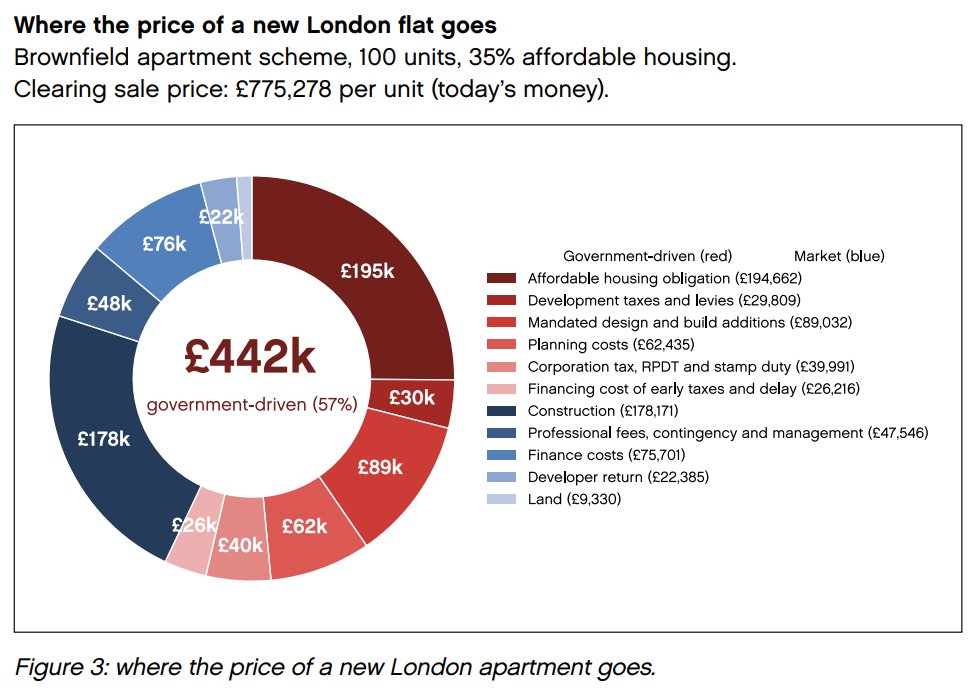
Here's the impact of this level of regulation on your household finances:
Using a 5% interest rate over 25 years on a 90% LTV, the cost of the £775k home is £4,079 per month. If you didn't have the givernment imposed costs (the red ones in the chart), your mortgage would be £1,753, which gives you £2,326 a month to do things (like meet a partner, have kids and so on).
To put it another way, the government has taken the equivalent of a £34k a year salary (which is the UK median) out of your household income in the borrowing requirement it has imposed on you through these regulations.
They've stolen a whole working member of your household.
Britain's "YIMBY problem" is basically a Social Housing Problem. Almost everything else is peripheral. You could very easily (a) make new housing developments less undesirable and (b) massively improve their viability at a stroke of a pen... (courtesy of @CPSThinkTank)
"Just before it was nationalised 94 per cent of its [c2c's] trains arrived within five minutes of the scheduled time. The latest available data from this August showed this had dropped to just under 71.5 per cent of trains."
@trevgoes4th Why would a blue collar worker go and fight for the government when all they do is vilify them. Thats why they hate social
Media. It doesn’t let them control the narrative