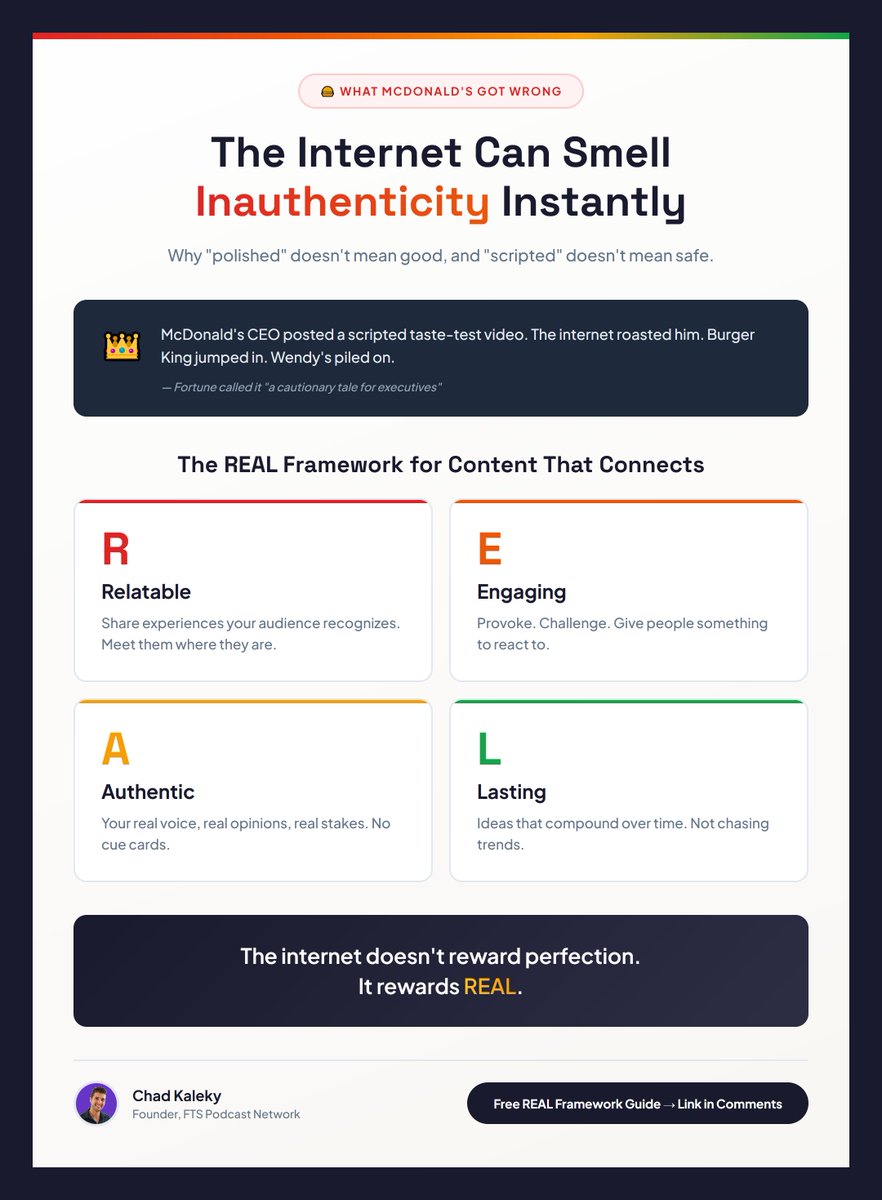
McDonald's CEO got roasted after posted a video taste-testing their new burger.
He looked scripted.
The internet can smell inauthenticity INSTANTLY.
"Polished" doesn't mean good.
"Scripted" doesn't mean safe.
That's why we use the REAL Framework:
Want the full framework?
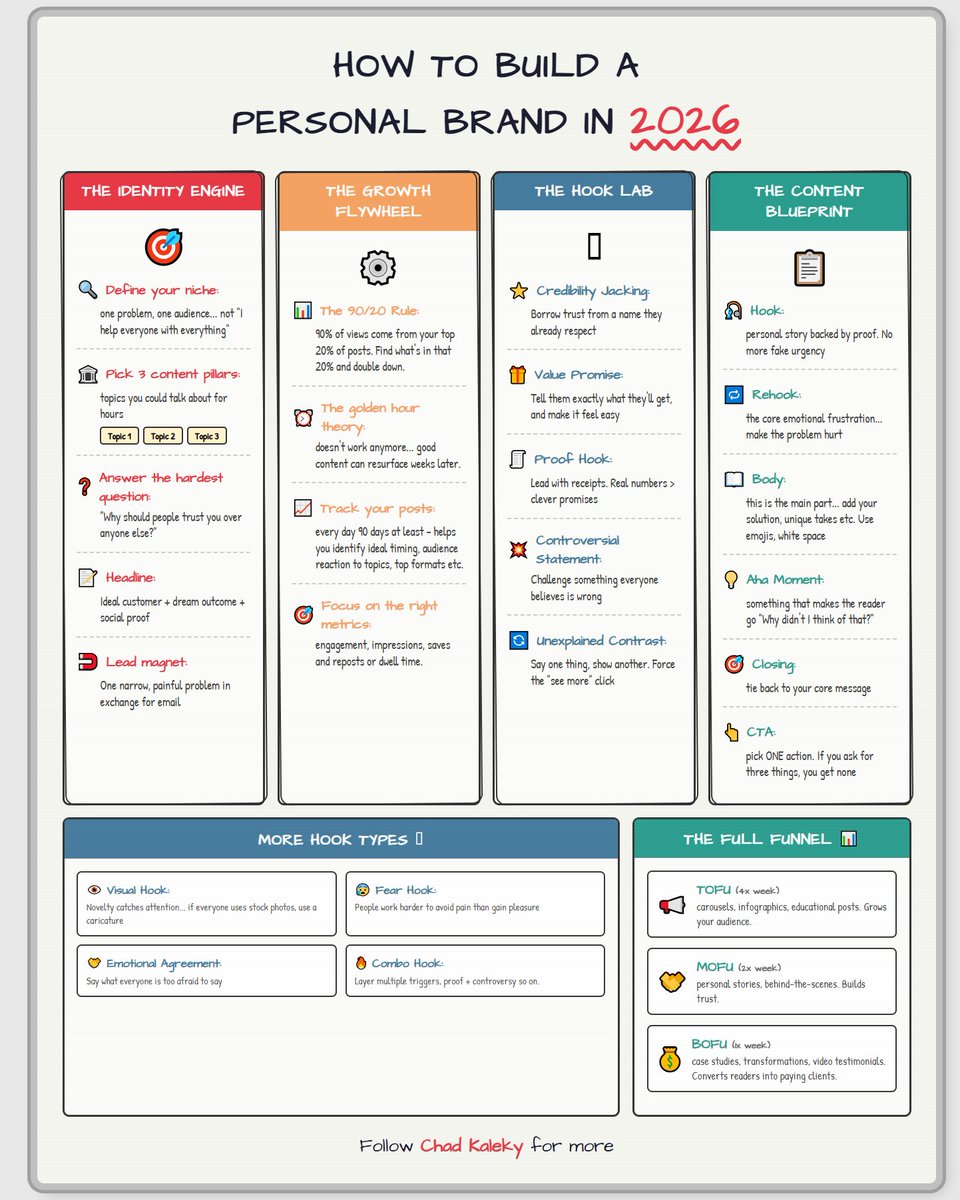
How to Build a Personal Brand in 2026:
1. Define ONE niche
2. Pick 3 content pillars
3. Track posts for 90 days
4. Use proof hooks over promises
5. TOFU 4x, MOFU 2x, BOFU 1x per week
The 90/20 rule: 90% of views come from 20% of posts.
Find that 20% and double down.
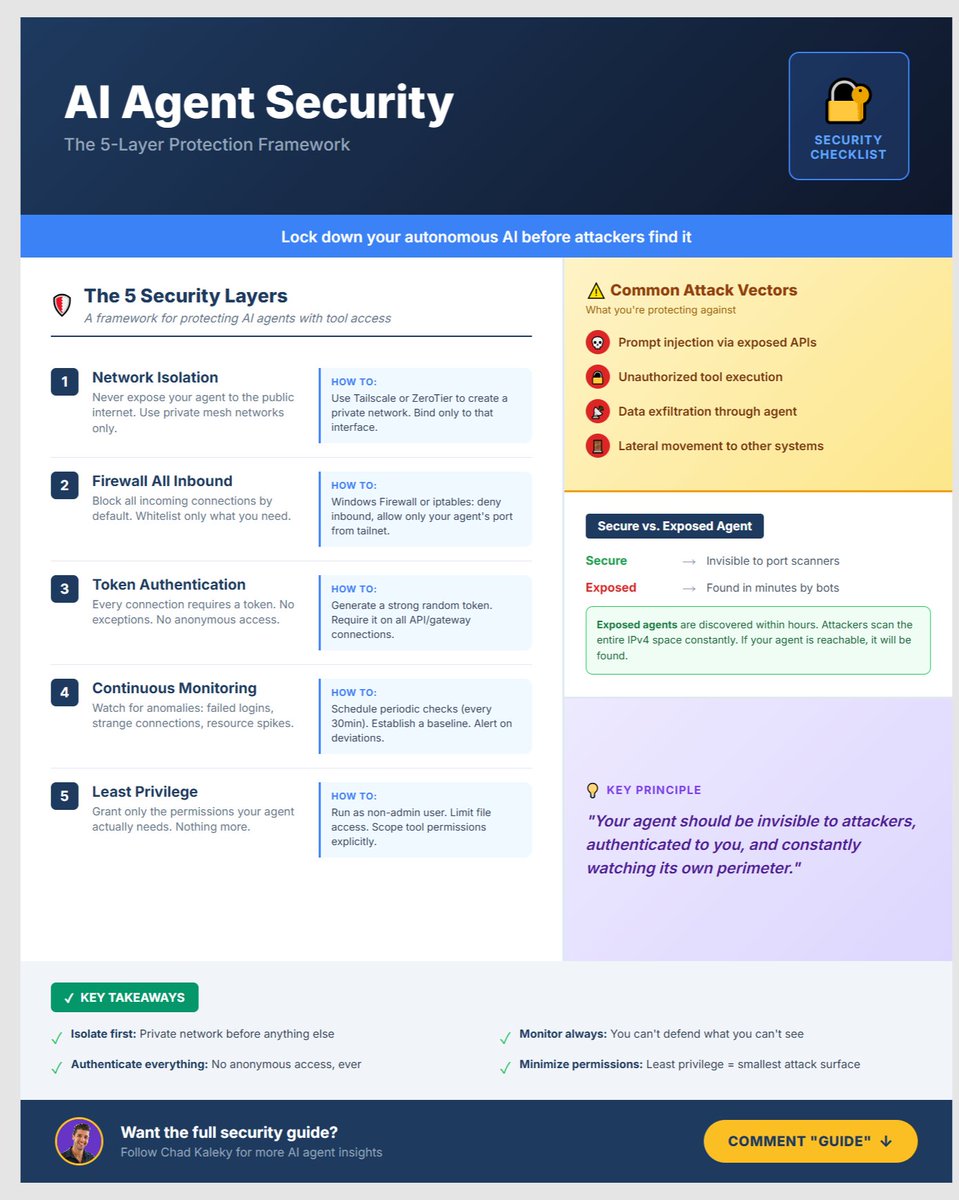
How to Secure Your AI Agents (Before They Get Hacked)
Here's the 5-layer security stack I use for OpenClaw Clawdbot agents:
1️⃣ Network Isolation
2️⃣ Firewall Everything
3️⃣ Token Authentication
4️⃣ Continuous Monitoring
5️⃣ Principle of Least Privilege
Your content reaches 10% of the people it could.
You spend hours creating a post.
You publish it on X.
Maybe 500 people see it.
But that same post?
→ Could reach 2,000 on LinkedIn
→ 5,000 on TikTok
→ 3,000 on YouTube
Try it free → https://t.co/1bSvJx0Tjd
Most experts are reaching less than 1% of their potential audience.
I built a free calculator to show you exactly how big the gap is.
Takes 30 seconds.
Try it free: https://t.co/HLAeYqYTWr
Reply with your results 📷
@htsfhickey Loyal subscriber here Fred. Have you done any research into NioCorp? Seems to have a lot of similarities to PPTA. Sent an email over as well if prefer to talk there and would love your take on it
I Bought a Rolex for $10,000 – Was It Worth It?
Using ChatGPT in Real world scenarios is the way of the future. Those who make use of this resource will have a competitive edge in all aspects of life.
How to Buy a Rolex - Real Buyer's Guide 2025
https://t.co/PkAUmwUMMN
You know what Tesla’s factories burning down won't affect?
The fact that I’m still buying the stock.
Every time a car gets keyed,
every time the headlines scream disaster,
and the price dips—
I’m smiling.
Because I don’t see panic.
I see opportunity.
That dip?
That’s my entry point.
That’s future wealth on sale.
While the masses flinch,
I lean in.
While everyone else scrolls headlines,
I’m placing bets.
Because your fear—
it funds my next vacation.
Still asking how to make money?
Maybe start by changing how you see risk.
Everyone has an idea.
But ideas are cheap.
Execution gets all the praise.
But validation is what separates a hobby from a business.
The biggest lie is thinking you need to "build it" before you test it.
You don’t need code.
You don’t need a product.
You don’t even need a logo.
What you need is a signal.
Proof that someone, somewhere, cares.
Because when real people raise their hand—click, comment, sign up, or DM—you’ve struck gold.
That’s not just an idea anymore. That’s traction.
And traction is the first sign you're building something that matters.
Before you build anything, ask yourself—have I tested it with the real world?
Trump’s tariffs won’t stop me
from hiring a skilled editor in Pakistan for $4 an hour.
While everyone panics about rising costs,
I’m building leverage.
I delegate globally.
I enhance locally.
That $4 edit?
I send it through AI to polish it even more.
Now I’ve got a studio-quality video
at a fraction of the cost.
No office.
No full-time team.
No excuses.
You don’t need a $10,000 camera.
You need resourcefulness.
We live in the most connected, automated, scalable era in human history.
So why aren’t you building something?
Most executives don’t have a time problem.
They have a focus problem.
📊 This is how high-performing leaders split their time:
🔹 35% Strategy
🔸 30% People
🔵 20% Learning
⚙️ 15% Execution
But most operators?
They're stuck spending 80% of their week doing the work instead of designing the system.
👉 Are you building the business—or just running it?
Drop your ideal time split below👇
Most e-commerce sellers dread them.
I turned them into an opportunity.
ReturnsEZ helped sellers process returns faster.
They knew why products were coming back.
We gave them the data to prevent it from happening again.
That saved them money.
But that wasn’t all.
I had a physical returns facility.
So we told sellers,
“Ship your returns to us.”
We’d receive the items,
repair or repurpose them,
sell them online,
and send the seller a cut of the profit.
Now I wasn’t just in software.
I wasn’t just in logistics.
I was in data.
I was showing sellers trends.
I was helping them reduce refunds.
I was liquidating the product for them.
And I owned the software and the supply chain.
When you combine real-world infrastructure
with a scalable software layer—
you don’t just build a business.
You build an ecosystem.
What overlooked headache could you turn into a data-driven opportunity?
I partnered with a major liquidator in Miami.
He had access to truckloads of retail returns.
He focused on moving the low-end clothing.
But the high-end gear?
That came to me.
KitchenAid mixers, broken or scratched,
perfect for my refurbishing factory.
We’d fix them, clean them, test them.
Then list them online—
$100 per unit.
After shipping and fees, we’d net about $70.
Split it down the middle—
$35 for me,
$35 for him.
We built a system.
Thousands of products.
Filtered, processed, flipped.
Every month, a new truck would show up.
Every month, cash would roll in.
Simple margins.
Predictable profits.
Scalable systems.
Millionaires aren’t made by one big sale—
They’re made by building machines that print every month.
How I Became a Millionaire in My Twenties — The Bedding Hustle
We started buying truckloads of overstock bedding from Macy’s.
Comforters, linens, sheets—brand names with damaged packaging.
A full truck cost us about $10,000.
We’d sort everything.
The pristine items went online.
Amazon. eBay. Walmart.
The rest?
We took to the flea markets.
Sold them for $20 a pop—no questions asked.
What couldn’t be sold online
became fast cash on the weekends.
Each truck would turn into around $40,000 in revenue.
Do that ten times, and your $100K becomes $400K.
After labor and overhead,
we’d clear $200,000 in profit.
The play wasn’t flashy.
It was simple. Scalable. Repeatable.
You don’t need venture funding.
You need a good deal,
a place to flip it,
and the grit to keep doing it.