I am half way through the new Market Wizards book, and few things stand out insane work ethics, self leadership, self belief bordering on delusion and ability to go deep once they found setup ideas.
Leopold went from small fund manager to large asset manager in like two years lmaooo.
All of this is really not only because he was right but because he was right and highly concentrated in just a few names. You can’t 10x or even 2-3x a fund without just high concentration in like a few names.
Solid trades today mostly on $UCAR shorts with heavy fades. $ONCO got taken for a bit of a ride but survived with some recycles, piked the rug pull tho. $GLMD more straight forward setup.
Why is $OPT.AX still trading at a ~$26mm mkt cap? They disclosed $31mm net cash at Mar`26, an ongoing burn of $1.8mm in the current Q, and another $2.5mm in the Sep Q. Strong expectation this is good $$ after bad given the failures thus far.
Realistically this should trade at a discount to 18mo fwd committed capex, imo - ie $31mm less $18mm less estimated wind up costs (another few mm minimum). Call it $15mm ie ~1.1c per share
DYODD. No position
$FTAI 1/21/25
Contextually similar to $SMCI 8/28/24
Making analogies to comparable trades is the best way to recognize patterns in real time
$ABC is just like $XYZ etc.
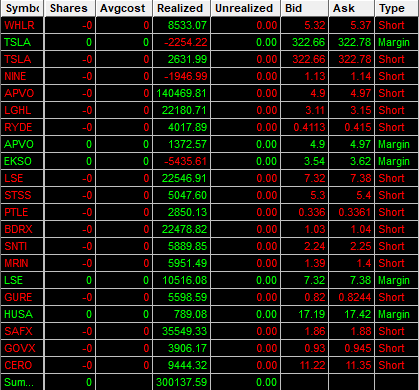
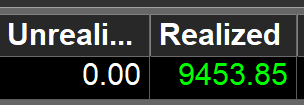
$300K+ Another awesome day ! Not a single red day this month so far. Small caps have been nothing but endless opportunities.
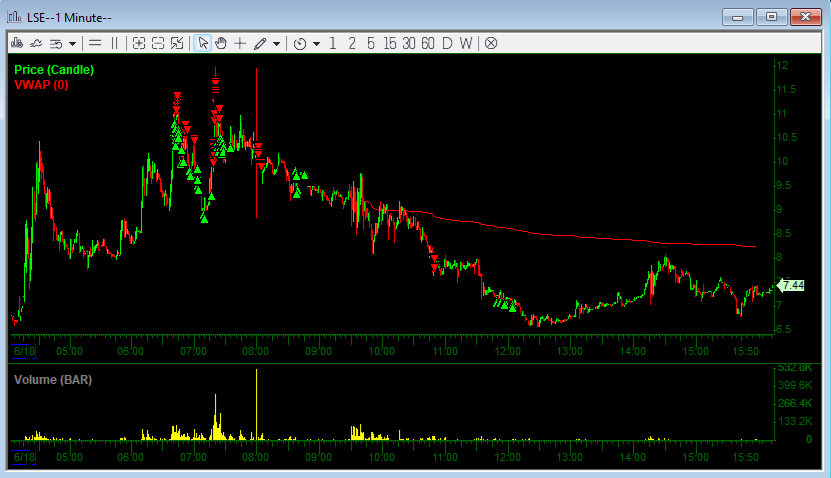
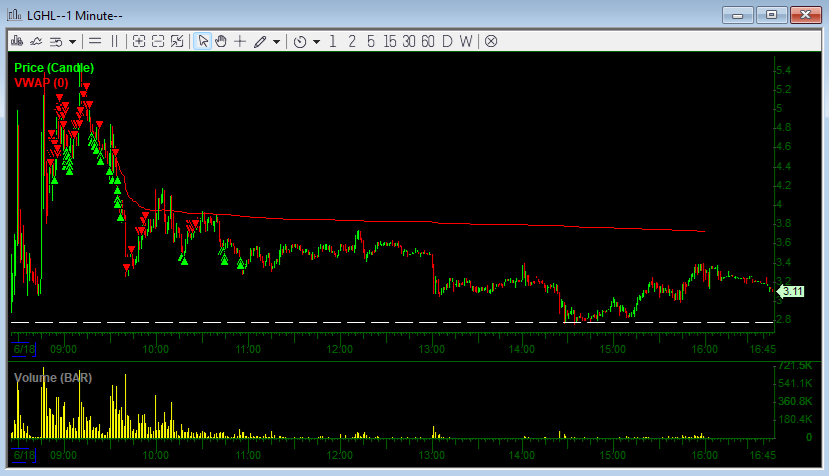
Mainly traded $APVO $LSE $LGHL $BDRX $CERO
Main one was obviously $APVO. Started on the long side using small size - I was cautious since an offering seemed imminent. Flipped short over $8 and $9, but didn’t plan to hold. Ended up shorting again right before the offering. Perfect timing on the cover as well.
Hope this hot market continues! Just realized tomorrow is a federal holiday -enjoy the day off!
Finding your way in life is like unlocking the combination of a safe. You have to go forwards and backwards. Life is not a direct march from A to B. The twists and turns are progress, not regression. What feels like a setback in the moment is later revealed to have been part of the path all along. Each move was necessary to get to your end goal.
The best way to read the environment is watching how price reacts to news. In April when we bottomed every headline was negative. Tariffs, supply chain issues, recession warnings, but stocks kept going up anyway. $TSLA reported genuinely bad earnings and instead of selling off it went up.
The market flipped from bearish to bullish before anyone believed it, and price was showing you that in real time by ignoring all the reasons to go down. That was a change in character telling you the environment shifted and you need to lean in.
Now we're seeing the exact opposite.
$NVDA crushed earnings & sold off. $PLTR crushed & sold off. Good news is being used to exit positions instead of add to them. When that starts happening consistently across multiple leaders, you're not in the same market anymore.
Until that changes back & we start seeing good news get bought again and bad news get ignored nothing else really matters.
The tipping point when AI is sufficient to eliminate fake email jobs is going to be brutal and swift.
The vast majority of the economy is driven by a small fraction of the working population with the rest carried along as moderate incremental contributors vs their wages.
A lot of that is hidden by the difficulty and complexity of mapping attribution and the fact that labor is priced at the margin by supply-demand instead of marginal economic contribution.
Said another way, most people clock-in and clock-out and do the bare minimum not to get fired.
And there is absolutely nothing wrong with that. You work to live and not vice versa.
But when AI brings radical transparency to an orgs labor-capital construct and productivity at an employee level while also abstracting away large swaths of why orgs have historically over-hired you get a rapid shift in the size and density of enterprises.
Now historical corporate inertia would lead you to assume this kind of thing takes years to play out.
But you would be radically underestimating how top-heavy our economy has become under years of brutal consolidation and how quickly pricing will react to something this disruptive to unit-economics.
Let’s use the example of retail.
If tomorrow robotics was solved you would see analysts write about a ten-year wave of adoption and gradual ramp of SMB adoption.
But you know who won’t take their time?
Amazon and Walmart.
The former faces warehouse churn of 50%+ per year and the latter has to keep up with the former.
Which means they will order as many robots as they can get their hands on.
The capex cycle will be more vicious than the current datacenter boom because the ROIC is far more tangible.
Now within a relatively short period of time that will translate into deflating cost of items on Amazons site which Walmart will match.
Now you are looking at a growing price differential between your local mom-and-pop which accelerates the steady erosion of share over the last two decades.
So SMBs go from “hey let’s explore this new tech” to “oh fuck I need to take a loan out to buy a robot so that my margins don’t collapse when I attempt to narrow the price gap on my products”.
And yes many will just shut their eyes and ignore. Just as they’ve been doing over the last two decades.
But you see that strategy works when the cost + convenience differential isn’t a mile-wide and it will be given the magnitude of savings you get from replacing a $50k human working 8-hour days with a $20k robot working 23-hour days with an hour break for charging and repairs.
Now play this forward for every part of the economy - faster for email jobs and slower for regulated pockets.
But remember there are added complexities that come with marginal supply.
For example if tomorrow all truckers were suddenly unemployed due to self-driving what happens?
Well if you don’t have UBI in place they will likely look for new jobs.
And what happens when you have a million new applicants overnight to a different sector?
What happens when the time to re-skill dramatically drops because a former trucker can use ChatGPT on their AR glasses to fix your pipes?
But what if the robots can fix your pipes so that’s not an option?
Shit is gonna get weird 🫡
NOV ‘24 @SMBCAPITAL TAKEAWAYS
1. A good handful of traders crushed $MSTR and had their best days or months ever. Congrats to them, they should be proud, but many traders I’ve spoken to weren’t. They were still disappointed.
Most traders are highly competitive and driven. I get it. I was there too. But one common issue I find with traders is that so often they are never happy or satisfied with their performance. Not only is this not a fun way to have a career, but it’s not sustainable.
That’s why many times now I’ve recommend the book The Gap and The Gain. A lot of type-A personalities need to spend more time focusing on their growth and how far they’ve come, rather than obsessing with some unattainable ideal.
@MikeBellafiore put it best to a 2-year trader who has grown more than he’d ever imagine: the right mindset is “happy but wanting more.”
It’s ok to want more and to push higher, but just make sure you do the happy part too, eh? Allow yourself a little time to take a step back and take stock of how lucky we are ;)
2. Lessons need to be learned the first time. Ideally also from the mistakes or misfortunes of others. I don’t need to touch the stove if I’ve seen someone get burnt by it.
In trading, you don’t always get second chances. $ZJYL last year posed existential risk to many traders. Many lost their careers. You CANT not learn from that! You CANT apathetically overlook those risks!
I made so many detailed cautionary tweets about how dangerous shorting low-float small caps has become.
If you were caught short $PGHL and made it out, don’t take that for granted! A lot of times in this game you don’t get second chances.
As traders, it’s our job to learn lessons the first time and ideally also learn from those around us as well as plays we aren’t involved in!
3. More pnl and risk isn’t always better! One of the teams at SMB has been prioritizing steady returns. They could easily add 20% or more to their risk.
I’m generally a home-run hitter. I want to maximize the pnl I walk away with. BUT that comes with a cost. Drawdowns and variance and stress.
This team has made the decision they don’t want that stress or variance at this early stage of their career. They want a steady paycheck. They know they’re giving away upside.
AND THAT IS TOTALLY OK!!
Especially on Twitter we can feel so much pressure to put up big numbers. But you also don’t see the downside of all that variance. Most aren’t sharing their holes and their losses and their struggles.
Never forget that more pnl or less variance isn’t better than the other. It’s only about what is right for YOU!
4. The continued big theme discussed is what does this Trump presidency mean for markets. Already we’ve seen a massive pickup in M&A headlines. Are you positioning yourself for where the puck might be headed to?
Are you ready for Trump Tariff Tweet Diplomacy?
Are you ready for whatever may emerge as the next big theme?
Do you have your tech stack optimized for seeing the most of YOUR opportunities?
Prep proactively now, not after you’ve already missed some opportunities.
5. It’s been a LOOOOONG year! It’s been an incredibly busy year. It’s ok to take time off around the holidays to appreciate what you’ve accomplished and develop a review / gameplan ahead of next year.
Work hard, but don’t forget to enjoy and recover!
AVOIDING CRITICISM HARMS YOU & THEM
Early on in my work with SMB Capital, there was a trainee that was not meeting the standards of the firm. As a result, during a meeting, Bella chewed out this trainee regarding the quality of his work. Feeling bad for the trainee, I softened the blow by telling him it would be okay and that he's working hard and all these other platitudes at the end of the call.
After the meeting, Bella told me to never do that again because I was softening his message to the trader and ultimately hurting the trader's and the firm's long-term prospects, because if he does not learn that lesson, he will not be at the job in another few months.
As most humans do, I initially got defensive, but then the more I thought about it, I realized how right he was. If this message was not hammered into the trainee, he actually would be gone and his dreams would be broken. The trainee still had the possibility for change, but only if the emotional drive was strong enough to create new behavior.
So often in life, we avoid giving feedback because we don't want to hurt the other person's feelings. Yes, there absolutely is a productive and an unproductive way to give feedback. One of the most important skills in life is being able to give feedback in the most productive manner possible. Too soft and they don't listen. Too harsh and they get defensive and unresponsive.
Similarly, in life, it is just as important to be able to learn to receive feedback. We all get defensive. It is our ego and human nature, but with time we learn to tone that response down and objectively listen to the feedback to find out whether it is true and whether it is actionable. There is tons of feedback that isn't true and can be dismissed, and there's tons of feedback that isn't actionable and ultimately we can't change. The feedback that comes from a position of caring to help us be better is the feedback we must take.
Almost comically, what inspired me to write this post is that a local small business bagel shop opened up by me. Many in the area love to see small local businesses thrive. The truth is, though, that the bagels were not good and barely edible because of how crispy and chewy they were.
Despite this, many of the reviews gush about how important it is to have small local businesses but avoid giving the hard feedback that is necessary for this business to thrive in the long run.
If you do not give the necessary feedback, counterintuitively, the business will actually fail, and your actions are counterproductive to what your goals are. Sometimes in life, the nicest thing you can ever do for someone or something is to give the hard feedback to help them be better.
Additionally, avoiding feedback also hurts you. Not only are you suppressing your own thoughts and feelings, but if you care about something or you care about an outcome, good feedback helps you make sure your needs are met and the outcome you hope for occurs.
If you care about the prospects of a trainee or a business or a person, you end up harming yourself AND them by not giving them the feedback to succeed and grow. You’re avoiding short-term discomfort at the cost of long-term success.
This is a snapshot of one of the screens in the trading room https://t.co/Njj1KlDBNr . This display shows the ES, NQ, GC, and the CL. When entering into uncharted territory as we make new ATH (all time highs), it's important to take 1 data point at a time. Keep it simple! Just sharing... #ES_F $SPY $QQQ #NQ_F #EC_F #CL_F #US_F #ZB_F
A 40% probability of a hike by Dec 2026 is entirely coherent given current context: The 2y at 4.15% is already pricing in a relatively restrictive-but-stable #Fed – chart @BloombergTV live
Everyone wants to "Rebalance trade with China" and to "Avoid the next China shock"...
...but no one wants to make the currency moves that requires.
History is rhyming... a 🧵, post #1 of 4:
@Brad_Setser@shehzadhqazi China imported 939 tonnes of gold in 2025
Price it at $39,000/oz. and China’s trade surplus vanishes.
China argues the issue isn’t China’s trade surplus; the issue is USD wildly overvalued v. gold.
Same issue b/t Britain & China in 1760s, except w/silver.