Traversability depends on the robot, not just the terrain.
CAT [IROS '26] adapts predictions to what each robot can actually do.
See it in action 🤖 If you work with traversability, give CAT a try!
https://t.co/mFUZnoWOrB
I believe that LSTM based architectures (constant hidden state, constant flops / step) will crush transformers as we know them in 2-3 years.
we will laugh about KV Caches and how dumb we were..
to achieve this, the LSTM will need to have a large external memory bank with tool-use like Mem0 / RLMs / RAG to read/write memories into a db, but this will be more like us writing things in a notebook vs. being forced to memorize everything in a KV-cache.
this will require the model NOT to memorize facts inside the weights, but ONLY learn functions to manipulate, write, and retrieve facts, which of course is the better system.
if I am vibe coding, why do I need to know who Kevin Costner is, and how many people are in paris, and have all of those facts in my weight file.. seems like a waste.
and the whole model + fixed hidden state can sit in SRAM and the "memories" will sit in cpu ram (or disk?), as it will be addressed in small amounts and perhaps even regex-able vs. big heavy knn mat mul.
what is distinct about this structure is the model itself will need to learn a saliency function of what to store in short term, long term, vs. external memory such that it can be easily retrieved, and what to forget entirely... without ANY human example traces. just via RL.
the biggest implication as it comes to chips and DRAM is that it will prefer chips w large SRAM and a huge amount of SMs and likely little DRAM if any at all.
so chips that support this will be good investments.
does anyone else see this yet?
LeCropFollow: Latent Space Planning for Navigation in Unstructured Crop Fields
Felipe Tommaselli, Francisco Affonso, Arthur Pompeu, Gianluca Capezzuto, Arun Narenthiran Sivakumar, Girish Chowdhary, …
https://t.co/jcaeIS7yyC [𝚌𝚜.𝚁𝙾 𝚌𝚜.𝙰𝙸]
💬Code: https://t.co/RnYz4Xa6JO
Towards Capability-Aware Traversability Navigation for Unstructured Environments
Gianluca Capezzuto, Felipe Tommaselli, …
https://t.co/5g4ishnu2z [𝚌𝚜.𝚁𝙾]
💬Accepted to the 2026 IEEE/RSJ International Conference on Intelligent Robots and Systems (IROS 2026)
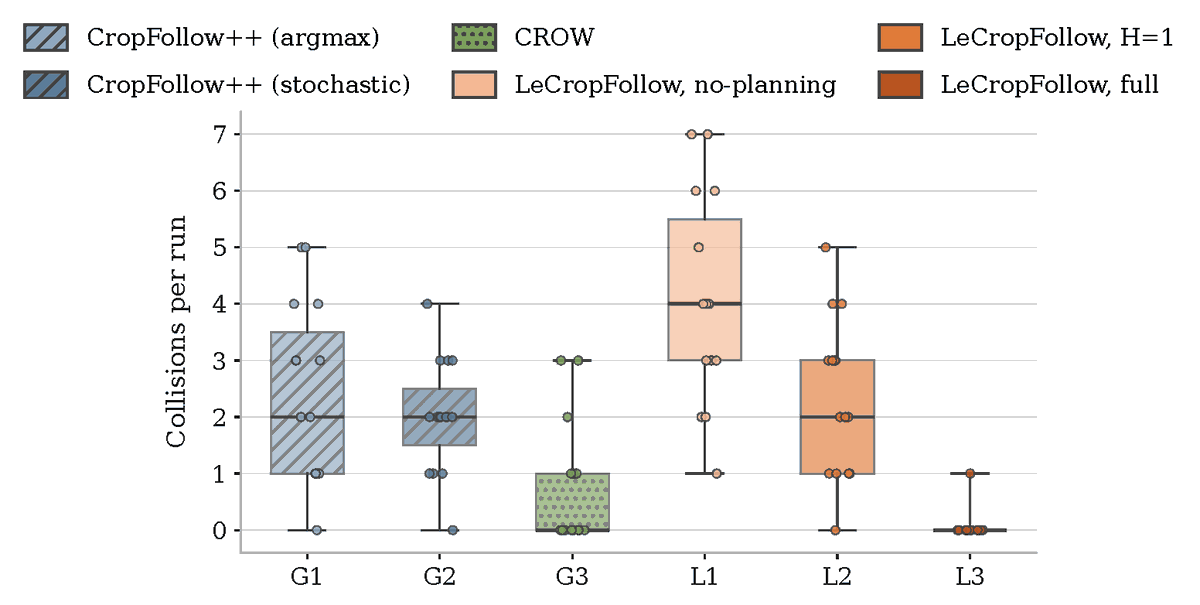
on the thrill of World Models, LeCropFollow (recently accepted to RA-L) shows how they can be used to handle unstructured scenarios (e.g. sensory occlusion), in real field robotics.
Check it out: https://t.co/n050RKi891
in our ablations, we found that world models are essential for plantation gap traversal (specifically challenging for crop row navigation), showing that planning in the representation space is very effective.
@faffonso2 nice work! as I read, this could be used as an alternative for on-policy distillation or routing classifiers. do you have any intuition on how this would scale for more tasks?
How do you get perceptive locomotion over rough terrain without brittle terrain classifiers?
Excited to share CTS-MoE, a framework for implicit terrain adaptation via Mixture-of-Experts for perceptive locomotion. No selectors or per-task policies; the policy adapts end-to-end straight from vision.
TL;DR:
→ Perception-driven routing handles diverse, discontinuous terrain implicitly; no high-level task selector or per-task policy distillation.
→ Big gains on hard tasks (climbing, gaps) under MTRL, with smooth transitions on both seen and unseen terrain.
🧵Thread:





![OWW's tweet photo. LeCropFollow: Latent Space Planning for Navigation in Unstructured Crop Fields
Felipe Tommaselli, Francisco Affonso, Arthur Pompeu, Gianluca Capezzuto, Arun Narenthiran Sivakumar, Girish Chowdhary, …
https://t.co/jcaeIS7yyC [𝚌𝚜.𝚁𝙾 𝚌𝚜.𝙰𝙸]
💬Code: https://t.co/RnYz4Xa6JO https://t.co/FmgNzlTQOi](https://pbs.twimg.com/media/HMRXlQmWwAARAfJ.png)
![OWW's tweet photo. Towards Capability-Aware Traversability Navigation for Unstructured Environments
Gianluca Capezzuto, Felipe Tommaselli, …
https://t.co/5g4ishnu2z [𝚌𝚜.𝚁𝙾]
💬Accepted to the 2026 IEEE/RSJ International Conference on Intelligent Robots and Systems (IROS 2026) https://t.co/5QbfH3J2hD](https://pbs.twimg.com/media/HN-UnUfWkAA0p-P.png)