The Utility of Prediction markets 🧵
People argue that the word "markets" in prediction market is a hoax, that sites like Polymarket and Kalshi are pure gamblig dressed as finance. I would argue the opposite. Gambling was the trojan horse, the gateway to a new layer of financialization these platforms are quietly building.
Behind every bet is a market trying to price uncertainty.
Underneath that gambling surface lies something more profound: a financial mechanism designed to extract truth.
Prediction markets are real financial markets.
And as you may know, markets can do two things better than any other system:
- Transfer risk.
- Aggregate information.
The information side is easy to see.
Prices move because markets compress collective expectations into a single signal.
What’s harder to notice is the second layer, risk.
Prediction markets don’t just reveal what people believe; they let participants transfer the cost of being wrong.
That’s what turns speculation into a real market.
In this article, we explore both sides of that mechanism:
how prediction markets can hedge volatility in fast, but flawed digital economies,
and how they can forecast delayed realities in slow moving markets like real estate.
3090 installed, plan for the next months
- get familiar with llama.cpp and run small models
- learn the real economics of inference
- add RAM, move towards a dual card setup
will report back
next article will be on @ryskfinance, full due diligence report, not a bull case (although i love the product), purely factual analysis based on the info available publicly. aiming for vc investment research grade on this one
this is now my most viewed post 🫣reminder of my philosophy for betting on poly, automating research as much as possible, code once - use many time. full detail here 👇
Prediction markets are purely PvP games. Every trade is two players thinking they are outsmarting each other: the seller believes the contract will be worth less, the buyer believes it will be worth more. You could say that’s true of all financial markets.
But here’s the difference: in prediction markets, the rules are dead simple. They’re spelled out for you in the resolution criteria. There is often not that much surprise in the resolution after following the market play out. Just a clear question with a clear outcome, which makes the direction of the market far more straightforward to read.
And just like in any PvP game, not every player approaches the game the same way.
Some come in clicking wildly, some play slow and calculated, and others bring in entire builds and scripts that give them a significant edge.
Here are the different levels of traders on Prediction Markets:
aiming for 4 for 4, $UPS is next.
same alpha as before, Ro Khanna AND Marjorie Taylor Greene bought less than a month ago. i bet on yes
earnings released oct 28th 👀
aiming for 4 for 4, $UPS is next.
same alpha as before, Ro Khanna AND Marjorie Taylor Greene bought less than a month ago. i bet on yes
earnings released oct 28th 👀
aiming for 4 for 4, $UPS is next.
same alpha as before, Ro Khanna AND Marjorie Taylor Greene bought less than a month ago. i bet on yes
earnings released oct 28th 👀
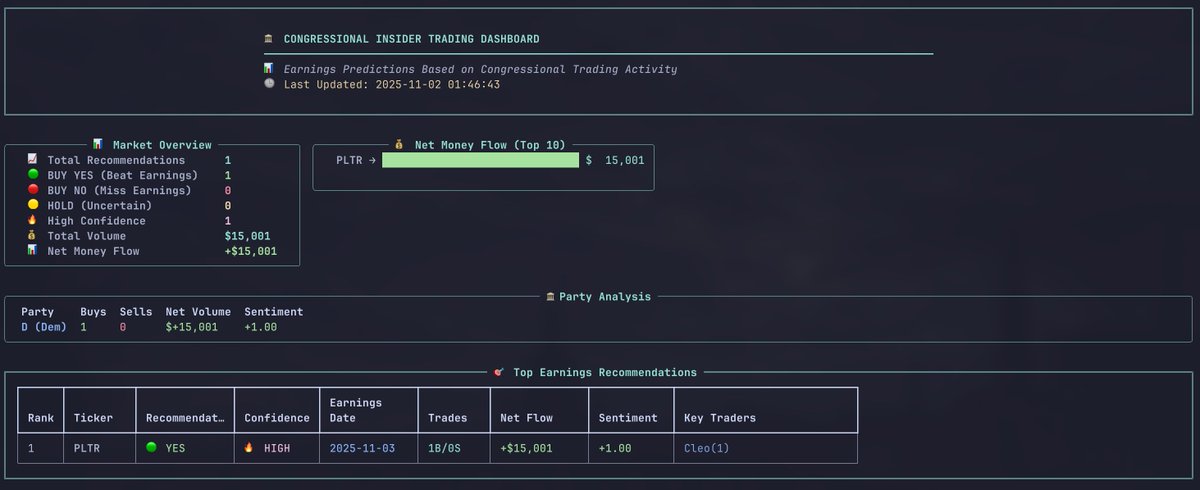
3 for 3 on earnings market, 100% winrate
we hit $FDX, $MS and today $PM
none of this was random, i was tracking congressional member buys via @QuiverQuant
they were not uncertain…
balance is still small but growing, one day i’ll get the @PolymarketTrade badge
strat fully detailed here ⬇️
i agree on point 1, 3 and 4
BUT if a wallet that used to be regarded as smart or as an insider lose their edge, they can absolutely decide to agressively take bets on a market, people will copy them, which will drive the prices up and then they dump and say oops i was wrong and exit