China retail sales growth slows further in August. This is the slowest retail growth in data history, excluding the COVID period and the 1984 and 1990 recessions.
It's concerning. Given that disposable income growth is still 4-5%, the propensity to consume must have been very low.
Weak consumption reflects the negative wealth effect, as property prices continue to fall and Chinese stocks haven't performed much this year.
Policy to boost asset prices and, in turn, consumption is much needed. Given that property is likely beyond immediate help, policy to boost stocks, as it did in late September 2024, will help the economy — a lot.
1/3
Journalists who cover China must dread monthly data releases because they have to come up with new and interesting ways to say exactly the same thing: the supply side of the economy continues to do well while the demand side continues to weaken.
https://t.co/g1yREA5Xqn
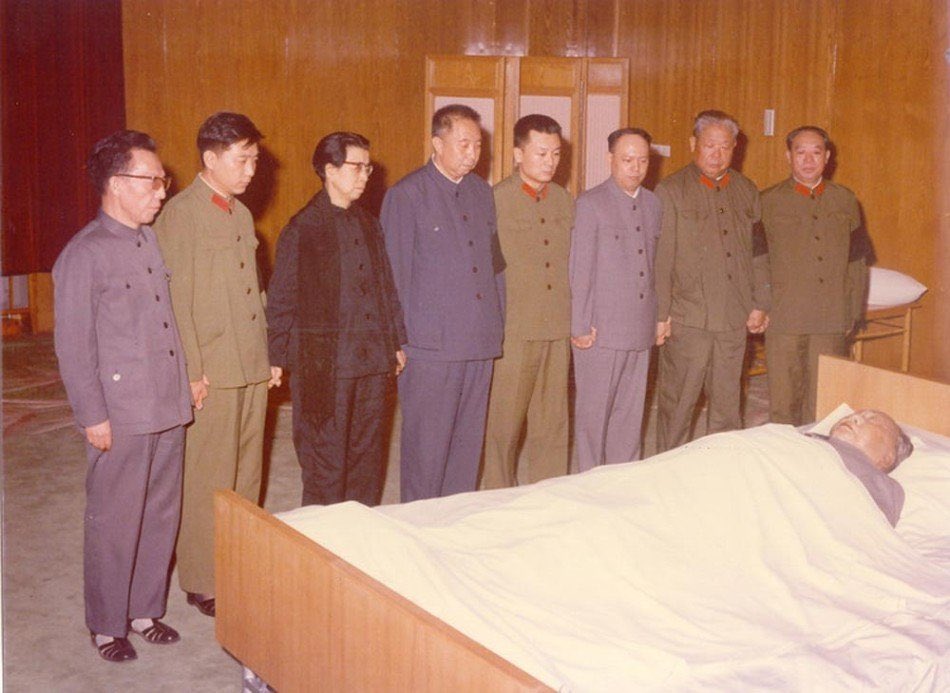
Three weeks later, Oct 6th, three of 8 plotted with Deng/Ye the military faction to jail the rest five in this picture, including Mao’s wife who purposely arranged to have this photo taken to extend her power, to no vail.
Hand to hand holding only lasts 3 weeks in politics.
Today , Sept. 9th, in 1976
Chairman Mao Zedong, died in Beijing at the age of 82.
Eight figures from Mao's inner circle stood in a row, their fingers interlocked.
From left: Zhang Chunqiao 张春桥、Wang Hongwen王洪文、Jiangqing江青、Hua Guofeng华国锋、Mao Yuanxin毛远新、Yao Wenyuan姚文元、Chen Xilian陈锡联和Wang Dongxing汪东兴。
Photo taken on the evening of Sept. 10, by Du Xiuxian杜修贤.
@SubinBKim Is that anecdotal or was that mentioned in newspaper articles? Need to look that up. This whole “peaceful coexistence and shared prosperity” rhetoric reminded me strikingly of You-Know-Who
@SubinBKim Teodoro has quite a history of not mincing words and he has been a repeated guest of SDD. While Ahn Guy-back was very cautious not to offend or even mention China, he nevertheless shared a very friendly handshake and smile with Teodoro after the panel. Many mixed signals -
@SubinBKim I was in the room and was quite surprised by the spontaneous applause among the audience. “Finally someone says those things out aloud!” was probably what many were thinking.
Propaganda statt Aufklärung: In #Nepal können Medien frei berichten. Das von #China kontrollierte #Tibet hingegen bleibt eine Blackbox, schreibt @FabiKretschmer in @tazgezwitscher
https://t.co/6xBUzzIcYE
This podcast featuring Mr. Setser reflects that American policy experts on China have reached a new height in their understanding of the "China Shock," but it is still not enough. I would like to outline a few initial ideas:
1. The Nature of the Chinese Government: The core motivation behind their decision-making is to maximize and preserve the long-term interests of the regime, rather than the interests of the Chinese people. Viewing their past and present behavior through this lens brings everything into clear focus.
2. Comprehensive Policy Toolkit: While everyone observes the Chinese government's powerful and continuous supply-side policies—including massive subsidies of various kinds—China actually employs demand-side policies as well. It is fair to say that the Chinese government's industrial policy toolkit is exceptionally comprehensive and nuanced, adapting flexibly to changing scenarios.
3. Execution Capability: Policies are the more visible component, but what is uniquely Chinese is their policy execution—a level of execution capability, coverage, and depth that is virtually unimaginable to Western scholars and governments.
4. Comparative Strategy and Response: All of China's industrial policies and their execution need to be viewed in comparison with the corresponding actions of the United States and Western nations. I do not believe the US or the West can change China in the short term (within 100 years), but they can alter their own industrial and trade strategies to respond to the China Shock.
I am considering writing a book to articulate these observations.
Colby’s soft talk vis-à-vis China starts to make sense.
Beijing has long theorised that America cannot fight, or even posture, in two theatres simultaneously. Pulling out the last aircraft carrier from Asia signals exactly this. One regional conflict against a mid-sized power has been enough to drain the Indo-Pacific of carrier presence entirely, and it will feed into PLA planning assumptions.