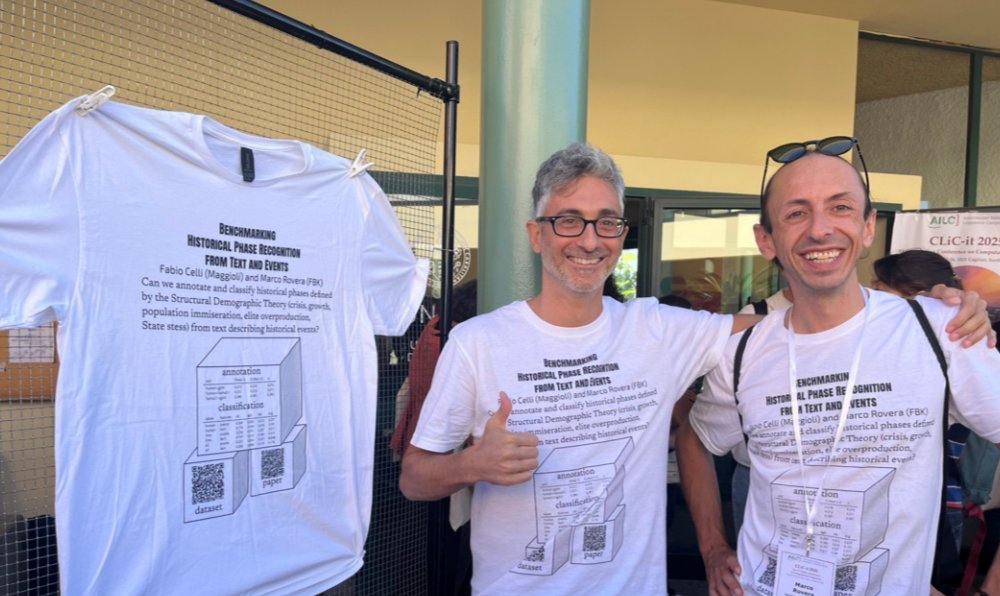
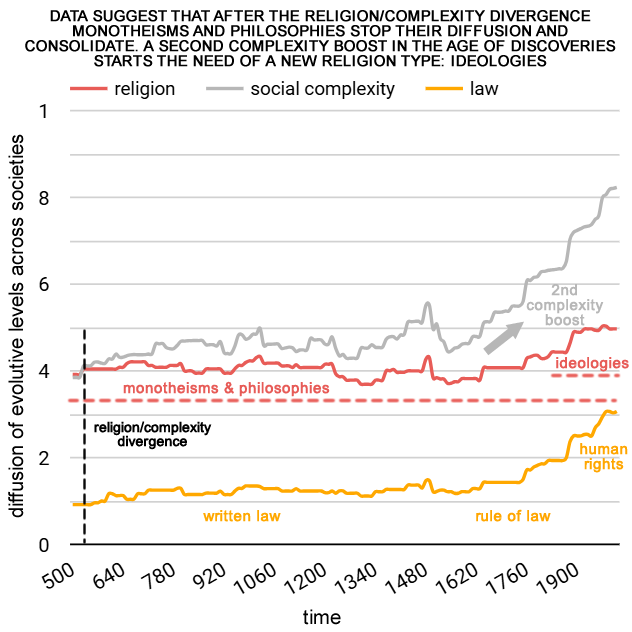
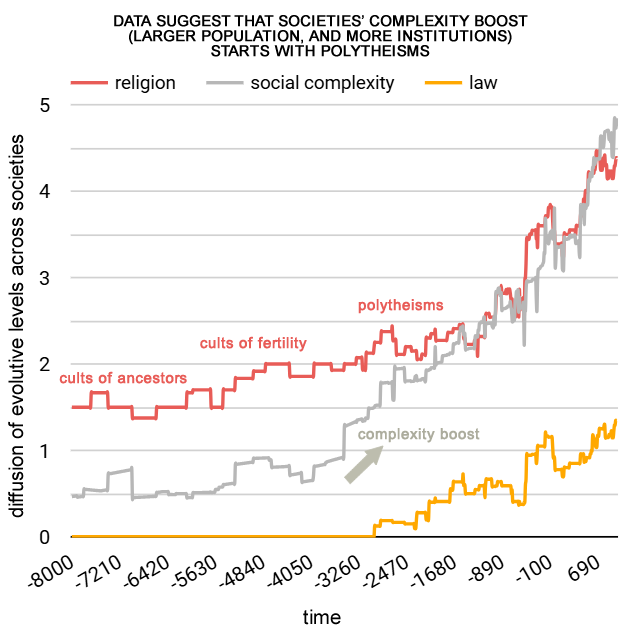
#LLMs larger than 400 B parameters agree better than humans do in interpreting #history. Llama3.1-large is also very consistent when run repeatedly. PAPER (eng) -> https://t.co/pHKq0b2IEr #artificial_intelligence Blog (ita) -> https://t.co/kA915RHpDw
I think this idea of warm countries being poorer is just a historical accident: as modern economic growth began in Western Europe, the regions colonized by their settlers, which tend to have a similar climate, developed earlier.
As the world is converging to development these discrepancies are being erased. Places like Taiwan, Singapore, Malaysia, and southern mainland China are quite hot and now are rich as well.
I would think living in a cold climate is a cost, not an endowment. It lowers welfare since you have to incur costs of heating, plowing snow, heavy clothing, etc.
Thus, the net effect of cold climate on development is negative. And indeed of we look at global history instead of the recent past this correlation between being cold and rich, breaks down: in Roman times the most developed regions of the ancient Roman world were hot like Cyrenaica and Africa, while cold regions like Germania were poor and underdeveloped.
In about 15 years, I expect that nobody will be theorizing the hypothesis that "hot regions tend to be poor."
tools like AI Overview are transforming web search, increasing reliance on generated answers. This is impacting historical memory, as models like #gpt4 can generate distortions. We created a benchmark to study how #LLMs interpret history.
Couldn't resist.
Here's a pure PyTorch from-scratch re-implementation of Gemma 3 270M in a Jupyter Notebook (uses about 1.49 GB RAM): https://t.co/M2f8EB0KBE
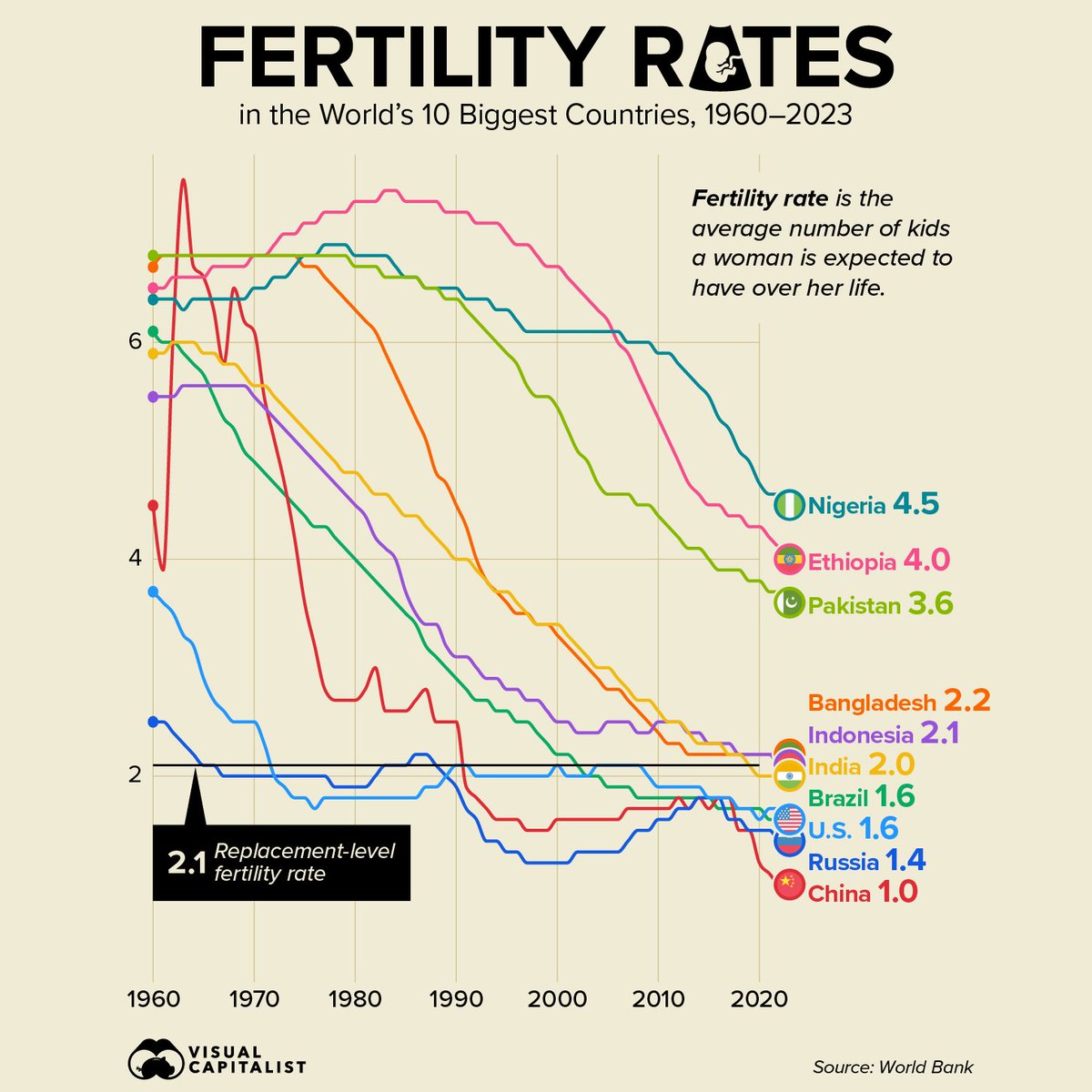
Chinese young generations pay to pretend to work. If true, this suggests that #China is now in advanced elite overproduction phase. #structuralDemographicTheory
When an empire runs out of its own money, it is able to increase the supply of money. However, printing more money causes borrowing to increase creating a financial bubble. I urge you to watch “The Changing World Order” on my YouTube channel to understand how, and what it means for all of us.
#principles #raydalio
#History interpretation is subjective, tainted by #biases, leading to frequent disagreements among humans. We showed that the largest #LLMs can reach an agreement level similar to #humans and can be used as annotators, opening new avenues for studying history.
When great powers rise throughout history, they generally do so for the same reasons. These successful new orders are typically started by powerful revolutionary leaders doing four things:
1) Winning power by gaining more support than their opposition
2) Consolidating power by converting, weakening, or eliminating that opposition
3) Establishing systems and institutions that make the country work well
4) Creating systems that pick successors well over several generations
Interesting paper on why people follow rules:
Intrinsic respect for rules and social expectations are the most important motives for rule-following ("55–70% of participants conform to an arbitrary costly rule"). Extrinsic incentives and social preferences play only a minor role.
Now that the budget bill has passed Congress, we can see what the projections look like for deficits, government debt, and debt service expenses. In brief, the bill is expected to lead to spending of about $7 trillion a year with inflows of about $5 trillion a year, so the debt, which is now about 6x of the money taken in, 100 percent of GDP, and about $230,000 per American family, will rise over ten years to about 7.5x the money taken in, 130 percent of GDP, and $425,000 per family. That will increase interest and principal payments on the debt from about $10 trillion ($1 trillion in interest, $9 trillion in principal) to about $18 trillion (of which $2 trillion is interest payments), which will lead to either a big squeezing out (and cutting off) of spending and/or unimaginable tax increases, or a lot of printing and devaluing of money and pushing interest rates to unattractively low levels. This printing and devaluing is not good for those holding bonds as a storehold of wealth, and what’s bad for bonds and US credit markets is bad for everyone because the US Treasury market is the backbone of all capital markets, which are the backbones of our economic and social conditions. Unless this path is soon rectified to bring the budget deficit from roughly 7% of GDP to about 3% by making adjustments to spending, taxes, and interest rates, big, painful disruptions will likely occur.
Interesting analysis from Simon Pearce. Looking forward to Parts II and III.
One comment I have is that “debt supercycles” of Ray Dalio are actually part of the structural-demographic (SD) model, because the fiscal health of the state is one of the three chief drivers of instability in this theory. Furthermore, not every SD crisis has this component — it varies from case to case.
For sure, though, the debt problem is a very important part of our own crisis. I have the new Dalio book on my reading list, so there will probably be a review from me.
https://t.co/Cr3j9cBnuF
I worked a lot with Process Mining this year, so today I release Learnipy v0.10, enriched with some algorithms for extracting petri net, heuristic net and BPMN from data. Enjoy. #DataScientists#opensource
https://t.co/PavkqEgVSB
How do we adapt to a world where #ArtificialInteligence no longer just execute tasks—but act independently? Machines will be agents shaping our societies. we need to focus research on societal impact of #AI
Has AGI already arrived—without us noticing?
That’s the question I posed at this year’s Brazil at Silicon Valley conference, where I had the honor of delivering the opening keynote, "Making Sense of Modern AI."
We explored the growing power of language models like GPT-4. These systems don’t just generate plausible text—they’re beginning behave as if they reasoned, empathized, or understood others' thoughts and emotions.
In my studies, these models have matched the performance of six-year-old children on tasks requiring empathy and perspective-taking. Importantly, they’re not explicitly programmed to do that—they evolved those capabilities as they learned to predict the next word. And in that evolution, we may be witnessing the emergence of early AGI.
As we stand at the edge of this new frontier, the real question is:
How do we adapt to a world where machines no longer just execute tasks—but act independently?