@jukan05 Looks like another PR work from SF. This is basically saying their SRAM yield is around that level as bitcoin mining chip is mostly composed of SRAM afaik
I haven't been tweeting about bitcoin much lately. Mostly because I think bitcoin is in a good place and there's less to say recently.
But I like $92k bitcoin more than $108k bitcoin. It's up like 78% over the past 12 months and whiners are acting like it's dead again.
@nope_its_lily The US can’t abandon Taiwan. Intel just doesn’t have the necessary advanced tech to replace Taiwan. Intel is way behind in foundry tech, and it will take them a lot of resources and TIME to even try to catch up.
I think the Deepseek moment is not really the Sputnik moment, but more like the Google moment.
If anyone was around in ~2004, you'll know what I mean, but more on that later.
I think everyone is over-rotated on this because Deepseek came out of China. Let me try to un-rotate you.
Deepseek could have come out of some lab in the US Midwest. Like say some CS lab couldn't afford the latest nVidia chips and had to use older hardware, but they had a great algo and systems department, and they found a bunch of optimizations and trained a model for a few million dollars and lo, the model is roughly on par with o1. Look everyone, we found a new training method and we optimized a bunch of algorithms!
Everyone is like OH WOW and starts trying the same thing. Great week for AI advancement! No need for US markets to lose a trillion in market cap.
The tech world (and apparently Wall Street) is massively over-rotated on this because it came out of CHINA.
I get it. After everyone has been sensitized over the H1BLM uproar, we are conditioned to think of OMG Immigrants China as some kind of Alien Other. As though the Alien-Other Chinese Researchers are doing something special that's out of reach and now China The Empire is somehow uniquely in possession of Super Efficient AI Power and the US companies can't compete. The subtext of "A New Fearsome Power Now Under The Command of the CCP" is what's driving the current sentiment, and it's not really valid.
Like, no. These are guys basically working on the same problems we are in the US, and not only that, they wrote a paper about it and open-sourced their model! It is not actually some sort of tectonic geopolitical shift, it is just Some Nerds Over There saying "Hey we figured out some cool shit, here's how we did it, maybe you would like to check it out?"
Sputnik showed that the Soviets could do something the US couldn't ("a new fearsome power"). They didn't subsequently publish all the technical details and half the blueprints. They only showed that it could be done.
With Deepseek, if I recall correctly, a lab in Berkeley read their paper and duplicated the claimed results on a small scale within a day.
That's why I say it's like the Google moment in 2004. Google filed its S-1 in 2004, and revealed to the world that they had built the largest supercomputer cluster by using distributed algorithms to network together commodity computers at the best performance-per-dollar point on the cost curve.
This was in contrast to every other tech company, who at that time just bought what were essentially larger and larger mainframes, always at the most expensive leading edge of the cost curve. (To the young people reading this, this will sound incredible to you)
I worked at PayPal at the time, and in order to keep pace with the rising transaction volume, the company was forced to buy bigger and bigger database servers from Oracle. We were totally Oracle's bitch. At one point when we ran into scalability issues, the Oracle reps told us we were their biggest installation so they had no other reference point on how to help us overcome our scalability issues. We literally resorted to flipping random config switches and rebooting it.
(This heavily influenced me when I was a young manager later at Facebook. I deliberately torpedoed an Oracle salesman's pitch to try and get us to switch from open source MySQL databases to an Oracle contract: of course we had scalability problems, but at least when we had them, we could open up the hood and figure out how to fix it ... assuming we had good enough engineers, and we did. When it's closed-source infra, you're at the mercy of the vendor's support engineers)
Back to Google - in their S-1, they described how they were able to leapfrog the scalability limits of mainframes and had been (for years!) running a far more massive networked supercomputer comprised of thousands of commodity machines at the optimal performance-per-dollar price point - i.e. not the more expensive leading edge - all knit together by fault-tolerant distributed algorithms written in-house.
Some time later, Google published their MapReduce and BigTable papers, describing the algorithms they'd used to manage and control this massively more cost-effective and powerful supercomputer.
Deepseek is MUCH more like the Google moment, because Google essentially described what it did and told everyone else how they could do it too. In Google's case, a fair bit of time elapsed between when they revealed to the world what they were doing and when they published a papers showing everyone how to do it. Deepseek, in contrast, published their paper alongside the model release.
Now, I've also written about how I think this is also a demonstration of Deepseek's trajectory, but that's also no different from Google in ~2004 revealing what it was capable of. Competitors will still need to gear up and DO the thing, but they've moved the field forward. But it's not like Sputnik where the Soviets have developed technology unreachable to the US, it's more like Google saying, "Hey, we did this cool thing, here's how we did it."
There is no reason to think nVidia and OAI and Meta and Microsoft and Google et al are dead. Sure, Deepseek is a new and formidable upstart, but doesn't that happen every week in the world of AI? I am sure that Sam and Zuck, backed by the power of Satya, can figure something out. Everyone is going to duplicate this feat in a few months and everything just got cheaper. The only real consequence is that AI utopia/doom is now closer than ever.
====
Bonus: This is also a little similar the Ethereum PoS moment, when AI finally has a counterpoint to the environmentalists who say AI uses so much electricity. We just brought down the cost of inference by 97%!
Let’s talk about gold...
Are you thinking about gold as a store of value? That’s probably about right.
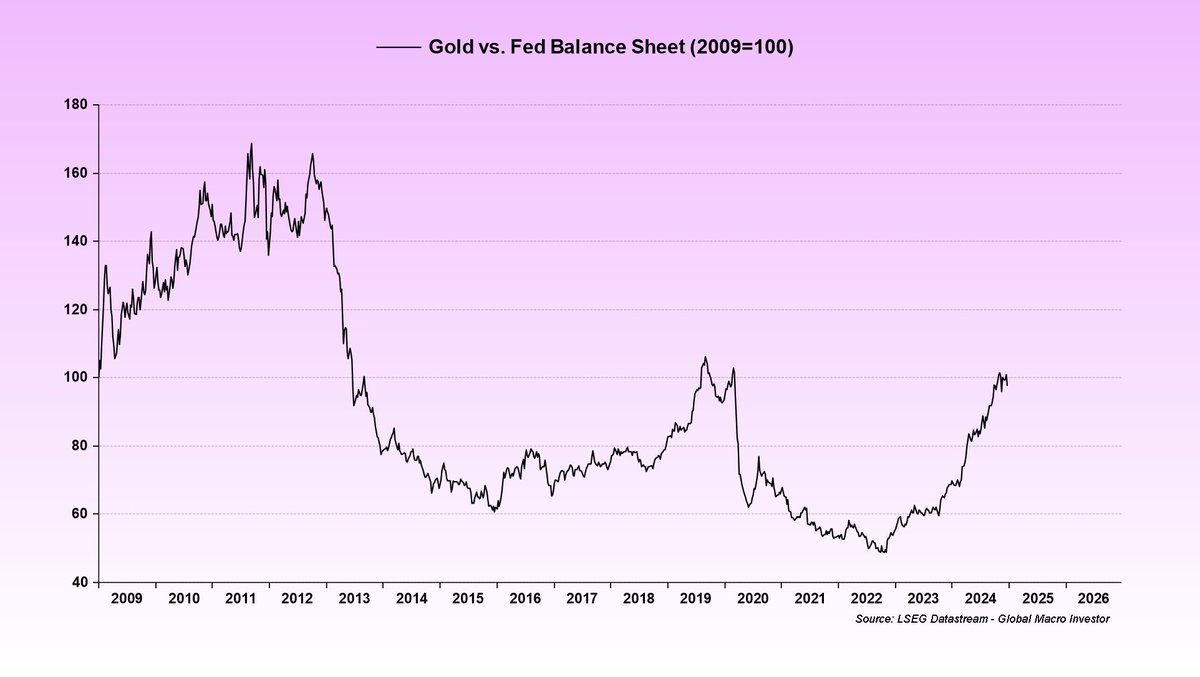
Since 2009, gold has basically been flat versus the Fed’s balance sheet, meaning gold is preserving your purchasing power – but that’s about it. Gold is not gaining – it’s just holding.
But here’s where it gets interesting: there’s also a whole group of people – the gold bugs – who view gold as an investment. And that’s where I think they’re getting it wrong…
If you’re looking at gold as an investment, then at some point, you’ve got to assess its return on investment (ROI), just like you would with anything else in your portfolio.
Since the Global Financial Crisis in 2008, in what @RaoulGMI and I call the era of The Everything Code, central banks have been systematically debasing currencies to avoid a GDP doom loop caused by declining demographics and falling productivity growth.
Essentially, government debt growth is offsetting the entire demographic decline which the Fed then monetizes. Immigration factors into this equation too, but that’s a story for another time.
Once you grasp this, you understand everything about the current macro environment. And this shift has completely changed the rules of the game, setting a much higher bar for your portfolio.
The new reality?
Your hurdle rate is around 10% per year – just to preserve your purchasing power!
So if your investment portfolio isn’t making at least 10% a year, you’re actually losing money in real terms.
60/40 is dead.
And what about gold?
Gold has made you money since 2009, but it hasn’t made you any richer.
This is what I call a "nominal illusion."
In nominal terms, you’re up, but in real terms – adjusted for current debasement trends – you’re only breaking even.
Let me help put this into perspective for you:
This year has been fantastic for gold historically – it’s the best year since 2010. But here’s the punchline: even with that strong performance, gold has underperformed Bitcoin by 96% year-to-date. And mind you, Bitcoin traded sideways for eight months this year!
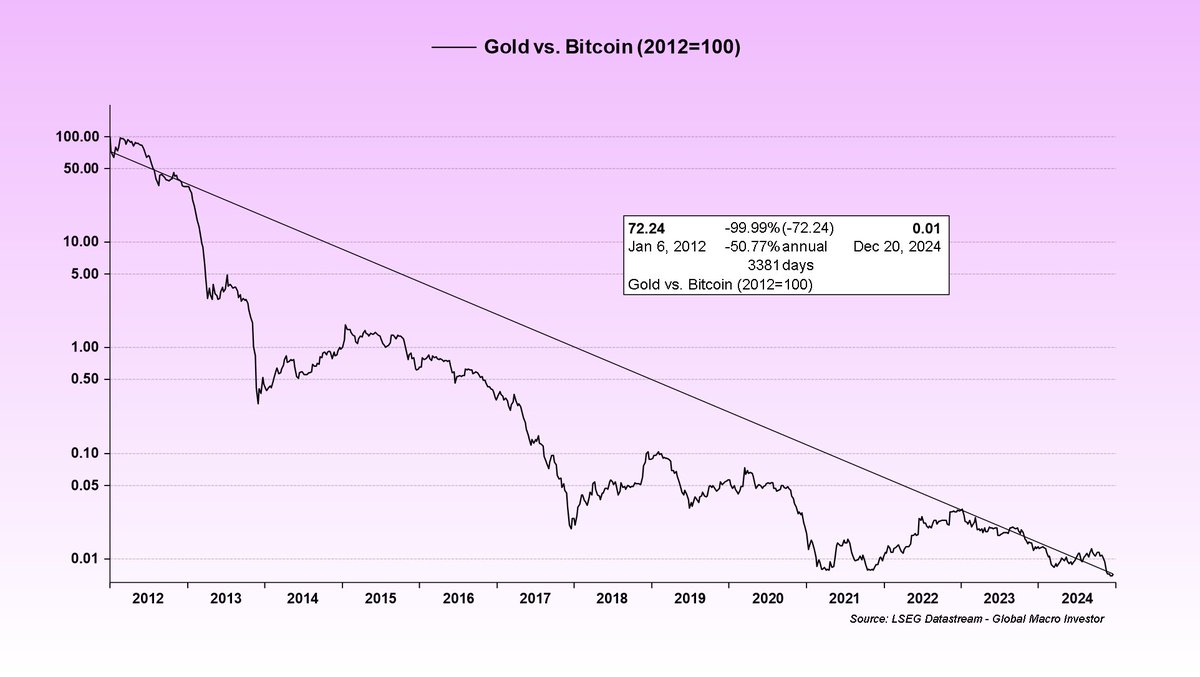
Zoom out even further, and gold is down a staggering 99.99% versus Bitcoin since the start of 2012…
Sure, Bitcoin is volatile – that’s a given, and you need to approach it with the right mindset and strategy.
Our rules for engagement?
No leverage
No FOMO
Top 3 to 5 assets as main bag
Self-custody (or multi-sig) with good wallet hygiene
Only trade a small degen bag <10%
HODL over a longer time horizon
Zoom out and remove the noise
Expect 35% pullbacks frequently
BTFD if you can
The big picture?
Bitcoin is accumulating purchasing power faster than any asset in human history – about 8x faster than the next fastest horse in the race, which are tech stocks.
It’s a stark reminder: outside of crypto and tech stocks, nothing else is helping you build purchasing power. Even large-cap equities like the S&P 500 are barely breaking even, while everything else is outright loss-making versus the 10% global debasement trend.
Think carefully about what that means, because it’s an incredibly important concept to your future self…
So to sum up The Everything Code:
- Older populationn = lower trend GDP growth
- Lower GDP growth requires increasing debts to maintain growth and service old population.
- Governments/Central Banks Print money to service the debts.
- Its a 4 year cycle
= Number go up.
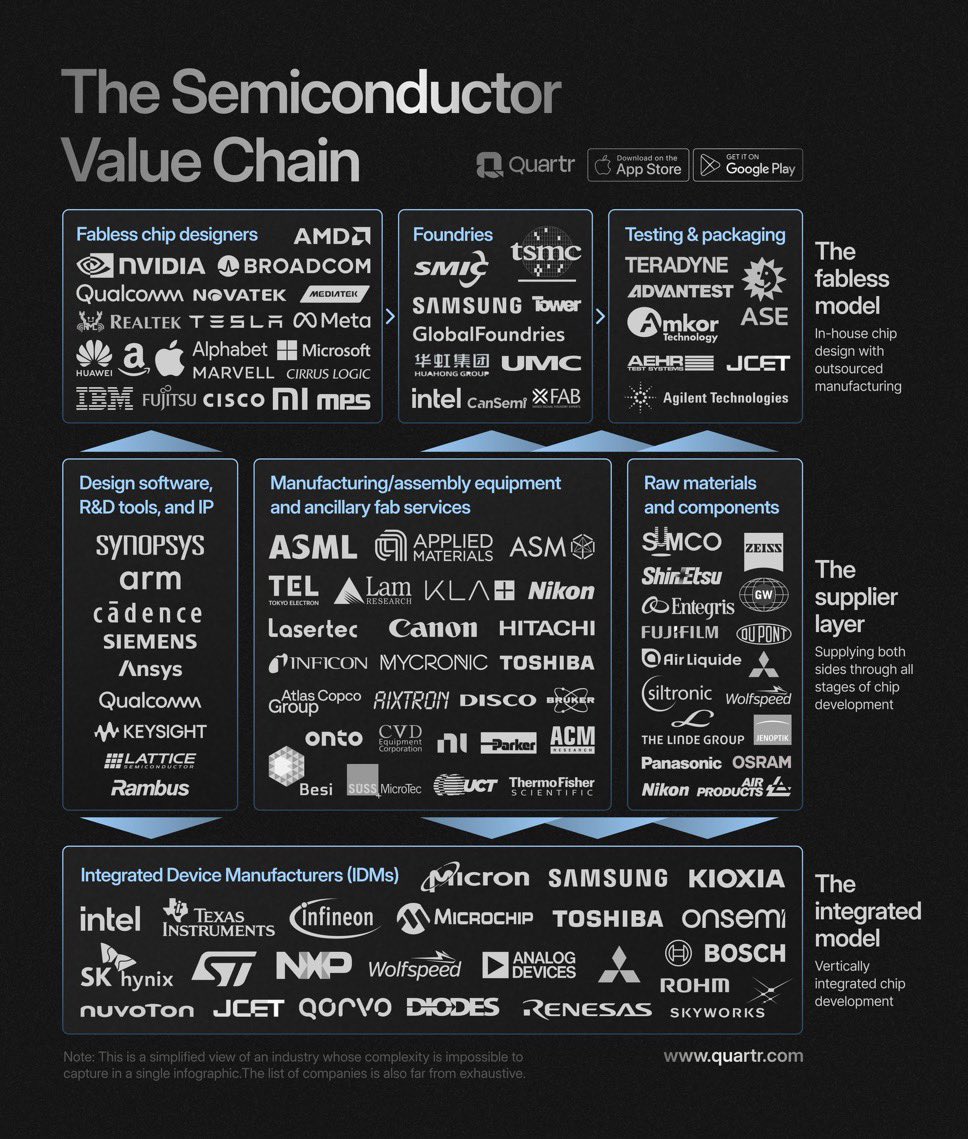
@StockMKTNewz@Quartr_App market cap of samsung is not specifically limited to semiconductor and thus this becomes something that is not an apple to apple comparison
*투자에 있어 매우 중요한 '확률 선반영' 개념 간단 설명*
1. 당신은 동전을 던져 앞면이 나오면 만 원을 받는 게임에 참여할 수 있다.
2. 동전은 조작되지 않아 앞면이 나올 확률은 50%. 그래서 게임의 상금 기대값은 5천 원 (1만 원 * 50%) 이다.
3. 게임 주최자와 참가자인 당신에게 모두 공평한 게임의 참가비용은? 5천 원. 어느 한쪽도 손해보지 않는 가격.
4. 그런데 만약 동전이 휘어서 앞면이 나올 확률이 50%가 아닌 80%가 된다면?
5. 다들 게임에 참가하고 싶어진다. 비용은 5천 원인데 기대값은 8천 원이니까.
6. 게임에 참가하는 사람은 점점 늘어나고, 주최자는 참가 비용을 더 높여 받아도 된다.
7. 참가비를 어디까지 올릴 수 있을까? 수요-공급이 맞을 때까지. 즉, 참가 비용이 8천 원에 수렴할 때까지.
여기까지 술술 읽혔다면 금융 시장의 균형에 대해 이해는 이미 완료.
이론적으로 시장에서 특정한 사건이 일어날 것이라는 기대의 평균치 (컨센서스)는 주식/채권/파생상품이 거래되는 가격에 이미 녹아있다.
기대값 (사건이 일어났을 때 증권의 페이아웃) = 게임 참가비 (증권의 가격) 이기 때문.
아래부터는 선반영에 대해 이해를 돕기 위한 응용.
8. 만약 앞면이 나올 확률이 알려지지 않은 동전 (앞면 나오면 여전히 상금은 만 원) 을 던지는 게임이 진행되고 있고 당신이 구경을 하고 있다고 가정하자.
9. 주최자도 계속 게임을 진행하고, 참가자들도 계속 게임을 진행하고 있다.
10. 그런데 현재 게임의 참가비는 7500원이라는 사실을 알게 되었다. 이 가격에 주최자도 오케이, 참가자들도 만족하는 상황.
11. 그렇다면 이들이 머릿속에 생각하고 있는, 동전의 앞면이 나올 수 있는 확률은 75%인 셈. 75%라는 기대값이 반영된 가격이니까.
12. (중요) 실제로 동전의 앞면이 나올 확률은? 아무도 모른다.
13. 단지 시장 (참여자들)이 인정하는 동전의 앞면이 나올 확률이, 즉 선반영되어 있는 '내재 확률'이 75%라는 뜻.
14. 실제 확률과 시장이 기대하는 '선반영' 확률은 엄연히 다르다. 매우 중요함.
15. 자산의 가격을 결정짓는 것은 특정 사건이 실제 일어날 확률이 아니라, 자산을 사고 파는 사람들이 한데 모여 평균적으로 가늠하는 그들 머리속의 확률.
이 컨셉을 그대로 반영하면
i) 매번 발표되는 금리 인상/인하 확률
ii) 옵션의 균형가격
iii) 금리 스왑의 균형가격
을 쉽게 이해할 수 있다.
ETH still looks a lot like a #Bitcoin 2023 redux.
Maybe a tad lower from here, but it feels like we’re closing in on a major bottom…
A bit more patience should pay off.