Está de @JoseLChilavert_ a Diego no solo es una de las mejores atajadas de la década del 90, sino que demuestra, como dijo Diego en su despedida: "el fútbol es el deporte más lindo y más sano del mundo". No sé podían ver y el tipo lo aplaude y se chocan la mano. Estuve ahí.
@OGlobo_Rio@folha@infobaeamerica@ABCDigital Querido Renato Gaucho mi solidaridad https://t.co/X7L6kyU4By hay que temer a los delincuentes del fútbol llamado Conmebol.Eres una leyenda mundial y a los corruptos hay que denunciarlos siempre.Exitos campeón
The Hubble Space Telescope has delivered yet another jaw-dropping portrait from the depths of the universe: the barred spiral galaxy IC 486, a luminous island of stars glowing with ethereal beauty against the infinite blackness of space.
Lying roughly 380 million light-years away on the outskirts of the constellation Gemini, this galaxy is a textbook example of grand design. A brilliant, elongated bar of ancient stars cuts through its heart, acting like a cosmic traffic jam that funnels material outward. From this glowing bar, elegant spiral arms unfurl in graceful, almost ring-like sweeps — a hypnotic dance of light and structure.Hubble’s sharp vision reveals the galaxy’s secrets in vivid color: the pale golden core is dominated by older, cooler stars, while subtle blue patches in the disk sparkle with hot, young star clusters born in recent bursts of formation. Delicate dust lanes weave through the arms like dark rivers, marking reservoirs of gas and dust where the next generation of stars is quietly assembling.But the real drama lies at the center. A fierce white glow marks an active galactic nucleus (AGN) — the unmistakable signature of a supermassive black hole devouring material at a furious rate. Weighing in at more than 100 million solar masses, this hidden monster powers jets and radiation that help sculpt the galaxy’s evolution over billions of years.IC 486 isn’t just beautiful — it’s a living laboratory showing how bars, spirals, dust, and black holes work together to shape the galaxies we see across the cosmos.
(Credit: ESA/Hubble & NASA, M.J. Koss, A.J. Barth)
A Cosmic Dance:
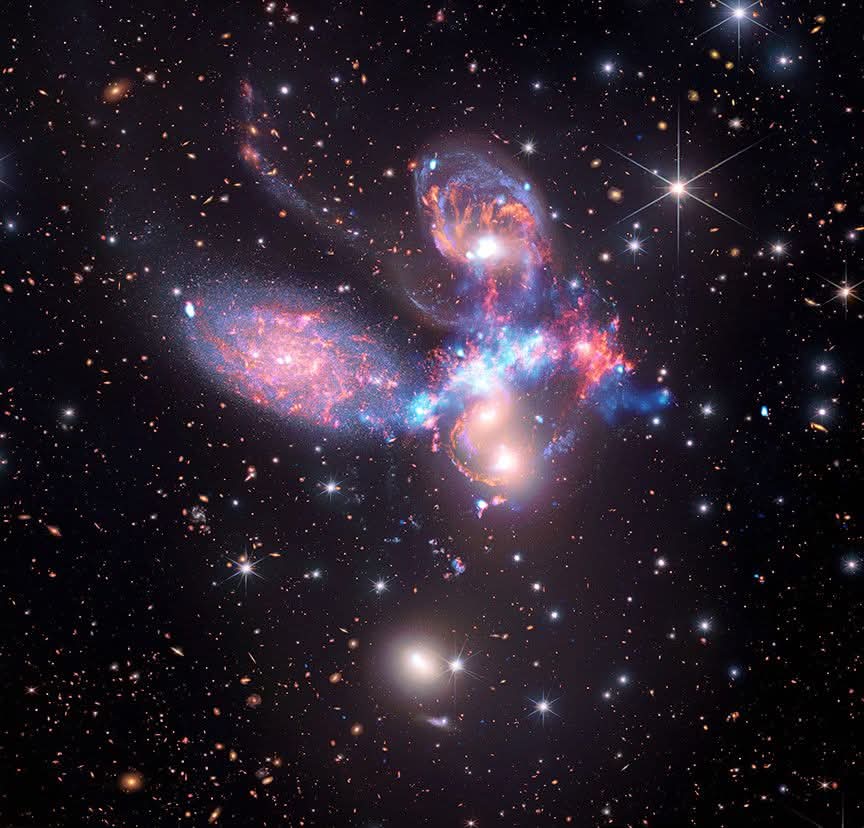
Stephan’s Quintet in X-RayDeep in the constellation Pegasus, 290 million light-years from Earth, five galaxies are locked in a breathtaking gravitational ballet known as Stephan’s Quintet. Four of them are caught in a chaotic cosmic collision, their distorted shapes and glowing tidal tails telling the story of a violent, ongoing merger that has been unfolding for hundreds of millions of years.The drama reaches its peak as one galaxy — NGC 7318B — screams through the group at nearly 2 million miles per hour (over 3,200 km/s). This intruder is plowing through intergalactic gas like a cosmic bullet, generating one of the most massive shock waves ever observed. Heated to tens of millions of degrees, this wave glows brightly in X-rays, shown in striking light blue in the composite https://t.co/dQ4K2mvJRO blending James Webb Space Telescope’s exquisite infrared detail with Chandra X-ray Observatory’s high-energy vision (and legacy data from the retired Spitzer Space Telescope), astronomers have created a multi-wavelength masterpiece. You can see:Sweeping, golden tidal tails of stripped gas and dust
Intense bursts of new star formation triggered by the gravitational turmoil
The hidden violence of the shock front ripping through the group
This image is more than just beautiful — it’s a powerful demonstration of how different wavelengths of light reveal layers of the universe we would otherwise miss. Infrared unveils the cool dust and young stars; X-rays expose the scorching, high-energy violence of the collision.Stephan’s Quintet reminds us that galaxies don’t live in isolation. They collide, merge, reshape each other, and spark new generations of stars in a never-ending cosmic dance.
Credit: NASA, ESA, CSA, STScI, CXC
Image Data: James Webb Space Telescope (infrared), Chandra X-ray Observatory (X-ray), Spitzer Space Telescope
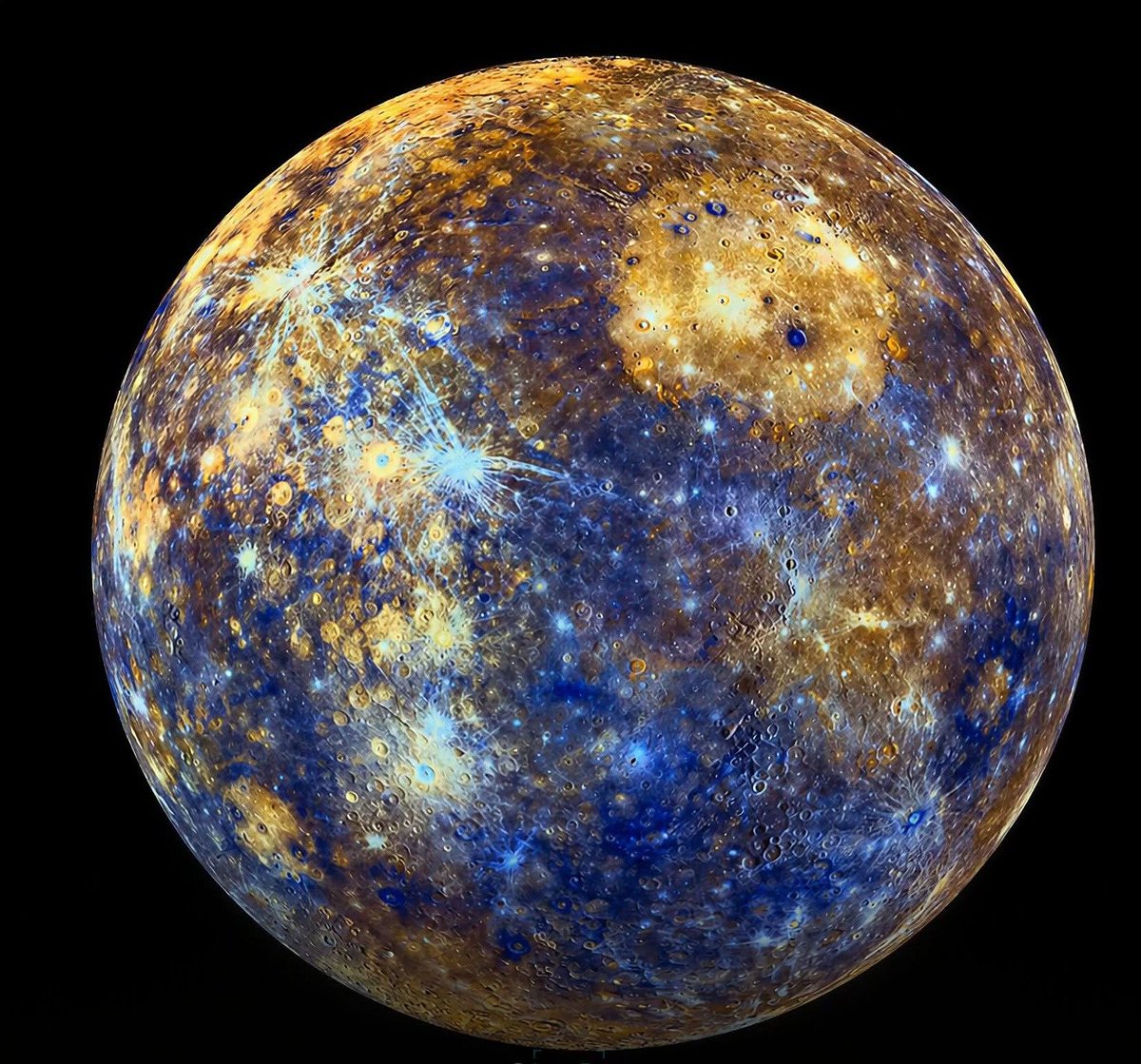
Mercury just got the glow-up it deserved.Forget everything you thought you knew about the Sun’s closest planet. This isn’t the dull, monotonous grey rock from old textbooks. What you’re seeing is Mercury in living color — a breathtaking swirling masterpiece of electric blues, molten golds, rich coppers, and deep shadows, revealed by NASA’s MESSENGER spacecraft.
These aren’t artistic filters. They’re real scientific data. MESSENGER’s Wide Angle Camera shot through 11 different filters across wavelengths invisible to human eyes. When scientists combined them, Mercury’s hidden chemistry exploded into view.Those vivid electric blue streaks? Fresh material excavated by relatively recent impacts, sparkling against the ancient surface.
The warm golden-tan plains? Vast volcanic lava flows from billions of years ago.
The darker patches? Low-reflectance rocks that have been scorched and altered by sunlight 11 times more intense than we experience on Earth.
This tiny world is a speed demon — racing around the Sun at 46.6 km per second (29 mph), completing a “year” in just 88 Earth days. Surface temperatures swing wildly from a blistering 450°C (840°F) in the day to frigid nights.Yet MESSENGER pulled off the impossible. Protected by a ceramic heat shield, it became the first spacecraft to orbit Mercury in 2011. For four years it mapped every inch of the planet before deliberately crashing into the surface in 2015 — sending back spectacular postcards like this right until the end.A scorched, cratered world full of surprises, now painted in colors no human eye was ever meant to see.
Source: NASA / Johns Hopkins University Applied Physics Laboratory / Carnegie Institution of Washington (MESSENGER mission)
#YoSoy Rodrigo Lara Bonilla fui asesinado un día como hoy en 1984 siendo ministro de justicia, por las mafias que lsecuestraron la política y el Estado, que han seguido destruyendo el país y arrasando la democracia. Sin memoria no hay justicia, sin justicia no hay paz.
Vou ser bem sincero.
Eu sei que existe a tradição do campeão da Major League Soccer ir até a Casa Branca, Isso acontece há anos e muita gente trata como algo automático, só que tradição nenhuma tira o peso de uma escolha.
E ver o Lionel Messi ali, ao lado de Donald Trump, me deixou com uma sensação bem ruim.
Não é sobre futebol, não é sobre rivalidade ou preferência. É sobre o contexto, a gente vive um momento em que muitos emigrantes dentro dos Estados Unidos ou algumas nações convivem com medo, com discursos agressivos, com um ambiente político bem hostil e opressor, aí você olha e vê um dos maiores jogadores da história ajudando a compor a imagem pública desse mesmo governo? Isso pesa...
Porque quando você é do tamanho do Messi, nada é só uma foto, nada é só protocolo, a sua presença vira uma mensagem, mesmo que você não fale uma palavra.
E se colocar ali, sorrindo, enquanto esse mesmo governo frequentemente fala abertamente sobre bombardear outro país ou reforça discursos duros contra imigrantes… também é uma escolha.
Talvez o erro seja nosso de esperar alguma consciência maior de jogador de futebol. Muitas vezes eles vivem numa realidade completamente distante da maioria das pessoas. ainda assim confesso que me decepciona.
Não chega a surpreender totalmente, mas vindo de alguém que sempre pareceu um pouco mais "consciente" do que a média… é triste.
No fim das contas fica aquela lembrança simples da vida.
A gente nunca conhece de verdade quem está do outro lado da tela ou do campo.
E talvez por isso seja melhor nunca esperar muito de jogador de futebol.
(Quem me conhece sabe a importância e o quanto eu idolatrava Lionel Messi na minha vida, uma lembrança tão legítima desde criança que acabou se arranhando no dia de hoje.)
🔥West Ham ya acordó verbalmente con Flamengo la venta de Lucas Paquetá. Será en ¡€41.25M! siendo la compra más cara en la historia de un club sudamericano.
NGC 6388 is a middle-aged (over ten billion years old) globular cluster in the Milky Way – but it isn’t showing its age as astronomers might have expected.
Observations from the NASA/ESA Hubble Space Telescope showed that globular clusters of the same age can have dramatically different distributions of blue ‘straggler’ stars (which tend to sink towards the centre of clusters over time), suggesting that clusters can age at very different rates.
NASA - National Aeronautics and Space Administration , ESA - European Space Agency , F. Ferraro (University of Bologna)
El equipo SUPLENTE de esta imagen sería:
Alves; Emerson Royal, Danilo, Vitao, Ayrton Lucas; Saul, De La Cruz; Plata, Araújo, Samu Lino; Bruno Henrique
No se ilusionen más con ganar la Libertadores. Es imposible.