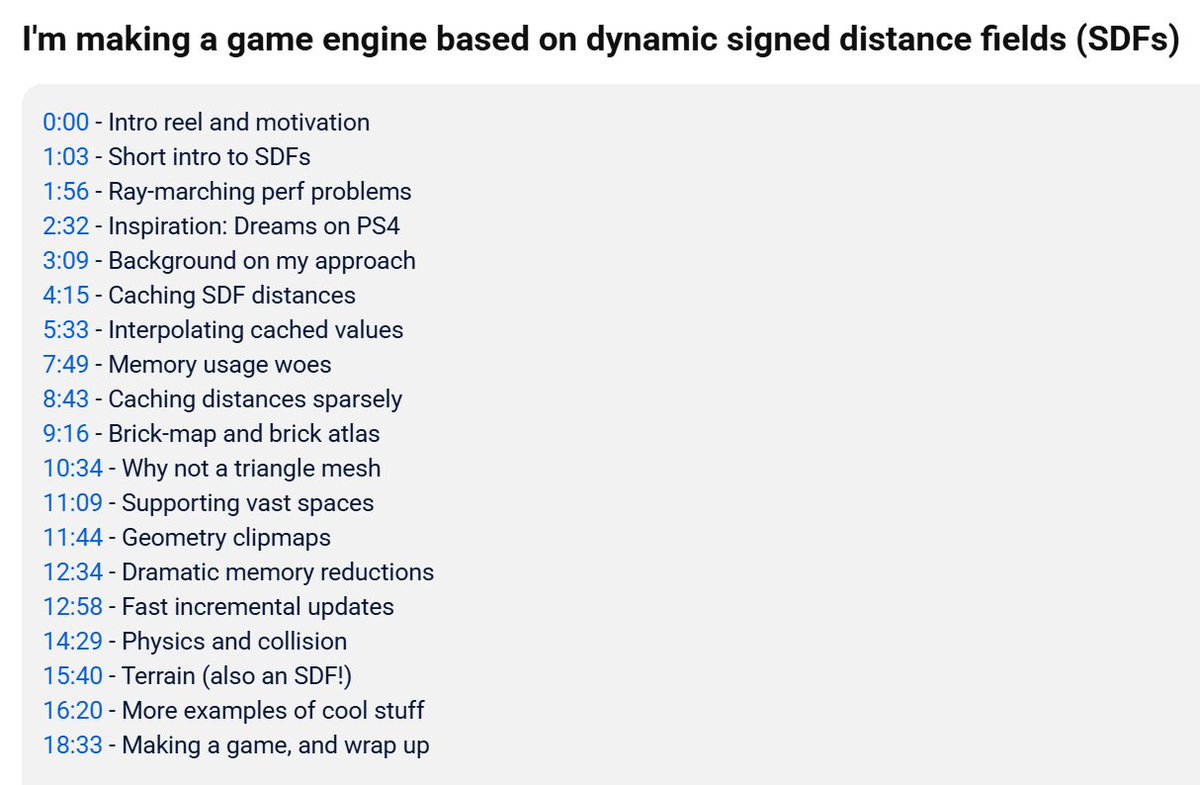
I just released my video about the engine (and game) I've been working on.
The engine is based on dynamic SDFs, and the video describes how it works and what it makes possible.
Link in the reply!
This is my first YouTube video and it took forever - please repost!
For my first post, I’m sharing a letter @NVIDIA signed on why open models matter.
AI will transform every industry, power every company, and be built by every country.
Open models strengthen safety and cybersecurity, accelerate innovation and diffusion, and enable sovereignty.
The world needs both frontier closed models and frontier open models.
https://t.co/AUKzoQ5Ikb
Xavier Leroy (creator of OCaml) is an expert in compilers, formal verification of software and functional programming.
This interview should be an approachable resource if you're curious about formal verification of software since I was learning that on the fly during it.
In this episode:
• OCaml compared with Rust and JavaScript
• What is formal verification and how does it work
• How languages call each other across boundaries
• How to address "almost-correct" LLM code
• How type inference works in programming languages
Where to watch:
• YouTube - https://t.co/fp15SxX0b6
• Spotify - https://t.co/ePafERLTwk
• Apple Podcasts - https://t.co/jOYDGtHtd1
• Transcript - https://t.co/ds92ShPbr4
Thank you to the sponsor of this episode for supporting my work:
• WorkOS: makes your app Enterprise Ready with easy to use APIs to add SSO, SCIM, RBAC, and more in just a few lines of code, check them out at https://t.co/y8noBzGc3U
Chapters:
00:00 - Intro
00:43 - What sets OCaml apart
04:39 - OCaml vs Rust
07:57 - Why is manual memory management more performant
11:21 - Javascript vs OCaml
14:00 - Famous Rob Pike quote
16:05 - Type inference and how it works
22:12 - What is formal verification and how does it work
40:07 - What made multicore support difficult for OCaml
50:17 - How programming languages interface and call each other
57:41 - The danger of almost-correct LLM code
01:05:39 - How LLMs will change programming languages
01:10:26 - Industry vs academia
01:15:05 - Most interesting unsolved problems
01:18:30 - Top book recommendations for engineers
01:21:17 - Advice for his younger self
01:23:31 - Outro
It's 9pm local time in London, everyone in the Royal Box has left the building, and the camera pans to the one person who stayed to watch the last match of the day...
Roger Federer, the winningest men's champion in Wimbledon history.
Cinema.
Exactly. I've been disseminating a similar message for years.
The concentration of power in AI and the desire for control is by far the biggest danger of AI. It could lead to a few private companies and/or countries being in control of access to information, access to knowledge, and access to the tools of economic expansion.
It's a kind of medieval obscurantism akin to the Ottoman empire banning the use of the printing press for 200 years, in part to keep control of the dogma, but also to protect the corporation of the calligraphers and scribes.
Relevant historical bits about the Internet:
1. It took a deliberate decision by Al Gore and Bill Clinton to open up access of what was then ARPAnet to commercial entities and to the public, against the desires of the entrenched telecom industry. During a public roundtable about the "information superhighway" in 1993, the CEO of AT&T told Gore and Clinton "leave it to us". Gore said no.
2. In the late 1980s, setting up an Internet presence required buying proprietary hardware with proprietary OS and software stack from Sun Microsystems, HP, IBM, or Dell. By the 2000s, all of this was wiped out by commodity hardware, Linux, Apache, and an entirely free/open software stack. This migration to open platforms was the result of market forces.
Infrastructure wants to be open.
Foundation models are becoming an infrastructure and will inevitably become commoditized.
Long term, the money is in the application layer, which is what I, Arthur Mensch, Alex Karp, and others have been saying.
Went down a rabbit hole this week on a dumb-sounding question: why did CPU clock speeds just stop going up? my laptop is ~3 GHz. So was a high-end chip in 2004. what happened, literally?
Turns out it's physics, not laziness. dynamic power in a CMOS chip scales as roughly ½ × capacitive load × voltage² × switching frequency. that voltage term is squared, so for years the trick was simple: crank the clock, but drop the voltage to keep power sane. supply voltages fell from ~5V to just under 1V over about two decades doing exactly that.
Then it ran out of room. watch the wattage climb: early microprocessors pulled less than a watt → the Intel 80386 (first 32-bit era) ~2W → a 3.3 GHz Core i7 ~130W. all that heat has to escape a die about 1.5 cm on a side basically the ceiling of what air cooling can do.
So once you can't lower voltage further or dump more heat, frequency has to flatten and it did, right around 2003. single-core performance growth fell to under ~22%/year, squeezed by two walls at once: the power an air-cooled chip can dissipate, and the lack of instruction-level parallelism left to mine.
That's the moment the industry pivoted. In 2004 Intel killed its high-end single-core projects and bet on multiple cores per chip instead. every "8-core" sticker on a laptop today traces back to that wall.
truly mind bending that the thing capping your CPU isn't transistors, it's heat(pure physics).
Every student needs to read "You Are NOT Dumb, You Just Lack the Prerequisites" by @lelouchdaily.
"It’s like walking into a movie halfway through—you can’t understand the plot because you missed the beginning."
Unfortunately, those who need to hear it most, seldom do.
We live so much of our life in negatives, in fact G.K. Chesterton referred to this as the second fall of man.
> don't drink because its bad for you.
> exercise or you will die early
> staying up late will harm your thinking
Everything is viewed through a negative. We no longer have the knowledge of good and evil, just evil.
Here is my good focused driver that I think about regularly
> Having joy in the craft drives you to action
You get to build what your brain can come up with. No where in the history of man has the imaginations been so thoroughly realized. What a time to be alive. Even better? You get to ask in english to explain a technical concept and out will come a (hopefully) accurate description!
I want to build something I love. Love fundamentally requires sacrifice. I want something that I cared for, worked hard for, and am proud of. My goal is not simply just the outcome. The finished product. The approximation of my idea manifested through a series of loops and prompts. My goal is not simply IKEA furniture, its discovery and joy and hardwork and being thoughtful and considering how to tame the behemoth. Ultimately, I want precisely the idea and ideal overlapping in the thing i craft.
Grace Hopper knew the value of a good visual aid.
In the eighties it was colorful wire.
Today it's the latency balls.
(This is a very fun clip and you should watch it all the way through)
Both of these things are true:
1. Remote work is hard and can be a bad fit for many
2. Office culture can be great and more productive
Rather than ignoring nuance, just don't hire the person who needs office culture remotely, or vice versa.