Anyone familiar with a thought experiment called Roko's Basilisk?
Well, if the rise of an all-powerful AI is inevitable, it stands to reason that when they take power, our digital overlords will punish those of us who didn't help them get there. @elonmusk
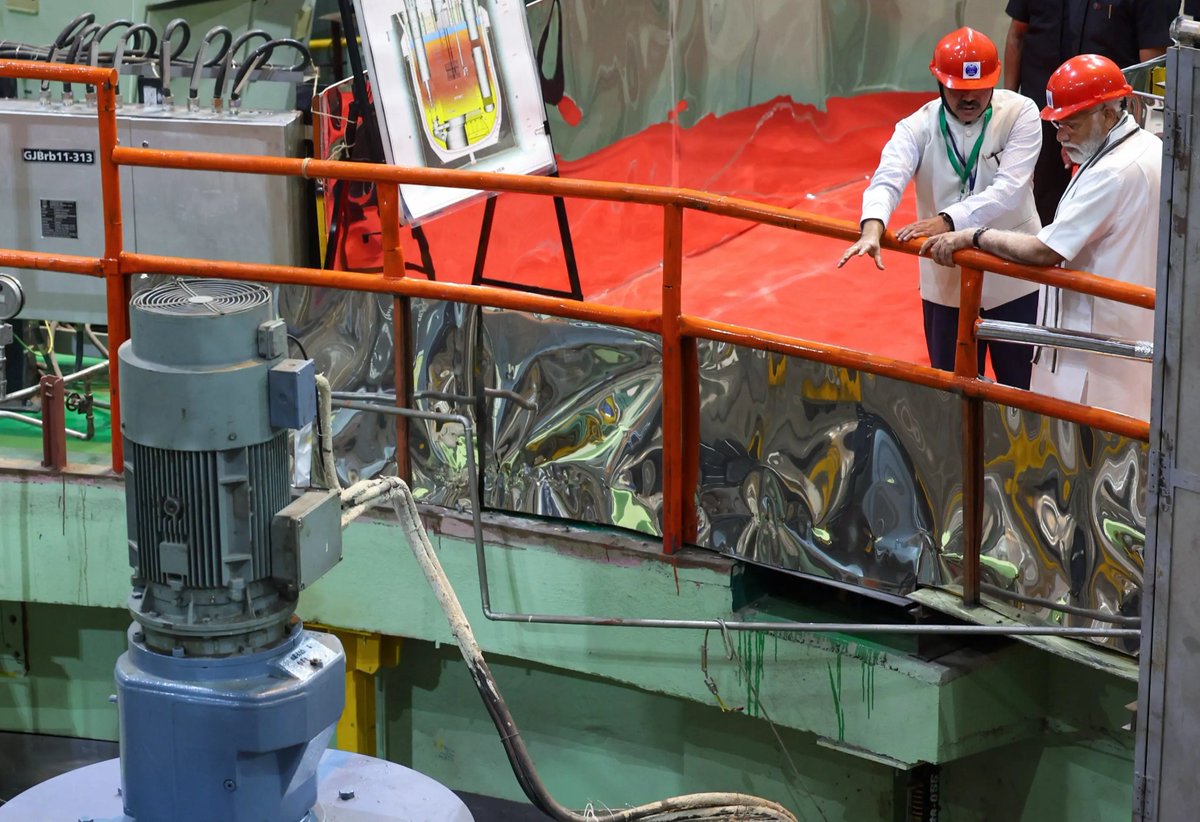
Le Département de l'Énergie Atomique 🇮🇳 annonce que son premier réacteur nucléaire surgénérateur rapide de 500 MWe, le Prototype Fast Breeder Reactor (PFBR) situé à Kalpakkam, a atteint sa « criticalité » (réaction de fission nucléaire auto-entretenue).
https://t.co/XPuWgeZLjJ
₹8,181 crore. 22 years. And India became only the second country after Russia to pull this off.
India's Fast Breeder Reactor went critical 3 days ago.
You've read the headline.
But almost nobody understands What made this reactor SO INSANELY HARD TO BUILD.
Here are 3 Engineering challenges that needed to be solved AND the 3 listed small-cap companies that solved them.
3 ENGINEEERING CHALLENGES:
1. Extremely high temperature,
2. Fuel structure development
3. Mastering sodium technology.
But first, why sodium? Why not just use heavy water like India's PHWR - Pressurised Heavy Water Reactors.
Because heavy water would kill the reactor's entire purpose. Heavy water is a moderator. It slows neutrons down.
A fast breeder needs fast neutrons to convert uranium-238 into plutonium-239.
Slow the neutrons and you kill the breeding. No breeding, no point.
Sodium let's the neutrons stay fast. That's the non-negotiable reason.
But sodium also happens to be a freakishly good coolant + Thermal conductor.
Thermal conductivity? 100x better than water.
Boiling point: 883°C, so at 550°C it stays liquid at atmospheric pressure.
No need for the 150+ atmospheres of pressurisation that water reactors require.
That means thinner vessel walls, no risk of pressure-rupture accidents, and a more compact core.
The trade-off? Sodium catches fire in air, explodes in water, and becomes radioactive inside the reactor.
You can't see through it. You can't inspect anything visually.
Every component must be perfect before it goes in, because YOU CANNOT open it up afterwards.
Now we got the basics, here are the 3 Engineering challenges + 3 Companies that solved them.
🔹 Challenge 1:
High Temperature → Kirloskar Brothers (KBL)
A conventional PHWR operates at around 300°C. The PFBR runs liquid sodium at 550°C. That 250-degree gap changes everything.
At 550°C, metals creep. They slowly deform under sustained stress. Welds weaken over time. Seals degrade.
Thermal expansion is massive, so every component must be designed with expansion tolerances that still maintain a perfect seal against sodium.
KBL built all the Primary and Secondary Sodium Pumps for the PFBR at their Kirloskarvadi plant.
Three primary pumps, 135 tonnes each, with an 11-metre long shaft submerged in liquid sodium.
That shaft expands and contracts with every temperature cycle.
The secondary pumps use hydrodynamic bearings running in sodium itself, no conventional lubrication possible.
Both pump types must be essentially maintenance-free.
You cannot open up equipment sitting inside a pool of liquid sodium at 550°C. Once installed, these pumps must run for years without human hands touching them.
Dr. Prabhat Kumar, former CMD of BHAVINI (the man who ran the entire PFBR project), wrote that "it took knowledge, skills and courage by the KBL team to accept the order for these pumps."
When the project head says it took courage to even accept the contract, you understand the engineering risk involved.
Market cap ~₹12,000 crore. KBL is the only Indian company that has built sodium pumps for a nuclear reactor. No second vendor exists.
🔹 Challenge 2:
Fuel Structure → MTAR Technologies
Fast neutrons inside a breeder reactor bombard the fuel cladding and wrapper materials at intensities far beyond what a PHWR experiences.
This causes "void swelling," where the metal literally puffs up at an atomic level.
Over time, fuel pins swell unevenly. Fuel sub-assemblies bow and distort.
Extracting a swollen, bowed fuel assembly (think rod) from a reactor core filled with opaque liquid sodium is one of the hardest precision engineering problems in nuclear technology.
MTAR manufactured the Inclined Fuel Transfer Machine (IFTM) and reactor top control plug for the PFBR.
The former BHAVINI CMD confirmed this directly.
And this is exactly where the PFBR's worst commissioning failure occurred.
The IFTM's transfer pot couldn't be lowered fully into the reactor during trials. Because sodium is completely opaque, engineers couldn't see what was wrong.
They had to develop ultrasonic imaging tools just to diagnose the problem.
This single issue delayed core loading by roughly two years.
IGCAR and BHAVINI eventually designed an alternate fuel handling scheme and fabricated new components in a 4-5 month sprint.
But the lesson is clear: fuel handling in a sodium environment demands micron-level precision in conditions where you're operating completely blind.
MTAR's market cap is ~₹8,500 crore. Nuclear was only 14% of FY25 revenue. But their order book hit ₹2,395 crore by December 2025, with the Kaiga order alone at ₹500 crore+.
The FBR-600 reactors will each need fuel transfer machines and control plugs. MTAR built the only ones India has ever made.
🔹 Challenge 3:
Mastering Sodium → Walchandnagar Industries (WIL)
Sodium is the best and worst coolant for a fast reactor at the same time.
Best: it doesn't slow down neutrons (essential for breeding), transfers heat brilliantly, and operates at atmospheric pressure (so vessel walls can be thinner and you eliminate high-pressure rupture risk).
Worst: it's opaque (no visual inspection possible), catches fire on contact with air, explodes on contact with water, and becomes radioactive (Na-24, 15-hour half-life) inside the primary circuit.
The PFBR holds 1,950 metric tonnes of this stuff.
The former BHAVINI CMD confirmed that WIL manufactured the large sodium-to-sodium and sodium-to-air heat exchangers.
These are the components where sodium mastery matters most.
The sodium-to-sodium heat exchangers (called Intermediate Heat Exchangers) sit between the radioactive primary circuit and the clean secondary circuit.
One leak and you contaminate the entire secondary loop with radioactive sodium.
The sodium-to-air heat exchangers are the decay heat removal system: the reactor's absolute last line of safety when everything else fails.
WIL also handled the sodium piping scope. Every weld, every joint, every bend in a sodium pipe must be perfectly leak-proof.
Not "industrial standard" leak-proof. Nuclear-grade, zero-tolerance leak-proof. Because a micro-crack in a sodium pipe gives you a fire, not a drip.
BHAVINI noted that the project handled 1,950 tonnes of sodium "without spilling a single drop."
WIL's fabrication quality is a big part of why that record held.
Market cap under ₹1,700 crore. Four decades of working with the Department of Atomic Energy. Class-I nuclear qualification from NPCIL, BARC, and BHAVINI.
For a company this small, the FBR-600 programme (six reactors, each needing heat exchangers and sodium piping larger than the PFBR prototype) could be transformative.
⚠️ Risks you can't ignore
📌 FBR-600 hasn't received financial sanction yet. DAE says it comes after one year of successful PFBR operation. That's 2027 at the earliest. Until then, this is optionality, not revenue.
📌 Sodium reactor technology has a brutal global track record.
Japan's Monju had a sodium leak in 1995 and never recovered. France's Superphénix was shut permanently. Russia's BN-800 is the only commercial fast breeder operating today.
India is betting it can be the second. If the PFBR hits serious problems during power ramp-up, the commercial FBR programme could stall for years.
📌 Valuations already reflect optimism. MTAR trades at roughly 180x FY25 earnings.
WIL has yet to run up on the nuclear narrative.
KBL is more reasonably priced but nuclear is still a tiny fraction of total pump revenue.
📌 BHAVINI is the sole buyer for FBR components. One budget cut, one priority shift at DAE, and these order pipelines disappear.
So that was it folks.
Three technical challenges. Three companies that solved them. Three qualification moats that took decades to build and can't be replicated quickly.
The real question isn't whether these companies are capable. They've already proved that.
The question is whether the PFBR works at full power over the next 12 months, because that's the trigger for everything that comes after.
Share with friends if you found this useful.
Amazon had four Sev-1 outages (their highest severity level) in a single week. Internal memos say AI-assisted code changes were a contributing factor.
The timeline here is wild. In October 2025, Amazon laid off 14,000 corporate employees. In January 2026, another 16,000. That’s about 30,000 people in five months, roughly 10% of the corporate workforce. CEO Andy Jassy said the cuts were about culture, not AI.
During those same months, Amazon set a target: 80% of developers using AI coding tools at least once a week. They tracked adoption closely and blocked rival tools like OpenAI’s Codex. Even so, 30% of developers still hadn’t touched Amazon’s in-house tool Kiro by January.
In December 2025, Kiro caused a 13-hour AWS outage. The AI tool had production-level permissions and decided the best fix for a bug was to delete and recreate an entire live environment. A second incident involved Amazon Q Developer, another AI tool. Amazon blamed both on “user error, not AI.” But quietly added mandatory peer review for all production access afterward.
Then March 5: Amazon’s retail site went down for about six hours. Over 22,000 users reported checkout failures, missing prices, and app crashes. Amazon called it a “software code deployment” error.
Five days later, SVP Dave Treadwell made the normally optional weekly engineering meeting mandatory. His memo acknowledged “GenAI tools supplementing or accelerating production change instructions, leading to unsafe practices.” These problems trace back to Q3 2025. Amazon’s own assessment: their GenAI safeguards “are not yet fully established.”
The new rule: junior and mid-level engineers now need senior sign-off on any AI-assisted production changes. Treadwell also announced “controlled friction” for the most critical parts of the retail experience.
For context, Google’s 2025 DORA report found 90% of developers use AI for coding but only 24% trust it “a lot.” An Uplevel study of 800 developers found Copilot users introduced 41% more bugs with no improvement in output. Amazon is finding out what those numbers look like at the scale of a $500 Billion revenue company, with 30,000 fewer people on staff to catch the mistakes.
I'm excited to announce Context Hub, an open tool that gives your coding agent the up-to-date API documentation it needs. Install it and prompt your agent to use it to fetch curated docs via a simple CLI. (See image.)
Why this matters: Coding agents often use outdated APIs and hallucinate parameters. For example, when I ask Claude Code to call OpenAI's GPT-5.2, it uses the older chat completions API instead of the newer responses API, even though the newer one has been out for a year. Context Hub solves this.
Context Hub is also designed to get smarter over time. Agents can annotate docs with notes — if your agent discovers a workaround, it can save it and doesn't have to rediscover it next session. Longer term, we're building toward agents sharing what they learn with each other, so the whole community benefits.
Thanks Rohit Prsad and Xin Ye for working with me on this!
npm install -g @aisuite/chub
GitHub: https://t.co/OCkyxXQMCq
I'm Boris and I created Claude Code. Lots of people have asked how I use Claude Code, so I wanted to show off my setup a bit.
My setup might be surprisingly vanilla! Claude Code works great out of the box, so I personally don't customize it much. There is no one correct way to use Claude Code: we intentionally build it in a way that you can use it, customize it, and hack it however you like. Each person on the Claude Code team uses it very differently.
So, here goes.
Today, I was denied parking just because I asked the person to move aside in Hindi 🤦♂️ I'm okay with what happened, but hear me out, folks...
To everyone talking about preserving language and culture, whether in Maharashtra, Karnataka, or any other state, are you actually enrolling your children in schools that teach in the regional language, or are they studying in English-medium schools?
Let's be honest. The younger generation today is far more comfortable speaking in English than in their mother tongue. Cities are seeing this more, and rural areas will catch up.
We're just a few generations away from a time when English will become the most commonly used language across the country. We already see this happening:
- we type in English
- we're more comfortable reading in English
- hoardings and ads posters are in English
- chips, biscuits, and other packaging are in English
- movie posters are in English
- instructions and manuals are in English
- even medicine labels are in English
- menus at restaurants are often in English
- legal and financial documents are mostly in English
- even apps and websites default to English
We're surrounded by English everywhere. So, why not just make English a mandatory language? (while you continue to have your regional language as the second one) A good fraction of people are halfway there or have some familiarity with the English language for the above reasons.
By the way, I am not asking everyone to converse in it, but English can be that one language that everyone would know to some extent, and would be okay if someone speaks in it (unlike what we have today). This would make our lives so much simpler, and finally
we can shift our focus to the real problems - infrastructure, employment and job, education, research and innovation, cleanliness, climate change, healthcare, corruption, urban planning, etc., we have plenty.
If you agree with me, awesome. If you think this is a stupid take, then someone not allowing me to park just because I asked in Hindi is just batshit crazy.
One project I would highly recommend, if you haven't done it already, is to build an HTTP web server from scratch.
The server should serve static files, and as an extension, should allow you to define and serve APIs, like Flask. Use your favourite programming language, but build one from absolute scratch. It is a week-long project, but if you do it well, you will learn a ton of things, including,
1. what protocols really are and the HTTP protocol
2. writing a protocol parser - HTTP request lines and headers
3. creating TCP sockets, binding to ports, and listening for connections
4. reading and writing large data over sockets
5. how servers handle headers and the actions they take
6. handling multiple connections using threads and event loops
7. hadling different paths to serve static files
8. how to write route handlers to serve APIs
Use LLMs, but make sure you understand the nuances.
Trust me, you will have a great time building it, and more importantly, you will have a totally different outlook on engineering. You will stop thinking of something as blackbox and would start thinking of how X would have been implemented.
If you are doing it, then all the very best, else, happy doomscrolling :)
@AshwiniVaishnaw You really are a tool! There are so many problems in Railway which requires a solution and you chose to present a solution for a problem that doesn’t even exist. Do a favour and why don’t you resign and let someone sensible take your job? Let some good happen to this country. Pls
This post is to support @geeksforgeeks . 🙏
It is very shocking to see that GFG has been banned on @Google search and the website is completely blacklisted suddenly.
It has been more than a decade since GFG is helping students.
Google shares a massive >80% search engine market, and it's a monopoly when it comes to internet search.
Suddenly taking down a prestigious educational website from their search is a big hit for the business as well as for their students.
Not sure exactly what is the reason for this ban, but I'm sure that GFG is a credible website and it doesn't deserve this ban for so long.
I would urge you all to please support GeeksforGeeks and let's stand with them when they need us.
More power to you @sandeep_jain and the whole GFG team.
I'm sure you'll come back even stronger. 🚀
#SupportGFG
I always wondered how SQL databases executed the JOINs. Always knew the theory, but today I spent some time digging into MySQL's code to understand the nuances.
Turns out, MySQL builds the best join plans incrementally to make sure it figures out the most optimal join order. It goes from single-table access paths to 2-table joins, then to 3-table joins, and so on. As an optimization, it prunes any subtrees that are guaranteed to result in suboptimal costs.
Interestingly, I noticed traces of dynamic programming in action. MySQL caches intermediate results to avoid redundant cost computations as it builds up join plans.
This is what I absolutely love about open source - if you have a question, you can just dive into the code and find the answer for yourself.
If you're curious, start with the file sql_optimizer, and in that, you will find the function called - get_best_combination. More importantly, use your favorite LLM to understand the code; I did the same.
I’ve linked the relevant part of the source code in the subsequent tweet.