Fairground is an engineering hiring platform built for technical teams. AI native tool for real world interviews on real world problems.
[email protected]
@SamuelRome97104 We are happy customers of @supabase and strongly vouch for the team/product. Would love to help team assess engineers better in this new AI world.
https://t.co/bICiotWPzW
Why "Replace Recruiters with AI" Misses the Point.
The hot take is appealing. AI can parse resumes faster and it does not ghost candidates.
Read full blog here - https://t.co/qAeWmgtzAx
Fairground CLI Interviews - available now!
Supports both - human (sync) and take-home (async) modes.
Level up your technical interviews today! Emails us at [email protected] to know more.
@lennysan@simonw The inflection point created a split. One group got productive while another just got faster at code and needs rewriting next w. 50% of tech roles now require AI skills but most interviews still test recall/checkbox "how" one is using AI tools matter more. https://t.co/LQ0bSf0nPL
@angeljimenez The best engineers already do this. Use AI selectively, validate everything, close the tool when the problem is too context-dependent. That restraint is what predicts quality.
We try to solve for this in tech interviewing - https://t.co/TLxg6ijDkK
@SpirosMargaris This is what we also keep coming back to. Esp when hiring or upskilling your engineering teams - need to check "how" people are using AI rather than just that are they using or not. Classic middle manager and TA team mistake.
We dug into the data here: https://t.co/TLxg6ijDkK
@GavinSherry This is what we keep coming back to. You need to check "how" people are using AI rather than just that are they using or not. Classic middle manager and TA team mistake.
We dug into the data here: https://t.co/TLxg6ijDkK
AI-native software engineering teams operate very differently than traditional teams. The obvious difference is that AI-native teams use coding agents to build products much faster, but this leads to many other changes in how we operate. For example, some great engineers now play broader roles than just writing code. They are partly product managers, designers, sometimes marketers. Further, small teams who work in the same office, where they can communicate face-to-face, can move incredibly quickly.
Because we can now build fast, a greater fraction of time must be spent deciding what to build. To deal with this project-management bottleneck, some teams are pushing engineer:product manager (PM) some teams are pushing engineer:product manager (PM) ratios downward from, say, 8:1 to as low as 1:1. But we can do even better: If we have one PM who decides what to build and one engineer who builds it, the communication between them becomes a bottleneck. This is why the fastest-moving teams I see tend to have engineers who know how to do some product work (and, optionally, some PMs who know how to do some engineering work). When an engineer understands users and can make decisions on what to build and build it directly, they can execute incredibly quickly.
I’ve seen engineers successfully expand their roles to including making product decisions, and PMs expand their roles to building software. The tech industry has more engineers than PMs, but both are promising paths. If you are an engineer, you’ll find it useful to learn some product management skills, and if you’re a PM, please learn to build!
Looking beyond the product-management bottleneck, I also see bottlenecks in design, marketing, legal compliance, and much more. When we speed up coding 10x or 100x, everything else becomes slow in comparison. For example, some of my teams have built great features so quickly that the marketing organization was left scrambling to figure out how to communicate them to users — a marketing bottleneck. Or when a team can build software in a day that the legal department needs a week to review, that’s a legal compliance bottleneck. In this way, agentic coding isn’t just changing the workflow of software engineering, it’s also changing all the teams around it.
When smaller, AI-enabled teams can get more done, generalists excel. Traditional companies need to pull together people from many specialties — engineering, product management, design, marketing, legal, etc. — to execute projects and create value. This has resulted in large teams of specialists who work together. But if a team of 2 persons is to get work done that require 5 different specialities, then some of those individuals must play roles outside a single speciality. In some small teams, individuals do have deep specializations. For example, one might be a great engineer and another a great PM. But they also understand the other key functions needed to move a project forward, and can jump into thinking through other kinds of problems as needed. Of course, proficiency with AI tools is a big help, since it helps us to think through problems that involve different roles.
Even in a two-person team, to move fast, communication bottlenecks also must be minimized. This is why I value teams that work in the same location. Remote teams can perform well too, but the highest speed is achieved by having everyone in the room, able to communicate instantaneously to solve problems.
This post focuses on AI-native teams with around 2-10 persons, but not everything can be done by a small team. I'll address the coordination of larger teams in the future.
I realize these shifts to job roles are tough to navigate for many people. At the same time, I am encouraged that individuals and small teams who are willing to learn the relevant skills are now able to get far more done than was possible before. This is the golden age of learning and building!
[Original text: https://t.co/1pUxNC5UXk ]
This is exactly what we are building for @btaylor. We believe even phone screens can be AI-assisted and still remain high signal. Need to ask better questions like debugging, code review, optimizations etc upfront (as you are experimenting)
https://t.co/qM9bQhO2La
As coding agents have become the standard for developing software, we've transformed Sierra's engineering interview process to be AI-native. We've documented our lessons here, and very curious how others in the industry are navigating https://t.co/xbqM5bzvUg
Frontier labs are giving "impossible" questions in their interviews now. Make a full end-to-end working app in 25-35 mins with logging, tests and automation. Might seem excessive but this is what the new bar is.
What seems "impossible" is now possible, coz you get to use AI agents and CLI agents like Claude Code, Codex etc.
We believe this is the new interview every company and software engineer needs to get used to.
Google is now asking PM candidates to open Cursor and build a working prototype in 45 minutes.
Not engineers. Product managers.
Figma does it. Perplexity does it. v0 does it. It's been confirmed on Blind and I've had candidates come back from these rounds stunned because nothing in their prep covered it.
The round doesn't test whether you can code. It tests whether you can think through a product problem and make it real while someone watches. Scoping, trade-offs, what to build first, what to skip, how you handle the moment something breaks. All the product judgment that used to happen in a whiteboard case now happens in a live IDE.
No framework saves you here. CIRCLES doesn't help. A product sense structure doesn't help. You either have reps in these tools or you freeze for 45 minutes while the interviewer writes their notes.
Google removed the standalone technical interview for PMs entirely. They replaced it with this. The bar moved from "can you talk about technology" to "can you build with it while we watch."
The candidates practicing behavioral answers and product cases are preparing for 4 out of 5 rounds. This is the round they don't know exists yet. And it's the one with a zero percent recovery rate. A mediocre behavioral answer still passes. A blank screen doesn't.
We talked to many recruiters and talent teams hiring PMs and most are thinking of testing PM candidates on their coding / vibe coding skills - this is a tectonic shift.
We are helping companies do these take-home tests on real world problems in real world scenarios.
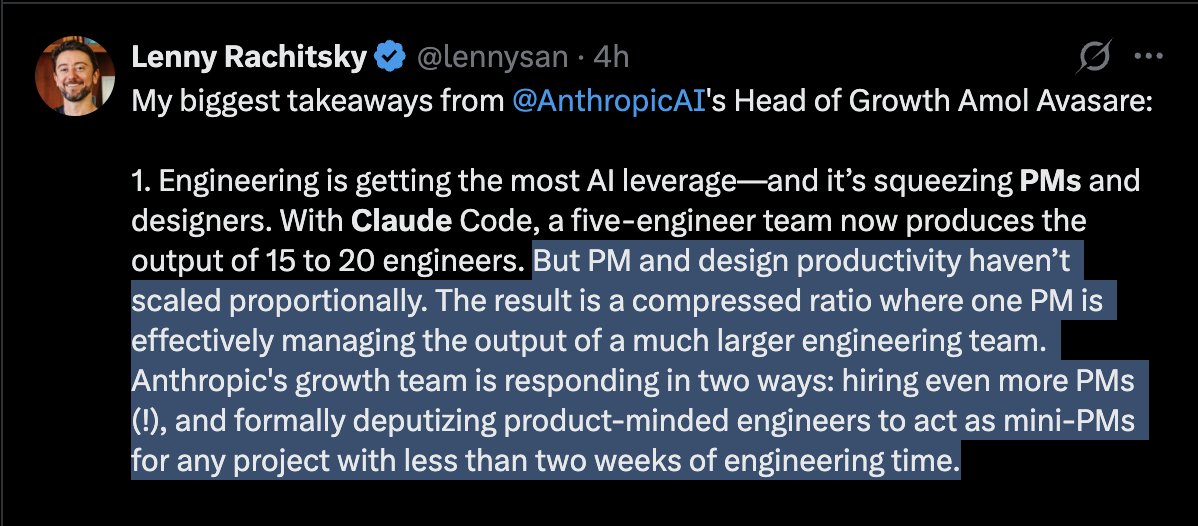
I tried to kill PM, but @AnthropicAI is hiring more of them.
Why?
Because engineering is getting massive AI leverage and the PM capacity cannot catch up. Even with standard ratios (1 PM: ~5 engineers) it feels more like 1 PM to 20 engineers.
Interesting that the response is both a) hire more PMs (which says that PMs are at max capacity/leverage) and my more favorite tool -> b) turning engineers into PMs
This is my fave use case of @chatprd - I see so many teams deciding "anyone can cook" and using the app to make non PMs a little more product-minded...without the meetings.
What I really want to see though is what we can build to get those PMs the same 4-5x leverage that the engineers are getting. So far PMs are still
- managing stakeholders
- getting everyone to agree
- spending time with customers
- playing with the right solution via prototypes
Are these things that AI can eventually replace?
My bet is yes, but until then... apply for those anthropic jobs 😎




![AndrewYNg's tweet photo. AI-native software engineering teams operate very differently than traditional teams. The obvious difference is that AI-native teams use coding agents to build products much faster, but this leads to many other changes in how we operate. For example, some great engineers now play broader roles than just writing code. They are partly product managers, designers, sometimes marketers. Further, small teams who work in the same office, where they can communicate face-to-face, can move incredibly quickly.
Because we can now build fast, a greater fraction of time must be spent deciding what to build. To deal with this project-management bottleneck, some teams are pushing engineer:product manager (PM) some teams are pushing engineer:product manager (PM) ratios downward from, say, 8:1 to as low as 1:1. But we can do even better: If we have one PM who decides what to build and one engineer who builds it, the communication between them becomes a bottleneck. This is why the fastest-moving teams I see tend to have engineers who know how to do some product work (and, optionally, some PMs who know how to do some engineering work). When an engineer understands users and can make decisions on what to build and build it directly, they can execute incredibly quickly.
I’ve seen engineers successfully expand their roles to including making product decisions, and PMs expand their roles to building software. The tech industry has more engineers than PMs, but both are promising paths. If you are an engineer, you’ll find it useful to learn some product management skills, and if you’re a PM, please learn to build!
Looking beyond the product-management bottleneck, I also see bottlenecks in design, marketing, legal compliance, and much more. When we speed up coding 10x or 100x, everything else becomes slow in comparison. For example, some of my teams have built great features so quickly that the marketing organization was left scrambling to figure out how to communicate them to users — a marketing bottleneck. Or when a team can build software in a day that the legal department needs a week to review, that’s a legal compliance bottleneck. In this way, agentic coding isn’t just changing the workflow of software engineering, it’s also changing all the teams around it.
When smaller, AI-enabled teams can get more done, generalists excel. Traditional companies need to pull together people from many specialties — engineering, product management, design, marketing, legal, etc. — to execute projects and create value. This has resulted in large teams of specialists who work together. But if a team of 2 persons is to get work done that require 5 different specialities, then some of those individuals must play roles outside a single speciality. In some small teams, individuals do have deep specializations. For example, one might be a great engineer and another a great PM. But they also understand the other key functions needed to move a project forward, and can jump into thinking through other kinds of problems as needed. Of course, proficiency with AI tools is a big help, since it helps us to think through problems that involve different roles.
Even in a two-person team, to move fast, communication bottlenecks also must be minimized. This is why I value teams that work in the same location. Remote teams can perform well too, but the highest speed is achieved by having everyone in the room, able to communicate instantaneously to solve problems.
This post focuses on AI-native teams with around 2-10 persons, but not everything can be done by a small team. I'll address the coordination of larger teams in the future.
I realize these shifts to job roles are tough to navigate for many people. At the same time, I am encouraged that individuals and small teams who are willing to learn the relevant skills are now able to get far more done than was possible before. This is the golden age of learning and building!
[Original text: https://t.co/1pUxNC5UXk ]](https://pbs.twimg.com/media/HG7HHJqbsAA3iao.jpg)