"there is currently a 3.7-year wait in the US just to get permission to connect to the power grid. Before a single cable is laid or transformer is purchased, AI data centers are stuck in a massive traffic jam." - Goldman
it's ok, hyperscalers can just recycle electricity, same way they do revenue
this is why all the climate doomers will be wrong.
we will be able to engineer our way out of a lot of our climate problems
> Rainmaker just became the first company to prove it had created extra rain and snow in Alaska
> in just three hours, they produced ~19M gallons of water, enough to supply 150 American households for an entire year, with just two drones!!
> the drones find clouds already holding water and help that water fall as rain or snow
> covering Utah’s entire 7,500-square-mile Bear River Basin will take 36 drones working in relays, and the same model can be repeated across the mountain ranges feeding the Colorado River
> the extra snow melts into streams and reservoirs, supplying farms, cities and hydropower through the dry months
> Rainmaker’s goal is to stop the Great Salt Lake from shrinking by 2030 and double the Colorado River’s flow by 2031
> now imagine this at full scale...
they'll basically turn the sky itself into a tool for fighting drought, empty reservoirs, shrinking glaciers, damaged ecosystems, and wildfire risk
J’ai toujours pensé que la cible était la Chine ! L’intervention de Bessent me conforte vraiment dans cette idée.
Les US sont dépassés par l’IA et la robotique chinoise. les US voulaient les atteindre avec le pétrole et bien ce sera la bataille financière. Pas le choix pour eux!
In the Second World War, D-Day marked the historic beginning of a campaign with our allies to target and drive the enemy from its positions, including those in third countries. Today, in that same spirit, we are launching an economic onslaught against Iran’s financial connections around the globe. Our objective is to sever every economic lifeline that sustains this tyrannical regime until Tehran stands alone.
President Trump has taken action that his predecessors have long deferred. Under his leadership, America is no longer managing the Iranian threat. We are ending it. Those who stand with the United States will reap the rewards of our partnership. Those who tether themselves to Tehran should expect to share in the isolation of a withering regime.
I believe people don’t realise that Iran is willingly letting some crude oil trickling out Hormuz. Why? To show goodwill and to keep their options open
They already said that if US goes ahead with new economic sanctions they will tighten the screw, this will likely result in hitting the hub of Fujairah hard because there is where most of the STS transfers occurs
Despite this obvious set up, it looks like Bessent will still go ahead stubbornly insisting on a plan doomed to backfire without support from key Iranian partners like China (something they made it already clear last week)
To me it looks like it will all end up with a repeat of the attempted intervention in the Treasuries market that miserably failed last week
Only one thing is certain: the world is draining its crude oil inventories and running out of time to stop it. It feels the insanity won’t stop till we hit a hard brick wall and then the crude oil left around will only be available to those willing to pay the most not to those who will need it the most
Farmers are selling their pre-purchased fertilizer at double what they paid instead of planting a crop.
Let that sink in. It is more profitable to sit out the season and flip your input costs than to put seed in the ground.
Soybean farmers lost $100 an acre last year. Corn farmers are looking at $50 to $100 losses this year. So what is the response? Switch from corn to soybeans.
Soybeans make their own nitrogen. They do not need the fertilizer corn demands.
The problem is we are already oversupplied on soybeans. More soybeans on a flooded market just drives prices lower.
Fertilizer prices have gone through the roof. The Strait of Hormuz disruptions made it worse. Farmers who locked in fertilizer early are reselling it instead of using it.
That is how broken the commodity food system has become.
Your rancher,
Jason Hanley | 208-714-0478
Two economists mathematically proved that AI will destroy the economy.
Researchers from Wharton and Boston University published a terryfiying paper called "The AI Layoff Trap."
They mapped out the economic end-game of the AI transition, and it exposes a fatal flaw in competitive capitalism.
When a company replaces a worker with AI, it captures 100% of the wage savings.
But that displaced worker is also a consumer. When they lose their job, they stop buying things.
The company gets all the savings, but the loss of consumer demand is spread across the entire economy.
If there are 20 competitors in a market, a CEO only absorbs 1/20th of the economic damage their layoffs just created.
So every single rational CEO has a mathematical incentive to automate as fast as possible.
They can literally see the cliff approaching, and they still step on the gas.
It triggers an unavoidable Prisoner’s Dilemma. If you don't automate, your competitors will, and they will crush you on price.
It doesn't just hurt workers. It destroys the businesses, too.
The economy gets trapped in an automation arms race. Companies fire their workforce to stay competitive, until the entire consumer base is completely hollowed out.
At the limit, the paper concludes: “Firms automate their way to boundless productivity and zero demand.”
And the scariest part?
The researchers mathematically tested every popular fix.
Universal Basic Income? Fails. It raises the living standard but doesn't change the corporate incentive to cut jobs. Retraining? Fails. Worker equity? Fails.
The paper proves that more competition actually makes the collapse happen faster. And "better" AI makes the damage worse.
The only thing that mathematically stops the collapse is a targeted automation tax, forcing companies to pay for the purchasing power they destroy before they automate the job.
One of the biggest fallacies of investing is that for outsized returns, you must buy companies which are unknown, small, and pioneers of something new.
I think this is why X obsesses over unprofitable shitcos.
In just 6 years, you could have had more than a 20-bagger, by simply buying an oil refiner.
Not some secret one, either. I'm talking the largest in the US at the time: Marathon Petroleum $MPC.
With dividends, you would have had a 66% CAGR since. Just a $10k investment would be over $250k today.
Were they on the verge of bankruptcy? Not at all. Manageable financial distress during Covid, so it wasn't that.
Even if you didn't buy at the bottom and bought the year before, still well over 600% gains.
You won't want to hear this but the truth is, what will make you rich - statistically - will unlikely be $OUST, $AAOI, $ONDS, $ASTS, $IREN, or $OKLO if you buy today.
Statistically, these types are more likely to lose you money in the long term. Sure, some retail favs work but the vast majority will have horrendous charts 6 years fast-forward.
10-100 bagger stocks often come from the places X isn't looking, because they're not sexy enough, and they don't believe something so unsexy could make so much money.
To be clear I'm not against your well-researched, high conviction speculative companies. However, the invested dollars in them should be a minor part of your portfolio. If they grow into a big part, that's fine.
Diesel - the fuel that prices almost everything in our daily lives - everywhere in the world sits firmly in the $160-185 per barrel range.
I wonder how many macro models got this right. Most are too fixated on ICE Brent or WTI. Useless.
1/2
I talk a lot around me about my Russia, we neglect too much the additional consequences of what is happening there...
Thank you for talking about it! 🤝
Americans face the most expensive August ever as gas hit $4.07 and diesel $5.40 a gallon
Infrastructure destruction in the Middle East and Russia has taken out nearly 40% of refining capacity, severely limiting fuel production.
Russia was forced to halt diesel exports and the U.S. has depleted domestic inventories to 10% below average.
Experts warn that even if crude prices fall, it won't significantly lower fuel costs without restored refining capacity, which could take until later in 2027.
Qwen3.8 AI model is insane. Close to performing at the same level as Anthropic back in Feb. And it runs on a 5090. We could see open source Fable 5 capabilities by the eoy running on a single Blackwell. This would result in 50-250x cheaper compute than current Fable 5 pricing.
The reason I'm perplexed is that it's one thing for us to put together breadcrumbs of a possible future, and entirely different for the company to just come out and say it all.
I'm glad they said it. It turns those breadcrumbs into a stated goal and shows the vision they've been building toward for years.
The "problem" is that none of it is a now thing. It's a future thing. The now thing is incredibly high cash burn and only 13 satellites up and a skeptical (or even adversarial) market.
The risk is people expecting all of it to get priced in soon, owning more $ASTS than they should (through margin, leverage, and options), anchoring to prior euphoria highs, and burning out before any of this comes to fruition.
💯 aligned with this vision of things... with the last part of the year that I expect explosive on the clues 📉, for reasons that I would not mention there. I consider that the entry point is very demanding at this stage of the cycle for society...
The reason I'm perplexed is that it's one thing for us to put together breadcrumbs of a possible future, and entirely different for the company to just come out and say it all.
I'm glad they said it. It turns those breadcrumbs into a stated goal and shows the vision they've been building toward for years.
The "problem" is that none of it is a now thing. It's a future thing. The now thing is incredibly high cash burn and only 13 satellites up and a skeptical (or even adversarial) market.
The risk is people expecting all of it to get priced in soon, owning more $ASTS than they should (through margin, leverage, and options), anchoring to prior euphoria highs, and burning out before any of this comes to fruition.
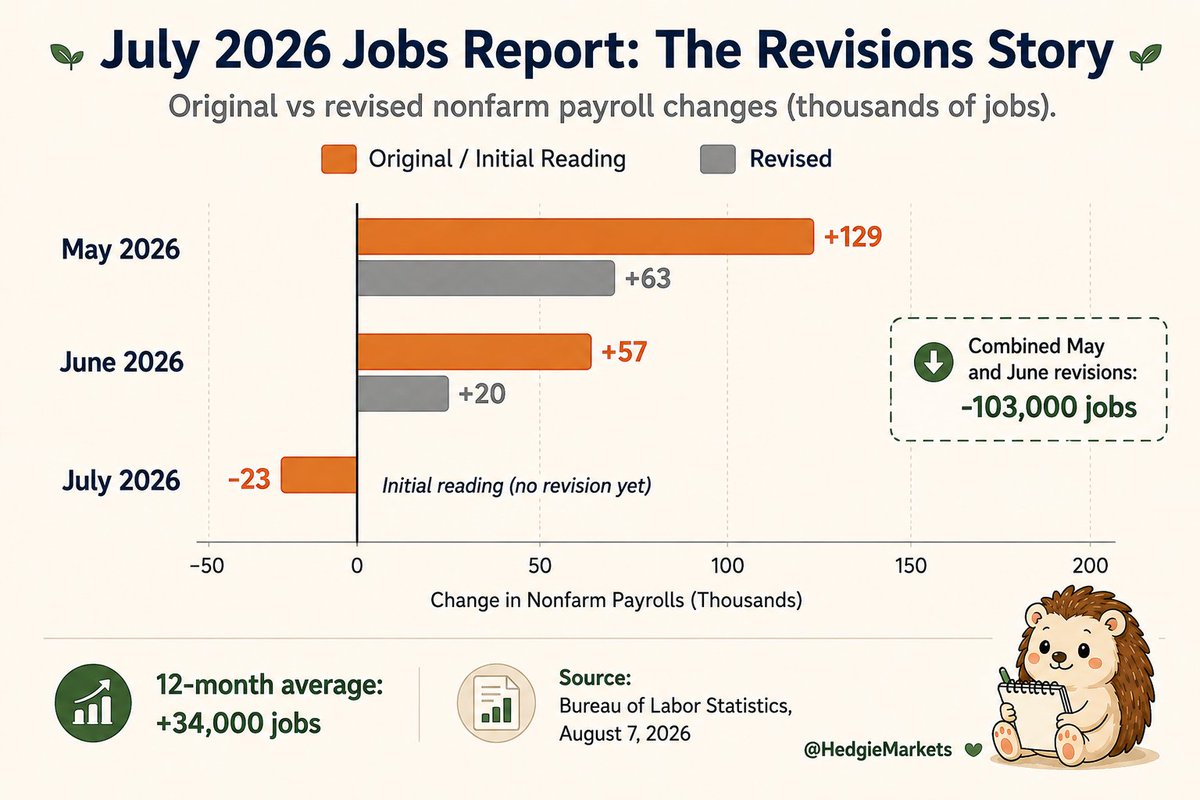
🦔U.S. payrolls fell 23,000 in July against economist expectations of an 83,000 gain. May and June were revised down by 103,000 combined, so the two months added 83,000 fewer jobs than originally reported. Unemployment dropped to 4.1% only because labor force participation fell to a five-year low. Temporary layoffs rose 153,000 in one month. Markets rallied on the report because a weakening labor market means the Fed is more likely to cut rates.
My Take
The revisions did more damage than the headline miss. The BLS took 103,000 jobs out of the May and June numbers this morning, which means the "strong labor market" story that supported stock prices through the spring rested on data that turned out to be wrong. Every month for the last three months has produced downward revisions to the previous data. Either the BLS models are overestimating hiring or the labor market is deteriorating faster than the models can catch.
Labor force participation fell to a five-year low, which is why the unemployment rate went down instead of up. Temporary layoffs jumped by 153,000 to 921,000 in one month, and companies are moving workers off payroll faster than they expect to recall them. Nominal wage growth slowed to 3.2% year over year while inflation still runs above the Fed's 2% target, so most workers are losing purchasing power every month.
This report puts stagflation on the table. Inflation remains stuck above target with tariff costs still passing through to consumer prices, and the labor market is now weakening at the same time. The Fed cannot fix both problems at once because cutting rates to help jobs risks re-igniting inflation, and holding rates to fight inflation causes more job losses. The last time the U.S. had this combination in the 1970s, Volcker had to drive rates to 20% to break inflation and the recession that followed lasted through the early 1980s. Traders bidding stocks up on today's report are betting the Fed can cut without any of that history repeating.
Hedgie🤗