I watched with disappointment the recent interview granted by Senator Ali Modu Sheriff to Channels Television on Monday.
After a prolonged absence from public discourse, one would have expected that time away might have sharpened Senator Sheriff’s judgment. Regrettably, that does not appear to be the case.
In the interview, the former governor claimed that Peter Obi cannot command sizeable support in Northern Nigeria. It is curious that he has appointed himself spokesperson for the Northern masses. For the record, in his first outing on the presidential ballot, Mr. Obi secured approximately 2.8 million votes in the region — a remarkable achievement that cannot be dismissed lightly.
Given the current national hardships, the widespread consensus on the failure of the APC administration, and the addition of a strong Northern figure to the ticket who previously garnered 1.45 million votes in the region, the OK ticket remains a formidable force in Northern politics.
Even more surprising was Senator Sheriff’s assertion that the people of Kano would not vote for Mr. Obi. Let me state clearly: the good people of Kano are neither bigoted nor xenophobic. They have consistently demonstrated strong trust in the Kwankwasiyya movement and will support any credible ticket presented under its banner.
I respectfully advise Senator Sheriff that, in future national television appearances, he would do better to speak to the serious insecurity and humanitarian challenges facing his home state, rather than making divisive and poorly considered remarks.
The OK ticket currently represents the best opportunity for Nigerians to reset the country and place it on a path of competence, unity, and progress. - RMK
Worsening Leadership Crisis in the Country Now Evident
The ultimate cost of uncompassionate leadership, as evident in the country today, is turning citizens’ frustration into deep, volatile resentment. It is even more traumatising when the leader presiding over that collapse demonstrates clear incapacity and a lack of compassion.
The government and people of Oyo State, more than 50 days after the abduction of the schoolchildren without any tangible effort toward their rescue, should rightly feel bitter and abandoned.
Since this unfortunate incident, I have spoken publicly about it twice, including appealing directly to the kidnappers to release the children. I also called the Governor twice to assure him of my solidarity, understanding that this issue is not just an Oyo problem but a Nigerian tragedy.
On Friday, July 3, I decided to travel to Ibadan with Prof. Pat Utomi to express solidarity with the Governor, as more than 50 days had elapsed without the rescue of the children and with numerous others still being held captive across the country.
During our two-hour meeting, I shared my experience in addressing insecurity as Governor of Anambra State. I recalled how President Olusegun Obasanjo, and later Presidents Umaru Musa Yar’Adua and Goodluck Jonathan, would personally call us several times whenever we faced major security challenges.
But, to my utmost shock, I discovered that, contrary to my assumption that they had been in regular communication over the matter, Governor Seyi Makinde had not received a single call from President Bola Tinubu.
I remember the only case of a school kidnapping during President Goodluck Jonathan’s era - the Chibok girls. It drew local and international attention. Even though the security agencies provided almost daily updates on their efforts, Nigerians and the rest of the world were outraged that it took President Jonathan over two weeks to call the then State chief Executive.
I vividly recall that the current President, Bola Tinubu, led a team of vocal critics who called for President Jonathan’s immediate resignation over the incident, citing his delay in calling the state governor. That call for IMMEDIATE RESIGNATION should actually be the case in this matter.
Today, under President Tinubu, there have been more than 13 school kidnappings, yet the President has found it difficult to call the affected state’s chief executive after more than 50 days (over 7 weeks). This is outrageous. I suspect the same may also have been the case in other school kidnapping incidents.
I cannot imagine any issue more important than the lives of our kidnapped children, their teachers, and the many other Nigerians being held captive across the country. It is now an indisputable fact that governance has completely collapsed under this administration.
The situation reflects a total lack of capacity and compassion, compounded by glaring insensitivity.
Amid such an apparent display of incompetence, the President should either resign or, at the very least, abstain from seeking re-election for the sake of our dear country. This call is patriotic, not political. A new Nigeria is POssible. -PO
Grand Corruption: Nigeria’s Greatest Threat.
The recent report from the IMF consultation further raises concerns about the scale of grand corruption under the Tinubu government. The IMF now reveals that about N8.83 trillion in expenditure undertaken in 2025 is not reflected in the budget. This expenditure is not budgeted and is therefore not under legislative oversight or administrative scrutiny. This is horrible.
N8.83 trillion is as follows:
1.About 2% of our GDP.
2.Over 35% of Nigeria’s 2025 N23.96 trillion capital project budget. In fact, the amount is more than the actual released capital funding for 2025.
https://t.co/Hta3LViCB8 is more than the entire combined budget for education (N3.52 trillion) and health (N2.38 trillion).
If such an amount is properly used and accounted for, it could transform Nigeria’s public health and education sectors. It could create hundreds of cottage industries that can provide jobs for thousands of graduates and build a solid foundation for economic development. But we cannot account for it. This is not an isolated incident.
This is a pattern of grand corruption that has become part of this administration.
We have a lot to worry about regarding the state of corruption under President Tinubu. The sort of corruption that is ingrained in total disregard of elementary rules of public finance management poses a grave danger to national security and the stability of the Nigerian state. The capture of the Nigerian state and the plunder of its resources are actions that undermine the basis of state stability and deepen poverty and state failure.
This recent revelation proves that the APC government is grossly corrupt, incompetent, and insensitive. With the growing poverty and the urgent need for significant upgrades to social and physical infrastructure, a responsible and responsive government would ensure that N8.83 trillion is prudently utilised to address these gaps. But not the Tinubu administration.
A few days ago, I called on President Tinubu to resign from office for incompetence, lack of capacity, lack of compassion, and failure to improve on his campaign promises. Some people thought perhaps the call was excessive. But with the daily revelations of pervasive corruption in this administration and its total lack of commitment to the welfare and security of Nigerian citizens, the only reasonable action is for President Tinubu to resign from office. The collapse of elementary forms of due process under Tinubu and the increased evidence of rampant looting of Nigerian public finances reinforce the need for greater accountability. It is now time for Nigerian citizens to rise within the law and hold this administration to account.
A New Nigeria is POssible. -PO
Chance Visits to INEC Registration Centres
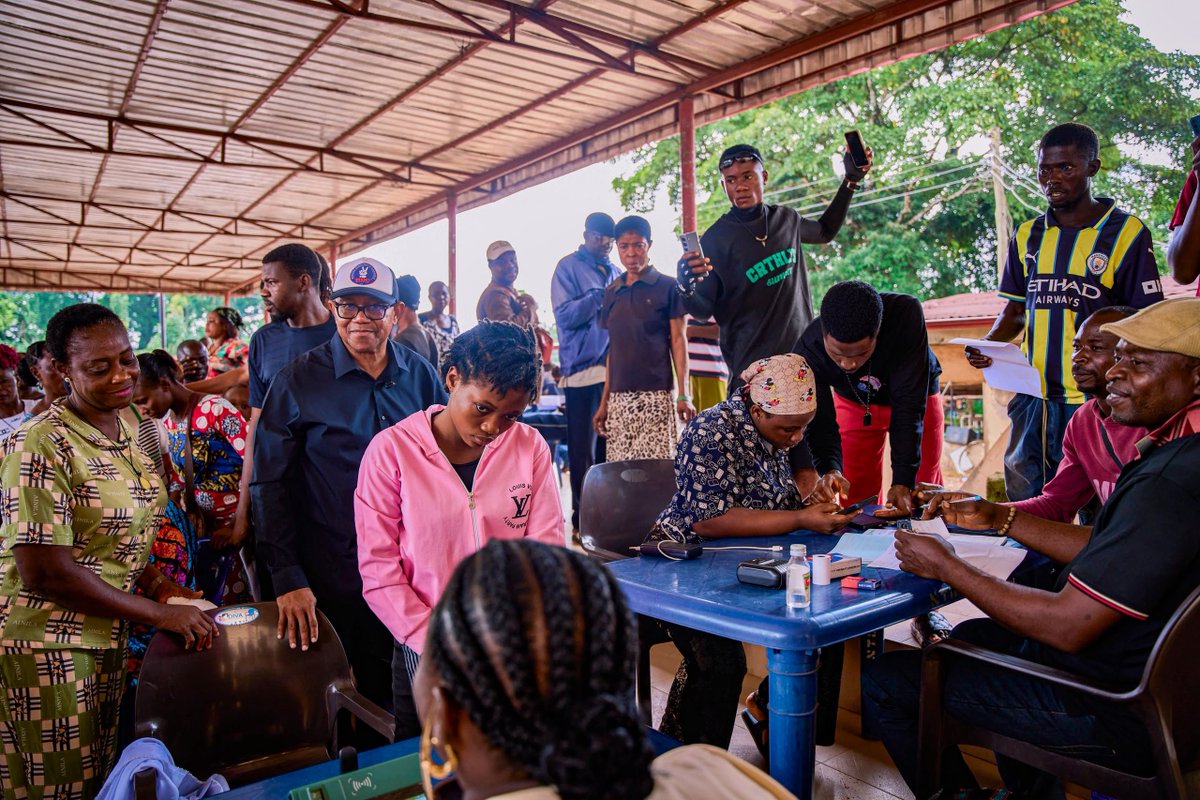
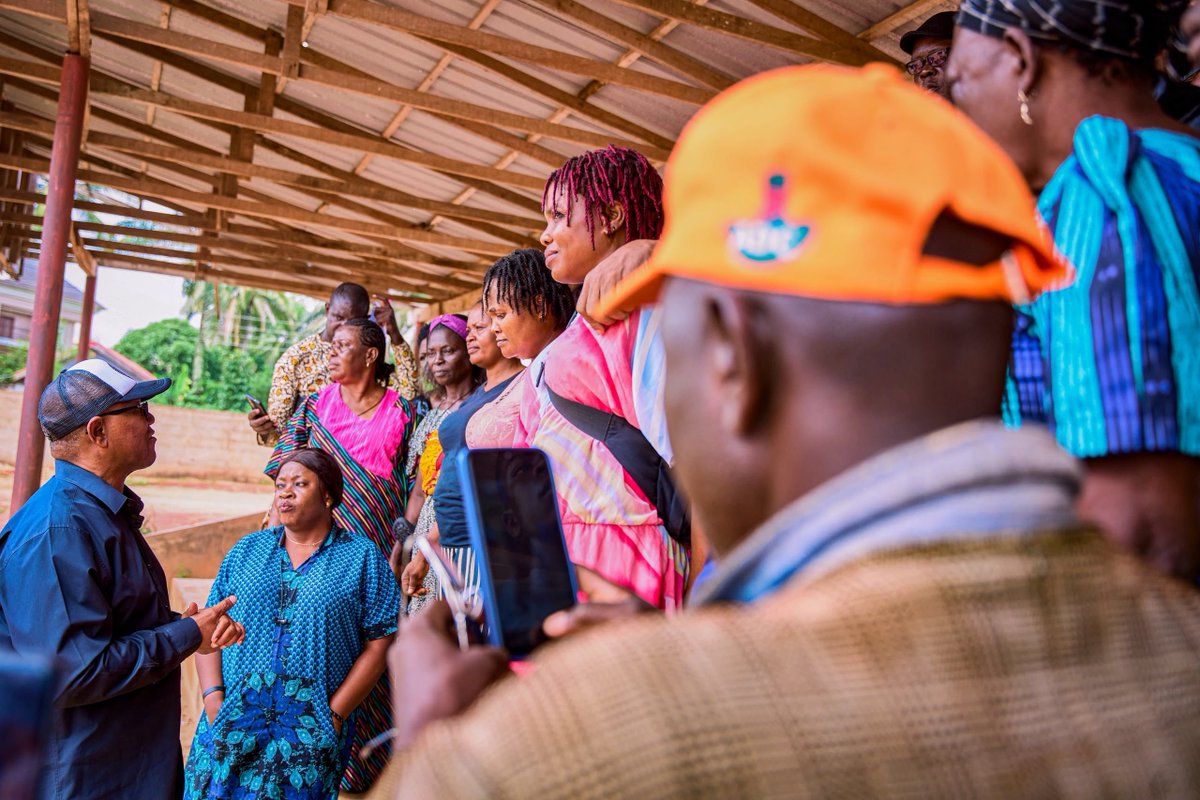
On my return to Anambra State yesterday, and on my way to attend some scheduled engagements, I made impromptu visits to the INEC voter registration centres at the Civic Centre, Nibo, and Nrijiofor Primary School, Nri.
I was pleased to see Nigerians registering to vote. I took the opportunity to commend those who had turned out and to encourage every eligible citizen to do the same. I reminded them that the journey to good governance does not begin on Election Day; it begins with voter registration. Registering to vote is not just a civic responsibility — it is an investment in the Nigeria we all desire.
I urged everyone who is eligible but has not yet registered to do so without delay. I also appealed to those who have already registered to encourage their family members, friends, neighbours, and colleagues to take advantage of the ongoing exercise before the deadline.
Every registered voter strengthens our democracy and brings us one step closer to building the secure, united, productive, and prosperous Nigeria we all seek.
A New Nigeria is POssible. -PO
Education Crisis: Calls for Fundamental Change, Not Just Policy
The Federal Government has finally admitted to its poor management of the education sector. Recently, the Minister of Education acknowledged that the policy separating junior and senior secondary schools has failed to improve educational outcomes. This is evident in recent examination results. In 2024, the West African Examinations Council (WAEC) reported that only 38.32% of candidates passed English and Mathematics in the WASSCE. In 2025, only 32% passed the computer-based WASSCE. This poor performance has been consistent across major examinations over the past two years.
This admission is tragic because education is the most vital contributor to human capital development, which forms the foundation for growth and economic development of any society. We cannot overcome economic stagnation without prioritising education, healthcare, and job creation to lift millions of unemployed youths out of poverty. As successful Asian nations have demonstrated, educational excellence requires sustained investment in curriculum development, motivated teachers, and better learning environments.
Unfortunately, the government continues to neglect the sector. In the 2026 budget, education received only ₦3.52 trillion, just 6.17% of total expenditure, down from 7.87% in 2025, and well below UNESCO’s recommended 15–20%. This low allocation indicates a failure to recognise education as a driver of sustained economic growth.
Education advocate, Mr Alex Onyia @winexviv , recently revealed that Nigeria failed to sponsor students to the International STEM and Mathematics Olympiads due to a lack of funding. It is heartbreaking that the government can sponsor hundreds to irrelevant international conferences yet fail to support its brightest students on the world stage.
The Minister’s admission reflects a broader failure of public leadership. The issue is not the JSS/SSS policy itself, but the lack of commitment to properly fund, manage, and deliver quality education.
In Anambra State, we proved that committed leadership can transform educational outcomes. Through effective funding, oversight, provision of laptops, generators, internet connectivity, and other learning aids, we turned the sector around. For example, our effort in providing computers across all secondary schools (public and private in the state) was recognised by HP Africa Head, who declared that Anambra had procured the largest number of laptops for school children of any subnational government in Africa.
For the future of our society, we must deliberately invest in education, healthcare, and job creation. As I have always said, failing to do the right things is equivalent to abusing society, and the society we abuse today will take its revenge on us and our children tomorrow.
A New Nigeria is POssible. -PO
Voter Registration: The First Step in the Journey to a New Nigeria
Yesterday, while passing through Waru Wazobia in Abuja, I made a chance stop to interact with our people. I seized the opportunity to encourage them, especially our youths and women, to take advantage of the ongoing voter registration exercise.
The power to change Nigeria does not begin on Election Day; it begins with voter registration. Registering to vote is not just a civic responsibility; it is an investment in the future we all desire.
I urge every eligible Nigerian who has not yet registered to do so without delay. Those who already have their voter cards should encourage their family members, friends, neighbours, and colleagues to register as well.
A new Nigeria will not happen through wishful thinking. It will be built by citizens who participate, who believe, and who act. Let us continue to choose hope over despair, participation over apathy, and nation-building over division.
A New Nigeria is POssible. -PO
My Vision for a Productive and Prosperous Nigeria
Today, being the 1st of July, 2026, I wish to humbly recall that when I decided to contest for the office of President of Nigeria, I pledged to place Nigeria on the path of unity and national transformation. Now, as the Nigeria Democratic Congress (NDC) candidate, I will, in the coming weeks and months, provide insights into the roadmap that I am confident will help curb abuse in government, halt the decline in the quality of life of Nigerians at all levels, and usher in an era of unity, peace, sustained progress, and prosperity.
This vision is anchored on a commitment to unity, inclusion, social justice, equity, and the freedom of every citizen to pursue lawful dreams.
Central to this proposed roadmap are significant reforms in education and healthcare, which are at the core of human capital development.
Robust human capital is indispensable infrastructure for national progress. It serves as the fundamental capital upon which daily life, economic expansion, and the delivery of essential public services depend.
These are foundational areas that we must reform with energy and determination if we are to reap the demographic dividend of our youthful population.
From the outset of my presidency, we will establish a task force dedicated to drastically reducing the menace of out-of-school children. We will place greater emphasis on Technical and Vocational Education and Training (TVET) to support our drive for massive industrialisation, anchored on our agricultural endowments and value addition across value chains organised around industrial parks to be located in development zones across the geopolitical regions of the country.
Funding and improving the equipment of TVET institutions, through partnerships among government, the private sector, and social entrepreneurs such as faith-based educators, will facilitate apprenticeship opportunities in the private sector, similar to the German dual education system.
The situation in which unemployment remains high while Nigerian entrepreneurs establish businesses elsewhere because skilled labour is scarce must be confronted decisively. Doing so is essential for the common good and for facilitating our transition from a consumption-driven economy to a production-driven one.
Character and civic education, emphasising the values that foster trust - an essential ingredient for enterprise and leadership - as well as shared national values, will receive significant attention within the tripartite approach to governance that we propose.
A New Nigeria is POssible. -PO
Lokoja Judgment: An Unnecessary Serious Setback for Nigerian Democracy
Today was an exceptionally busy day. I left Lagos in the early hours for Emekuku, where I visited the School of Nursing Sciences, an institution I have consistently supported over the years. It was gratifying to inspect projects funded through my previous interventions, including the school’s computer laboratory. Such investments reaffirm my belief that education remains one of the strongest foundations for national development.
From there, I attended the 80th birthday celebration of the Emeritus Archbishop of Owerri, Most Rev. Dr Anthony Obinna, whose commitment to justice, peace, and the common good has inspired many, before proceeding to Madonna University for another engagement.
It was at Madonna University that I received the court news of the Lokoja court rulings through my brother, Senator Rabiu Musa Kwankwaso.
Every Nigerian committed to the country’s progress should be deeply concerned. This judgment represents another setback for our democracy and the institutions upon which our future depends.
It is regrettable that some who claim to champion democracy now appear determined to weaken the very institutions that sustain it. In doing so, they are undermining public confidence and endangering the future of millions of Nigerians.
The legislature and the judiciary are increasingly being drawn into this pattern of institutional decline. Democracy cannot thrive where institutions lose their independence and credibility.
Those who seek to weaken Nigeria’s democratic foundations will not ultimately prevail. When a similar situation recently affected the ADC, I condemned it without hesitation. I do so again today because my position has always been guided by principle.
My concern is not about who becomes President. My concern is that Nigeria works. Our politics must move beyond the quest for power and focus instead on building a united nation founded on justice, strong institutions, the rule of law, and equal opportunity. That is the Nigeria we owe ourselves and the one we must leave for future generations.
I therefore urge all well-meaning Nigerians to rise above partisan interests and defend our democracy. The survival of our institutions is inseparable from the survival of our nation. It's when we work together that a new Nigeria of our dream is made POssible. -PO
State Police: Commendable Step, but Disorderly Legislation Raises Concerns of Political Misuse
The recent passage of the State Police Bill by the National Assembly marks a significant legislative milestone in addressing a long-standing demand of the Nigerian people. For years, many of us, alongside security experts and regional stakeholders, have consistently argued that a highly centralised policing structure is fundamentally unsuitable for a country as vast, diverse, and complex as Nigeria. However, the legislative and constitutional implementation appears shaky and raises legitimate concerns.
The process should involve greater community participation. Policing should be more visible at the local government and community levels. The mechanism for passing the law appears highly disorganised, with no public hearing on such a sensitive issue. Indeed, the rush to enact the law without proper legislative procedures fuels suspicion among many observers about the political motives behind it.
The greatest concern does not arise from logistical issues; it stems from history. There is a widespread, justifiable fear that state police forces could become instruments in the hands of governors. The suspicion is that a state-controlled police force could be weaponised to suppress political rivals, disrupt opposition rallies, and manipulate elections.
For state policing to evolve from a risky political gamble into a genuine security solution, the law must not only permit states to establish police forces but also clearly provide for independent oversight bodies, such as a state-level Police Service Commission that is entirely free from executive influence, to ensure that policing serves the public interest rather than the interests of the ruling elite.
Going by what Nigerians have seen so far, there is no guarantee that this administration can resist the temptation to take advantage of state policing to influence the 2027 general election by proxy. In view of that possibility and the danger it poses to the polity, it is necessary to defer its implementation until after the general election.
A New Nigeria is POssible. -PO
Father’s Day: A Time for Reflection
Today is Father’s Day. After attending church service and in my routine reflection, I find myself once again asking a difficult question: Are we cursed, or are we the cause?
I grew up in a Nigeria that was more united and peaceful. In my primary, secondary school and university days, students related freely without divisions of religion, ethnicity, or region. We simply saw ourselves as Nigerians.
After university, I entered business in an environment where partnerships were built on trust and competence, not tribe or religion. I also lived in Nigeria, where the naira commanded respect, and Nigerians enjoyed dignity abroad, with easier global mobility and much respect for our passports.
I lived in Nigeria, where I travelled across the country—from Onitsha to Lagos, Maiduguri, and Calabar—without fear. Roads connected people, and life was more secure. Nigeria’s Armed Forces and the Police were also widely respected for their role in global peacekeeping and international stability.
Beyond security and unity, there was also a stronger sense of public trust in institutions, with greater confidence in elections, a clearer culture of accountability in governance, more stable universities that served as centres of intellectual excellence and national pride, a more functional and accessible healthcare system, and relatively better-performing basic infrastructure such as electricity, roads, and public utilities, which—though imperfect—were far less chaotic than what we experience today.
Today, as a father reflecting on Nigeria, I am pained that much of this has changed. Insecurity has grown, national unity has weakened, and many citizens no longer feel safe. Opportunities have also diminished for the younger generation compared to what we once had.
It is also worrisome that Nigeria’s influence in global affairs appears reduced, as seen in recent international gatherings such as the just-concluded G7 meeting, where African countries like Egypt and Kenya were invited, while Nigeria was absent. Whether symbolic or not, it reflects a decline in standing we cannot ignore.
As fathers, we must not only lament. We must not bequeath this reality to our children. We owe them a better Nigeria built on security, opportunity, fairness, and national pride.
A key part of achieving this is active civic participation. We must obtain our Permanent Voter Cards (PVCs), vote responsibly, and remain committed to protecting the integrity of our votes. Change will not come from complaints alone but from citizens who choose and defend accountable leadership.
With responsibility, unity, and determination, we can together build the new Nigeria that is POssible. -PO
Today is World Refugee Day.
Yet, millions of Nigerians have become refugees in their own country. Across the North and other parts of Nigeria, communities have been displaced by terrorism, banditry and violent attacks, with IDP camps now a painful symbol of our national failure to protect our people.
Many of these camps are grossly underfunded and inadequate for the thousands forced to live there. Families struggle daily for food, healthcare, education and basic dignity. For many, survival has become their only reality.
Children are abducted from schools. Families are forced to flee their homes. Farmers abandon their lands. Citizens live in fear of kidnapping and violence.
Worse still, with insecurity continuing to spread and intensify, there is little hope for many displaced Nigerians to return to their communities and rebuild their lives safely. This is not OK
On this World Refugee Day, we must remember that behind every statistic is a human life disrupted, a family uprooted, and a future put on hold. Nigerians deserve safety, dignity and the right to live peacefully in their own country.
A new Nigeria is POssible. -PO
Accountable Borrowing: The South Africa Example.
I have consistently maintained that borrowing, in itself, is not a bad thing. Every nation borrows. The critical issue is not the act of borrowing, but what the borrowed funds are used for and whether citizens can clearly see and measure the impact of such borrowing in their daily lives.
There is a lot to learn in the open and transparent manner in which South Africa handled its recently secured a $1 billion loan from the New Development Bank, with a clearly defined purpose. Publicly announcing the targeted purpose of the loan for all to know and monitor, upgrading water supply systems, modernising sanitation infrastructure, improving electricity distribution, and strengthening waste management services across eight major metropolitan cities, including Johannesburg, Cape Town, and Durban.
This is indeed what accountable borrowing should look like; the purpose is clear, the projects are identifiable, and the expected benefits to citizens are measurable. Such investments directly improve living conditions, enhance productivity, and stimulate economic growth.
In Nigeria, however, the opposite is the case: public debt has risen dramatically under the current administration, and its deployment is shrouded in secrecy from the people who will indeed pay back the loan. Today, our total public debt has increased from about ₦87 trillion in 2023 to nearly ₦200 trillion.
Yet, despite this unprecedented accumulation of debt, Nigerians are often left without a clear and detailed account of how these borrowings are being deployed to improve critical sectors such as education, healthcare, power, security, and infrastructure.
Borrowing must never become an end in itself. Every loan obtained in the name of the Nigerian people must be tied to specific, productive investments capable of generating economic value, creating jobs, reducing poverty, and improving the welfare of citizens.
Good governance demands transparency and accountability. The government must be able to clearly explain what was borrowed, where it was invested, and what measurable outcomes have been achieved. The ordinary Nigerian should be able to see and feel the benefits of every debt incurred on their behalf.
At a time when millions of Nigerians are struggling with rising costs of living, unemployment, insecurity, and declining purchasing power, fiscal discipline and prudent management of public resources are no longer optional; they are imperative.
Every borrowing decision should answer one simple question: How does this improve the life of the ordinary Nigerian? If that question cannot be convincingly answered, then we risk merely transferring today's burdens to future generations.
A New Nigeria is POssible. - PO
BRICS bank approves $1 billion lifeline for South Africa’s struggling cities | Business Insider Africa https://t.co/VN0C0Xo8zp
Reflecting on the Prison Exchange with Ethiopia
The news of the conclusion of the prisoners exchange between Nigeria and Ethiopia is refreshing.
Every life is precious, and ensuring the constitutional right to human dignity for all Nigerians - regardless of where they are or the circumstances they find themselves in - must remain a cornerstone of our national foreign policy.
I must therefore appreciate the efforts of our Foreign Affairs Minister, Amb. Bianca Odumegwu-Ojukwu, Attorney General Lateef Fagbemi (SAN), and their Ethiopian counterparts for finally concluding these protracted negotiations.
However, we must reflect deeply on this development. It is heartbreaking to learn that at least four Nigerian citizens lost their lives in custody while this diplomatic and administrative process dragged on over the past few years. My heart goes out to their families, who had to endure the ultimate pain of losing loved ones in a foreign land.
While we commend this humanitarian intervention, it serves as a reminder of a larger systemic crisis. The overwhelming majority of these citizens are young Nigerians. A significant number were arrested while transiting through Addis Ababa’s Bole International Airport in search of green pastures. While we must continuously urge our citizens to remain law-abiding and respect the laws of host nations wherever they travel or reside, we must also ask ourselves a hard question: What drives our young and productive population into desperate circumstances across the globe?
Until we build a New Nigeria that offers genuine economic opportunities, a functional educational framework, and an environment where hard work is rewarded, we will continue to grapple with the tragic consequences of mass emigration and its associated vulnerabilities.
As these citizens are brought home to serve out their terms, our correctional facilities must be properly managed with a focus on genuine rehabilitation and societal reintegration. Let us use this moment not just for short-term relief, but as an urgent call to build a nation that protects, values, and empowers its citizens here at home.
With the right policies and leadership, a New Nigeria is POssible. -PO
Coping with the systematic collapse of our institutions.
When the controversy surrounding the removal of former Chief Justice of Nigeria, Walter Onnoghen, unfolded, I expressed a concern to a friend: that the greatest damage might not be immediate, but the message it sends about the sanctity and independence of our institutions to the world.
Strong economies are built on trust. Investors can manage security risks, policy risks, and even market risks. What they fear most is uncertainty in the rule of law and a judiciary that is perceived to be vulnerable to political pressure.
Today, many Nigerians have lost confidence in systems that should protect them. Businesses increasingly request that their contracts be governed by foreign jurisdictions because they have greater confidence in those institutions than in our own. That should concern every patriot.
We must never sacrifice our sacred institutions on the altar of politics. Nations rise when institutions are stronger than individuals. "The federal High Court Judgement ordering the de-registration of the ADC and other political parties is just one of those activities that further reduces the common man's trust in our legal systems" it should be reversed.
I pledge that we will restore the dignity, independence, and integrity of the Judiciary. The common man must have a voice. The business community must be protected from legal uncertainty and intimidation. Justice must be impartial, accessible, and respected by all.
To our judges, legal luminaries, senior advocates, and lawyers: this is your moment. Rise, defend the rule of law, take back your country!
A New Nigeria is POssible. -PO
Sustainable Success Is Built on Competence, Integrity, Discipline and hardworking.
On Saturday, I had the privilege of interacting with young entrepreneurs, professionals, business leaders, and members of the emerging generation at the This Generation Conference hosted by Summit Bible Church in Abuja.
Our discussion focused on what it takes to thrive in the marketplace despite prevailing economic challenges. I shared insights from my years in business and public service, emphasizing that sustainable success is built on integrity, competence, discipline, and a commitment to creating value for society.
I reminded participants that no nation develops by consumption alone. Nations progress when their citizens are productive, innovative, and committed to excellence. Our young people must resist the temptation of shortcuts and instead embrace education, skills acquisition, entrepreneurship, and ethical leadership.
The future of Nigeria depends largely on the quality of leadership and enterprise this generation is willing to build. We must move from a culture of sharing poverty to one of creating prosperity through production, innovation, and responsible governance.
I left encouraged by the energy, intelligence, and determination of the young people I met. Their questions, ideas, and aspirations reaffirmed my belief that Nigeria’s greatest resource remains her people.
Together, through hard work, integrity, and purposeful leadership, we can build the New Nigeria that is POssible. -PO
Insecurity: Nigeria Cannot Continue Like This
I received with deep shock and sadness the tragic death of retired Major General Rabe Abubakar, who reportedly died while in the custody of kidnappers. Earlier, before this heartbreaking news, I also received disturbing reports of renewed bandit attacks in Sokoto and Kwara States.
The armed bandits reportedly blocked a market route in Sokoto and abducted traders, while terrorists invaded communities in Kwara State, kidnapping scores of citizens and killing innocent people, are heartbreaking and alarming. These incidents are not isolated tragedies; they are clear manifestations of the deepening security crisis confronting our nation.
But particularly painful is the reported death of Major General Rabe Abubakar, a distinguished military officer who dedicated a significant part of his life to defending Nigeria and protecting its citizens. It is tragic that a man who served his fatherland with honour, rose through the ranks of the Nigerian Armed Forces, and retired after years of meritorious service, would meet such a heartbreaking end at the hands of criminal elements. His death is a national tragedy and a sobering indictment of the insecurity that has engulfed our country.
When traders can no longer travel safely to markets, farmers cannot access their farms, communities live under constant fear, and even retired senior military officers are not spared from the menace of kidnapping and violent crime, it becomes evident that our nation is facing a grave security emergency.
Security remains the foremost responsibility of any government. Every life lost, every citizen abducted, and every community displaced represent a painful failure of our collective duty to protect the Nigerian people. The recurring attacks in Sokoto, Kwara, and many other parts of the country demonstrate that insecurity is not only persisting but spreading in both scope and intensity.
I once again urge the Federal Government and our security agencies to move beyond rhetoric and adopt a more proactive, intelligence-driven, technology-based, and coordinated approach to tackling insecurity. We must strengthen our security architecture, improve intelligence gathering, secure our borders, equip and motivate our security personnel, and ensure that those responsible for these heinous crimes are apprehended and brought to justice.
A nation where citizens live in fear cannot prosper. A nation where economic activities are disrupted daily by criminal elements cannot attract investment, create jobs, or guarantee a better future for its people. We must urgently reclaim every part of our country from terrorists, bandits, kidnappers, and all criminal gangs threatening our collective existence.
My heartfelt condolences go to the family of Major General Rabe Abubakar, his former colleagues in the Armed Forces, and all Nigerians who have lost loved ones to insecurity. I also sympathise with the families of those killed, those abducted, and the affected communities in Sokoto, Kwara, and across the nation.
The recurring tragedies and embarrassing security failures we continue to witness make the quest for a New Nigeria not only necessary but inevitable. We must build a nation where every citizen can live, work, travel, and pursue legitimate economic activities without fear.
A New Nigeria is POssible. -PO
Yesterday, I had the honour of hosting my brother and partner, His Excellency Peter Obi, at my residence in Abuja.
I warmly welcomed him back from his highly productive international trip, and we engaged in frank and productive discussions on key partisan and national issues.
Our party, the National Democratic Congress (NDC), remains united. As leaders, we must continue to demonstrate maturity by making the necessary sacrifices and tolerating our differences in pursuit of our shared goal.
We are resolute in this mission, and together, we shall ensure that Nigeria is OK. - RMK
What June 12 Should Mean to Us Nigerians
Today, we observe a day that should mean a great deal to us as a people who cherish democratic principles. Every year on June 12, the conversation inevitably turns to a critical assessment of the state of our nation. It serves as an annual benchmark for asking important questions: Are our elections today as transparent as they were in 1993? Is the social contract being honoured? Are the institutions of governance truly serving the people?
Ultimately, June 12 is a powerful blend of reflection and aspiration. It honours a fractured past while serving as a constant and foundational reminder of the immense power inherent in the collective democratic will of the Nigerian people.
For us in Nigeria, June 12 is not merely a date on the calendar; it is the emotional and structural bedrock of our modern democratic identity. Officially recognised as Democracy Day, June 12 carries deep historical, political, and social significance, representing both a monumental tragedy and the ultimate triumph of the collective will of the people.
To understand what June 12 means to Nigeria, one must examine its history, its evolution, and its enduring symbolism.
A new era of true democracy is POssible. -PO