For seven years, planners struggled to complete a $1.2 million wetland restoration project in the Brdy region of the Czech Republic. The goal was to build a dam that would improve water management and bring back valuable wetland habitat, but the project remained trapped in a maze of permits and approvals.
Then a family of eight Eurasian beavers did what engineers had planned…
without permits, machinery, or a budget.
The beavers built a network of dams in almost the exact area chosen for the proposed project, naturally restoring the wetland system officials had spent years trying to create. After seeing the results, authorities decided there was little point continuing with the original human-built dam.
Although some reports suggested the beavers completed the work overnight, experts say their construction likely took several weeks. The reason it seemed sudden is that the animals quietly worked away until their finished dams became impossible to miss.
Beavers are known as “ecosystem engineers” because their behaviour can reshape entire environments. By cutting trees and blocking streams, they create ponds and wetlands that support countless species, including fish, amphibians, insects, birds, and mammals.
Their wetlands also act as natural water reservoirs, helping during droughts, reducing flood risks, filtering water, storing carbon, and keeping landscapes wetter during wildfires.
The world’s largest known beaver dam, located in Canada’s Wood Buffalo National Park, stretches for hundreds of metres and is so vast it can be detected from space.
Once heavily hunted across Europe, beaver populations have been recovering thanks to conservation efforts, proving that sometimes nature can solve problems humans spend years trying to fix.
Read here
"These eager beavers saved the Czech government $1.2
million." National Geographic
She wrote the words in 1931 for a hymn book. She died in 1965, never knowing what would happen next. Six years after she was gone, her quiet poem became one of the most recognized songs on the planet.
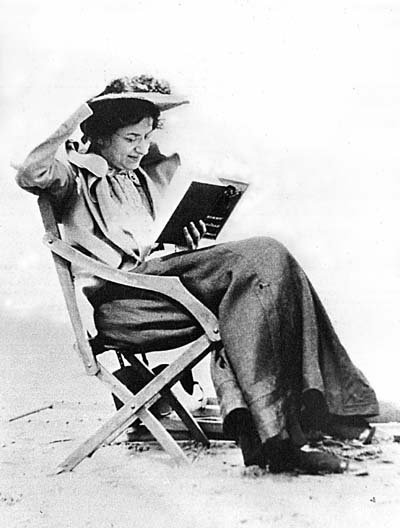
Eleanor Farjeon was born in London in 1881 into a family built from words and music. Her father was a novelist, her brothers became writers, and her eldest brother composed music. Their home was always filled with books, stories, and the particular warmth that comes from people who believe deeply in the power of language.
Eleanor herself was small and shy, with poor eyesight and fragile health. She spent much of her childhood in the attic, surrounded by books, creating elaborate imaginary worlds with her brother Harry. She beautifully described writing as "the flow of ease that makes everything feel like delight."
She grew up to write children's stories and poetry gentle, lyrical work full of wonder and quiet hope. It wasn't the kind of writing that made headlines, but rather the kind that children carry into adulthood without quite knowing why it stays with them.
Then, in 1931, a hymnal editor named Percy Dearmer came to her with a request. He had a beautiful old Scottish Gaelic melody called "Bunessan," which had long been paired with a Christmas carol. He wanted something different a morning hymn, a song of thanksgiving for ordinary days. He asked Eleanor if she would write words to fit the tune.
She thought about a village she loved in East Sussex called Alfriston. A church near a river. A garden in the early morning light. She thought about Genesis, about the first day, and about what it might have felt like when light entered the world for the very first time.
And so, she wrote three verses:
Morning has broken, like the first morning.
Blackbird has spoken, like the first bird.
It was simple language, yet profound in the way that simple things often are. It painted each new day as a gift, and each morning as fresh as the very beginning of everything.
The hymn appeared in Songs of Praise in 1931 as Hymn Number 30. Children sang it in English schools, and congregations sang it on Sunday mornings. Those who knew it loved it, but practically nobody outside those church pews had ever heard it. For forty years, "Morning Has Broken" lived quietly in British hymnals as a lovely prayer and a gentle poem nothing more.
Eleanor kept writing. She befriended writers like D.H. Lawrence and Robert Frost, won literary awards, and a prestigious prize for children's literature was eventually established in her name. She lived a full, rich, creative life, and passed away on June 5, 1965, at the age of eighty-four.
She never knew what was coming.
In 1971, a young British singer-songwriter named Cat Stevens was working on his album Teaser and the Firecat. He was going through what he later described as a slightly dry period, needing another song or two before the record felt complete.
While browsing through a bookshop, he came across a hymnal. He was looking for older songs or public domain material that might spark some inspiration. As he turned the pages slowly, he found it.
"I came across this hymn book, found this one song, and thought this is good," Stevens explained years later. "I put the chords to it and then it started becoming associated with me."
Having grown up attending school in England, the words may have felt familiar in some deep, unplaceable way like something he had always known but had never quite found the form for:
Mine is the sunlight. Mine is the morning. Born of the one light Eden saw play.
The optimism in Eleanor's verses perfectly matched something Stevens was searching for at that moment in his life a belief that each day is a beginning, that gratitude is a form of reverence, and that morning itself is something worth singing about.
#archaeohistories
Torpenhow Hill, England
When the Saxons arrived and asked the locals what that hill was called, the Welsh replied, “Pen,” which simply means hill in Welsh.
The Saxons, apparently not spotting they’d already been given the full answer, added their own word for hill: tor. So it became Torpen - literally Hill Hill.
A few centuries later, the Norse turned up and repeated the exercise, adding haugr, their word for hill. Now it was effectively Torpenhaugr - Hill Hill Hill.
Then the English arrived, looked at the whole thing, shrugged, and added “Hill” on the end for good measure.
Thus we ended up with Torpenhow Hill:
Hill Hill Hill Hill.
It’s comforting to know that for over a thousand years, successive generations have been independently deciding that the previous lot hadn’t made it quite clear enough that it was, in fact, a hill.
Language is magnificent.
Humans… less so.🤷🏻♂️🤣