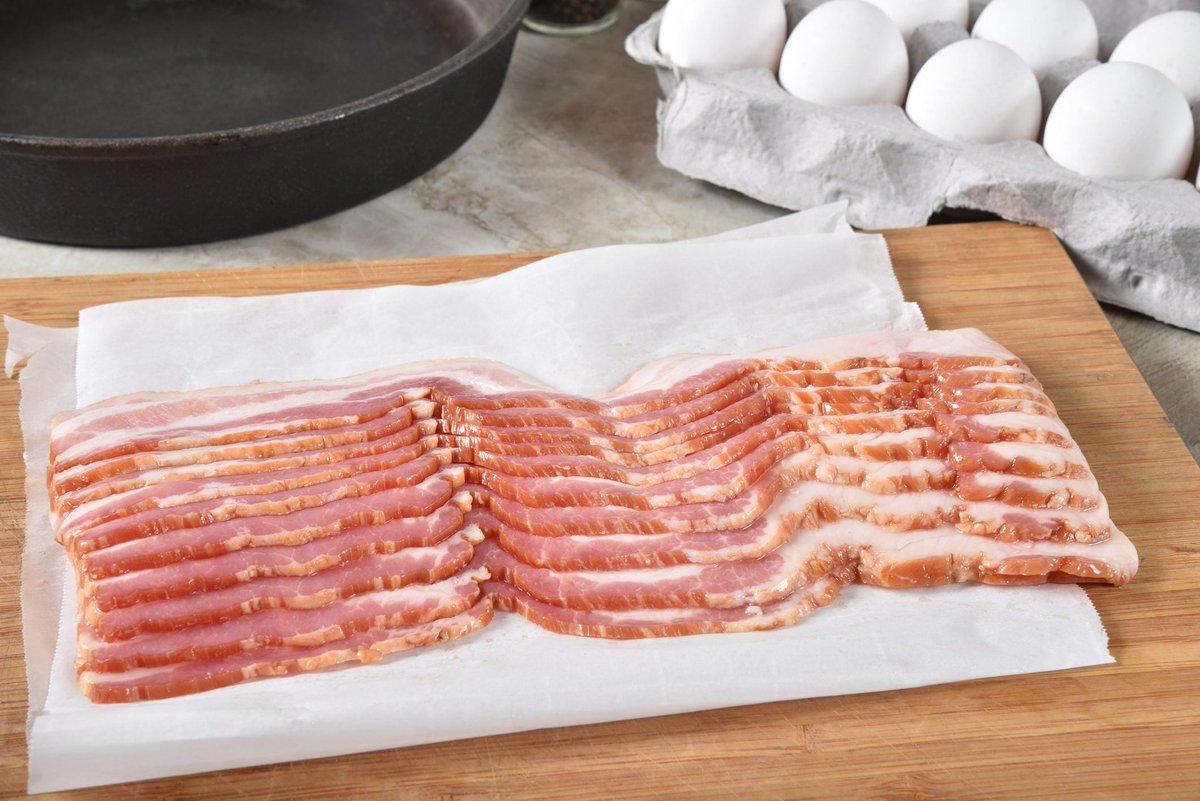
"Bacon contains nitrites and nitrites cause cancer."
A 100g portion of bacon contains roughly 5.5 mg of nitrate.
A 100g portion of spinach contains roughly 741 mg.
Spinach has approximately 130 times more of the substance bacon is being prosecuted for. Around 80 percent of dietary nitrate in the human diet comes from vegetables. The leafy salad your dietitian recommends is, by mass, a nitrate delivery system that makes a rasher look like a rounding error.
The standard rebuttal is that vegetable nitrates are different. They are not. The exact same molecule, absorbed in the exact same gut, recirculates through the exact same salivary glands, gets reduced to nitrite by the exact same bacteria on the back of the tongue, and ends up in the exact same stomach. The pathway is called the enterosalivary circulation. It is how your body makes nitric oxide. It is the basis of every beetroot pre-workout product on the shelf.
The absolute increase in colorectal cancer risk from 50g of processed meat per day is roughly 0.7 percentage points over a lifetime. One in twenty-five becomes one in twenty-one. Only if you eat that much, every day, for the rest of your life.
The molecule isn't the problem. The framing is.
Eat the bacon.
What people expect to happen when they go carnivore:
- Constant constipation.
- Scurvy within weeks.
- Total energy collapse.
- A heart attack by month six.
- A divorce, probably, from the strain on the household budget.
- Profound boredom with food.
- Inability to socialise.
- A friend visibly worried about them at the dinner table.
What actually happens:
The first week can be genuinely uncomfortable. You feel flat. You crave bread. You sleep badly. You wonder if you have made an enormous mistake. This is real and should not be dismissed.
The second week, something shifts. The cravings ebb. The energy lifts in a manner that does not depend on caffeine. Sleep improves. The 3pm slump leaves the building.
By month two, the things you did not know were problems are visibly absent. The reflux. The skin issues. The afternoon brain fog. The vaguely inflamed feeling you had been treating as your personality.
By month six, you have stopped thinking about food in the manner you thought about food for twenty years. You eat when hungry. You stop when full. You do not graze. You do not snack. You do not need a reminder to drink water because the meal you ate has fat in it and the fat satiates and the satiety lasts.
The bread craving never comes back.
The friend at the dinner table is still visibly worried because you look better than you have looked since university and they have not.
That is the actual diet.
The expectations were marketing.
One tick bite made this man allergic to red meat.
Now over 450,000 Americans are allergic to beef & dairy and the number is rising.
What’s is going on?
Want to support the American Heart Association and
the American Diabetes Association?
Then eat a high carbohydrate diet that they promote
in order to drive the diseases that fund their sponsors.
🚨New Paper: "Seven Years of 700 Cholesterol Without Coronary Atherosclerosis: A Lean Mass Hyper-Responder Case Report"
Link: https://t.co/5VnRpZlFdR
For the past 7 years, I’ve been running what is essentially a natural experiment in cholesterol and heart health.
During that time, I’ve largely lived with:
👉Total cholesterol around 700 mg/dl
👉LDL cholesterol between 500–600 mg/dL
I recently underwent advanced coronary CT angiography imaging with AI-guided analysis. This is not a CAC. It measures all plaque (soft + calcified), with expert interpretation and AI-guided analysis capable of quantifying plaque down to the cubic millimeter (mm3).
Now, to address the obvious question:
Am I too young for plaque?
In brief: No.
The clearest comparison is individuals with homozygous familial hypercholesterolemia, who often have similarly extreme LDL/ApoB levels and can develop advanced plaque as toddlers, and even heart attacks as early as age 8.
Also, nutrition influencers in their 30s have publicly shared quantified plaque scores from these same imaging technologies. In one recent case, a plant-based influencer in his thirties was found to have 61.3 mm³ of plaque despite having far lower lifetime LDL exposure. (He can identify himself if he so chooses.)
My case also isn’t a one-off.
There are many individuals like me, including older individuals with similar LDL-C and ApoB without any plaque.
The difference is that I’m an unusually well-characterized subject, with extensive metabolic data and health markers tracked over time. You can learn more at the newsletter or open-access paper, linked above.
The science of heart health is not settled. And cholesterol is not a simple story.
🚨 If you want to help spread the word...
Quote Tweet this post (or create an original post) including the article link with a thought. Academic papers are increasingly evaluated using attention metrics. Original posts from unique users are one way to increase these metrics and help ultimately increase its reach.
🚨 If you want to learn more, I'll include more learning resources below 👇
Most people try to fix every symptom at once and still feel stuck. This quiz helps you identify the one biological signal your body needs most so you can focus on what matters first.
Take my free 2-minute quiz now: https://t.co/NDoFKgko86
Dr. Eric Berg, DC, not MD; information only