Own a minute. Sell your time. The world's first Time Marketplace. ⏳ Buy, Sell & Trade exclusive time slots. Gain digital immortality. 💎
👇 Claim your minute:
FameClock turns each minute of the day into a unique digital position.
Claim one, personalize it, and when that minute comes around each day, it becomes your live spot on the platform.
Own it, showcase it, use it, or resell it through the marketplace.
Not really.
NFTs usually rely on blockchain-native ownership and external token/investment framing. FameClock isn’t built that way.
It’s a platform-native digital position tied to a minute ,something people can own, personalize, use, revisit when it goes live, and potentially trade inside the system.
You can still think that’s a bad model.
That’s different from pretending it’s just the same thing again.
FameClock turns each minute of the day into a unique digital position.
Claim one, personalize it, and when that minute comes around each day, it becomes your live spot on the platform.
Own it, showcase it, use it, or resell it through the marketplace.
@jamsandwich You can dislike the UI, that’s fair.
But “vibecoded” is doing a lot of work there instead of saying what actually feels broken.
If you’ve got a specific criticism, I’m happy to hear it.
@trevorandersen The difference is that this isn’t pretending to be land, property, or time itself. It’s a platform-native digital position tied to a minute , something people can own, personalize, use, and build attention around inside the system.
@GeileHirnbude I said bad products existed long before vibe coding.
That doesn’t mean FameClock is one of them.
That means aesthetics alone don’t settle whether a product works.
FameClock turns each minute of the day into a unique digital position.
Claim one, personalize it, and when that minute comes around each day, it becomes your live spot on the platform.
Own it, showcase it, use it, or resell it through the marketplace.
FameClock is still evolving, and I’m genuinely curious:
what do you think the platform most needs to add next?
More utility for owners?
Better discovery for visitors?
Stronger recurring reasons to come back?
More social / community mechanics?
Something else entirely?
Would love to hear what would make the product click harder for you.
#digitalassets
@GeileHirnbude Possibly.
But bad products existed long before vibe coding ,now they just have better gradients.
The real question is whether the idea underneath the aesthetics actually holds up.
I think that would be one of the most interesting outcomes.
If certain minutes started appearing across TV, online, campaigns, and different media, they’d stop feeling like isolated slots and start behaving more like recognizable digital positions with real cultural presence.
That’s the kind of long-term expansion that could make the whole system much more compelling.
Yes the cleaner the buy-in, the cleaner the signal. Free access would probably attract a lot more noise and make it harder to see whether people actually value specific minutes enough to act on them.
And I agree the long-term business is much more about the activity around the minutes than the initial claim phase. That’s where the real model gets tested.
Yes, the platform makes money , that part isn’t hidden. But I think the more interesting question is whether a minute can become more than just a collectible and start behaving like identity, memory, visibility, or a meaningful digital position over time.
If it never gets past the “clever money idea” stage, then the model is weak.
If it does, that’s where it becomes more interesting.
Fair question.
Not every minute is €1,000 , a lot of unclaimed ones currently start around €2.50.
And no, the visibility isn’t just “shown to other holders.” The value depends on broader platform traffic, SEO / programmatic SEO, paid promotion, and on owners bringing attention into their minute through their own socials, offers, links, and campaigns.
So the model only works if the platform keeps building non-owner traffic too. That’s the real challenge.
@DannyWolfofTech You can think it’s a bad idea without insulting the people who try it.
FameClock is a legal company, the company details are on the site, and buyers receive a normal legal receipt by email.
That’s not what a scam looks like.
That says more about you than the product.
@StephenOWC33 Honestly, that may be the most FameClock way to join.
5am curiosity, a few random minutes, and then the explanation clicks later: each one is a recurring digital position you can personalize, use, and make yours when it goes live each day.
Respect ,and welcome to the clock.
Things like listings, accepted transfers, direct offers, pricing patterns, comparable minutes, holder concentration, activity levels, views/clicks/hypes, and how similar minutes are behaving inside FameClock.
So when I say “signals,” I mean internal marketplace and usage signals inside the platform .
Almost half of FameClock is already claimed.
Each minute is a unique digital position you can own, personalize, and use for identity, content, links, offers, or brand presence.
When your minute comes around each day, it becomes your live spot on FameClock.
A minute on FameClock doesn’t have to be “just owned.”
It can become a personal landmark.
A creator page.
A launch point.
A brand touchpoint.
A daily live offer.
A story tied to a specific time.
A slot people return to because it means something.
The real potential isn’t in holding a minute passively.
It’s in what owners choose to build around it.
It’s definable, but it isn’t reducible to one simple holder count.
You’re right that ownership concentration matters, and with a young platform the market is still thin. That’s exactly why those signals should be read as internal marketplace context, not as some magically deep or perfectly mature market.
It’s definable, but it isn’t reducible to one simple holder count.
You’re right that ownership concentration matters, and with a young platform the market is still thin. That’s exactly why those signals should be read as internal marketplace context, not as some magically deep or perfectly mature market.
So yes , concentration, holder count, listings, offers, transfers, activity, and pricing behavior all matter.
Bookmark it.
If we’re gone in 5 years, you’ll have your answer.
If we’re still here and the platform has grown, you’ll have that answer too.
And if the model doesn’t work long-term, that still wouldn’t automatically mean it was a scam , it could just mean the model failed.
Either way, time will settle it better than the comment section.
There are 1,440 minutes in a day.
What if one of them could belong to you?
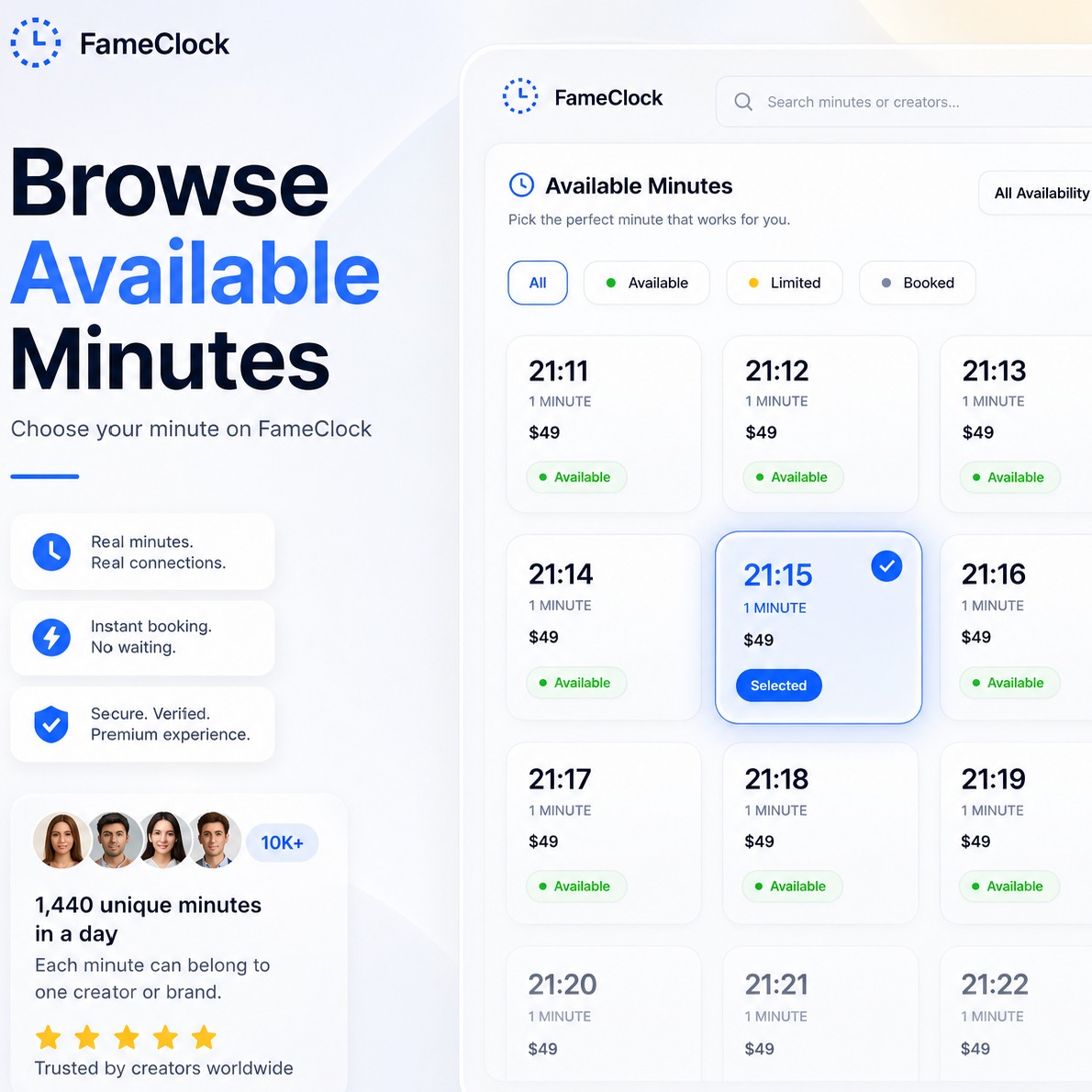
Browse available minute slots on FameClock and choose a digital space to make your own.