This study evaluated how family medicine program directors used preference signals during the 2023–2024 recruitment season, the 1st year this tool was available to family medicine programs: https://t.co/rNS51RB0YB
Post-COVID-19, some residency program interviews remained virtual, others returned to in-person, and some allow applicants to choose between a virtual or in-person interview. Concerns exist that this hybrid approach may introduce bias: https://t.co/72Fw5E0e52
Mental health stigma remains prevalent in clinical practice, affecting even family physicians. Despite serving as frontline mental health providers, family physicians also face stigma and barriers to seeking care: https://t.co/2MborXzDs4
"Will artificial intelligence (AI) replace the physician?
It is the question echoing through our clinics, our classrooms, our journals, and our news."
Now STFM Immediate Past President Steven Lin, MD, with his final President's Column: https://t.co/nWZzd7itYa
Despite being critical to maternity care access, family physicians attending births continue to decrease in number. Residency obstetric training exposure has a significant impact on whether a family physician attends births in practice: https://t.co/Wrrk0BUs8Z
CLAP ( Commit to committees, Leverage leadership opportunities, Actively engage community, Peer review) is a framework that simplifies the components of service and provides strategy for promotion.
"CLAP for Your Service" in FM Focus
D. Jason Frasca, DO, with the editorial in the May issue of Family Medicine: "The Need for Transformational Leadership in Academic Family Medicine": https://t.co/TlbbQqQhVV
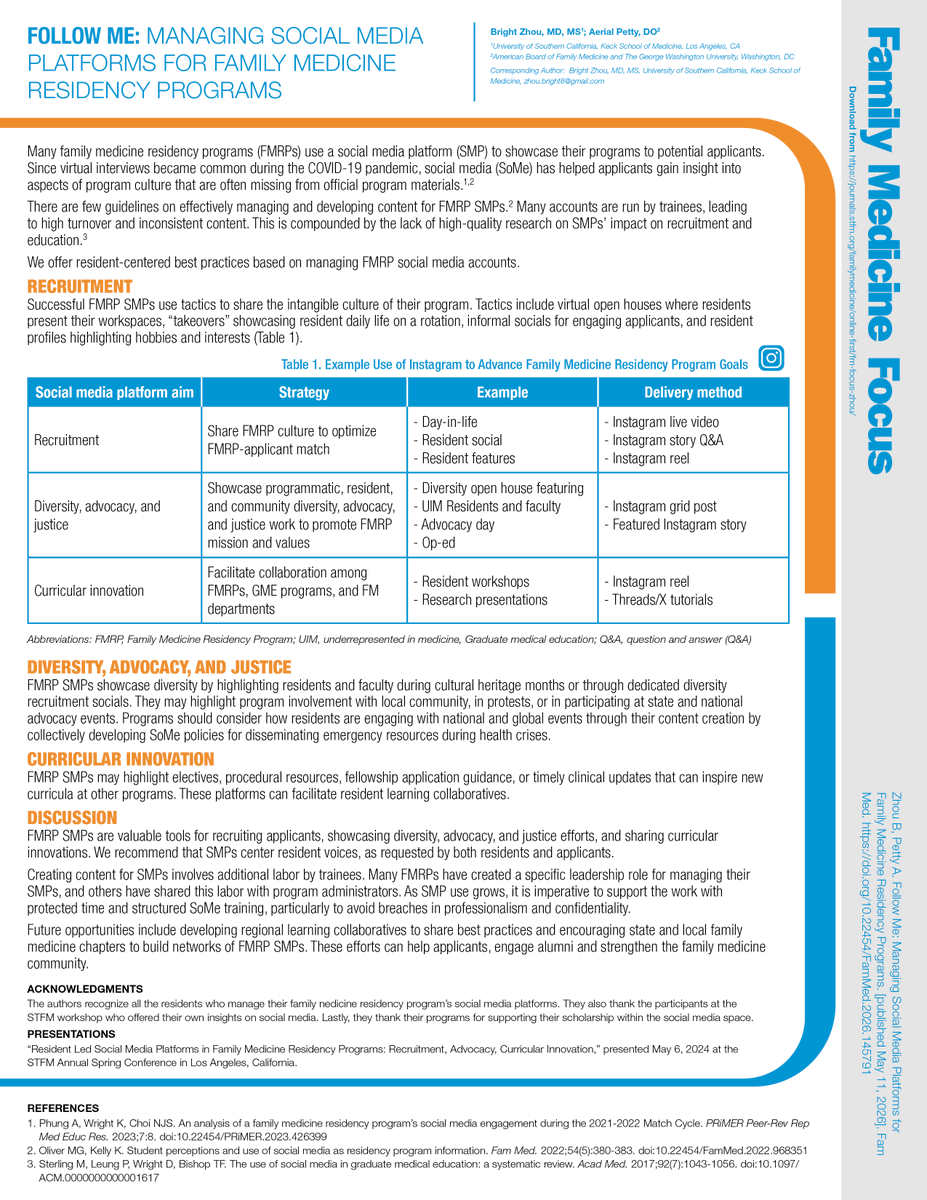
Residents are increasingly running social media accounts for their programs. Authors provide guiding strategies and call for protected time and education to take on these new skills.
From @BrightZhou https://t.co/ImskIC7JKR
"When Arthur told me he needed his nails trimmed, I was apprehensive.
'Of course I will be shut down,' I thought. 'That’s what happened last time.'"
Laurel Neufeld in the narrative essay "Pedi-Cure": https://t.co/CjSHHos09J
"Before leaving him, I would say, 'Rematch next week, this time I’m going to win,' and we’d exchange a fist bump."
Maria DelPico in the narrative essay "Cribbage, Cowboy Hats, and Connection": https://t.co/DFFefCqByT
Make sure to read the latest STFM blog series by @fammedjournal Editor in Chief Sarina Schrager, MD, and Deputy Editor Jose E Rodriguez, MD. This three-part series reviews the nuts and bolts of peer reviewing, giving you step by step guidance: https://t.co/soPMlzUM2u
"I think about how much easier it would be to hide behind systematic, analytical thought—a place where I can mow lawns, drawing clean clinical lines between my patients and me."
Natalie Snyder, MD, in the narrative essay "Ugly Cells": https://t.co/rNQaPuAHbd
In this narrative essay, the author learns through a regular patient encounter that healing isn’t always about curing; it’s about witnessing, validating, and simply being present.
"My Family Doctor: A Legacy Through One Patient’s Life": https://t.co/hQkYJ86fNf
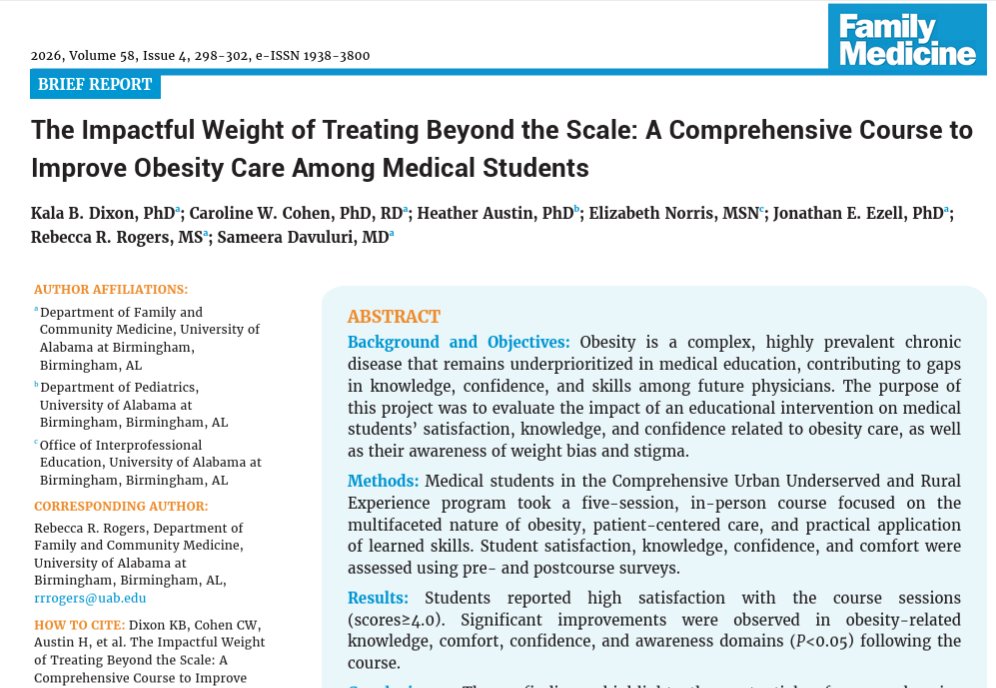
This study highlights the potential of comprehensive obesity education to improve medical students’ knowledge, confidence, and awareness related to obesity care, including weight bias and patient-centered communication.:
https://t.co/tb2uVXA3m6
A 2-week, in-person research course improved residents’ knowledge and perceived skills, highlighting the importance of such training during family medicine residency in cultivating a research culture and promoting evidence-based practice in primary care
https://t.co/hjzimTLysc
A highly interactive workshop increased the participant-reported competence and comfort with, knowledge of, and use of a novel model (ARCH-SPIKES) for giving high-stake, bad news, and complex feedback: https://t.co/feRGXAL2nS