In this second installment of our two-part series on demoralized men,
we look at the social lives of young men, including social integration and support, friendship and participation in organized groups, and family relations, especially with parents.
Next, we consider feelings of alienation and frustration, perspectives on the American Dream and their future, and reports of mental health problems and potentially traumatic experiences.
Lastly, we survey online activities, such as pornography, gaming, and gambling, and some of the trouble correlated with these.
We tell a sobering tale about the predicament a significant number of young men find themselves in. As part I notes, some young men are doing quite well, but others are struggling mightily for reasons laid out in part II.
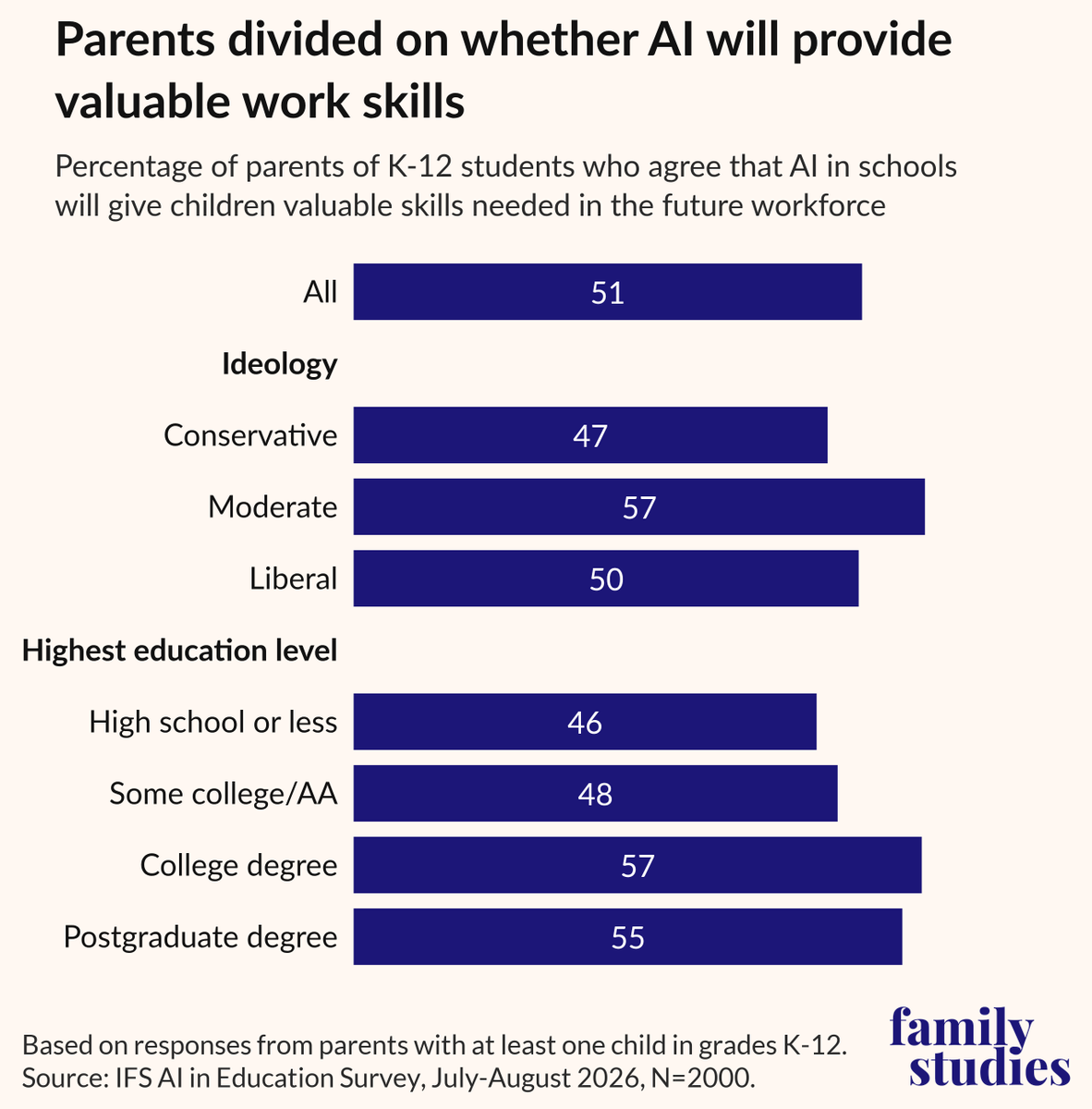
We also asked parents whether they think AI will equip children with the skills they need to enter the workforce in the future. Here, a very slim majority (51%) of parents agree.
For this question, the demographic breakdowns are much more varied. For one, there is a clear split among parents by education level.
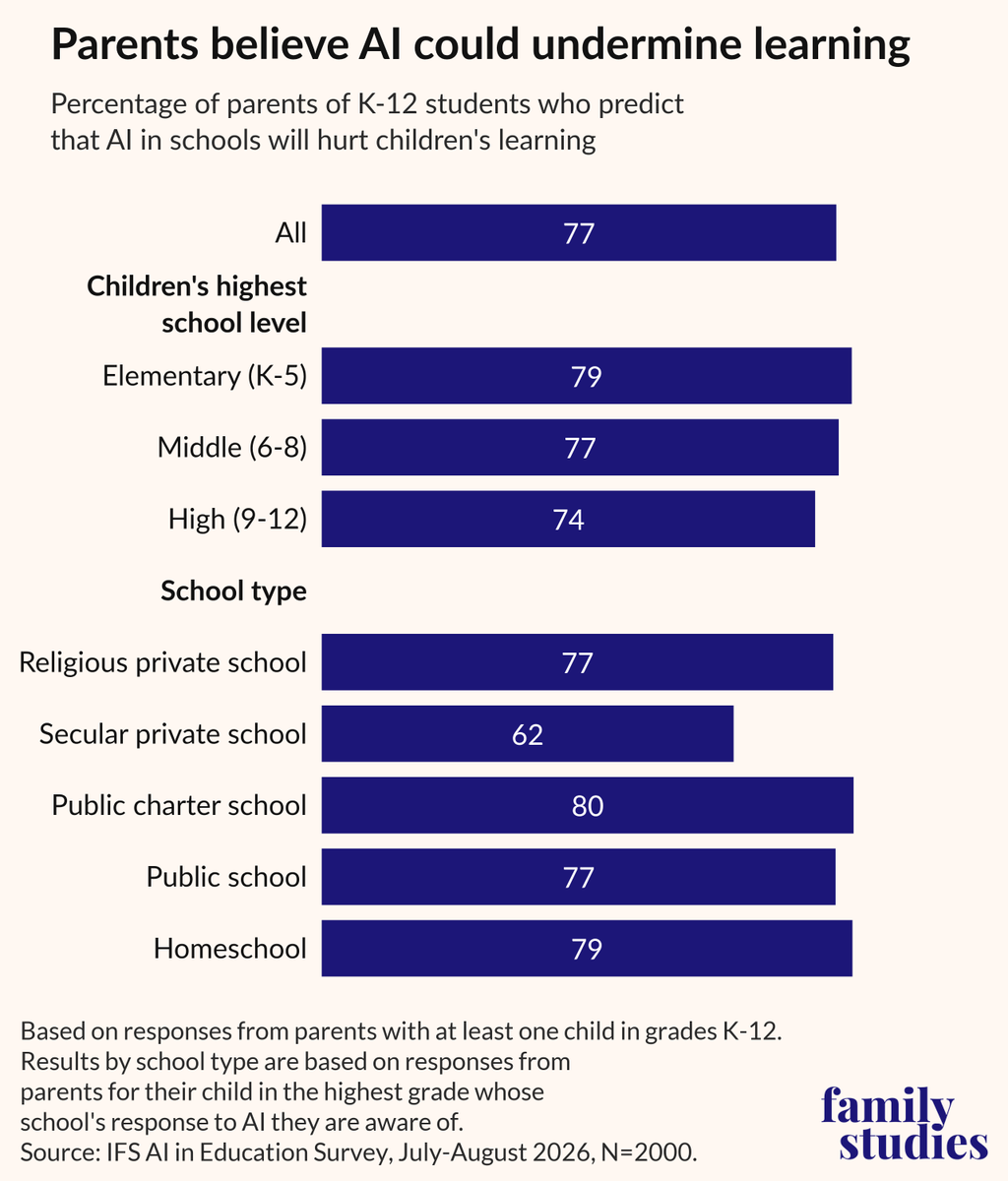
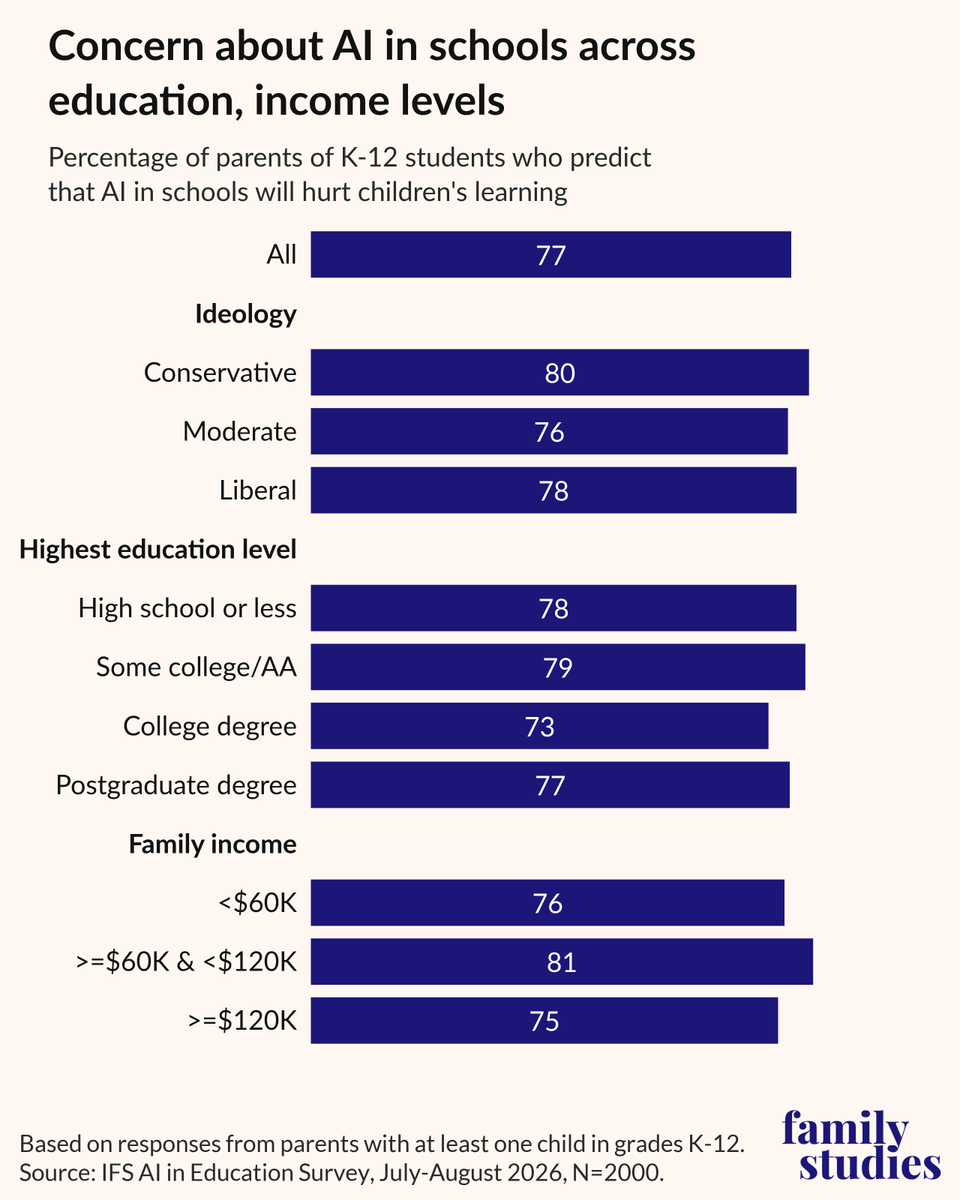
More than 3 in 4 parents (77%) strongly or somewhat agree with the statement that “AI in schools will hurt children’s learning, such as decreasing test scores, writing skills, or attention spans.”
The same is true across income, education level, and political ideology, with at least 73% of college-educated parents agreeing with the statement. For every other group in these demographics, at least 75% or more agree.
@jareddhayden@KBurchfiel3
A fraction of parents have a positive view of the AI-and-tablets classroom.
11% agree that tablets have been good for learning and that AI will only make it better.
26% of parents support tablets in education, but are concerned that AI would undermine learning.
25% agree that replacing books and handwriting with tablets and typing has been a “mistake,” and that schools should bring back books and re-emphasize handwriting.
38% prefer a re-balanced approach, where printed texts and handwriting are the primary media of education, and computers and AI are used in a restricted setting.
Religion is not the only major factor that shapes baby names, of course. Pop culture has a big effect, too, observes @lymanstoneky
In 1956, very few girls were named "Tammy." By 1959, thousands were. Why? The popular show Tammy and the Bachelor, of course, and its theme song “Tammy,” which was a #1 hit.The name faded out over time, but for two decades, it was a staple of girls’ baby names.
Likewise in 1976, the name “Jaime” surged from under 1000 births to almost 8000, probably because the movie The Bionic Woman had a heroine “Jaime Sommers.” In the 1980s, “Krystle” rose in popularity, probably driven by “Krystle Carrington” in the show Dynasty. And in the 2000s, “Keira” surged as actress Keira Knightley’s career made headlines.
It is meaningful that while episodes of major depression in youth declined from 2021 to 2024, religiosity increased over the same period.
Religious children are less likely to be anxious, depressed, or suicidal, so the increase in religiosity could partly explain the recovery of mental health.
Why is Korean fertility so low? Writing for @JoongAngDaily , @PeterRFB and I offer a simple explanation:
KPOP is destroying Korea.
https://t.co/VpS2ggp5XQ
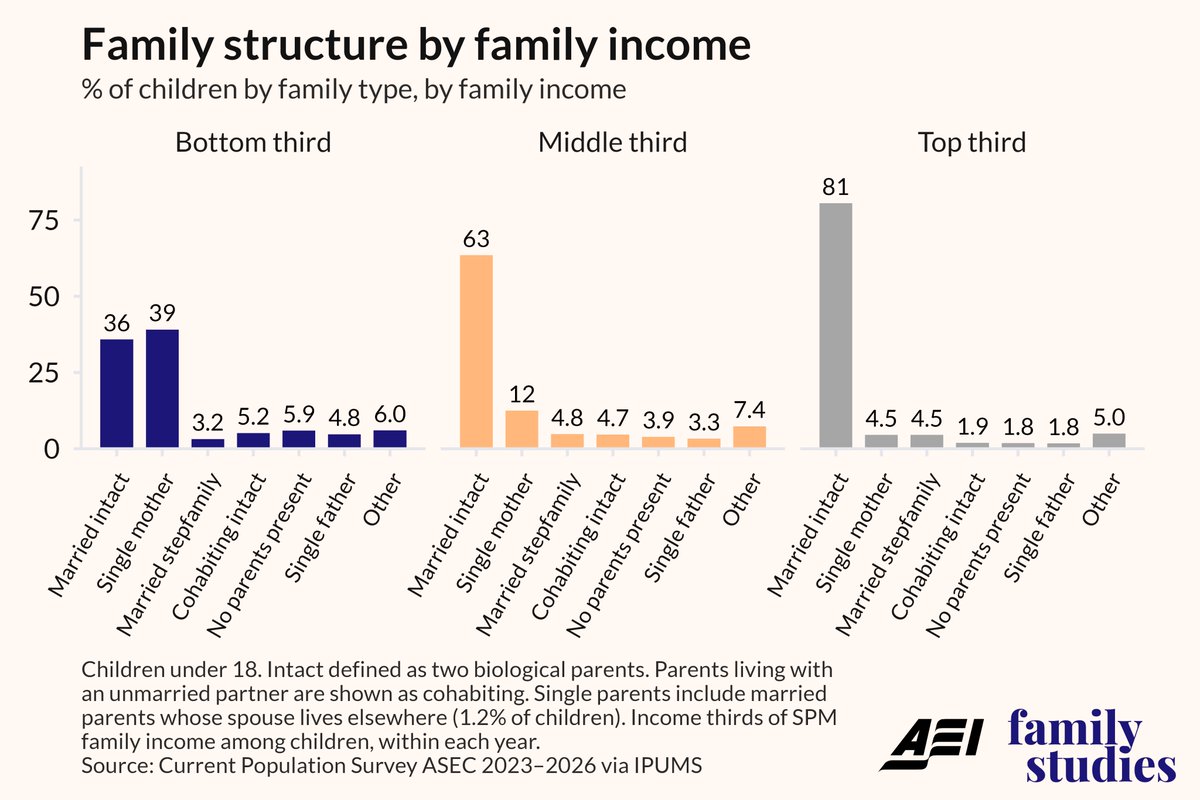
Family structure is stratified by race, ethnicity, and income in America.
36% of children in lower-income homes live in an intact, married family, compared to 63% of children in moderate-income homes, and 81% of children in high-income homes.
The "family revolution" of the last half-century is over.
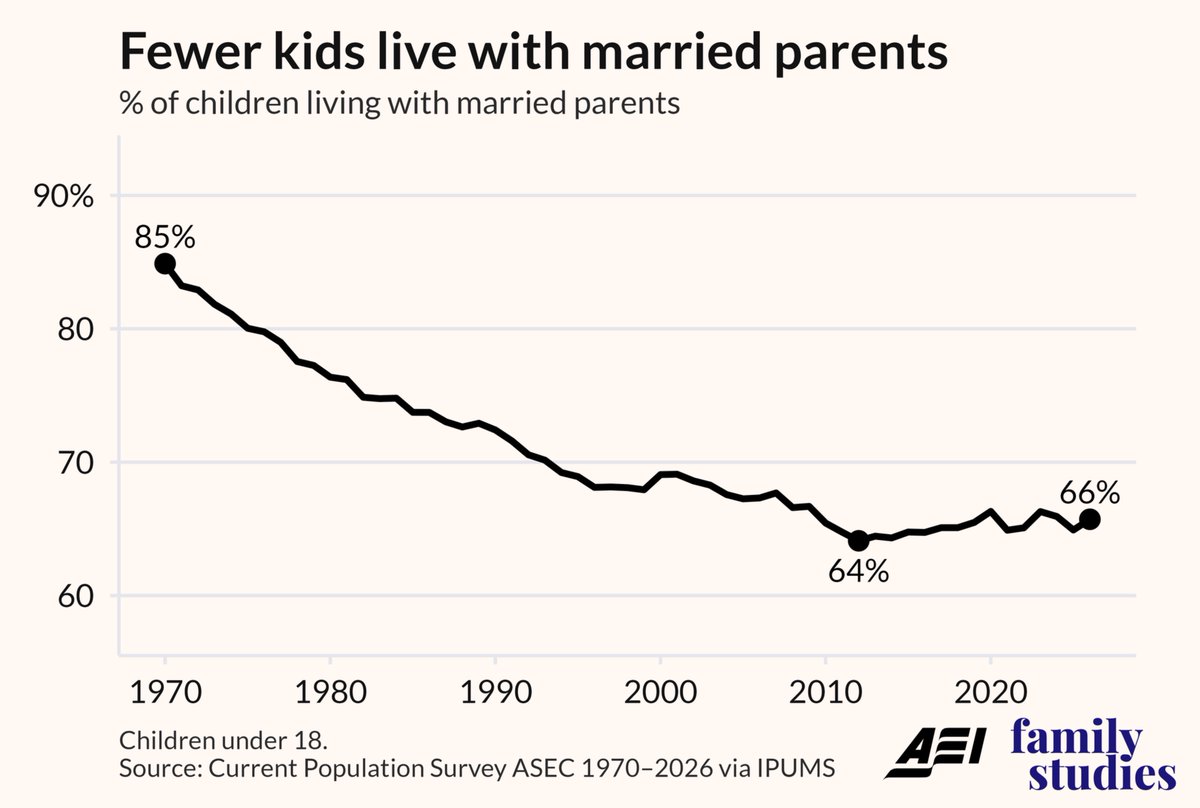
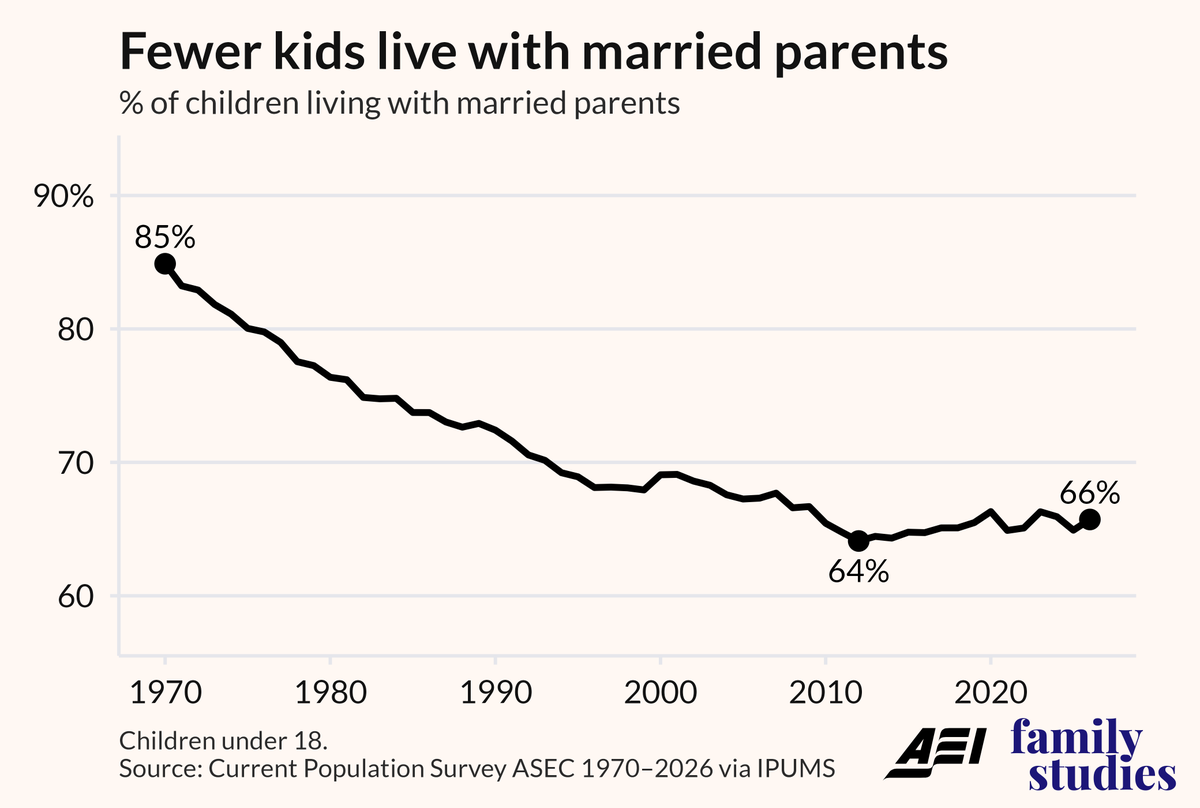
✅ Kids living w/ married parents: 64% '12 → 66% today
✅ Kids raised by their married, bio parents for their whole childhood: 51% '14 → 54% in 2024
Bottom line: most American kids are being raised in stable, married families.
As American family life has become more selective for Americans who are more intent on having children, and for those who are more religious, educated, and affluent, one consequence is that the movement away from the intact, married family for children has reversed.
The share of kids in a married-parent family bottomed out at 64% in 2012 and now stands at 66 percent. Likewise, the share in an intact, biological married family for their whole childhood rose from 51% in 2014 to 54% in 2024. The bottom line: a majority of American children are now being raised in stable, married families.
@BradWilcoxIFS@grantjbailey@IanVRowe
The decades-long retreat from married-parent families has ended.
The share of children living with married parents fell to a low of 64% in 2012 and has climbed to 66% today. Still, slightly more than 4 in 10 children will spend time outside of an intact married family, in a range of family forms.
This family instability can be as predictive of child outcomes like school failure, college graduation, depression, and incarceration as other variables that often get more attention.
In our new research brief with @AEI, "The Family-Structure Blind Spot," we explain why tracking the shape of America's families matters to both individual and community well-being.