Trump thinks he can solve a clash of ancient civilisations that started more than 2500 years ago.
The Israelis are Mesopotamians, and the Iranians are Indo-Europeans.
Abraham is explicitly from Ur of the Chaldees, which is in southern Iraq, near modern Basra. There is no meaningful genetic discontinuity between the people of ancient Mesopotamia and the people who became Canaanites who became Israelites.
Hebrew is a Semitic language. The Semitic language family originated in Mesopotamia and the Arabian Peninsula. Hebrew, Aramaic, Akkadian, Arabic, Babylonian — all branches of the same tree. Hebrew and Babylonian Akkadian are cousin languages the way Spanish and Italian are cousins. They share root words, grammatical structures, and conceptual vocabulary going back thousands of years before the Bible was written.
The foundational myths of Judaism — creation, the flood, paradise, the first man, the tower — all have direct Mesopotamian predecessors that are older. The ethical and legal framework — the covenant structure, the law codes — mirrors Mesopotamian forms. The calendar is Babylonian. The alphabet is Aramaic-Mesopotamian. The very concept of recording sacred history in written texts is a Mesopotamian invention.
El — the chief god of the early Israelites and the root of the word Elohim, one of the Hebrew names for God — was a Canaanite/Mesopotamian deity. The word Israel itself contains El. The angels, the cosmic hierarchy, the idea of a divine council — all have deep Mesopotamian roots. Early Israelite religion before the exile looks very much like a local variant of broader Mesopotamian religious culture, with Yahweh gradually absorbing the attributes of El, Baal and others into a single deity.
"Iran" comes directly from "Aryana" — land of the Aryans. The Iranians were Indo-European, not Semitic. This is the foundational distinction. Where the Semitic world — Sumerians absorbed by Akkadians, Babylonians, Canaanites, Jews, Arabs — emerged from the Fertile Crescent and Arabian Peninsula, the Iranians came from somewhere completely different.
The Iranian peoples were part of the great Indo-European migration — a population that originated on the Pontic Steppe, the grasslands north of the Black Sea and Caspian Sea, in what is now Ukraine, southern Russia and Kazakhstan. Around 2000–1500 BC these steppe peoples began expanding in all directions on horseback, carrying their languages with them. One branch went west and became the Greeks, Romans, Celts, Germans, Slavs. Another branch went south and east and split into two streams — one into India becoming the Vedic civilization, one into Iran becoming the Persians and Medes.
Old Persian, Sanskrit, Greek, Latin and all their descendants are branches of the same tree. The word for father in Persian is "pedar," in Latin "pater," in Greek "patér," in Sanskrit "pitár," in English "father." The word for god in Persian is related to the Sanskrit "deva." The Iranian god Mithra appears in Roman religion as Mithras and possibly echoes in the Vedic Mitra. These are not coincidences — they reflect a common origin perhaps 5,000 years ago on the Eurasian steppe.
The two main Iranian tribes that entered history were the Medes in the northwest and the Persians in the south. The Medes formed the first Iranian empire around 700 BC, destroying the Assyrian Empire — the superpower of its day — in alliance with the Babylonians. Then the Persians under Cyrus the Great overthrew the Medes in 550 BC and built the Achaemenid Empire.
In 651 AD the Sassanid Persian Empire — the last great pre-Islamic Persian dynasty — was destroyed by the Arab Muslim armies in one of the fastest conquests in history. Iran was Islamicized. Arabic became the language of religion and high culture. Yet something remarkable happened — unlike Egypt, like North Africa, like the Levant, which gradually became Arabized in language and identity, Iran kept its language. Persian survived. Within two centuries Iranians were writing sophisticated poetry, philosophy and science in Persian — using the Arabic script but their own language. The Persian cultural identity proved resilient enough to absorb Islam without being dissolved by it.
The Persian literary renaissance of the 9th-10th centuries produced figures like Ferdowsi, whose Shahnameh — Book of Kings — deliberately reconstructed pre-Islamic Persian identity and mythology. It was a conscious act of cultural preservation remarkably similar to what the Jewish scribes did with the Torah in Babylon. A conquered people writing their way back into existence.
So you have two civilizational streams that met in the Middle East:
The Semitic stream — out of Arabia and the Fertile Crescent, producing Sumerians, Akkadians, Babylonians, Canaanites, Jews, Arabs. Urban, agricultural, text-centered from very early, building civilization in river valleys.
The Indo-European Iranian stream — out of the Eurasian steppe, mounted, pastoral, bringing a completely different cosmology, a dualistic theology, a warrior aristocratic culture that then learned to govern sedentary civilizations from the Semitic world.
Modern Iranians are the descendants of that Indo-European Iranian stream, heavily mixed with the pre-existing Elamite and Semitic populations of the region, then further shaped by Arab Islamic conquest. Genetically they are distinct from Arabs — closer to South Asians and Europeans than to Semitic Arabs in certain markers, reflecting that ancient steppe origin. Linguistically Persian is closer to English than it is to Arabic — both are Indo-European, while Arabic is Semitic.
Which makes the current conflict between Iran and Israel — between the heirs of the Indo-European Iranian world and the heirs of the Semitic Mesopotamian-Canaanite world — in some sense a resumption of the oldest cultural fault line in the Middle East. The same two civilizational streams that first encountered each other when Cyrus walked into Babylon in 539 BC, when he freed the Jews and sent them home. Except then they were allies. And the Iranian was the liberator of the Semite.
History has a very dark sense of humor.
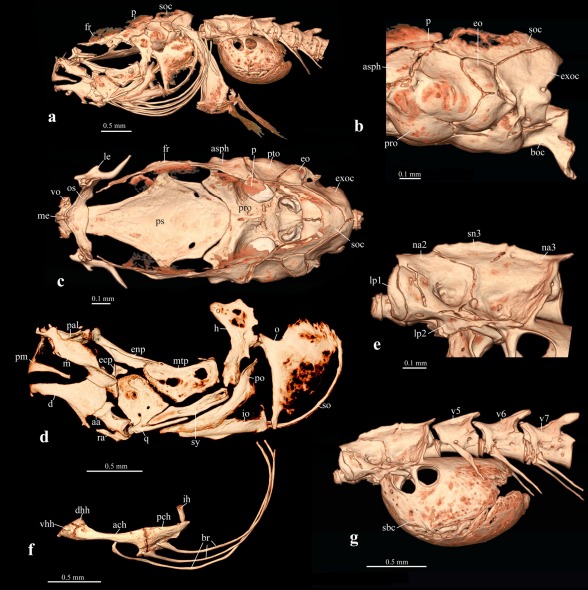
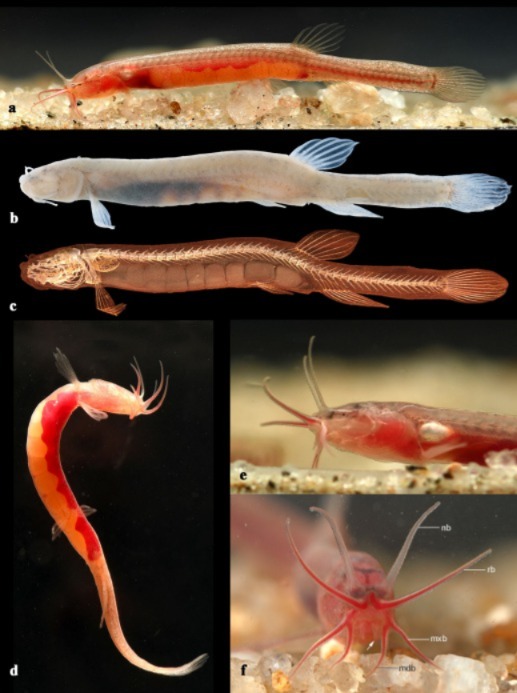
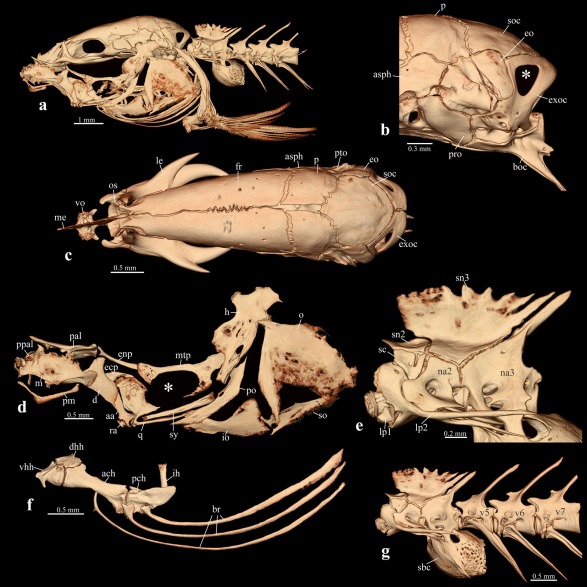
My heartfelt appreciation to the scientists of Assam Don Bosco University for the remarkable discovery of 𝐆𝐢𝐭𝐜𝐡𝐚𝐤 𝐧𝐚𝐤𝐚𝐧𝐚 — the first groundwater-dwelling fish ever recorded in Northeast India, found in Goalpara district.
Unearthed from a local well, this 2-centimeter-long, translucent red and blind “miniature marvel” is scientifically extraordinary for completely lacking a skull roof. The discovery shines a light on the rich yet hidden biodiversity of the Brahmaputra Valley and underscores the immense ecological treasures that remain to be explored.
@DonBoscoUniv
@MmhonlumoKikon He is someone the North East deserves to know better — a WWII veteran, Minister in Manipur Maharaja Govt , Ambassador, Chief Secretary, and the man who helped secure Tawang for India. Few in the region can match that legacy. Yes also the Shillong Accoprd and formation of Nagaland
Unbelievably proud 💪 We never gave up and kept pushing until the very end. Thank you @redbullracing, Honda and everyone for your support along the way!!!
@LandoNorris congratulations on your first championship. Well done mate 👏
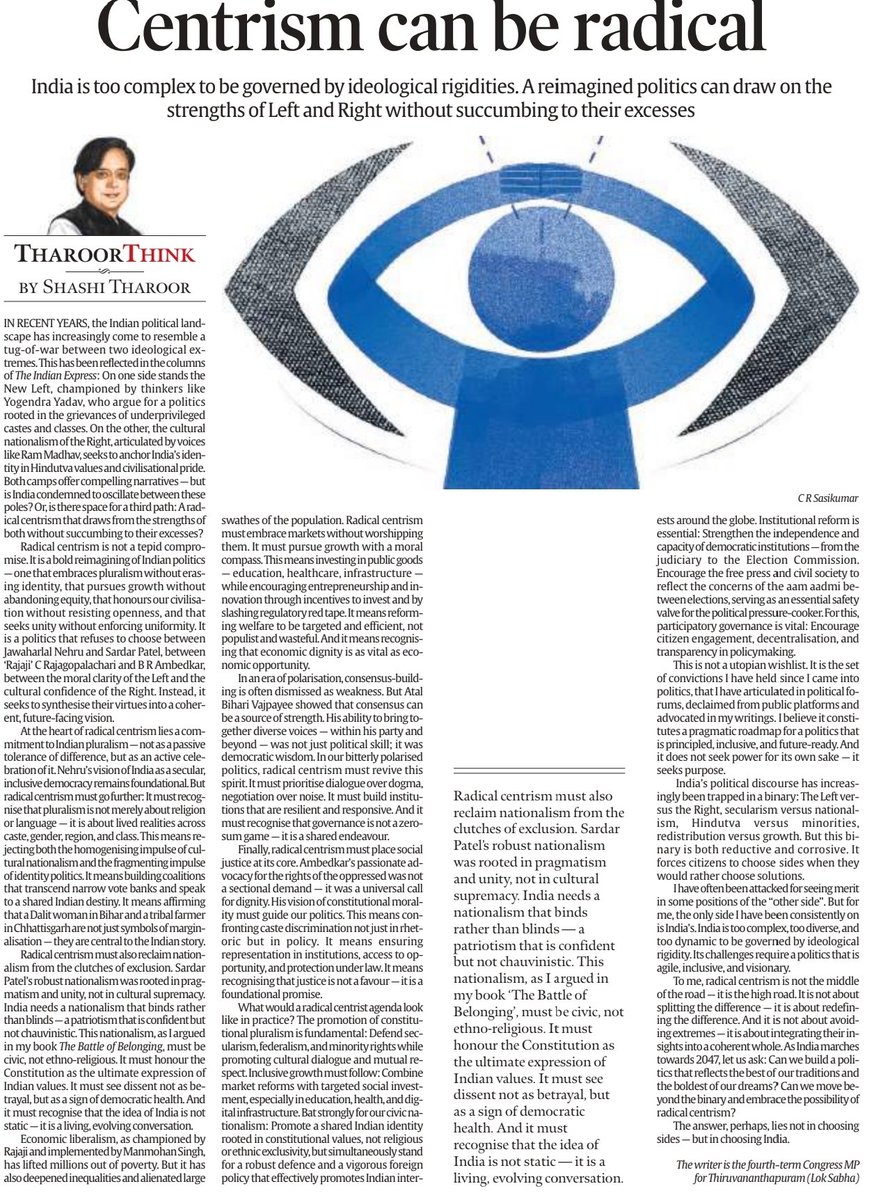
Dr. Shashi Tharoor @ShashiTharoor writes not to please the Left or pacify the Right, but to rescue Indian political imagination from binary addiction. His eloquence makes thought tactile: each phrase balances moral idealism with institutional realism.
The following 🧵 is a UPSC-grade crystallization of his essay “Centrism Can Be Radical”—distilled to the densest clarity possible. 🌿✨ #TharoorThink #PoliticalPhilosophy
CORE THESIS 🧭 #RadicalCentrism #UPSCReady
India’s diversity defies ideological absolutism. A reimagined centrism—neither timid neutrality nor opportunistic middle-path—can draw moral energy from both Left and Right while rejecting their excesses. 🕊️
🌿 #RadicalCentrism #EthicalGovernance #PluralDemocracy #UPSC #PSIR #GoodPolitics #DemocraticRenewal