https://t.co/E7l4IxK2ij
Few people outside East Asia may have noticed it, but on February 4, during a phone call between the leaders of China and the United States, President Xi paraphrased a saying attributed to a man who lived 1,800 years ago.
"It is always right to do a good thing, however small, and always wrong to do a bad thing, however small."
Liu Bei (刘备) is a household name across much of East Asia. 1,800 years ago, in the chaotic final years of the Han dynasty (202BC-220AD), this impoverished collateral member of the imperial family began his life weaving straw sandals and mats. Starting from extreme disadvantages, he rose in a near-miraculous way to govern today's southwest China as a highly respected ruler.
Countless figures regarded, both then and later, as among the greatest strategists and military leaders in Chinese history were willing to serve him. Among them were Guan Yu (关羽), revered as the "God of War" in Chinese culture, and Zhuge Liang (诸葛亮), widely seen as the embodiment of Chinese wisdom.
I have introduced Liu Bei in previous posts, which I will also link in the comments section.
What, then, was Liu Bei's secret recipe?
In my view, beyond the widely recorded accounts in historical chronicles and classical novels that describe his extraordinary benevolence and generosity toward others, the key also lies in this final message he left to his son as he was departing this world. It was a calm reflection on a lifetime of experience and observation.
Major failures are rarely the result of a single mistake. More often, they are built from the accumulation of countless small wrongs. Conversely, the value of good deeds does not lie in their scale, but in their visible consistency over time. Such consistency allows trust capital to accumulate and creates predictability.
A brief contrast with other major figures of the era helps explain why:
Cao Cao (曹操): ruthless in employing talent, and equally ruthless in purges
Sun Quan (孙权): persistent tensions between his ruling clan and meritorious officials
Liu Biao (刘表) and Lv Bu (吕��): indecisive, and prone to betrayal
Returning to 2026, for China-US relations to navigate through turbulent waters, what may matter is which side is more willing or if both sides are willing to let credibility serve as its compass, and to accumulate mutual trust through careful attention to detail.
After Liu Bei's death, he was buried in the southern part of Chengdu in southwest China's Sichuan province. Over the following eleven years, Chancellor Zhuge Liang devoted himself wholeheartedly to assisting Liu Bei's son, launching multiple northern expeditions in an attempt to restore the Han dynasty's mandate.
In 234 AD, exhausted by years of overwork, Zhuge Liang passed away in what is now Shaanxi province in northwest China. As time passed, the memorial shrine dedicated to him in Chengdu was combined with Liu Bei's mausoleum, forming what is known today as the Wuhou Shrine (武侯祠).
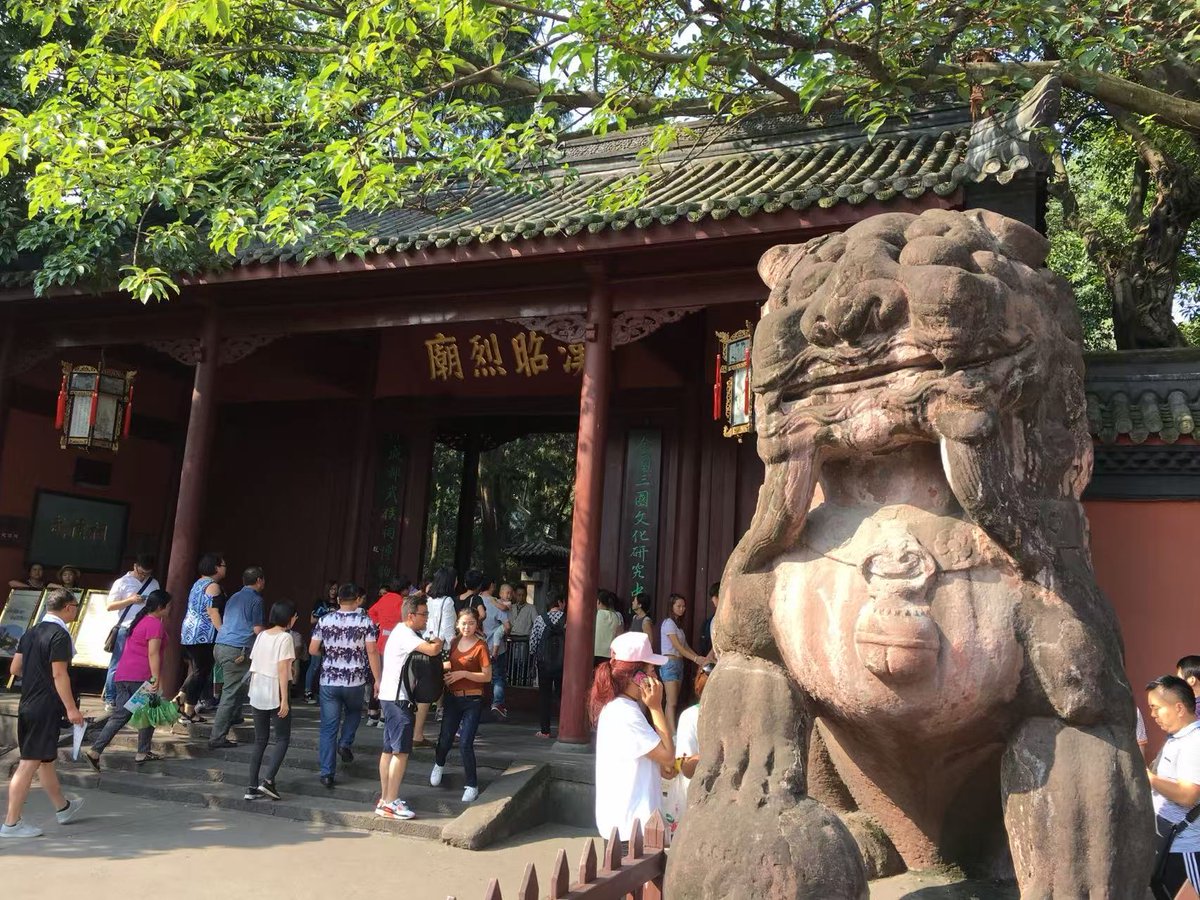
As a historian, I had long hoped to visit this site. In October 2016, during China's National Day holiday, I finally fulfilled that wish. After arriving in Chengdu, I went straight there from the airport.
Top left is the main entrance to the Wuhou Shrine.
Top right is the hall dedicated to Liu Bei, with his statue visible in the distance.
Bottom left shows my favorite alley within the complex, lined with dense bamboo groves. Behind the wall on the left lies Liu Bei’s tomb. Over the past 1,800 years, Chengdu has experienced numerous wars, and most major ancient tombs were looted at some point. Yet it is said that grave robbers across generations shared an unspoken understanding: Liu Bei's tomb, given his widely admired reputation, was not to be touched.
Bottom right is Jinli/Brocade Street (锦里), located right next to Liu Bei's tomb and Zhuge Liang's shrine. Chengdu has long been famous for producing finely patterned brocade, and Jinli was already a bustling commercial street selling silk textiles during the Han dynasty. Today it remains lively and vibrant.
There, I came across a cartoon depiction of Zhuge Liang. Standing to his left was Zhou Yu (���瑜), the chief strategist of the Wu. Six years older than Zhuge Liang, Zhou Yu also led a legendary life. At just twenty years old, he crossed the Yangtze River alongside Sun Ce (孙策), the founder of Wu, who was his contemporary, and gradually secured control over southeastern China. Together, they also won the hearts of the two sisters known as the Greater and Younger Qiao, widely regarded as the most beautiful women of their time.
In 200 AD, Sun Ce was assassinated at the age of twenty-five. Zhou Yu continued to assist Sun Ce's younger brother, Sun Quan (孙权), helping him consolidate power. In 208 AD, Cao Cao attempted to push south of the Yangtze River to unify China, claiming to command nearly one million troops, at a time when China's total population may have been only around twenty million. Liu Bei and Sun Quan chose to cooperate, and under the joint command of Zhou Yu and Zhuge Liang, a force of forty to fifty thousand defeated Cao Cao's army, more than ten times larger, along the Yangtze River, securing what is China's Trojan War: the Battle of Red Cliffs (��壁之战).
In the Romance of the Three Kingdoms, Zhou Yu and Zhuge Liang are portrayed as having a tense relationship. Zhou Yu's lament-"If Heaven created Yu, why did it also create Liang?"-became one of the novel's most famous lines. Two evenly matched rivals, they sharpened each other's brilliance, even as they competed.
In the era of Liu Bei and Zhuge Liang, ultimate victory was not determined solely by any single decisive battle, but by who could better reassure allies, remain predictable to adversaries, and inspire followers to entrust their future to them.
The same is true in today's global landscape. Credibility, restraint, and predictability may ultimately prove closer to a true stabilizing force than any short-term advantage.