Today we release LFM2.5-2.6B, an agentic model that runs entirely on-device. It plans, calls tools, and works through multi-step tasks on phones, laptops, PCs, and robots. Data never leaves the device, and the marginal cost of each run is essentially zero.
> Pre-trained on ~34T tokens
> LFM2.5 flagship hybrid architecture
> Context length: 128K
> Vocab size: 128K
> balanced intelligence per watt
> customizable on a single GPU for any specialized task
> LFM2 open-weight license
Comparable or better scores compared to models up to nearly 4x its size:
> ToolSandbox 77.83, ahead of Qwen3.5-9B at 76.44
> Multi-IF 80.07, ahead of Gemma-4-E4B-it at 77.35
> IFStruct 85.49, ahead of Qwen3.5-9B at 78.50
🧵
In strong support of open-weight AI and American AI leadership, we are proud contributors to the open-source community and excited to announce that Liquid Foundation Models (LFMs) have surpassed 40 million downloads by the community!
Going forward, we remain committed to accelerating the open-weight release of the next generation of lightweight, powerful LFMs to the world. excited to see what you build with them!
https://t.co/vUaEPzXSeJ
Today we release Antidoom, an open-source method that removes a common failure mode in reasoning models: the doom loop.
Doom-loop rates before and after, with eval scores up across the board:
> Early LFM2.5-2.6B checkpoint: 10.2% → 1.4%
> Qwen3.5-4B: 22.9% → 1% (greedy sampling)
🧵
Meet Liquid ShieldFlow.
An on-device privacy layer powered by a device-native Liquid Foundation Model, Liquid ShieldFlow redacts sensitive data before it ever leaves your machine. No GPU needed and light on memory. It runs on almost any PC, locally, in real time.
ShieldFlow was featured yesterday at @Microsoft Build for Foundry Local. It also ran live on @AMD laptops at @computex_taipei.
Request your early access here to ShieldFlow here: https://t.co/wU2ZPECvQx
A human genome is billions of base pairs. You can't use one as model context unless the model is efficient enough to handle it. Our CTO Mathias Lechner, @mlech26l, sits down with co-founder and Chief Science Officer Alexander Amini, @xanamini, on what it takes to build foundation models for biology.
Introducing LFM2.5-230M: our smallest model yet, built to run fast anywhere (CPUs, NPUs, and GPUs) to enable agentic tasks on phones, robots, home and network automation devices.
> 230M parameters, built on the LFM2 architecture
> Pre-trained on 19T tokens, with a 32K context extension
> Post-trained with distillation from LFM2.5-350M
> 213 tok/s decode speed on Galaxy S25 Ultra (CPU)
> 42 tok/s on a Raspberry Pi 5 (CPU)
> Competes with and often beats models more than twice its size on instruction following, data extraction, and tool use.
> use it for large-scale data extraction pipelines or lightweight on-device agentic workloads.
🧵
I recently switched from Qwen 3.5 9B to LFM2.5-8B-A1B by @liquidai, and it's quickly become my default local model in Hermes Agent Desktop.
For agentic tasks, it's one of the strongest local models I've used so far. It's surprisingly fast, reliable, and works really well with tools.
Coding is still where it struggles the most.
Other than that, it's been consistently solid and easily one of my favorite local models right now.
Best models for your hardware this week.
8-12GB
- https://t.co/5SYi6D56FR incredible model, so fast, so small
16-32GB
- latest Google model, Gemma 12B: https://t.co/TLm2x2l3lk really solid performance up neck and neck with a model 2x its size from a month ago.
Jetbrains new model, best in class on livecode bench
32-96gb
- Nex-N2-Mini GPT style postrain of Qwen-35B it seems to be its class leader caveman style reasoning https://t.co/EL1ePzwI58
- Jackrong’s Qwopus is the #1 overall Q4 of Qwen3.6-27B on our benchmark suite of 5 agent + coding benchmarks (1200 samples total) https://t.co/P1gypZwufi
192gb
- Step-3.7-Flash is hard to beat, high scores, really fast inference, vision capable, later cutoff dates https://t.co/oaVf5wMILx
384gb
- Nex-N2-Pro GPT style post train of Qwen-3.5-397B incredibly strong and #1 on deepswe if their claims are right https://t.co/LsGXZRl6nh
768gb
- very promising post-train of GLM-5.1 that wins out on 8 benchmarks https://t.co/25KElLHEos
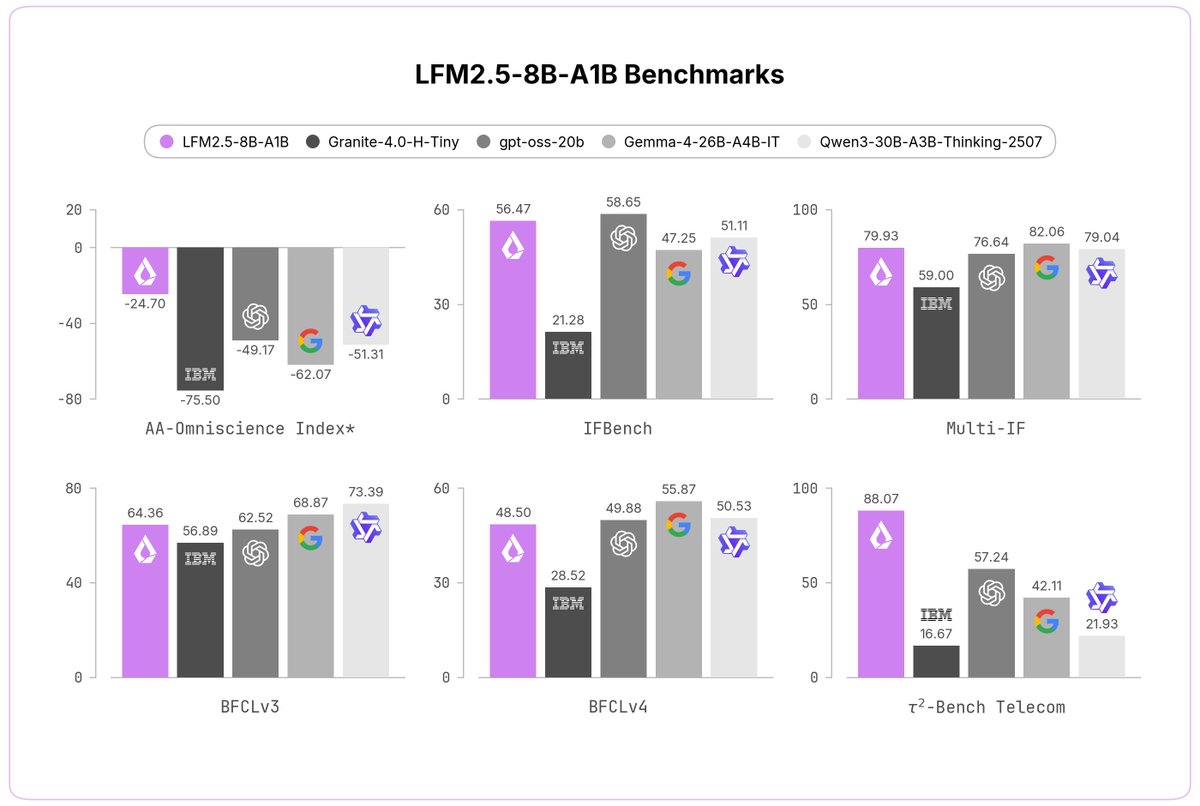
Today, we're releasing LFM2.5-8B-A1B, a device-optimized model designed to power real-life applications on phones, laptops, PCs, robots, and fast & lightweight server-side use-cases.
> 8B MoE, 1.5B active
> Expanded 128K context
> LFM2.5 flagship hybrid MoE architecture
> Trained on 38T tokens + large-scale RL
> fast, reliable tool calling, punching above its weight, comparable to models with up to 4x its size
> customizable on a single GPU for any specialized task
> LFM2 open-weight license
🧵
LFM2:3B in space, on Cluster Gate2: ✨
“This image is a highly detailed, close-up view of Earth as seen from space, likely captured by a satellite or space telescope. The Earth is depicted as a large, circular sphere with a predominantly blue hue, indicating the vast oceans that cover most of its surface. The blue is interspersed with swirling white clouds, which are particularly prominent over the landmasses, suggesting the presence of weather systems and atmospheric activity.
The overall composition of the image highlights the beauty and complexity of our planet, showcasing the dynamic interplay between the oceans, atmosphere, and landmasses."
Congratulations to @DPhiSpace for this incredible milestone! 🌎
Proud to partner with @MercedesBenz in a multi-year agreement to bring embedded, on-device intelligence to Mercedes-Benz vehicles, first in North America. This marks an important step toward making in-car AI more capable, more responsive, and more useful in everyday driving.
At @liquidai, we believe the future of intelligence in the physical world depends on models that are fast, private, efficient, and able to run directly on the hardware already inside the system.
In the vehicle, that means advancing speech, language understanding, and reasoning enabling more natural and robust conversational experiences for drivers and passengers.
The software-defined vehicle is one of the most consequential real-world deployments of AI, and Mercedes-Benz has approached it with exactly the rigor this challenge deserves.
Proud of what our teams are building together, and excited for the road ahead as we work toward production deployment in the second half of 2026.
https://t.co/AlPkjxMD3B
In the US, the average person spends >5 YEARS (!) of their lifetime sitting behind the wheel of a vehicle. If you include time spent as a passenger, that estimate easily doubles.
I'm very proud of this partnership with @MercedesBenz — together we will be making in-car AI more capable, more responsive, and more useful to everyone.
A truly AI-native vehicle is the perfect embodiment capturing the worldwide impact of massively multimodal on-device AI.
We’re entering a multi-year partnership with @MercedesBenz to scale embedded, on-device intelligence for their third- and fourth-generation MBUX.
Our goal: to make the driver/vehicle relationship even more natural and effortless.
Read more about our partnership: https://t.co/Glpu87KuJs
Today, we release LFM2.5-VL-450M, a vision-language model built for real-time reasoning on edge devices.
It processes a 512×512 image and returns structured outputs in ~240ms on-device.