“You either die a hero, or you live long enough to see yourself become the villain.”
I was rewatching “The Dark Knight”, yet again. It made me wonder, again, about the world we live in. It makes me question why the Joker believes that Batman completes him and that they are destined to do this forever.
This is where Schelling’s notion of “indifference” becomes relevant. For Schelling, indifference is when two opposite things have not yet become separate. He explains evil from how freedom arises from the dark ground, and that freedom is not necessarily rational in humans. This is why it can determine the direction of one’s own being.
Thus, this leads to the conclusion that good and evil are not simply two external forces confronting one another, they arise from the depths of freedom itself. Good and evil are therefore not separated.
Perhaps this is what makes the relationship between Batman and the Joker interesting. They are opposites, but they are also strangely dependent upon one another. The Joker needs Batman to give his chaos meaning, while Batman needs the Joker to give his morality meaning. And perhaps that is what the Joker means when he says that they are destined to do this forever.
But if Schelling is right, the more frightening question is not whether Batman can remain the hero forever, nor whether the potential for the villain was already present within him, but whether, at the level of the Absolute, the distinction between hero and villain is itself still undifferentiated.
Awakening
I was reading something about Arthur who became the Joker. It discussed how he spent his life enduring mockery, bullying, and insults, and how these repetitive encounters eventually contributed to his transformation.
It made me wonder whether we need other people’s consent in order to feel valued.
A final answer to this might be difficult.
A no would be linked to the idea that we are born free. What is value? And what sets its standard in the first place?
A yes emerges from the fact that we certainly need the Other in our lives. But not simply to make us hear what we want to hear, or to confirm the image we have constructed of ourselves. The Other can instead become a way of listening to what existence itself is trying to unfold.
And there is something quite funny about this. Individualists might interpret the actions and judgments of others as barriers to their liberty, as if freedom means protecting the self from whatever comes from outside. While relationalist might understand liberty as revealing oneself without predetermined limits, through and with the Other.
I guess I am biased toward the second idea. Yet perhaps what lies beyond both positions is existence itself. Our opinions, after all, do not really matter, do they?
Finally, if I were to answer whether a person changes because of environmental factors, my answer would simply be that it depends on the level of openness.
How open are we toward existence? How much are we willing to let what happens to us speak?
Heidegger spent much of his philosophy trying to articulate what openness to being is. Perhaps the language of existence was revealed through his words. Not because he has the final answer, but because he taught us how to listen.
Terrible Individualism
There is a difference between meeting someone and truly communicating with them. Meeting is the shallow aspect… We sit together, exchange ideas, and perhaps discover common grounds. But communication? It never depends on meeting. It is what creates a true bond with the other.
Now when thinking more deeply about this bond, it exists in the space between intention and action. We never have direct access to another person’s intentions, so we usually judge them through what they actually do. At the same time, and paradoxically, when they act, we still question their hidden intention. So we withdraw into isolation.
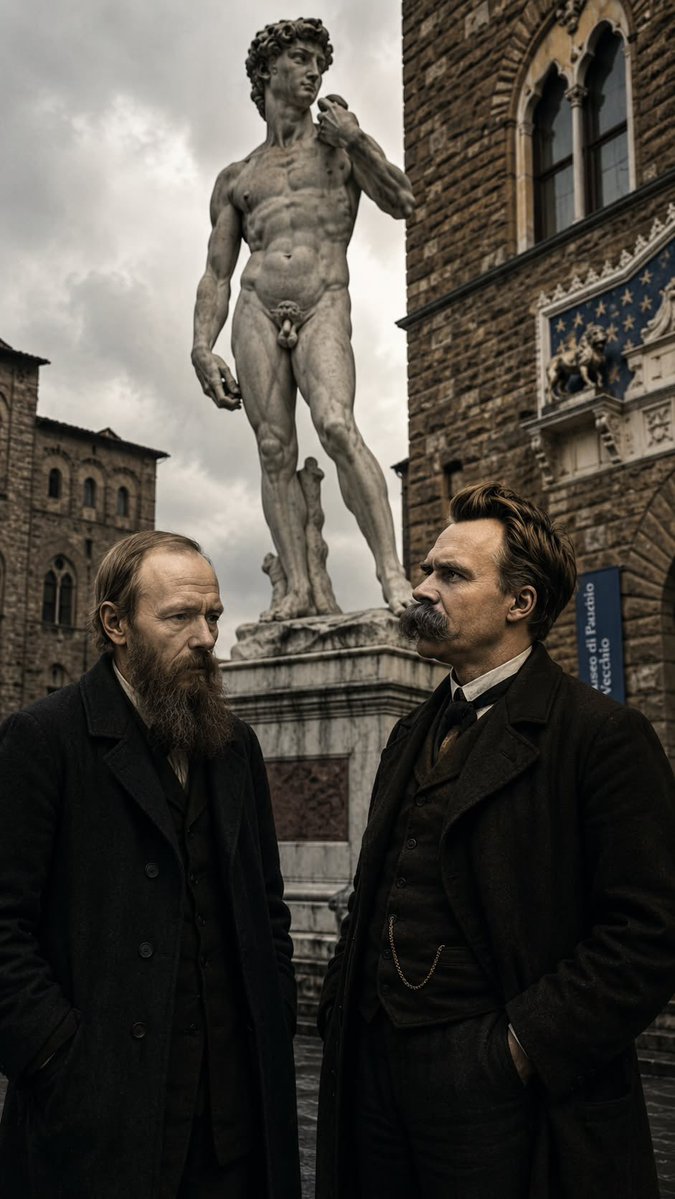
This reminds me of Dostoevsky’s The Brothers Karamazov. He writes about the terrible isolation of modern individuals, each one retreating into himself and becoming increasingly separated from others. He even defines separation as “unnatural”. Every person strives in his madness to keep his individuality as separate as possible, and wishes to secure the greatest fullness of life. But instead, all his efforts lead to self-destruction as he cuts himself off from the whole.
Perhaps Dostoevsky’s idea of separation discusses the deep problem which is the failure of communication…
Maybe this is what he means when he says that this terrible individualism must inevitably have an end.
@laylouthaa اعظم الفلاسفة كانوا فقراء وفي الخفاء أمثال سينيكا و سبينوزا وعاشوا على كفاف القوت.. الأفكار لا تنظر إلى الرأسمال إذ هو ليس شرط توليدها
ولعل الفقر يمكنه ان يكون مساعد لإنتاج الأفكار
Meaning
I was reading some of the Derrida-Searle debate, and it is quite interesting how it exposes two different ways of thinking about what language is.
I was especially drawn to Derrida’s refusal of the idea that language can be understood primarily through clear, stable intentions and “normal” uses. He insisted that irony, jokes, literature, fiction, unconscious intentions, and the possibility of taking words out of their original context reveal something important about language.
What interested me most is that Derrida is not simply saying that language can be ambiguous. He is questioning whether language itself depends on the fact that we can never completely control how other people understand or interpret our words.
I was also really interested in Derrida’s idea of “repeatability.” It is the idea that words and sentences can be repeated and still function even when the original speaker is no longer present to explain what they meant. He particularly explores this through writing, since writing can continue to communicate even when the writer is absent.
This means that language can exist beyond the speaker’s original intention, making meaning less fixed and less completely controlled by the person who speaks.
What makes the debate even more fascinating is the tension between Derrida’s deliberately playful and literary style and Searle’s insistence on clarity, explicit intention, and philosophical precision.
In a strange way, their disagreement seems to perform the very problem they are arguing about.
Wittgenstein suggested the impossibility of having a universal “absolute” language, because meaning is not some essence with a fixed and limited nature.
And this leads me to a question that keeps returning to me… Can we really open ourselves to the being that gives language its meaning?
The hunt goes on…
I was reading The Hunting Gun novel, and it made me wonder what “hunting” really means. I came to the conclusion that to hunt is to pursue something that can never be completely captured… Like another person, a truth, or even oneself.
This reminded me of the anime ‘Hunter × Hunter” and its idea of the Hunters. Hunters are basically people who choose a life defined by pursuit, not to possess objects, but to find purpose and meaning in their existence.
A Hunter is someone who refuses to accept any form of limits. He hunts the infinite human potential. Yes, human potential is infinite. Ideas are infinite. What is more beautiful than hunting infinity?
Perhaps the most profound thing one can hunt is freedom. What makes this worthwhile it that freedom is not a destination we eventually arrive at. The moment we think that we captured it… It tends to escape. It ceases to be free. And the hunt goes on.
Like water flowing
A dear friend recently shared a very interesting idea… It completely changed how I perceive Nietzsche’s eternal recurrence.
I always understood it as something we have to change… And if we don’t, we would not be evolving. In fact, we would be limiting ourselves instead of living in a state of openness.
But then there is amor fati…
Amor fati is the bright side of eternal recurrence. It might sound simple to love our fate… But giving it deeper thought, can we really accept that we might have to live this exact life, with all its mistakes, suffering, disappointments, and limitations, over and over again?
Embracing eternal recurrence means “wanting” to repeat our life as it is. To be the same person, make the same choices, experience the same joys and losses, carry the same wounds, think the same thoughts, and endure the same pain infinitely.
And perhaps this is where amor fati as eternal recurrence becomes ontological. Through accepting Being itself… And perhaps this is the deepest form of freedom.
To be really free is to affirm Being as it is. To will it… To love it… Even when nothing within it can be changed… Like water flowing without resistance…
Something New
Ideas are very strange…
In Plato’s dilemma of “The one and the Many”, Socrates happens to mention that Zeno was putting all his effort into convincing us that his argument was entirely new, when in fact, he was only repeating Parmenides’ idea. Parmenides was proving the One, while Zeno was denying the Many.
Now regardless of its validity… It is quite fascinating how ideas emerge throughout history. They appear to be taking the form of evolution. One thought appears to follow another in the form of affirmation, transformation, or even contradiction.
But… This leaves us with a question. Does something constant exist within the evolution of ideas? And if such a constant exists, would it not lead us toward a completely different paradigm? A paradigm where repetition is not opposed to difference? Can repetition be a way where difference actually emerges?
Deleuze gives us a concrete way of perceiving this. His Difference and Repetition shows that repetition doesn’t necessarily mean the reproduction of an identical thing, but can produce difference.
Perhaps ideas do not “simply” evolve.
Perhaps they repeat…
And perhaps repetition is exactly why they change…
The One has astonishing ways of revealing itself through ideas, from entirely different angles. All these different productions may appear to be separate, even contradictory… But in fact, they may be repetitions of the “One” that does not itself remain identical. The “One” that encompasses everything.
And this is where the strange relationship between the One and the Many returns…
Space Bound
I was surfing my X when I crossed into that phrase: "We are all searching for someone who understands us”. It is such a quest indeed to find someone who understands us. Why? Because it is actually conditioned for people who are beyond the matrix. People who explicitly chose the red pill over the blue one.
These rare few are the only ones capable of erupting the desire to discuss personal narrative, fears, contradictions, passion, dreams, pain, ideas, shallowness, and the endless negotiations with life.
These rare few are able to approve you and then criticize you, break your ideas and then repair them, make you lose yourself and then lift you up like you never imagined before.
These rare few are the ones with all kinds of stories you can’t get enough of. The horizons they found, borders they crossed, journeys they have been through. You just can’t help falling deeply for their mesmerizing strange ways. Without a limit.
These rare few are the only ones who know the meaning of a “philosopher’s astonishment”, the meaning of openness to existence, and the true meaning of the Heideggerian listening.
These rare few are the ones who make you write with spontaneity, produce with affect, and feel with honesty. Perhaps they are Nietzsche’s people who were seen dancing and thought to be insane by the ones who couldn’t hear the music…
They are the space-bound people
Dreamers
Today I was thinking about the arts of production. This quiet arts that allows us to produce meaning.
The art of dialogue is arguably the most interesting. Hegel’s dialectic teaches us that a thing cannot be fully understood in isolation from what contradicts it. Dialect moves from a determination, to its negation, finally towards a richer determination.
However, every person has a logic that precedes them. We always approach the other with a “preponderance” toward what we already know. It can be quite difficult to surround an idea we believe in from different points of entry and to refuse a single point of entry.
But the best dialogues happen when we are able to affirm what we believe in, negate its opposite, and be open for the production of something more complex. This is close to what Parmenides teaches the youthful Socrates in the dilemma of the One and the Many. This means not allowing thoughts to settle too quickly on a single determination.
But this leads me to a question.
Can we change our angle of entry? Can a person governed by logic have a new more affective point of entry? Or can a person learn a different “language” of thought?
I think this is the real art. It is not in escaping our logic, but becoming capable of not being limited by it. It is indeed fascinating how multiplicity always has a way of finding the unity. The purpose. The one.
This where philosophy begins, and where philosophers become the rare “dreamers” who truly exist.
Breaking the Habit
There is an unusual way in which we can become imprisoned without ever realizing it. This imprisonment reveals itself in the form of habits. Falling into habits is the moment we stop questioning, lose curiosity, and seek the same distractions. It is the imprisonment of our own mind.
This kind of imprisonment makes me laugh. Our lives are a lifelong call for freedom. We are creatures in love with being free. Freedom itself is the purpose. When we understand this, we stop waiting for life to entertain us because we discover that a free mind can find meaning everywhere.
However, freedom does not mean following every desire. We can become slaves to our desires just as easily as we can become slaves to our fears. The true freedom is that of the mind. The Tao might have given us a way to understand it. It is when we move without forcing, when we let go without becoming passive, and when we allow life to unfold without needing to control every moment. It is the effortless action where the mind does not fight reality.
Perhaps, the meaning is freedom itself. It had always been. And maybe Nietzsche’s Amor Fati belongs here too. It is not a passive acceptance of whatever happens, but actually to love fate is to become free from the endless negotiation with reality.
Now you see me
The easiest way out is to believe that nobody can ever be completely honest. This might be due to fear of rejection, shame, self-defense, or simply the belief that revealing too much of ourselves is unnecessary.
Dostoevsky’s Underground Man takes this to its extreme. He withdraws into himself precisely because being exposed just feels unbearable. Yet this withdrawal does not free him.
Withdrawal is like pursuing a purpose to infinity. Because by now, we are well aware of our need for that “other” in our lives. Our need for his differences, contradictions, and spark. It is only in standing completely naked in front of the other without defenses, silences, and masks, that something new can emerge within us. This nudity does not come without a cost. We have to surrender the safety of remaining unknown and confront the clashes that can arise from our differences with others.
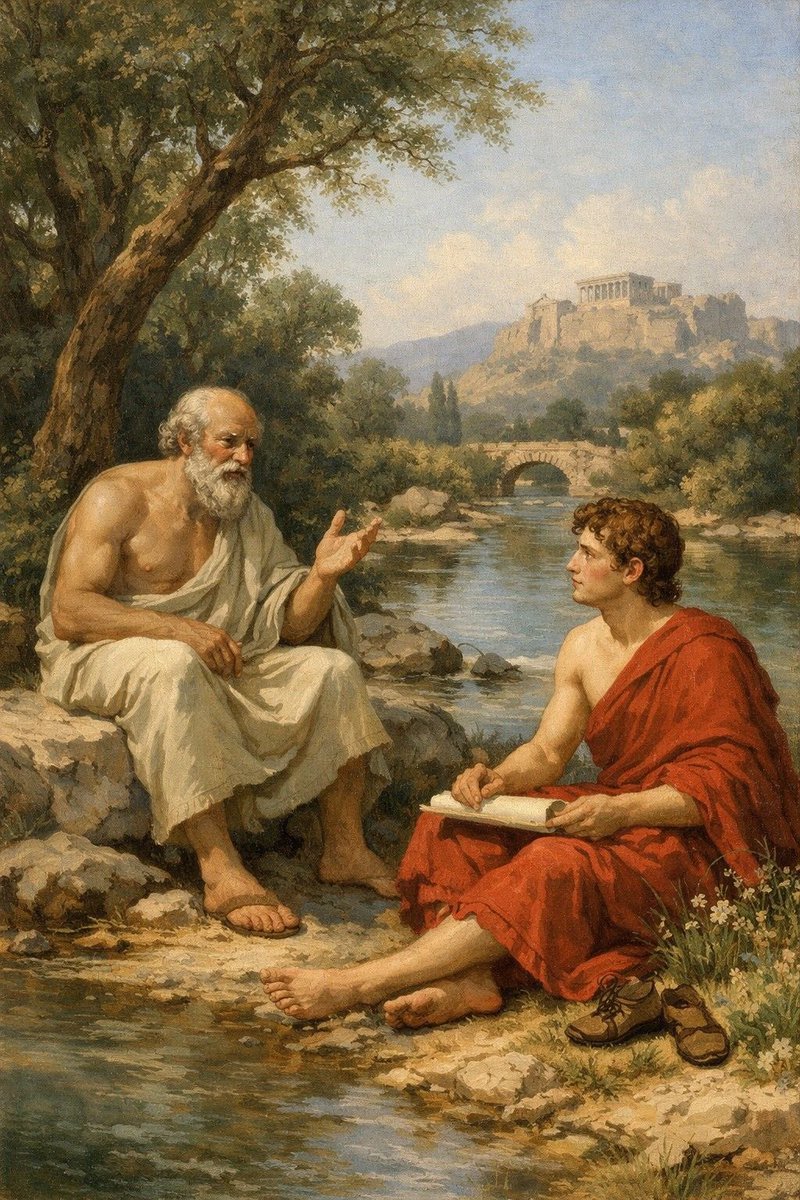
Socrates taught us the limitations of our knowledge. Heidegger taught us openness to being. Plato taught us in the dilemma of the One and the Many that everything is one through its participation in unity, and at the same time multiple through its participation in multiplicity. This might show that unity does not necessarily require the disappearance of difference. Schelling taught us that beneath our oppositions lies the absolute, the point of indifference. Therefore, why would our differences surprise us?
I think the greatest discovery is that we do not have to defend ourselves because otherness does not complete us by becoming identical to us. And perhaps saying “Now you see me” allows us to truly exist.
“Too much consistency is as bad for the mind as it is for the body. Consistency is contrary to nature, contrary to life. The only completely consistent people are the dead”
— Aldous Huxley
"إختلافه يجعل الوجود أجمل"
خلال سيرنا في الحياة، دائمًا ما نحاول "مطابقة" لغة الآخر وتشكيلها بطريقة تتناسب مع أفكارنا. نحاول أن نجعله مطابقًا لتصوّراتنا ورغباتنا وتشكيله وفقًا للصورة التي رسمناها له.
ولكن في الواقع هذا الإختلاف هو حاجة لا ندركها. الإختلاف بحقيقته هو ما يجعل الحياة نابضة. إنّه ما يدفع الكائن ليصبح كالعَوسَج المُلتهب، يحترق ويضيء ويضفي على الوجود معنى.
فيتغنشتاين يطرح اشكالية أكثر تعقيدًا. فنحن لا نستطيع فهم لغة الآخر بالمطلق، لاننا لا نستطيع ان ندرك نواياه الداخلية. فإننا نفسّر كلماته من خلال لغتنا الخاصة. ويعتقد كذلك إستحالة وجود "لغة مطلقة"، لأن المعنى ليس جوهرًا له ماهية محدودة.
سؤال يراودني… هل حقًا نستطيع الانفتاح على الوجود الذي يمنح اللغة معناها؟ أي الانفتاح على اختلاف لغة الآخر الذي يجعل الوجود أجمل؟
Four Letters of Love
It is astonishing to refuse to remain imprisoned within what we think is our identity. This comes with a consequence. It is Heidegger’s existential anxiety, that is the terrifying openness of existence itself. It is where we understand that there is no predetermined path to follow. We are not a fixed essence. But we are beings thrown into the world and we are always projecting ourselves toward possibilities.
Freedom begins precisely there, in refusing to be confined by who we think we are.
Perhaps four letters of love are: F R E E
“Put on a happy face”
Dostoevsky would have understood the terrible absurdity of this. Smiling while collapsing does not necessarily deceive others… It deceives oneself. The Underground Man is aware of the distance between what he feels and what he presents to the world. It may seem to him that complete honesty with oneself is not liberating.
Yet Nietzsche, stands beyond good and evil. Perhaps the abyss really did gaze back at him, and he was Übermensch enough to climb out of it. But if we look directly into its darkness, do we possess enough meaning to say that what does not kill us makes us stronger?
Or will we just “put on a happy face”?
Through the highs and lows
Through the joy and grief
Through the 10s and 6s
Through peace and war
Because the depths deserve to be lived as fully as the heights.