This is me, and this is what I've spent my career fighting for.
Cleaner air. Better food. Healthier cities. A planet we can actually live on.
None of it happens alone. If any of this resonates, join me — let's amplify the impact together. 🌏
The region with the world's highest measles vaccination coverage also accounts for 47% of global cases.
South-East Asia. 2025.
An estimated 4.6 million cases. 16,800 deaths.
This is not an argument against vaccination. It is a reminder that coverage figures can conceal dangerous gaps.
1.1 million infants missed even their first dose.
The real measure of a health system isn't how many it reaches. It's whether it knows who it hasn't reached.
Imagine waking up to learn your bank has failed. Your salary, business cash flow and children’s education savings suddenly feel less secure.
Financial losses and crushing debt can trigger severe psychological distress, affecting not just individuals but entire families.
A bank failure is more than a financial event. It tests the safety net around ordinary people.
US regulators closed United Fidelity, with $5.9bn in assets. Deposits are being transferred; the FDIC estimates a $1.83bn insurance-fund cost.
Asia’s lesson: prepare before panic. Can regulators detect trouble early, protect depositors and keep payments moving?
If a bank this size failed in your country tomorrow, could people access their money on Monday?
@Sachin_TWCN The manufacturers need to take a note.
We can't leave it to the users and their caregivers. These fixes as shown in the images below are commonly available on many shops.
Imagine your city faced an outbreak, instability or a humanitarian crisis beyond its borders. Is helping contain it charity—or an investment in your own safety?
That is the case for foreign assistance like that of USAID: healthier, more stable societies can mean fewer threats, less displacement and a safer world. It is not simply money “sent abroad”; it can help protect Americans at home.
The US spent $997 bn on its military in 2024 alone. The debate should be about priorities, evidence and accountability—not assuming every dollar spent overseas is wasted. What kind of security should taxpayers invest in?
Seven more children reportedly died with measles-like symptoms in Bangladesh in the past 24 hours. The combined toll of suspected and confirmed measles deaths has reached 1,378.
Imagine this happening in your city/district/country. Would your clinics know which children had missed doses? Would vaccines be available? Would outreach teams reach every neighbourhood?
Bangladesh’s outbreak followed vaccine stockouts and disrupted immunisation. A vaccine in a warehouse cannot protect a child.
Political context must never become interruptions in essential health services. How resilient is your regions' immunisation system?
@UNICEF@unicefchief@UNICEFAPRO@WHOSEARO@savechildrenuk
Katie Miller, wife of the US White House Chief of Staff, recently blamed mandatory child car seats for America's falling birth rate.
Think about that.
A study has explored this connection, but car seats also save children's lives.
When influential voices turn complex social problems into simple political explanations, they risk confusing the public and distorting policy priorities.
Falling birth rates deserve serious debate: housing, childcare, job security and community support all matter.
Shouldn't we make raising children easier rather than question the protections that keep them safe?
Perhaps we are meeting more people but remembering fewer of them.
Think about close-knit communities where people repeatedly meet the same neighbours, share meals, know each other's families and remember small details.
Compare that with modern professional life: endless introductions, meetings, networking events and business cards.
We have expanded our networks but may be weakening our connections.
If I noticed this happening to me, I'd first look at sleep, stress and workload, and get persistent changes medically assessed rather than assume it's age or a vitamin deficiency.
Are we becoming more connected digitally but less connected socially?
Imagine going for a 6 AM run in Singapore, Helsinki or Stockholm without having to check whether the air is safe to breathe.
Now imagine making that decision in a mega city across Asia.
This isn't just a difference in pollution levels. It's a difference in what cities allow their residents to take for granted.
Clean air doesn't happen by accident. It reflects years of decisions on transport, energy, urban planning, industrial regulation and enforcement.
Why should something as basic as breathing clean air depend on where you live?
A news report citing RTI data says three Delhi hospitals recorded 6,581 lung cancer cases between 2020 and July 2026; four hospitals reported 913 deaths. These figures do not prove what caused each case, but the wider risk is real: long-term exposure to air pollution can cause lung cancer.
We check AQI, avoid busy roads, wear a well-fitted N95 and use cleaner indoor air where possible. But unlike a cigarette, polluted air is hard to opt out of. What do you do to reduce your exposure—and what more should cities make possible?
A simple question for my readers: Do you check the AQI before going out for a morning run or walk?
Or have you been fortunate enough to live in a city where breathing clean air is something you never have to think about?
Absolutely. Women shouldn't have to negotiate their freedom to stay safe.
But there are three more public health concerns for anyone running in Delhi at 5 AM: toxic air, unsafe roads and the risk of repetitive injuries from running on hard surfaces.
It would be okay if you were running in Singapore, where the infrastructure and environmental conditions are generally more supportive of outdoor exercise. Delhi is a different reality.
Personal precautions matter. But clean air, pedestrian-friendly streets, safer roads and accessible running spaces are public responsibilities.
The goal shouldn't just be to teach women to run safely. It should be to build cities where everyone can run safely.
There is an important distinction here. Her independence is not just a product of Norwegian culture; it is supported by an entire system of municipal care, social protection, emergency services and accessible infrastructure.
In India, families often compensate for what public systems don't provide.
The goal shouldn't be to choose between family and independence. It should be to build a society where ageing doesn't mean losing either.
@Sachin_TWCN Happy to connect and discuss if someone is building a prevention and health promotion programs. I work on NCD prevention across the APAC region.
It depends on the context. In some cities, states and countries, doctors become celebrities. As a public health practitioner, I don't necessarily see this as a good sign. Hospitals need doctors who follow established SOPs, exercise sound clinical judgement and put patients' interests first. Popularity may build a reputation, but it cannot be a substitute for clinical competence and professional accountability.
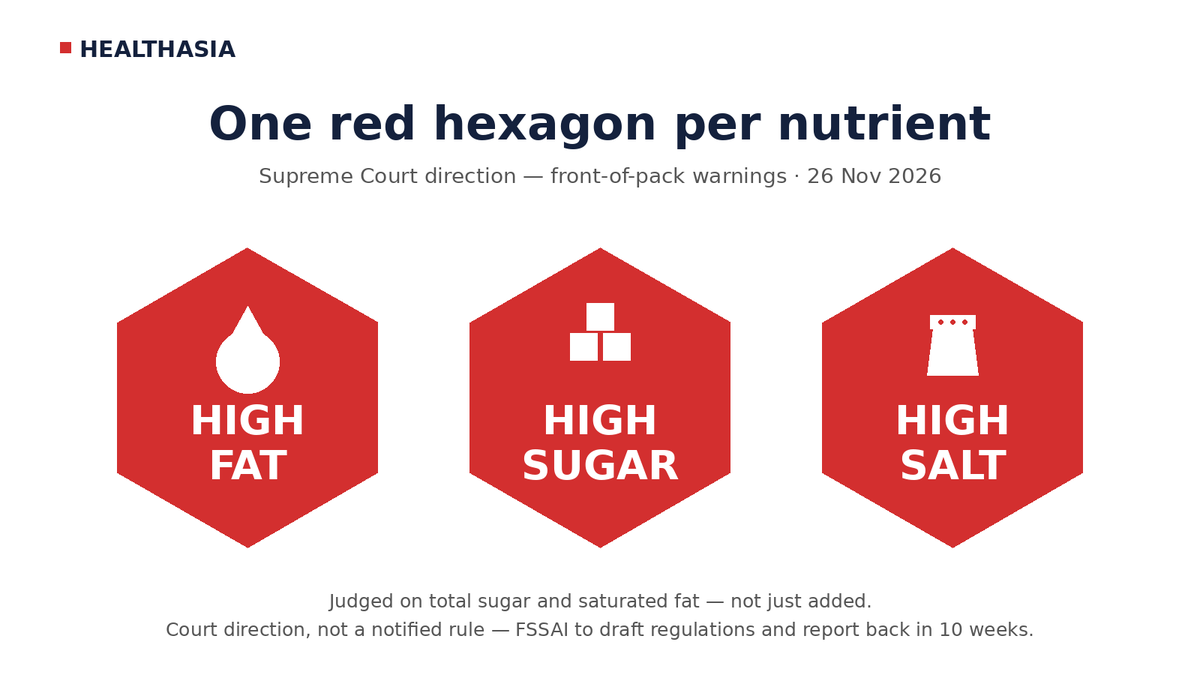
India's Supreme Court just ordered separate red warnings on packaged food — one hexagon each for
HIGH FAT,
HIGH SUGAR
and HIGH SALT,
judged on total sugar and fat, not just added.
Which pack in your kitchen would carry all three?
The Maldives has almost no heavy industry. Yet its people are choking on pollution generated hundreds, sometimes thousands, of kilometres away.
In November, AQI reached 159 in Greater Malé and 160 in Kulhudhuffushi — unhealthy levels.
Seasonal winds carry polluted air from South Asia across the Indian Ocean.
This is a climate justice issue: a country does not have to create pollution to pay its health costs.
Air pollution is not just a city problem. It is a regional governance issue.
The atmosphere has no borders. Our public health response cannot have them either.