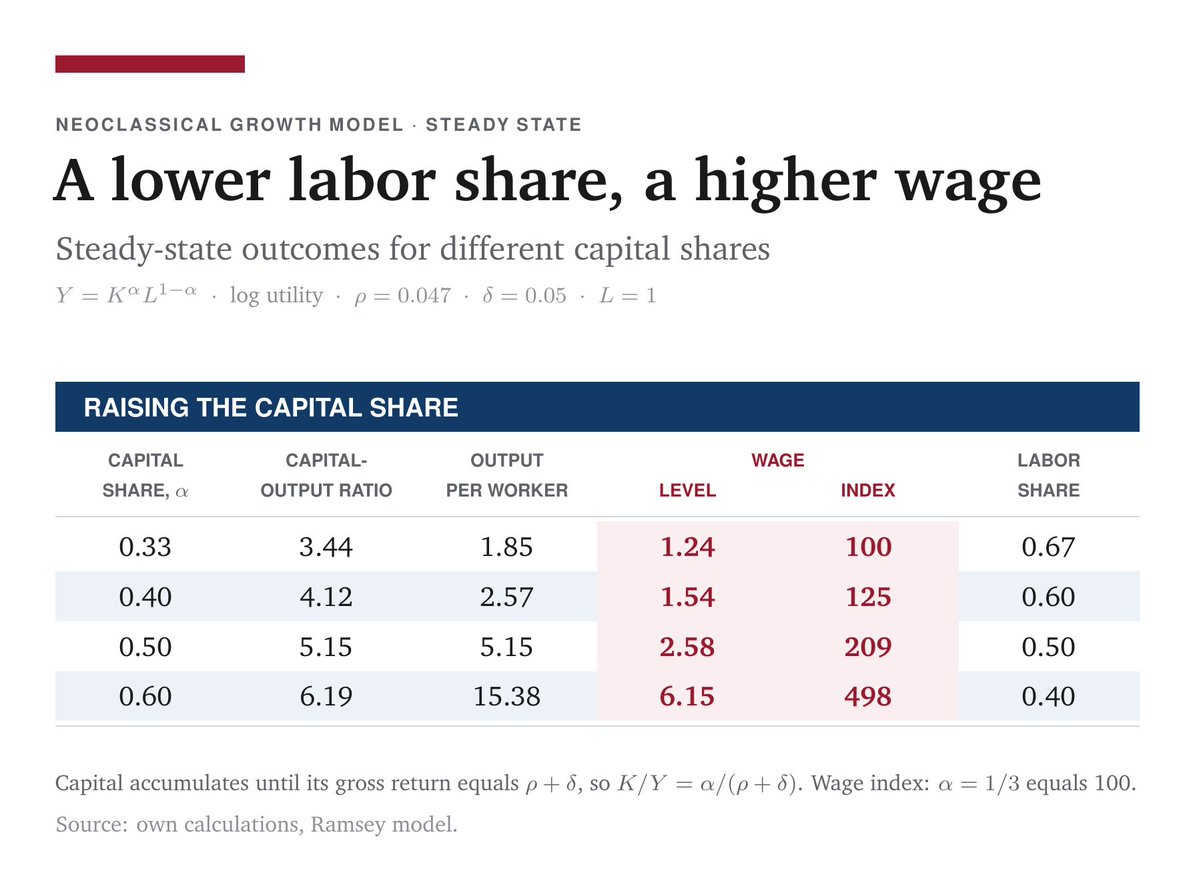
A simple point that many economists miss (and nearly all non-economists) is that a falling labor share and rising wages are not in tension. In fact, it is what we should expect when the capital share rises, and capital is free to accumulate.
The reason is intuitive. In the long run, the supply of capital is perfectly elastic at a gross return determined by depreciation and the discount rate: households accumulate or run down capital until its return is back there. In comparison, the supply of labor is much more inelastic.
That means the gains from a technological change that makes capital more important in production (short of making it the only factor) end up with the inelastic factor, not the elastic one. In the long run, capital owners cannot get a rent from a higher capital share of output, only a compensation for their patience. We learned that from David Ricardo over two hundred years ago!
To see this, consider the textbook neoclassical growth model with log utility (not needed, but it makes things easy).
In the table below, I compute the steady-state wage for different values of the capital share. Increasing the capital share from 0.33 to 0.6 multiplies wages by nearly five. Capital owners receive a much larger slice of output, but the net rate of return stays at 4.7%: all the extra income has gone into more capital. Now, you might not want capital owners to have so much capital for political reasons (rich people have a curious habit of buying newspapers), but that has nothing to do with wages being lower. They are higher.
I learned this lesson the hard way many years ago with my paper “Bargaining Shocks and Aggregate Fluctuations” with Thorsten Drautzburg and @pablo_guerron in the JEDC. We gave more bargaining power to capital owners (in our model, wages were not set competitively but through Nash bargaining), and workers ended up with higher wages! The logic is the same: give capital owners more power, and they compete it away. Karl Marx, by the way, already understood this. He was a much better economist than 99.99% of his followers and admirers.
Like all results, this one has exceptions: I can think of environments where a technological change that makes capital more important in production does not raise wages. And the transitional dynamics can get tricky. But the basic logic is hard to escape.
📄 My first working paper at Anthropic, with the @ChadJonesEcon, @SzymonSacher, Tess Cotter & @PeterMcCrory : "Economic Scenarios for Transformative AI"
How could AI reshape growth, wages and jobs by 2030? A framework to compare the possibilities 🧵
Se van afinando los cálculos del impacto de la IA en el empleo.
Me encontré con este mapita que cuantifica su efecto sobre cada ocupación para EEUU: https://t.co/TERvP26ocw
Desagrega su impacto entre 3 efectos distintos:
1) Efecto sustitución (S): la IA reemplaza tareas humanas. Esto destruiría empleos.
2) Efecto complementario (C): la IA puede hacer tareas humanas pero necesita de la presencia del humano para realizarla. Esto tiene el potencial de crear empleo o al menos no hacerlo desaparecer.
3) "Aislación" de la IA (I): no hay forma todavía de automatizar ese empleo.
Por ejemplo, al puesto de "financial advisor" le asignan 48% sustitución (S) y 52% complemento (C), a "educadores": S: 29% / C: 54% , a desarrolladores web S: 94% / C: 3% , y así.
En este paper los autores explican cómo se calcula todo: https://t.co/vRUkHQcaYj
Dos reflexiones más de ahí que me parecieron interesantes:
1) lo que hace/deja de hacer la IA son "tareas" no "empleos". Por lo que es importante distinguir qué parte de cada empleo es reemplazable/potenciable/aislado de la IA para cuantificar su riesgo de automatización general.
2) el impacto empírico de la IA se ve más en los ingresos nuevos de empleados y no tanto en las personas ya empleadas, por lo que una regresión sobre las contrataciones nuevas puede/va a dar resultados distintos que las conclusiones que se pueden sacar de cálculos sobre la masa total de empleados.
Creo que todavía no tenemos del todo la info disponible acá para replicar algo así, pero estaría interesante.
مواقع مفيدة للباحثين و طلبة الدراسات العليا:
[Google Scholar] (https://t.co/V0dYniYP3u): محرك بحث مخصص للبحث عن الأبحاث العلمية، المقالات الأكاديمية، الكتب، والرسائل الجامعية. يُعد أداة أساسية للباحثين للوصول إلى مصادر علمية موثوقة.
[ResearchGate] (https://t.co/x7NjIYkCTO): شبكة اجتماعية مخصصة للباحثين والعلماء. توفر هذه المنصة مكانًا لنشر الأبحاث، التواصل مع زملاء في المجال، والبحث عن فرص تعاون علمي.
[JSTOR] (https://t.co/OdtahjPSyS): مكتبة رقمية تحتوي على مجموعة ضخمة من المقالات الأكاديمية والمجلات والكتب في مختلف التخصصات. تُعد مصدرًا موثوقًا للباحثين في جميع المجالات الأكاديمية.
[Zotero] (https://t.co/sYd5skmu4s): أداة مجانية تساعد الباحثين على تنظيم وإدارة مصادرهم الأكاديمية. تتيح لك حفظ المراجع وإنشاء قوائم المراجع بشكل تلقائي واحترافي.
[EndNote] (https://t.co/T70OZs0hza): برنامج لإدارة المراجع يساعد الباحثين على تنظيم مصادرهم العلمية وإنشاء المراجع والمصادر بأسلوب احترافي وسهل الاستخدام.
[https://t.co/I1N2zOUOcu] (https://t.co/PIm6fPOBB9): منصة تتيح للباحثين نشر أبحاثهم، التواصل مع باحثين آخرين، والاطلاع على أحدث الأبحاث في مختلف المجالات الأكاديمية.
[Mendeley] (https://t.co/oBFsiM3BMX): أداة لإدارة المراجع وتنظيم الأبحاث، بالإضافة إلى أنها توفر إمكانية التواصل مع شبكة من الباحثين من مختلف أنحاء العالم.
[Thesis Tools] (https://t.co/PIHyhl5JLx): موقع يقدم أدوات مساعدة لطلاب الدراسات العليا، مثل إعداد الاستبيانات وتحليل البيانات بسهولة.
[ProQuest Dissertations & Theses] (https://t.co/QHLpvdYMbq): قاعدة بيانات ضخمة تحتوي على أطروحات ورسائل ماجستير ودكتوراه من جامعات حول العالم. مصدر ممتاز للحصول على أفكار ودراسات سابقة في مجال بحثك.
[PubMed] (https://t.co/T7N35buzO5): قاعدة بيانات متخصصة في المقالات البحثية في مجالات الطب والعلوم الحياتية. تُستخدم بشكل واسع من قبل الباحثين في المجالات الطبية والصحية.
La informalidad no es una sola historia. En #AmLat, muchos trabajadores eligen el autoempleo: valoran la flexibilidad y la libertad de ser su propio jefe por encima de un sueldo formal.
Explora la historia de datos: https://t.co/XKX70hW5nK
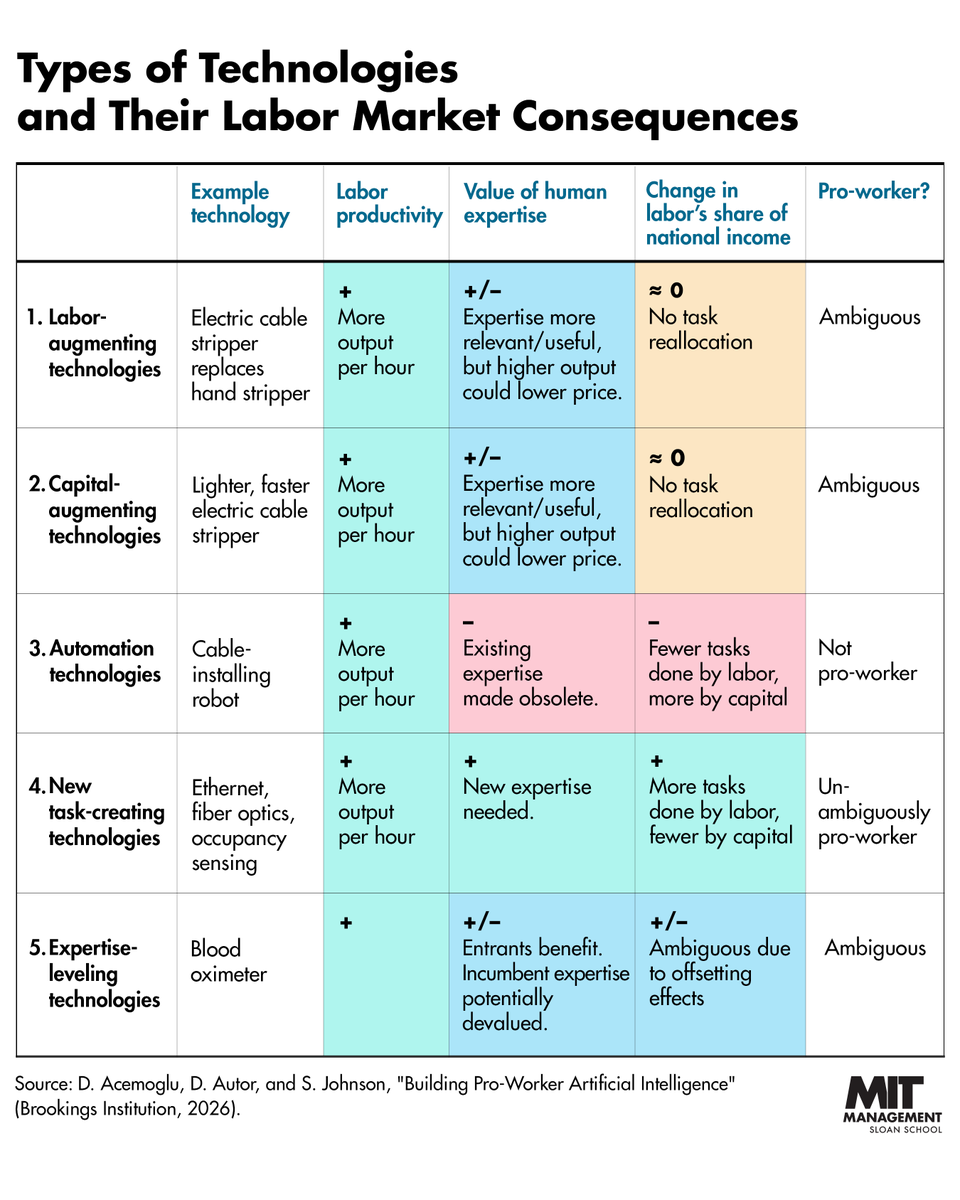
MIT economists @DAcemogluMIT, @davidautor, and @baselinescene offer a framework for understanding how different technologies affect workers. Only new task-creating technologies are “unambiguously pro-worker,” because they create demand for new forms of human expertise rather than make existing expertise less necessary.
Learn more: https://t.co/WWlLWn6PVj
Dos economistas demostraron matemáticamente que la IA destruirá la economía.
Investigadores de Wharton y la Universidad de Boston publicaron un artículo aterrador titulado "The AI Layoff Trap".
Mapearon el fin del juego económico de la transición a la IA, y expone un defecto fatal en el capitalismo competitivo.
Cuando una empresa reemplaza a un trabajador con IA, captura el 100% de los ahorros salariales.
Pero ese trabajador desplazado también es un consumidor. Cuando pierden su empleo, dejan de comprar cosas.
La empresa obtiene todos los ahorros, pero la pérdida de la demanda del consumidor se distribuye por toda la economía.
Si hay 20 competidores en un mercado, un CEO solo absorbe 1/20 de los daños económicos que sus despidos acaban de crear.
Por lo tanto, cada CEO racional tiene un incentivo matemático para automatizar lo más rápido posible.
Pueden ver literalmente el precipicio acercándose, y aun así pisan el acelerador.
Desata un Dilema del Prisionero inevitable. Si no automatizas, tus competidores lo harán, y te aplastarán en precio.
No solo daña a los trabajadores. Destruye las empresas también.
La economía queda atrapada en una carrera armamentística de automatización. Las empresas despiden a su fuerza laboral para mantenerse competitivas, hasta que toda la base de consumidores queda completamente vaciada.
En el límite, el artículo concluye: “Firms automate their way to boundless productivity and zero demand.”
¿Y la parte más aterradora?
Los investigadores probaron matemáticamente cada solución popular.
¿Ingreso Básico Universal? Falla. Eleva el nivel de vida pero no cambia el incentivo corporativo para recortar empleos. ¿Reconversión? Falla. ¿Equidad para trabajadores? Falla.
El artículo demuestra que más competencia hace que el colapso ocurra más rápido. Y una IA "mejor" hace que el daño sea peor.
Lo único que matemáticamente detiene el colapso es un impuesto a la automatización dirigido, obligando a las empresas a pagar por el poder adquisitivo que destruyen antes de automatizar el empleo.
A young person asked me today for a few papers that would be great to read early on in one’s career. Here is a list I came up with (I posted a shorter list earlier in reply to a comment). There are many other great papers (and I apologize if I didn’t include yours), but my goal was to focus on papers that a 21-year-old undergrad would enjoy a lot. A paper on the asymptotic properties of the bootstrap or on some subtle point about New Keynesian models, as important as it might be, is not what I am looking for. Also, of course, the list reflects my deeply biased taste. So, feel free to add in the comment section other papers you love!
Philippe Aghion and Peter Howitt (1992), “A Model of Growth Through Creative Destruction,” Econometrica.
George A. Akerlof (1970), “The Market for ‘Lemons’: Quality Uncertainty and the Market Mechanism,” Quarterly Journal of Economics.
Armen A. Alchian (1950), “Uncertainty, Evolution, and Economic Theory,” Journal of Political Economy.
William J. Baumol (1967), “Macroeconomics of Unbalanced Growth: The Anatomy of Urban Crisis,” American Economic Review.
Gary S. Becker (1973), “A Theory of Marriage: Part I,” Journal of Political Economy.
Douglas W. Diamond and Philip H. Dybvig (1983), “Bank Runs, Deposit Insurance, and Liquidity,” Journal of Political Economy.
Xavier Gabaix (1999), “Zipf’s Law for Cities: An Explanation,” Quarterly Journal of Economics.
Xavier Gabaix and Augustin Landier (2008), “Why Has CEO Pay Increased So Much?,” Quarterly Journal of Economics.
Luis Garicano (2000), “Hierarchies and the Organization of Knowledge in Production,” Journal of Political Economy.
Edward L. Glaeser, Bruce Sacerdote and José A. Scheinkman (1996), “Crime and Social Interactions,” Quarterly Journal of Economics.
Sanford J. Grossman and Joseph E. Stiglitz (1980), “On the Impossibility of Informationally Efficient Markets,” American Economic Review.
Oliver Hart and John Moore (1990), “Property Rights and the Nature of the Firm,” Journal of Political Economy.
Friedrich A. Hayek (1945), “The Use of Knowledge in Society, American Economic Review.
Bengt Holmström (1979), “Moral Hazard and Observability,” Bell Journal of Economics.
Charles I. Jones (1995), “R&D-Based Models of Economic Growth,” Journal of Political Economy.
Charles I. Jones (2005), “The Shape of Production Functions and the Direction of Technical Change,” Quarterly Journal of Economics.
Michael Kremer (1993), “Population Growth and Technological Change: One Million B.C. to 1990,” Quarterly Journal of Economics.
Michael Kremer (1993), “The O-Ring Theory of Economic Development,” Quarterly Journal of Economics.
Paul Krugman (1991), “Increasing Returns and Economic Geography,” Journal of Political Economy.
Robert E. Lucas, Jr. (1978), “On the Size Distribution of Business Firms,” Bell Journal of Economics.
Kevin M. Murphy, Andrei Shleifer and Robert W. Vishny (1989), “Industrialization and the Big Push,” Journal of Political Economy.
Paul M. Romer (1990), “Endogenous Technological Change,” Journal of Political Economy.
Sherwin Rosen (1981), “The Economics of Superstars,” American Economic Review.
Alvin E. Roth (2007), “Repugnance as a Constraint on Markets,” Journal of Economic Perspectives.
Thomas C. Schelling (1971), “Dynamic Models of Segregation,” Journal of Mathematical Sociology.
Andrei Shleifer and Robert W. Vishny (1993), “Corruption,” Quarterly Journal of Economics.
Michael Spence (1973), “Job Market Signaling,” Quarterly Journal of Economics.
Robert M. Townsend (1979), “Optimal Contracts and Competitive Markets with Costly State Verification,” Journal of Economic Theory.
Martin L. Weitzman (1974), “Prices vs. Quantities,” Review of Economic Studies.
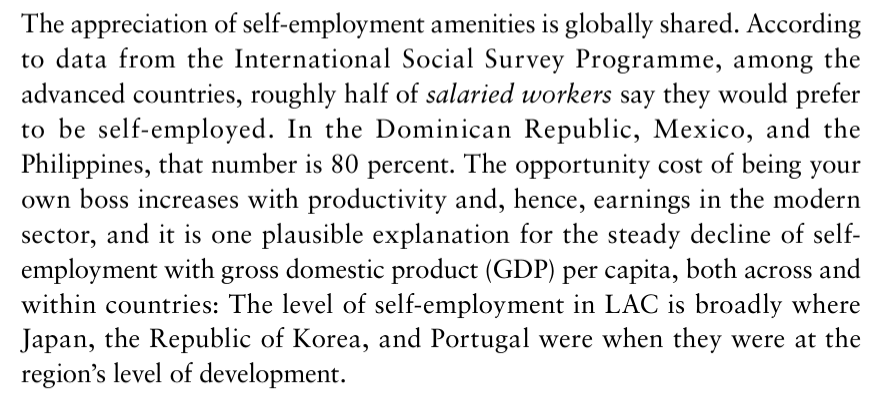
Leyendo el último informe del Banco Mundial sobre informalidad, doy con este párrafo, que dice algo muy interesante: la crisis del empleo tradicional está asociada al hecho de que, cuando la productividad es baja, los trabajadores prefieren ser emprendedores
Recentemente Maurice Obstfeld fez uma nova avaliação do experimento do governo Milei de reformas na Argentina. Creio que o diagnóstico é bem calculado.
Para Obstfeld a eleição de Milei representou uma ruptura drástica com a dinâmica política do peronismo que dominava a Argentina desde 1940. Herdando uma economia com inflação mensal superior a 25%, com crescimento anualizado superior a 1.400%, e reservas líquidas negativas em U$ 8,5 bilhões, o novo governo conseguiu seguir com um pacote amplo de reformas que reverteu o massivo desequilíbrio macroeconômico. Ao eliminar um déficit fiscal que girava em torno de 5% do PIB e desmantelar uma complexa teia de controles de preços e comércio, Milei enviou um sinal aos mercados de que os desequilíbrios fiscais seriam revertidos e a dominância fiscal seria anulada. Como resultado direto dessa mudança de regime, a taxa de inflação desacelerou de maneira expressiva.
Entretanto, Obstfeld adverte que a âncora cambial e monetária argentina ainda é bem frágil. A estratégia inicial de controle da inflação se baseou no uso da taxa de câmbio como âncora nominal, primeiro mediante um crawling peg estrito e, posteriormente, através de bandas cambiais flexíveis. O problema central dessa abordagem reside no fato de que a inflação interna continua a rodar acima do ritmo de depreciação do peso, gerando uma persistente apreciação real. A transição ocorrida em janeiro de 2026, que passou a indexar a expansão da banda cambial à inflação de dois meses antes, evitou a apreciação real forçada, mas com a política monetária sem estabelecer uma nova âncora nominal crível, tornando o sistema autorreferencial e incapaz de garantir a convergência da inflação para níveis mais baixos do que 1%.
Todavia, descordo de Obstfeld de que a solução seria simplesmente adotar um regime de metas de inflação. Isso não crível em uma economia com uma dolarização informal tão forte. Como poupança, contratos e dívidas são indiretamente precificados em dólar (os argentinos pensam em termos de dólar e não em pesos), alterações na taxa básica de juros sobre o peso exercem efeito mínimos sobre as decisões de investimento e consumo, esvaziando a capacidade do BCRA de controlar demanda via taxas de curto prazo.
A exigência de câmbio flexível também não é crível. Na Argentina, a depreciação da moeda local é repassada quase instantaneamente aos preços, desancorando as expectativas inflacionárias a qualquer oscilação do mercado. Essa vulnerabilidade gera o infame medo de flutuação, agravado pelo descasamento de moedas nos balanços público e privado. Diante do risco de insolvência sistêmica provocado por desvalorizações bruscas, os agentes econômicos antecipam que a autoridade monetária inevitavelmente priorizará a contenção do câmbio em detrimento da meta de inflação; gerando um problema de economia política sobre a sustentabilidade desse regime cambial.
My Nobel lecture and the video of the Stockholm lecture are online.
It covers what creative destruction tells us about secular stagnation, firm dynamics, the middle-income trap, and AI as the next GPT revolution.
Paper: https://t.co/Viem3OXkiC
Video: https://t.co/9rfqTvWXMy
Highly relevant!
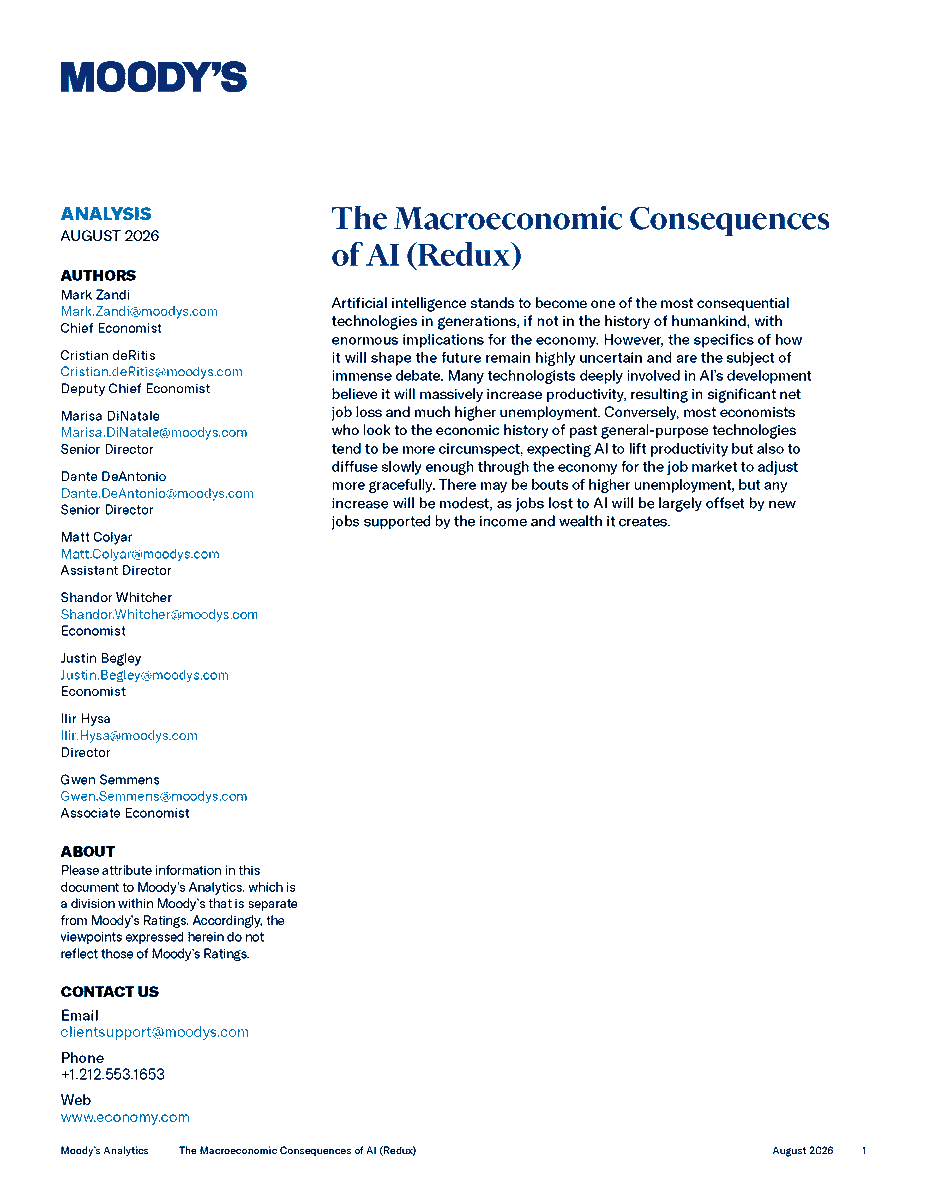
"The Macroeconomic Consequences of AI (Redux)" by Mark Zandi, Cristian deRitis, Marisa DiNatale, Dante DeAntonio, Matt Colyar, Shandor Whitcher, Justin Begley, Ilir Hysa, and Gwen Semmens.
"Artificial intelligence stands to become one of the most consequential technologies in generations, if not in the history of humankind, with enormous implications for the economy. However, the specifics of how it will shape the future remain highly uncertain and are the subject of immense debate. Many technologists deeply involved in AI’s development believe it will massively increase productivity, resulting in significant net job loss and much higher unemployment. Conversely, most economists who look to the economic history of past general-purpose technologies tend to be more circumspect, expecting AI to lift productivity but also to diffuse slowly enough through the economy for the job market to adjust more gracefully. There may be bouts of higher unemployment, but any increase will be modest, as jobs lost to AI will be largely offset by new jobs supported by the income and wealth it creates."
https://t.co/L3jPtH8eSS
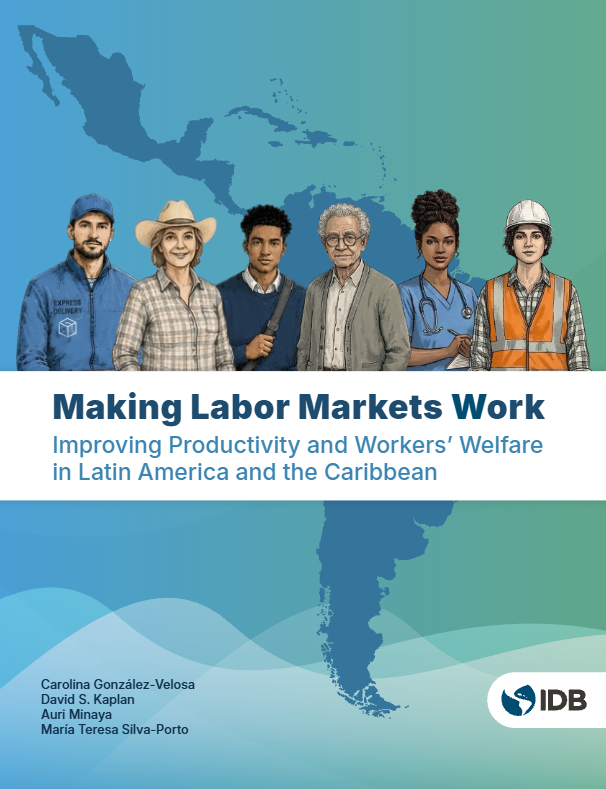
El orgullo de mi trayectoria profesional ha sido publicar este libro, ya disponible en inglés, pronto en español y portugués, con
@Gonzalezv237, @auri_minaya y @MariterePorto.
https://t.co/xVf8KAnwCh
Lanzamiento, lunes 3 de agosto. Regístrense aquí: https://t.co/BZEqjugVkc
MIT economists @DAcemogluMIT, @davidautor, and @baselinescene offer a framework for understanding how different technologies affect workers. Only new task-creating technologies are “unambiguously pro-worker,” because they create demand for new forms of human expertise rather than make existing expertise less necessary.
Learn more: https://t.co/WWlLWn6PVj
Para crear más empleos, primero debemos entender las decisiones de las personas.
Un análisis riguroso nos muestra el camino hacia mercados más dinámicos y oportunidades más claras. Conoce más:https://t.co/s7dpadBbGj
كثير يسأل: هل استخدام الذكاء الاصطناعي في كتابة الأبحاث مقبول؟
هذه الورقة تلخص أفضل الممارسات والتوصيات الأخلاقية لاستخدامه بطريقة صحيحة، مع الحفاظ على النزاهة العلمية وجودة البحث.
ورقة جميلة وأنصح بقراءتها لكل مهتم بالبحث العلمي. 👌
¿Quieres saber que tan fácil es inspeccionar cualquier aplicativo móvil de tu celular con IA para crear funcionalidad propia? (Hacer pedidos, reservar antes que todos tu cancha de padel/fulbito, data de tu aplicativo favorito, etc.).
¿O tal vez como inspeccionar el website del Ministerio de Finanzas para saber en qué se gasta el dinero tu municipalidad?
Hoy Lunes a las 8p (hora Perú) les enseñaremos en vivo que tan fácil es usar IA (Claude Code) esto y más. Hagan sus preguntas.
https://t.co/YET67LKlSV