My book, tentatively titled “A History of New Things,” shows how industrial design created newness as a value. I trace the history of our desire for the new, show its impact on our lives & environment (as we dispose of things at an accelerating pace), and what we can do about it.
Harvard, apparently, is about to adopt a new policy to combat grade inflation. I devised my own anti–grade inflation policy 25 years ago. I’ve shared it with provosts and deans, to no avail. Here it is:
The Muñoz Plan Against Grade Inflation
The plan has three key components:
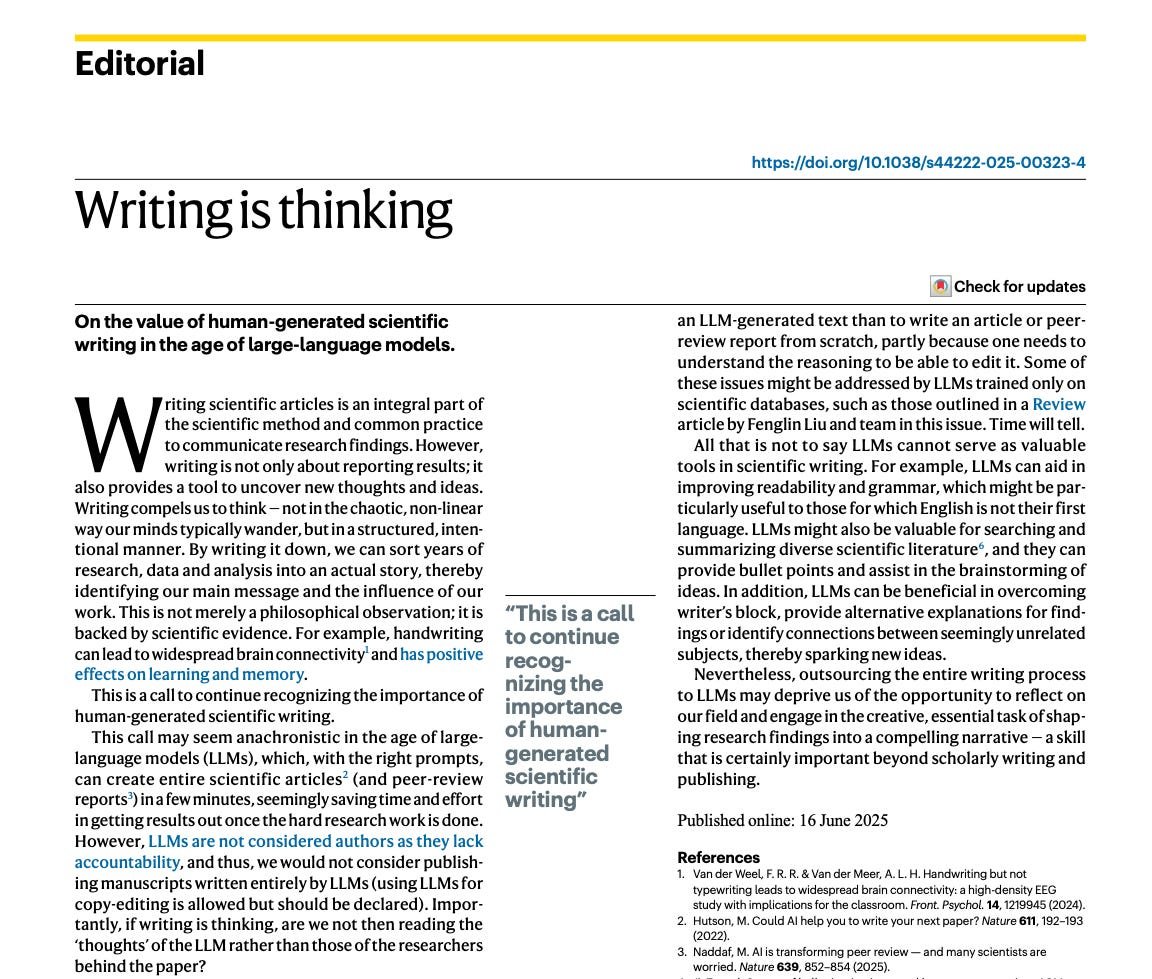
So it turns out that writing is thinking. It's the same process.
"Writing compels us to think — not in the chaotic, non-linear way our minds typically wander, but in a structured, intentional manner."
Outsourcing writing to LLMs is THE SAME THING as outsourcing thinking.
@farman thinks usability in tech design is a problem, but not the way you think. “The problem isn’t usability itself; it’s what it has become—a design approach that replaced any need whatsoever to understand complex systems with the ability to thoughtlessly interact with them.” https://t.co/veDwJxEV25...
A great piece by @farman on frictionless design's perils:
"Intuitiveness is often achieved by hiding complexity...When we trust systems we can't see into, we lose the capacity to recognize—let alone resist—how they've been built to shape our behavior."
https://t.co/Z94Euwme9I
Why We’re Wired to Want, But Not Enjoy, Black Friday Deals: A Neuroscientist and an Industrial Designer Have Advice About Your Black Friday Buying Habits. My latest post on Substack https://t.co/mP3Pth1uio
Why We’re Wired to Want, But Not Enjoy, Black Friday Deals: A Neuroscientist and an Industrial Designer Have Advice About Your Black Friday Buying Habits. My latest post on Substack https://t.co/mP3Pth1uio
My new Substack article: How a Camera’s Design Changed Technology Forever
When industrial design gave technology a sleek surface—one that could be change each year to represent updates—consumers were distanced from how these devices actually work.
https://t.co/db0asqvclM
Baudelaire in 1859 on photography (or perhaps a 2024 critic of #AI promptography?): "If photography is allowed to supplement art in some of its functions, it will soon have supplanted or corrupted it altogether, thanks to the stupidity of the multitude which is its natural ally.”
My new Substack article: How a Camera’s Design Changed Technology Forever
When industrial design gave technology a sleek surface—one that could be change each year to represent updates—consumers were distanced from how these devices actually work.
https://t.co/db0asqvclM
When he told me, “We are more adept at wanting than we are at liking,” it felt like he gave me the keys to unlock the deeper reasons why we’ve ended up in a cycle of endless upgrades. https://t.co/7sf9yHvFgV
Giving an online talk, "Getting Maintenance Organized," for @LindaHall_org and @SocHistTech this Thursday at noon CT. https://t.co/QBAFIXMkxV
Looking at the history of the phrase "operations and maintenance." The British Navy adopted it in 1917. US railroads by the 1930s.