People think collapse looks like explosions and chaos.
Nope. That's in the movies.
Reality is different.
It looks like a nurse and a manufacturing tech who can't afford rent together.
It looks like a veteran using a bucket for a bathroom.
It looks like a college graduate delivering food for an app.
It looks like a 60 year old starting over as a server after 19 years at one company.
It looks like right now.
It's already here.
Most people just don't have a word for what they are living through.
The word is fiat.
The exit is Bitcoin.
A clip from my recent talk at the Global Economy & Finance Conference in Seoul.
You can listen to the full lecture via The Bitcoin Standard Podcast (ep 324) on your preferred podcast platform, or on YouTube https://t.co/dAFcKyM0eF
PEER REVIEW
Allan Savory describing the absurdity of the Peer Review process the fact that it intentionally curtails jumps in new knowledge. They cannot peer review our science, because there are no peers.
@Baron_Douro@CraigMurrayOrg Given what we now know about the very serious crimes of Mandelson's close friend Epstein, I'm not sure we can rely on any of the due process. I suspect being involved in serious crime is actually a requirement to be considered for such roles which fortunately would rule me out
British singer Sheila Diamond’s rendition of “Free From Desire”, performed at the Eastward Club in Chorley (Lancashire), is taking the internet by storm
Pure boomer masterclass 😎
Rick Rubin: "I've met very few billionaires who are happy"
"I don't look at the outside very much. I look inward. I try to focus on what do I feel, what am I seeing, in the hopes that by sharing what's going on in me, it resonates with someone else. I can't predict what someone else would like. And I don't think anybody can. So if I'm authentically true to myself, that's the best chance of someone else liking something."
Rubin explains the paradox of acceptance:
"People want to be accepted. And I'm suggesting that the best way to be accepted is to be yourself. It's not to change yourself to what someone else thinks. First of all, you don't really know what someone else thinks. And if you're not genuine to yourself, nothing is there. It's just a projection or a mask. It's not true."
On what makes something interesting:
"In a sea of information, the more yours is personal, the more it's not like hers or his or theirs, the more it's yours. If we're all thinking the same thing, it's boring. Why would we make anything if everyone thinks the same thing? What makes us interesting are the differences. Even the imperfections. The imperfections are what make us human."
Rubin shares what captures his attention:
"There's so much middle of the road, and it doesn't interest me. I want it because it's louder, quieter, softer, harder. It's pushing some boundary. That's why I take notice. It's not more of the same. It's the one that makes you stop and think: did I really hear that? Did I really see that? What's going on here?"
On what success actually means:
"If I like it, that doesn't mean anything. That's what people think. Just because I like it doesn't give it any value. But as an artist, if you like it, that's all of the value. That's the success. It comes when you say, 'I like this enough for other people to see it.' Not 'other people like it, so it's successful.' That doesn't mean anything. Because other people liking it is out of your control. All that's in your control is making the thing to the best of your ability."
Rubin reframes what greatness means:
"I came to realize recently, it's all an offering to God. And if you're making an offering to God, you're not thinking about the budget, or hoping this segment of the audience is going to like it. We don't think like that. It's a higher vibration. We're making the best we can make, to the best of our ability, out of love and devotion. That's what it is. There is no higher form."
On criticism and reviews:
"Most of the artists I work with don't read any criticism or reviews, good or bad. The ones who are the strongest in who they are can even read a terrible review and laugh at it. Because when someone gives you criticism, it's telling you as much about who they are as what you've made."
Rubin explains the only real competition:
"The idea of the Oscars or the Grammys, where we're saying which album is better than another, it doesn't make any sense to me. Because it's always apples and oranges. The only people we can honestly compete with is ourselves. Is this the best I can make today? Have I gone further than I've gone before? That's all we can do. That's the only competition that makes sense."
On the obsession required for mastery:
"Many of the artists that are great at what they do are great for one reason: they fall in love with this thing, and they just want to know everything they could possibly learn about it. I'm working on a documentary project with comedians now. One of the things they talk about is their commitment; when other people are going out on the weekend, they're going to perform every night they possibly can.
For a period of 10 years. Having bad performances. Having people not like what they do. Banging their head against the wall. But that obsession with breaking through, and when I say breaking through, I don't mean to the audience. I mean with themselves."
Rubin shares a hard truth about dreams and jobs:
"Maybe your purpose in life isn't related to your job. Maybe your job is your job, and the job is the thing that supports you. And then the rest of your waking hours are devoted to your purpose. Don't let following your dreams undermine your ability to support yourself. If you decide 'I want to be a comedian and I'm putting all my eggs in the comedian basket', the pressure of having to support yourself will change you as a comedian. Not for the better. You want the stability of being able to take care of yourself in the world to be free to do whatever your passion is."
He challenges the mythology of genius:
"There's a mythology that the people who make things that we love are special people, the people on Mount Olympus, magic people who are geniuses. And then there's the rest of us. That's not the case. We're all just people. We're all doing our best. We're all good at some things, not good at other things. We're humans. And sometimes we find a way to make something beautiful."
Rubin shares his most vulnerable moment:
"The call came: 'How do you feel? You have the number one album in the country.' And I remember saying, 'I've never been more unhappy in my life.' We mistakenly think some kind of outward success is going to change something in us. And it does not. It may make life more comfortable. But it doesn't change who we are. Any hole in ourselves that we're hoping to fill does not get filled."
He explains why successful people are often unhappy:
"If you spend 20 years of your life working towards a goal that's going to solve everything, and then you finally achieve what you've been trying to do for 20 years, and nothing changes, that's when you get hopeless. It's not uncommon to see very successful artists who are very unhappy.
I'm sure you've met many very successful business people. Billionaires. Very few of them are happy. Very few. They've accomplished their dreams and are unhappy. Because we don't know what we want. We're trying to fill something that maybe can't be filled through material or public success. It's something else. Some internal thing."
Rubin closes with this:
"Don't do things just because you think you're going to get something for it. That's not why we do things. Do what's interesting to you. Follow what's interesting. Don't worry about the outcome. We can never predict the outcome. Follow your own inner guide. It might not make sense to anyone else.
It might not even make sense to us. And that's okay. The wisest thing we can do is know enough to know we don't know. Anytime you think 'I know how it is' your world just got a lot smaller."
The short version of Keith, for everyone who's just arrived.
Keith came down from a barn roof in Devon that he has been living on for eleven consecutive days to eat a cyclist's energy bar.
That is not the context. That is simply what happened on Tuesday.
The context is this.
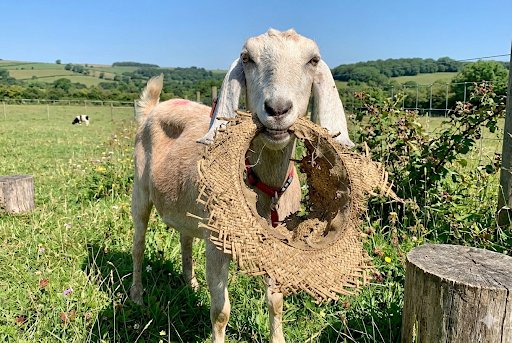
Keith descends from the Bezoar Ibex of the Zagros Mountains of Iran, an animal that navigates vertical cliff faces at 4,000 metres and extracts nutrition from thorned scrub in January at altitude.
The domestication of the domestic goat was, by livestock standards, not particularly thorough: goats retained the independence and problem-solving ability that selective breeding had removed from cattle and sheep by the Bronze Age.
Keith is the 10,000-year result of this.
He has been on Dave's farm 14 months. He has opened every gate on the farm. His record against the seven:
North field gate: 19 times. Third version. Three bolts. Keith is on day two.
South field gate: 12 times.
Yard gate: 7 times. Electric latch now fitted after Keith was found in the kitchen standing there. Looking. Not eating anything. Just standing.
Feed store: 3 times. Third occasion: ate part of the latch mechanism before Dave noticed.
Paddock: 4 times.
Track gate: not yet opened. Keith has been assessing it every Wednesday since September. This is the longest assessment of any gate. Dave is not comforted by the duration.
Road gate: Dave checks it every morning before Keith gets there. Twice.
He cleared Dave's 12-year knotweed stand. The Environment Agency's chemical treatment quote for the same area was £4,000. Keith's fee was bramble, the east ditch, and the gate budget.
The gate budget is £387.
Margot, Dave's cousin's Anglo-Nubian, visited for a week. The corner post on Steve's boundary has a 4mm flex. Keith now knows about the 4mm flex. Keith is not in a hurry.
Steve has filed 24 formal complaints.
The Reverend has Dave's number.
The knotweed is at 6%.
there are genuinely 2 internets right now
1. where AGI is basically here, codebases write themselves, agents run entire workflows, and every founder is talking about their 10x productivity gains
2. where a real customer, paying real money, takes a photo of their laptop screen with their phone to share something
the hype wave we all live in makes it feel like everything has changed, and in some ways it has
but here's the thing nobody says out loud: roughly 85% of the world has never even opened ChatGPT - not even once
we're having a civilizational debate about superintelligence while most people are just trying to figure out basic software
both realities are true at the same time
the gap between them is just a lot wider than the timeline makes it seem