FarmPady connects African farmers to investors and funding - rebranding the continent's agripreneurs as the investment opportunity the world overlooked.
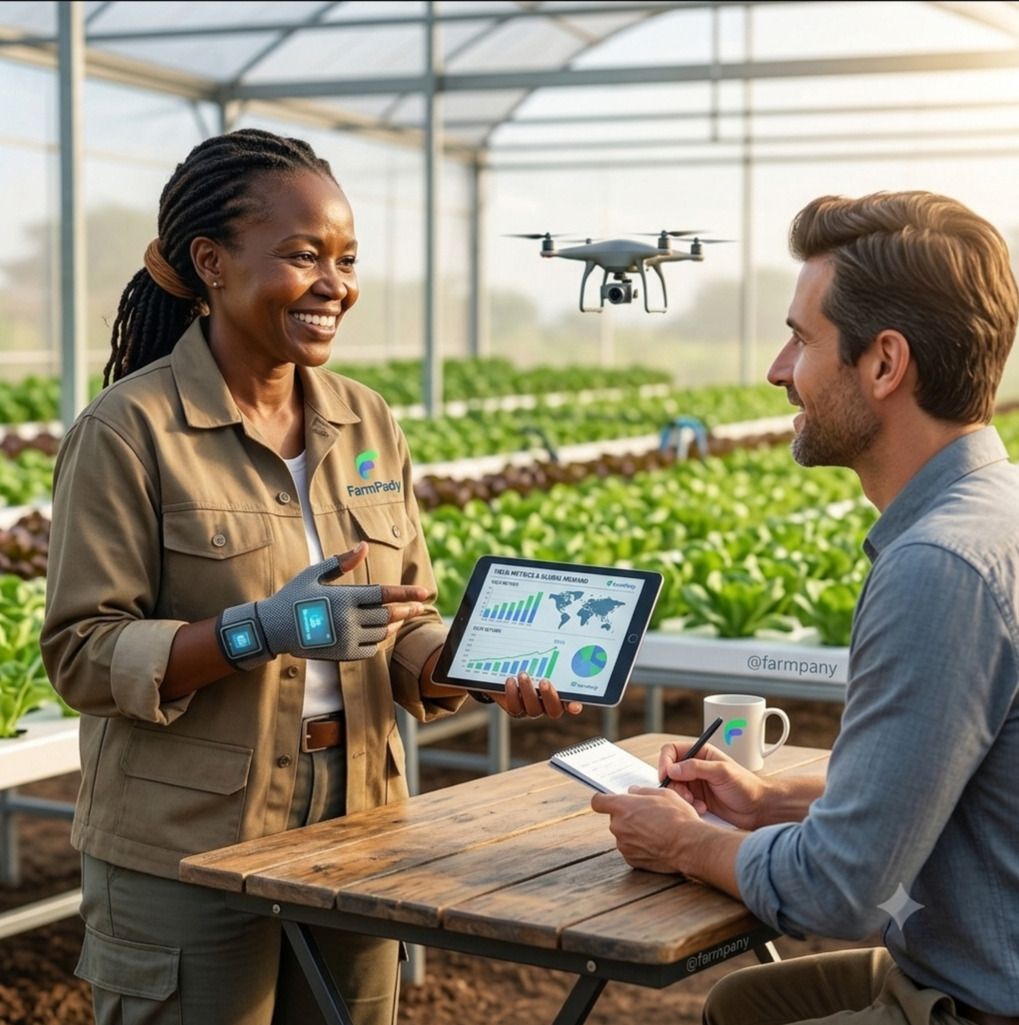
Investors search for farms to fund. Can they find yours?
The FarmPage: your farm's free, verified profile on FarmPady. Photos, projects, real numbers, direct investor contact.
No upfront fees, ever.
Create yours → https://t.co/n5VTLtSdDD
#AfricanAgriculture#Agripreneur #AgriInvestment
Seasonal workers deserve written terms too - pay, hours, duration. Verbal deals cause the most labor disputes.
Most farm labor disputes don't come from bad intentions - they come from nobody agreeing on the details upfront. A worker shows up expecting a daily rate; you were counting on a per-task rate. Harvest runs two weeks longer than planned and now there's a fight about whether that's covered.
None of this needs a lawyer. Before the season starts, write down: who's working, what the pay rate is (daily, weekly, or per task), expected hours, how long the engagement runs, and how overtime or extension is handled. One page, signed by both sides, kept with your other farm records.
This protects your workers from being shortchanged, and it protects you from a dispute mid-harvest when you can least afford the disruption. It's also one more piece of paper that shows an investor or buyer you run this like a business, not an arrangement.
Start with your next hire. Write it down before they start work, not after a disagreement.
#Agripreneur #Agribusiness #FarmBusiness
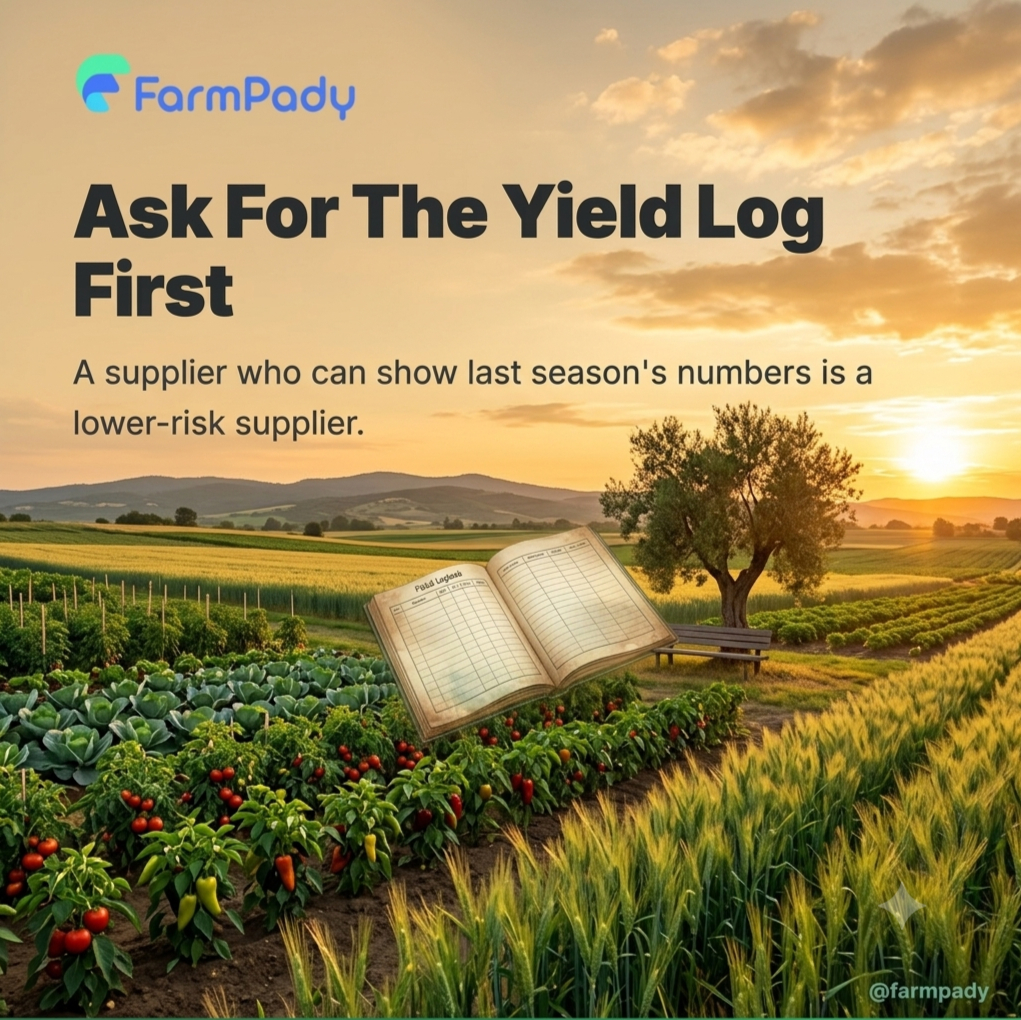
A supplier who can show you last season's yield log is a lower-risk supplier. Ask for it before you ask for a discount.
Most buyers negotiate price first and due diligence never happens. Flip that order.
Before you talk numbers, ask a supplier for three things: last season's yield log, who they sold to before you, and how they handled a delivery that went wrong. A farmer who can produce all three without scrambling has already done the risk assessment for you.
The ones who can't aren't necessarily bad suppliers - but you're now the one carrying the risk they should've been managing. That's worth more than a 5% discount buys you back.
Build this into your sourcing checklist. It costs you one extra conversation and saves you a mid-contract surprise.
#Agribusiness #AfricanAgriculture #SupplyChain
Most farmers don't get turned down for a bad harvest. They get turned down because nobody could verify a single number they gave.
Recordkeeping is the fix. 👇
https://t.co/diW5ZslfKs
Hey farmers, let's talk about something that quietly wrecks more farm businesses than bad weather ever does - the handshake deal.
You know the one. You and your buyer agree on price over a phone call or a chat in the market. No paper, no signature, just "trust." It feels fine until delivery day comes and suddenly he "doesn't remember it that way." Now you're stuck — either you eat the loss or you burn the relationship trying to argue for what you already agreed on.
Here's the thing: a verbal agreement isn't a contract. It's just a hope that everyone stays honest under pressure. And harvest season is exactly when pressure shows up ,prices shift, buyers get competing offers, cash gets tight. That's when a written agreement earns its keep.
It doesn't need to be complicated. Just get four things down on paper before the harvest moves: price, quantity, delivery date, and payment terms. Both sides sign it. That's it. It takes twenty minutes and it protects months of work.
And here's the part most farmers don't realize, this isn't just about protecting yourself from a difficult buyer. It's also the first thing an investor asks to see when they're deciding whether your operation is real or just promising. A written off-take agreement tells them you're not just farming, you're running a business with terms other people can rely on.
That's the difference between "hardworking farmer" and "investable operation" in their eyes.
So this week, before your next sale goes through, write it down. Price. Quantity. Delivery date. Payment terms.
Future-you will thank present-you.
#Agripreneur #Agribusiness #AfricanAgriculture
6am. Fatima S. checks a signed offtake agreement she locked in three months ago - a mill in Suru, Kebbi committed to buying her paddy at ₦480,000/tonne before planting season even started.
When paddy crashed 51%, other farmers took whatever price they could get. Fatima's contract held.
That's not luck. That's planning ahead of the season most farmers never get to do because most don't have a lender who'll back a contract before harvest.
FarmPady exists to fund farmers who plan like this.
#Agripreneur #AgriInvestment #NaijaFarmer
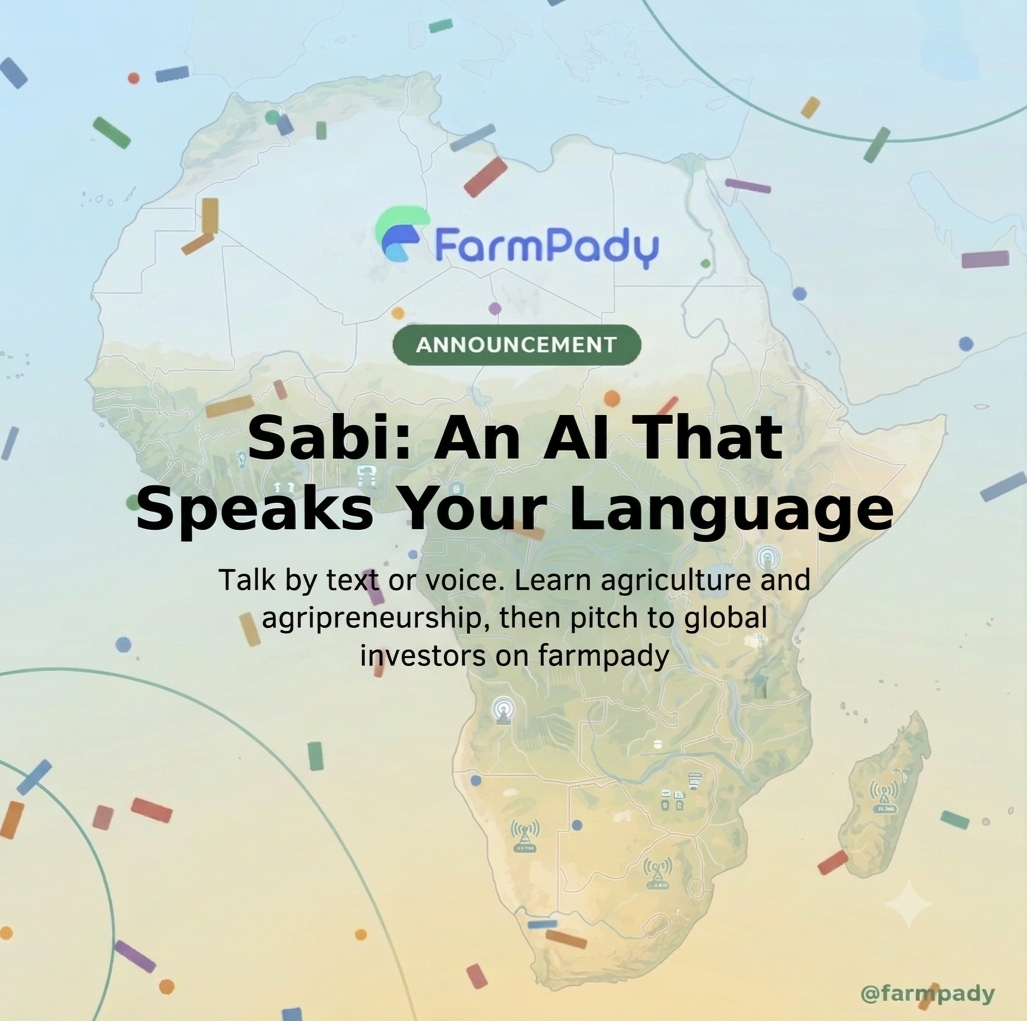
🌾 Sabi is coming. 🌍- the AI that speaks your language, literally.
Across Africa, millions of farmers run real businesses - managing crops, workers, harvests, and risk - but get locked out of the systems built to fund them. Because those systems assume you read English, type fast, and already know investor language.
We are building Sabi to remove that wall.
Sabi is a conversational AI you can talk to - by text or by voice - in your own language. Ask it how to time your planting season, how to price your yield, how a loan actually works, or what "equity" means. It teaches. It explains. It meets you where you are.
And when you're ready, Sabi becomes your bridge: helping you frame your farm, your numbers, and your story so you can hold real conversations with global investors on FarmPady - no translator, no jargon, no gatekeeping.
A cocoa farmer in Ondo. A poultry agripreneur in Kaduna. A rice grower in Delta. Different languages, same ambition - and now, the same AI in their corner.
This is what we're building at FarmPady: making every African farmer investable, on their own terms.
Sabi is coming. 🌍
#Agripreneur #AfricanAgriculture #AgriInvestment #AgriTech
🌾 Sabi is coming. 🌍- the AI that speaks your language, literally.
Across Africa, millions of farmers run real businesses - managing crops, workers, harvests, and risk - but get locked out of the systems built to fund them. Because those systems assume you read English, type fast, and already know investor language.
We are building Sabi to remove that wall.
Sabi is a conversational AI you can talk to - by text or by voice - in your own language. Ask it how to time your planting season, how to price your yield, how a loan actually works, or what "equity" means. It teaches. It explains. It meets you where you are.
And when you're ready, Sabi becomes your bridge: helping you frame your farm, your numbers, and your story so you can hold real conversations with global investors on FarmPady - no translator, no jargon, no gatekeeping.
A cocoa farmer in Ondo. A poultry agripreneur in Kaduna. A rice grower in Delta. Different languages, same ambition - and now, the same AI in their corner.
This is what we're building at FarmPady: making every African farmer investable, on their own terms.
Sabi is coming. 🌍
#Agripreneur #AfricanAgriculture #AgriInvestment #AgriTech
Here's the thing nobody tells new farmers: ethical behavior on FarmPady isn't a moral nice-to-have. It's the actual strategy. A farmer who cuts corners might dodge accountability once. But they burn their account, their reputation, and their shot at ever raising capital again. A farmer who communicates honestly builds a track record that compounds - every completed project makes the next one easier to fund. The ethical path and the smart path are the same path.
And it goes beyond your own farm. Every investor you treat well makes it a little easier for the next farmer on this platform to get funded. Every investor you burn makes it a little harder for all of us. Your reputation isn't just your business anymore.
If you're raising capital or thinking about it, this is the mindset to bring in from day one. We built a full course on it: Investment Ethics - Your Obligations as a Farmer on FarmPady. Free, in your farmer dashboard, five lessons, under three hours.
Take it before your first bid, not after your first dispute.
https://t.co/xRhkkVXsCo
#NigerianFarming #FarmPady
Two farmers had the exact same crisis last dry season. One kept his farm wallet, his investors, and his reputation. The other lost all three.
Here's the difference, and why it matters more than almost anything else you'll learn as a farmer raising capital.
When the first investment lands in your farm account, something shifts. Input costs you couldn't cover last season are suddenly covered. The expansion you kept postponing is suddenly possible. It's a genuinely exciting moment and it's exactly the moment where farmers get into trouble, because excitement makes it easy to forget one plain fact:
That money isn't yours.
Not loosely, not "basically yours until harvest." Someone else earned it, someone else is trusting you with it, and Nigerian contract law treats what happens next as a binding agreement - not a favor, not a soft handshake deal. FarmPady's platform agreement backs that up with real enforcement. An investor who doesn't get their agreed return has recourse. This isn't meant to scare you off investment. It's meant to make sure you go in with your eyes open.
Here's the part most farmers get wrong: they think the risk is the crop failing. It isn't - not by itself.
A drought that cuts your yield, a market crash that eats your margin, a pest outbreak that damages the harvest - that's agriculture. Every investor who puts money into a farm knows that risk exists. If you communicate it honestly and early, that's a business setback. Manageable. Survivable.
What isn't survivable is going quiet. Which brings me to Olawale and Segun. 🧵
https://t.co/xRhkkVXsCo
Same crisis. Same weather. Completely different outcomes. The variable wasn't the drought , it was what each of them did in the first 48 hours.
That's really the whole lesson: misusing investor capital is fraud, not bad luck, and the law and the platform both treat it that way. Being inexperienced isn't a crime, but hiding that inexperience when you pitch a project is. And silence - even when the underlying problem is completely legitimate - is its own violation, separate from whatever went wrong on the farm.
Here's why these particular varieties still matter enough for IITA to be spotlighting them again.
Back in 2023, IITA and Nigeria's National Root Crops Research Institute (NRCRI) released three new yam varieties: UMUDa35-Delight, UMUDr33-Blessing, and UMUDr34-Sunshine. The release went through Nigeria's National Committee on Naming, Registration, and Release of Crop Varieties, Livestock Breeds and Fisheries, the official body that has to approve a variety before it can legally reach farmers. UMUDa35-Delight is Dioscorea alata, known as water yam. UMUDr33-Blessing and UMUDr34-Sunshine are both Dioscorea rotundata, the white yam that dominates Nigerian farms and kitchens. All three were bred by IITA and released to farmers through NRCRI's station in Umudike.
IITA is bringing this back into the spotlight now as part of its yam-focused campaign, and the reasoning behind these varieties is worth repeating: high yield, high dry matter content, strong flour production, and good boiling and pounding qualities. That last point matters more than it sounds. A variety can yield well in the field and still fail completely in the kitchen if it doesn't pound into proper fufu or hold up the way people expect. Breeders have to solve for the field, the pot, and the processing plant all at once - a much narrower target than simply "more yam per hectare."
Why revisit a three-year-old release at all? Because varieties like these don't finish their work at the naming ceremony - adoption takes years, and a variety only proves its value once it's actually spread across farms and shown up in flour mills and markets. Nigeria produces more yam than any other country on earth, well over half the world's supply. It's a staple, a cultural crop, and an export earner all at once. Better varieties mean better yields for the same land and labor, less post-harvest loss, more consistent raw material for processors, and improved nutrition for households that depend on yam as a dietary staple.
It's a reminder that a lot of the highest-leverage work in African agriculture isn't happening in a field with a tractor - it happened years earlier, in a breeding program, long before a farmer ever planted the tuber.
Original release details: https://t.co/NsQ2mNCCYb
#WithScienceWeCan #IITAResearch #FoodSecurity #IITAYamMonth
Improved yam varieties are doing more than increasing yields, they are helping provide nutritious, high-quality food for families across Africa.
Through research and innovation, IITA and its partners have developed yam varieties with high dry matter, excellent boiling and pounding qualities, and good flour yield. These traits improve the quality of yam-based foods while supporting food and nutrition security.
By developing varieties that meet the needs of farmers, processors, and consumers, IITA is contributing to healthier diets and more resilient food systems.
Read more:
https://t.co/MV64c4MF1e
@CGIAR@IITARWANDA@benin_iita@IITA_Uganda@iitatv@RadioIITA
#WithScienceWeCan #IITAResearch #FoodSecurity #IITAMandateCrops #IITAYamMonth
Ok so somebody sent a DM, "what is FarmPage and why do I need it?..."
If you're new here, this is for you. Your FarmPage is your business profile on FarmPady - the one page an investor sees before they ever call you, visit your farm, or ask a single question. It's pitching for you, whether you're in the room or not.
Think of it less like a listing and more like proof. Investors want to see proof of scale (how much are you actually growing), proof of operation (real infrastructure - storage, water source, working equipment), and proof of person (who's actually running this day to day).
A complete FarmPage answers all three before an investor even has to ask. That's the whole job it's doing for you.
Case study: a cassava farmer in Oyo State had a FarmPage sitting untouched for over a year - three photos, no updates, zero inbound interest. After a FarmPady review, he added seven photos: his processing shed, his water source, a wide shot of his 15-hectare farm at harvest, and himself supervising his workers.
Same farm. Same output. Within five weeks, two investors requested a call. One turned into a ₦3.4 million expansion loan.
Nothing about his farming changed. What investors could see of it did - and that's the entire point of a FarmPage.
New to FarmPady? Start by building yours properly: https://t.co/n5VTLtSdDD
#Agripreneur #AgriInvestment
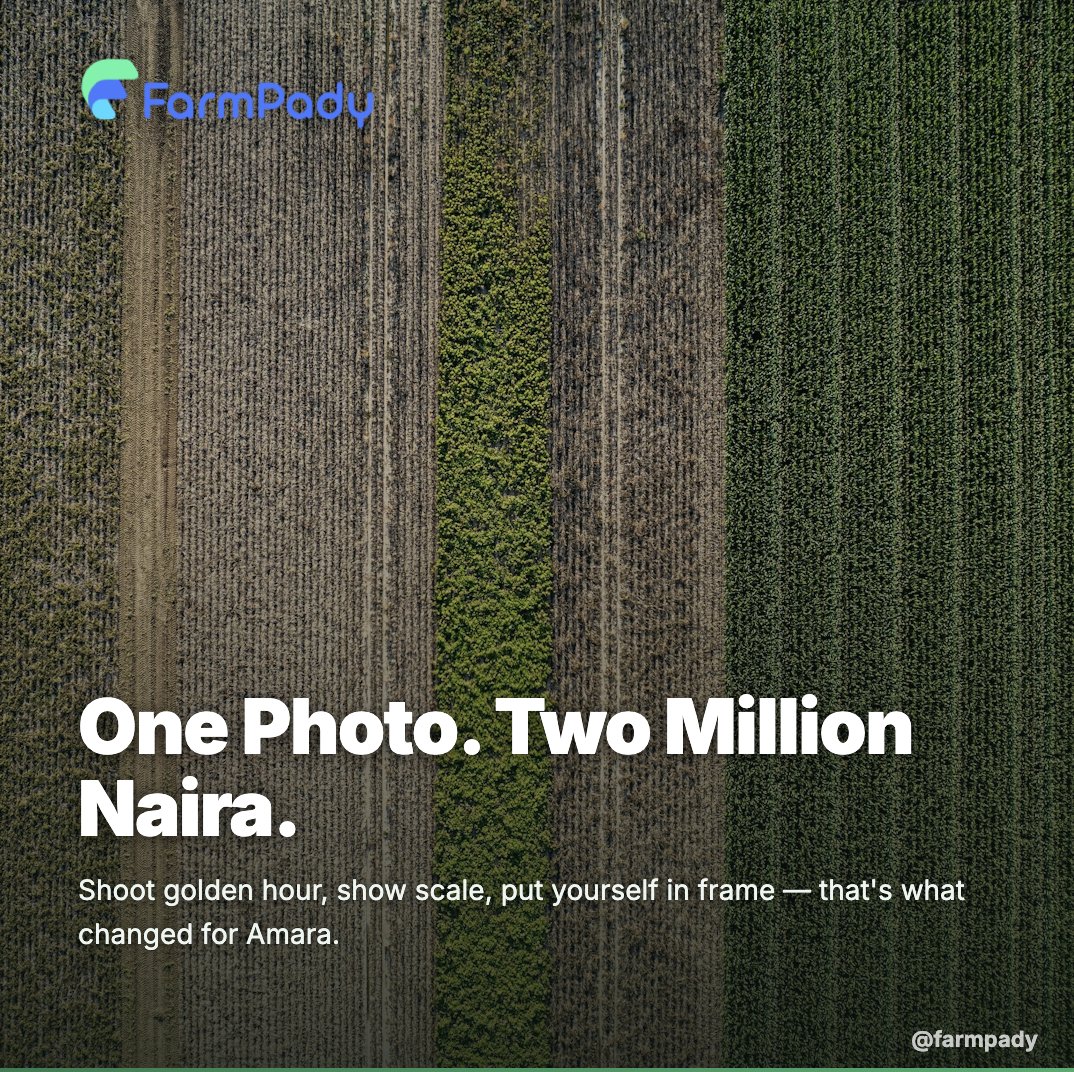
One photo unlocked ₦2 million for a watermelon farmer in Niger State. Here's what changed.
Amara had farmed watermelons for eight years. Her FarmPage had twelve photos - all shot in harsh midday sun, all tight close-ups of individual fruit with no scale, no context, no sign of a person behind the farm. Views were steady. Bids weren't coming.
A FarmPady workshop facilitator gave her one note: take a wide shot at harvest that shows the scale of what you're growing, and put yourself in it.
She went out the next week at 6:30am - golden light, 200 metres of watermelon rows loaded with ripe fruit, herself in frame. She made it her new cover photo.
Profile views doubled in three months. She landed bids totalling ₦2.1 million, including one investor who came back specifically because of that image: "I had seen your page before and moved on. That new photo brought me back. I could see exactly what I was investing in."
The technical lesson is simple and free: shoot in the first and last hour of daylight, not between 10am and 3pm when the sun bleaches colour and flattens everything. Use the rule of thirds. Show foreground and background together so investors can judge scale. And put yourself in at least one photo - investors are funding a person as much as a farm.
Every FarmPage needs photos of: a wide cover shot, your crop up close, your water source, your equipment in use, your storage, a harvest shot, and you, working.
No professional camera required. Just good light and a plan.
Update your FarmPage photos this season: https://t.co/n5VTLtSdDD
#Agripreneur #AgriTech #NigerianFarming
One photo unlocked ₦2 million for a watermelon farmer in Niger State. Here's what changed.
Amara had farmed watermelons for eight years. Her FarmPage had twelve photos - all shot in harsh midday sun, all tight close-ups of individual fruit with no scale, no context, no sign of a person behind the farm. Views were steady. Bids weren't coming.
A FarmPady workshop facilitator gave her one note: take a wide shot at harvest that shows the scale of what you're growing, and put yourself in it.
She went out the next week at 6:30am - golden light, 200 metres of watermelon rows loaded with ripe fruit, herself in frame. She made it her new cover photo.
Profile views doubled in three months. She landed bids totalling ₦2.1 million, including one investor who came back specifically because of that image: "I had seen your page before and moved on. That new photo brought me back. I could see exactly what I was investing in."
The technical lesson is simple and free: shoot in the first and last hour of daylight, not between 10am and 3pm when the sun bleaches colour and flattens everything. Use the rule of thirds. Show foreground and background together so investors can judge scale. And put yourself in at least one photo - investors are funding a person as much as a farm.
Every FarmPage needs photos of: a wide cover shot, your crop up close, your water source, your equipment in use, your storage, a harvest shot, and you, working.
No professional camera required. Just good light and a plan.
Update your FarmPage photos this season: https://t.co/n5VTLtSdDD
#Agripreneur #AgriTech #NigerianFarming
The most common mistake farmers make when pitching for investment is pitching like a farmer.
Soil quality. Variety performance. Market relationships. Hard work. All of it matters enormously to you and to an investor who's never seen your land, none of it means anything on its own.
Investors evaluate three things, in this order: Will I get my money back? Will the return be worth the risk? Do I trust this farmer enough to find out?
Your FarmPage, your project listing, your response time to questions every layer of your pitch should be built to answer those three questions with evidence, not assertions. Take ROI. An investor's default assumption is that your headline number is optimistic, they've seen 40% promises deliver 8%. The fix isn't a bigger number. It's showing your work: historical yield data, named markets with current prices, a full cost breakdown, and an ROI that's clearly derived from those numbers rather than pulled from hope.
New to the platform? You're not stuck. Josephine had never run a FarmPady project. She was up against seven farms in Anambra State, four with real track records. Instead of competing on history she didn't have, she competed on transparency: a 400-word financial breakdown, twelve cost line items, soil analysis she paid for herself, current prices from three named Onitsha markets, four specific risks with mitigation plans and an upfront admission that this was her first project, priced conservatively because of it.Her listing was fully funded in nine days.
Faster than all four veterans. One investor told her: "I usually only invest with farmers I know. Your listing was so specific that I felt like I knew you."Honesty about your limitations, backed by rigorous preparation, beats a track record you don't have yet. Start building a pitch investors trust: https://t.co/n5VTLtSdDD
#Agripreneur #AgriInvestment #NigerianFarming
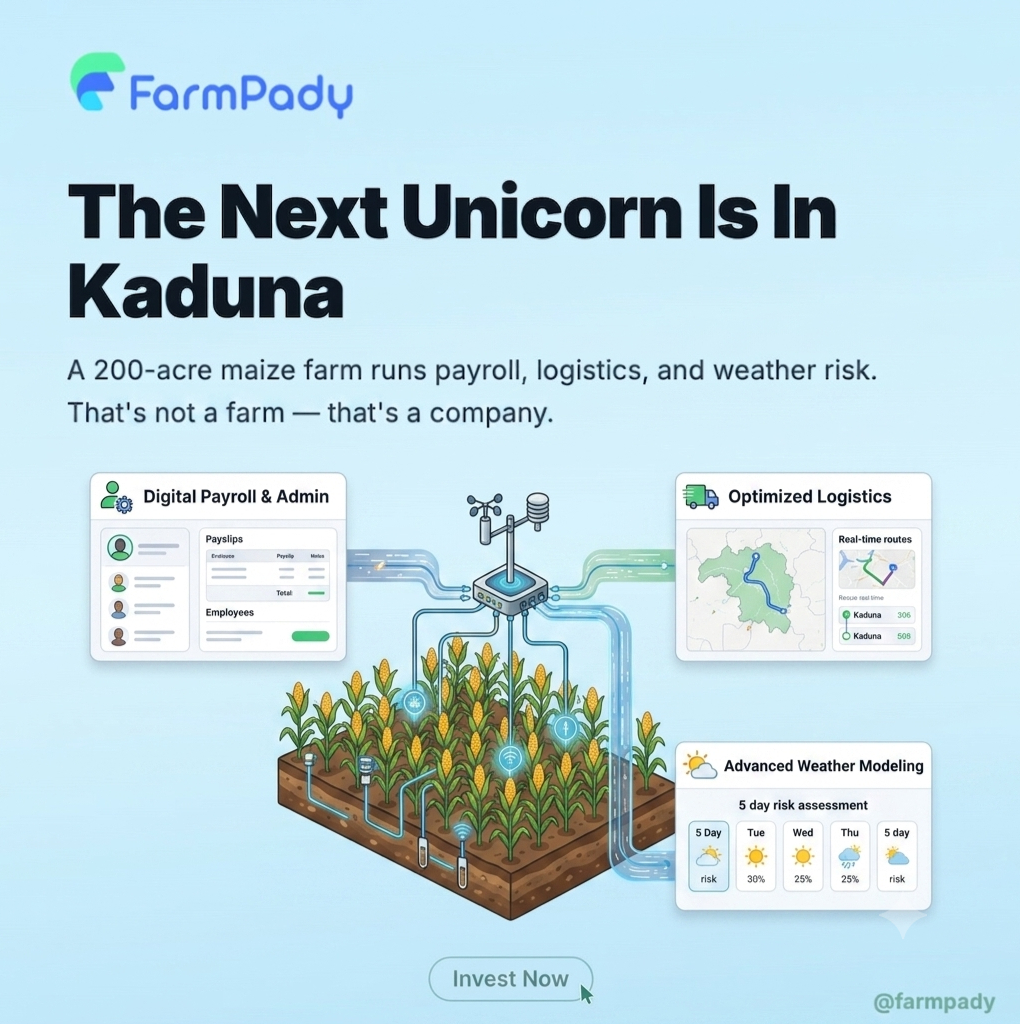
A 200-acre maize farm in Kaduna runs payroll for 40 workers, manages logistics, and hedges weather risk.
That's not a farm. That's a company.
Investors hunt for the next unicorn in Lagos. It's already growing in Kaduna. 🌾
#Agripreneur#AfricanAgriculture
#JobOpening
IITA-@CGIAR invites applications for the internationally recruited position of Hub Director-Western Africa Hub & Sahel and Agricultural Policy Expert:
Educational Qualifications and Experience
🎓The candidate should possess an advanced degree (https://t.co/vadCFwz4YC. or Ph.D.) in Agricultural Science or a related field from a reputable institution
📌Minimum of at least 20 years of relevant professional experience, including a minimum of five years in a senior leadership role
🏢Duty Station: Abuja -Nigeria
📌General information: The contract will be for an initial period of three years. IITA offers an internationally competitive remuneration package.
📌Applications: Applications must include a cover letter which should address how the candidate’s
background/experience relates to the specific duties of the position applied for, curriculum vitae, and
names and addresses of three professional referees (which must include either the Head of the
applicant’s current or previous organization or applicant’s direct Supervisor/Superior at his/her present or former place of work). The application should be addressed to the Director of People and Culture.
Please complete our online application form using this link: https://t.co/JLHkZLnOH8
Closing Date: 24 July, 2026
IITA is an equal opportunity employer and is committed to building a diverse workforce, particularly
welcoming applications from women.
@Jobbermandotcom@JobbermanGhana@MyJobMag