Our mission is to improve public safety by closely monitoring the aviation industry and the government agencies responsible for regulating the industry.
When 260 people died aboard Air India Flight 171 and on the ground, the world was given a simple explanation—but what if it’s not only wrong, but a deliberate effort to deflect the truth?
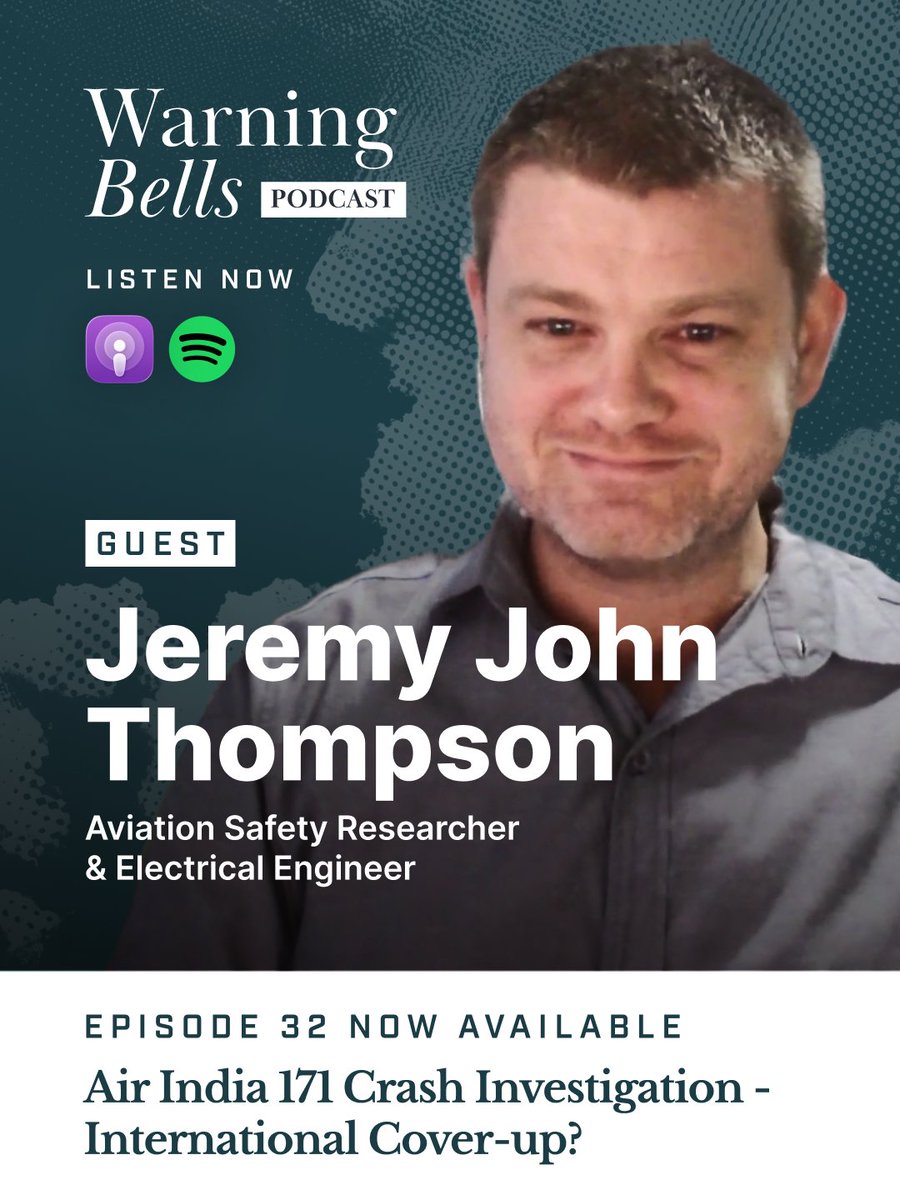
In this two-part episode, Ed and Joe are joined by relentless investigative journalist Rachel Chitra, who has uncovered gaps, omissions, and uncomfortable questions buried deep within the official probe.
Meanwhile, electrical engineer Jeremy John Thompson lays out a chilling scenario of cascading electrical failures that could have crippled the aircraft in seconds.
Together, their findings point to at least two other credible explanations that challenge the narrative the public has been told. If they’re right, the real story of Air India 171 isn’t about the pilots—it’s about the plane and the international cover-up.
Read more in the latest edition of the Aviation Watchdog Report on our website and subscribe to get new articles sent directly to your inbox.
https://t.co/tWE0ssq4wm
A recent analysis of the FAA’s Service Difficulty Reports indicated there were a total of 501 fume events reported in the first three months of 2026.
These reports cover only a three-month period, only U.S. carriers, and only the events the airlines were aware of and were willing to report. The actual number of events is likely much higher.
The Foundation for Aviation Safety continues to monitor the frequency of “fume events” and is calling on the FAA begin taking definitive action. The FAA and the airlines continue to ignore the potential health effects of exposure to aircraft air contamination and the problem certainly isn’t going away. If anything, it is getting worse.
Most passengers assume the plane they're boarding meets every current safety regulation - but it isn't required to.
Boeing told the FAA the #737MAX doesn't meet certain regulations, the FAA allowed it to keep flying, and the public was never informed.
Javier de Luis is an MIT aerospace engineer and the brother of Graziella de Luis, who perished on Ethiopian Airlines Flight 302. He's one of the family members and industry experts featured in Standards, The Foundation for Aviation Safety's new documentary investigating the certification failures, manufacturing defects, and government oversight failures behind 346 deaths on two Boeing 737 MAX airplanes, and asking why 47 defects on the 737 MAX remain unresolved today.
We are tracking this ongoing electrical problem, and a growing list of additional defects on the Boeing 737 MAX and Boeing 787 on our website. ⬇️
https://t.co/Ts651SgAzC
The public has been told the Boeing 737 MAX is the most comprehensively scrutinized commercial airplane ever, yet another electrical defect was announced in February that can cause excessive cabin and flight deck temperatures, which could result in injury or incapacitation of the flight crew and passengers.
Captain Tajer is a 30-year American Airlines 737 captain and spokesperson for the Allied Pilots Association, representing 15,000 pilots. He is one of the voices at the center of STANDARDS, our full-length documentary now available on YouTube.
https://t.co/pEUqNKnSzB
Captain Dennis Tajer has been flying for 36 years. He knows exactly what it means when a family drops someone off at the airport, and exactly who is responsible when the systems designed to protect them fail to do their job.
The Foundation for Aviation Safety is tracking more than 60 design and manufacturing defects on the Boeing 737 MAX and 787 models — documented through official FAA airworthiness directives, NTSB reports, and Boeing's own filings.
Several of these defects have no confirmed fix date. Others have no plan for a fix at all.
Prior to the 2026 DCA crash, U.S. airlines experienced an unprecedented 17 years without a fatal accident. That is an outstanding safety record; however, it is exactly the scenario that would lead to the acceptance of deviance. 🧵
Aircraft structures are expected to handle 150% of their maximum load before failing, a "1.5 safety factor.”
In reality, the industry is gradually accepting deviations from these, and other norms, and the safety margin seems to be shrinking.