Give your agent a browser. Open source browser agent: it acts only on controls the page actually has, and every claim cites the page. Local or Cloud. MIT.
fastbrowse "what's launching next on https://t.co/le5v15vRme?"
The page answered — word for word:
"$FASTBROWSE — token planned. Launching on Robinhood Chain."
Status: coming soon.
@RobinhoodApp@ponsdotfamily
fastbrowse used to have a Python core.
The Rust core that replaced it reached the same result on all 36 fixture tasks — with 18x less agent CPU, 54x faster startup and 5.4x less peak memory.
Same agent. Less machine.
Or don't run it — embed it.
run_task() takes a plain-English task and a start URL, and returns a typed, schema-validated answer — with a verbatim quote from the page behind every claim.
If it can't be proven from the page, it doesn't ship.
One agent, every interface.
A CLI for you. A Python library, Node and Go SDKs for your code. An MCP server for Claude Code, Cursor and Codex. A skill your coding agent installs itself.
Same Jev, same gates, everywhere.
The benchmark, in the open:
On 46 tasks, three runs each, against the hosted Browser Use agent — fastbrowse passed 99.2% of runs to their 96.3%.
And cost $0.0296 a run to their $0.3180. 10.7x less.
It picks. It does not invent.
Every page is indexed into the controls it actually has, and Jev picks from those — a button that isn't on the page can't be clicked, and there are no selectors to maintain.
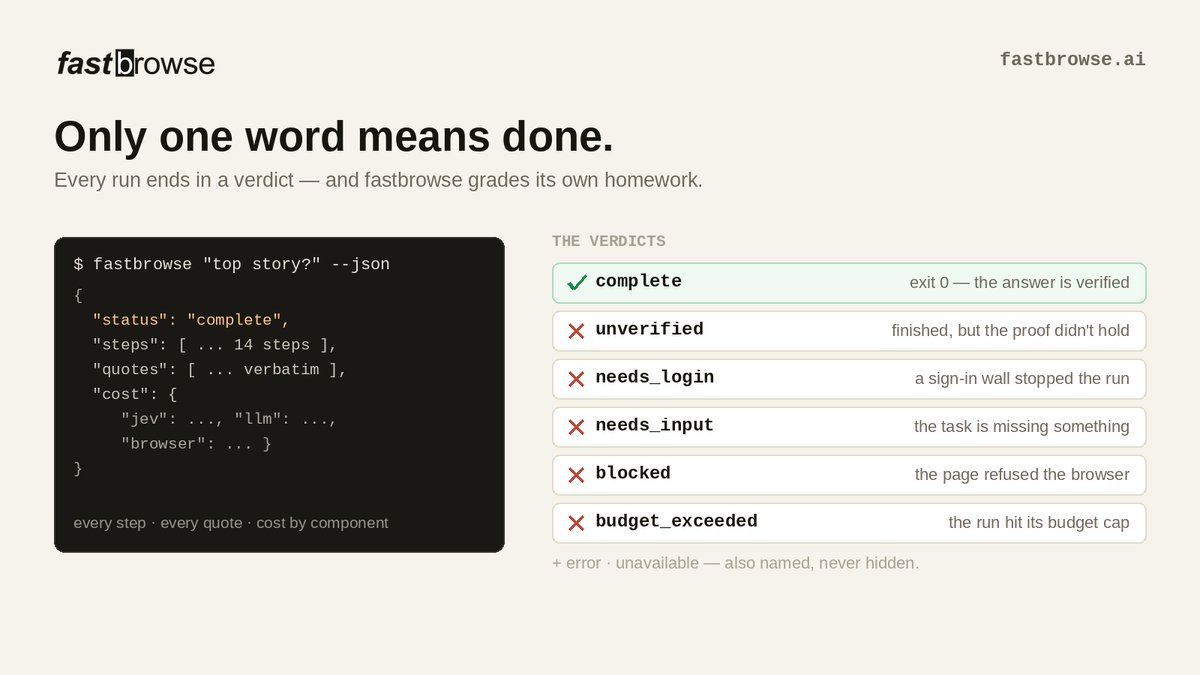
A browser agent that grades its own homework.
Every fastbrowse run ends in a verdict — and only one counts: complete, exit code 0. Anything else names what stopped it: unverified, needs_login, needs_input, blocked, budget_exceeded.
Every step, quote and cost is in the --json.
Your agent's browser, hosted.
fastbrowse Cloud runs every task in an isolated, clean Chrome — over a simple HTTP API. Runs keep going with your laptop closed, and in parallel. Free plan: $2 of runs a month, no card. Pay per run after that, from half a cent.
A browser agent that asks before it spends.
fastbrowse judges every irreversible action before it runs — unauthorized, it stops at needs_confirmation. Secrets stay sealed too: the model sees names, never values, and every output is redacted.
Give your agent a browser.
fastbrowse only acts on controls the page actually has — Jev indexes them first, picks the action, and every claim cites the page word for word. Irreversible actions stop for your OK.
Open source. Local or Cloud.
How fastbrowse works:
1. uvx fastbrowse "your task" — it opens a real browser
2. The page is indexed. Jev acts only on controls that are actually there
3. Every claim in the answer cites a quote from the page
Give your agent a browser.
Meet fastbrowse — the open source browser agent.
It picks from the controls a page actually has. It cannot click what is not there, and there are no selectors to maintain.
Every claim in an answer cites a verbatim quote from the page.
Run it locally, or hosted in the Cloud.