Sustainable Metabolic Health and Fasting Strategist for High Performing Professionals | Private One on One Advisory | Certified Human Performance Nutritionist
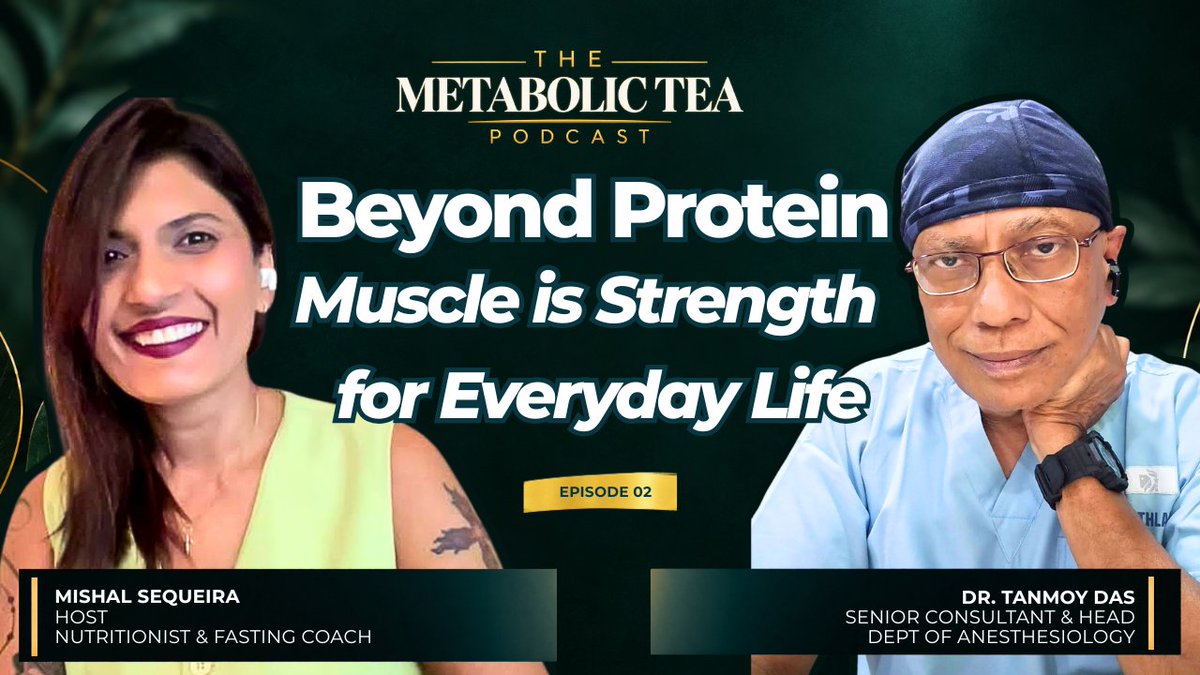
🎙️ Beyond Protein — Muscle Is Strength for Everyday Life
EP 02 - @drtanmoy shares why strength training & skeletal muscle matters for recovery from serious illness and surgery, preventing fatal fragility fractures and maintaining independence as we age.
https://t.co/XQgFoUAeKd
#Insulin is essential for survival, yet access to the right kind often depends on what a family can afford.
@NupurLalvani of @BlueCircleDiab argues India should add rapid- and long-acting insulin analogues to the National List of Essential Medicines.
https://t.co/nSclejsVA3
The ~70% figure (from tracer studies like Sonko et al.) holds mainly for mixed/higher-carb diets, where insulin favors adipose uptake of meal fat. On very low-carb diets, low insulin and fat adaptation raise oxidation rates, so a larger share of dietary fat is burned more promptly rather than stored long-term. Temporary turnover into adipose still occurs, but net depends on energy balance. Overfilled adipocytes remain a key driver of IR either way.
Some people’s businesses depend on me as their lucky mascot.
They’ll crumble if they don’t remember me, whether positively or negatively.
Such is my powerful presence in the universe.
Just imagine what would happen if they stopped posting about me: their shops would shut down!
Please do not forget he was resurrected into a vampire
after being killed by Voldemort,
only to be left to suffer as an insomniac with psychological issues,
before finally earning unlimited martinis on the tab of his British employer.
There is hope!
Meet Mishal Sequeira, sharing her module on Low Carb & Fasting for Weight Loss.
Explore practical strategies for using low-carb eating and fasting to support weight loss as part of the Nutrition Network course with Metabolic Health India®.
Enrol now
https://t.co/iiaNW027jT
A special moment from the World Nutrition Summit Oct 2026 in Cape Town - South Africa:
@ProfTimNoakes introducing me at the opening of the conference on the first day.
I’m grateful for the opportunity to share my work & represent India at this international gathering of low-carb experts.
Thank you, Professor Noakes, for the warm introduction.
When a person loses fat, their fat cells shrink, but the number of fat cells stays the same. The number is largely set during childhood and adolescence, and it holds steady through adulthood in lean and obese people alike, even after major weight loss.
That doesn't mean the cells never change. About 10 percent of fat cells are replaced every year, and the body keeps the total number steady.
This is why I care so much about what kids eat, and it's why I focus adults on fat cell size. Smaller, healthier fat cells are the goal, and that comes from lowering insulin and keeping the weight off over time.
Vegetarian low carb is much more than paneer and salad.
It requires an understanding of protein adequacy, carb thresholds, nutritional quality, metabolic applications & practical meal construction.
The Low Carb for Vegetarians course goes beyond food lists. It teaches the science and strategy needed to build nutritionally complete, culturally relevant vegetarian low-carb + ketogenic plans.
Created by @NutritionNetwrk in association with Metabolic Health India®.
Enrol now and explore the possibilities.
49 enrolments so far and the response has been truly encouraging!
Participants have joined from India, the USA, Europe, South Africa and other parts of the world.
Here are some of the comments we have received:
1) “An excellent course. It makes it much easier to understand how to support vegetarian clients effectively.”
2) “This course has added value to my professional qualifications and given me a clearer understanding of how to manage vegetarian cases.”
3) “I had never enrolled vegetarian or vegan clients earlier, but I now feel confident working with them. Thank you, Nutrition Network & Metabolic Health India!”
4) “Some of the concepts are truly unique and are not covered in other courses. The programme is compact yet sufficiently comprehensive.”
5) “I was amazed by the variety of vegetarian, vegan, low-carb and ketogenic dishes included in the course. Special appreciation for the Low Carb Vegetarian Kitchen section!”
6) “The course successfully connects scientific principles with practical, culturally relevant food choices.”
7) “It goes beyond simply reducing carbohydrates and explains protein adequacy, nutritional quality & practical meal formulation.”
8) "The historial low-carb references are excellent. Never knew this. Thank you"
A proud beginning for our entire team and we look forward to reaching many more learners worldwide.
- Metabolic Health India @MetHealthInd
The fear that GLP-1 drugs strip away muscle is overstated. In the STEP 1 body scan substudy, fat mass fell about twice as much as lean mass, 19.3% versus 9.7%, so the share of the body that was lean actually went up. Some lean loss happens with any weight loss, since a smaller body needs less support tissue. A person on a GLP-1 still needs adequate protein and resistance training, but the drug itself isn't causing the muscle loss people fear.
After menopause, insulin resistance becomes much more common in women, and the usual low-fat, high-carbohydrate advice keeps insulin high all day. When insulin comes down, fat can be released from fat cells again, and hunger and blood sugar settle. That is why a woman over fifty often feels better within weeks of cutting the starches and sugars.
There are essential fatty acids and essential amino acids. There is no essential carbohydrate.
The body does need some glucose, mainly for red blood cells, which have no mitochondria. But the liver and kidneys can make all of it through gluconeogenesis, typically around 100 to 150 grams a day in adults, using lactate, glycerol from fat, and a small amount of amino acids.
Carb tolerance still varies a lot from person to person, and my new book, The Carb Crisis, explains why. The evidence is clear: carbs are optional, not required. Preorder link in the first reply.
Some people starting a ketogenic diet notice their thyroid T3 levels drop. And many, including some clinicians, immediately conclude keto is causing hypothyroidism.
The reality is more nuanced than that. Let's talk about what a lower T3 actually means and what it may not mean. 🧵
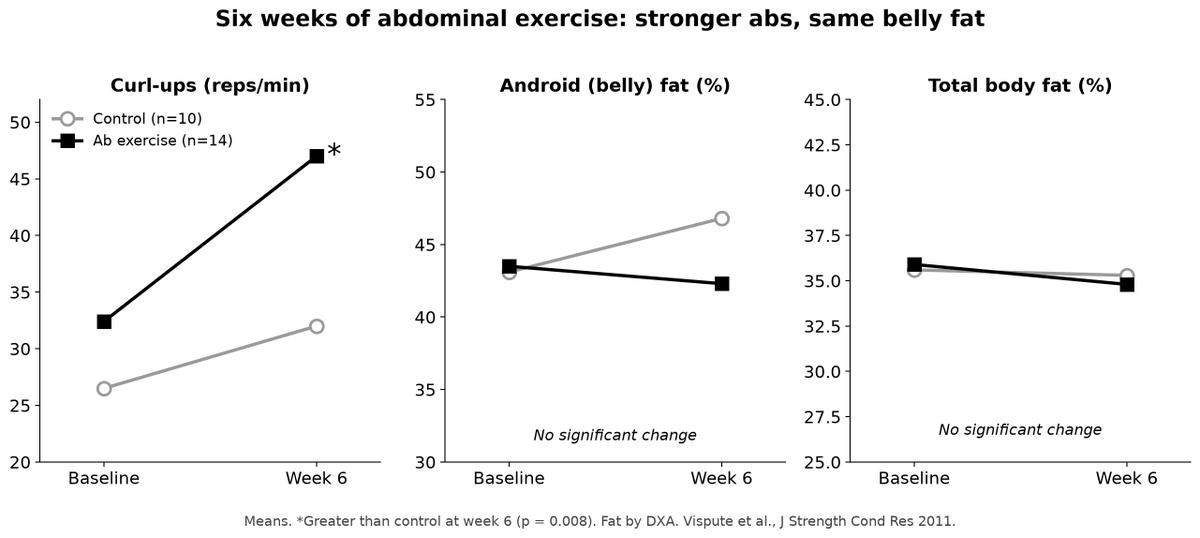
Exercising a specific muscle will not selectively burn the fat on top of that muscle. This has been studied well.
In one randomized trial, researchers assigned 24 sedentary adults to either 7 abdominal exercises, 2 sets of 10 reps, 5 days a week for 6 weeks, or no exercise. Diet was held constant.
The ab group got much stronger at curl-ups, ending at 47 reps compared with 32 in the controls. But body weight, body fat percentage, abdominal fat, waist circumference and abdominal skinfolds did not change.
Where fat is stored and released is set by hormones, mainly insulin. When insulin stays high, fat cells hold on to their fat, wherever they are.
The evidence is clear: belly fat is a hormonal problem, not a crunch deficiency.