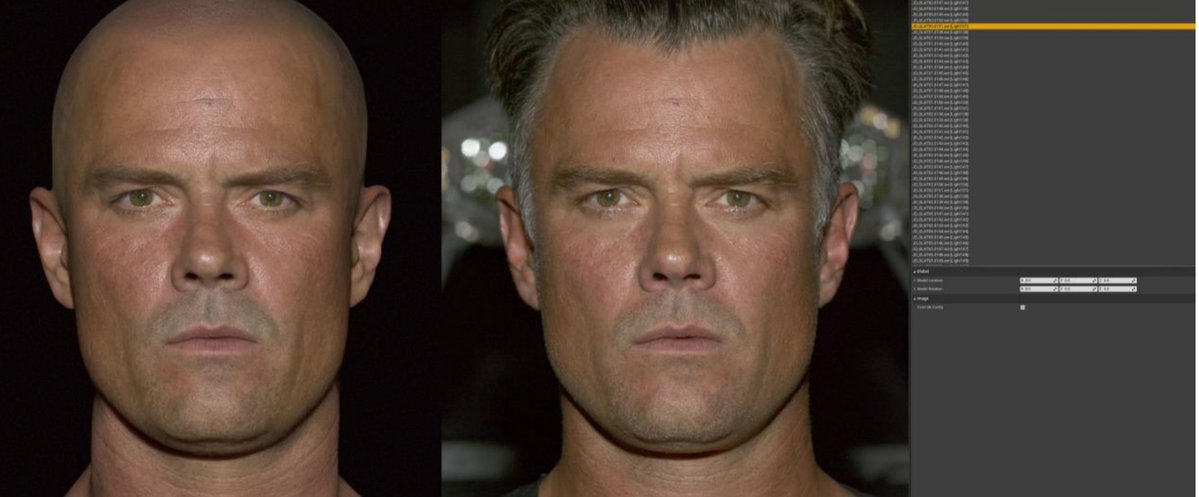
Introducing sigmaPBR - our new PBR solver which is currently in closed beta testing.
sigmaPBR uses photometric images, camera poses, and input geometry to reconstruct accurate physically based material properties for use in rendering, ML training and 3D scanning pipelines.
Here is the difference between graphics research and an expensive image filter.
The Callisto Protocol’s skin rendering is the result of actually modelling the problem. Its rendering research deals with skin thickness, light transmission, subsurface scattering, specular response and how those properties behave under different lighting conditions. The render is 1:1 to the actual photo, it doesnt add imaginary sweat, oily skin, shadows etc.
The important part is that the material stays the material. Change the lighting, hair or environment and the skin still responds according to the parameters authored by the artists. The renderer isn’t looking at the final frame and deciding that “realistic human skin probably needs more pores, grease, contrast or wrinkles.”
That’s fundamentally different from what DLSS 5 is doing.
DLSS 5 operates on the final rendered image and uses a learned model to guess a more photorealistic result. It does not suddenly possess a better physical model of that character’s skin, cloth or lighting. It is estimating what those pixels should look like from its training data.
And that distinction becomes obvious in examples like this: facial regions acquire shadows that weren’t produced by the scene’s original lighting, while clothing gains apparent detail that wasn’t present in the authored material.
Those additions may look plausible. Plausible is not the same thing as correct.
A physically motivated skin shader asks: given this geometry, material and incident light, how should light interact with it?
A generative image model effectively asks: given these pixels, what would a more photorealistic version probably look like?
The first is graphics research. The second is inference.
Callisto demonstrates what happens when you research the material and improve the renderer itself. DLSS 5, at least from these examples, looks more like an extremely expensive “realism” filter applied after the actual rendering work has already been done.
i saw a lot of Box3d on my feed and I couldn't contain myself and built a gravity gun playground in @threejs with it! Super fun to play around with! @erin_catto cooked with this one
(props to @monteslu for the wasm version)
I'm disheartened to learn that CD PROJEKT S.A. issued a DMCA notice against Luke Ross for removal of the truly incredible Cyberpunk 2077 VR mod enabling PCVR users full immersion in its epic environments. Details here. https://t.co/9EX1YKHLaF
@Flat2VR@UploadVR@RtoVR@Zimtok5