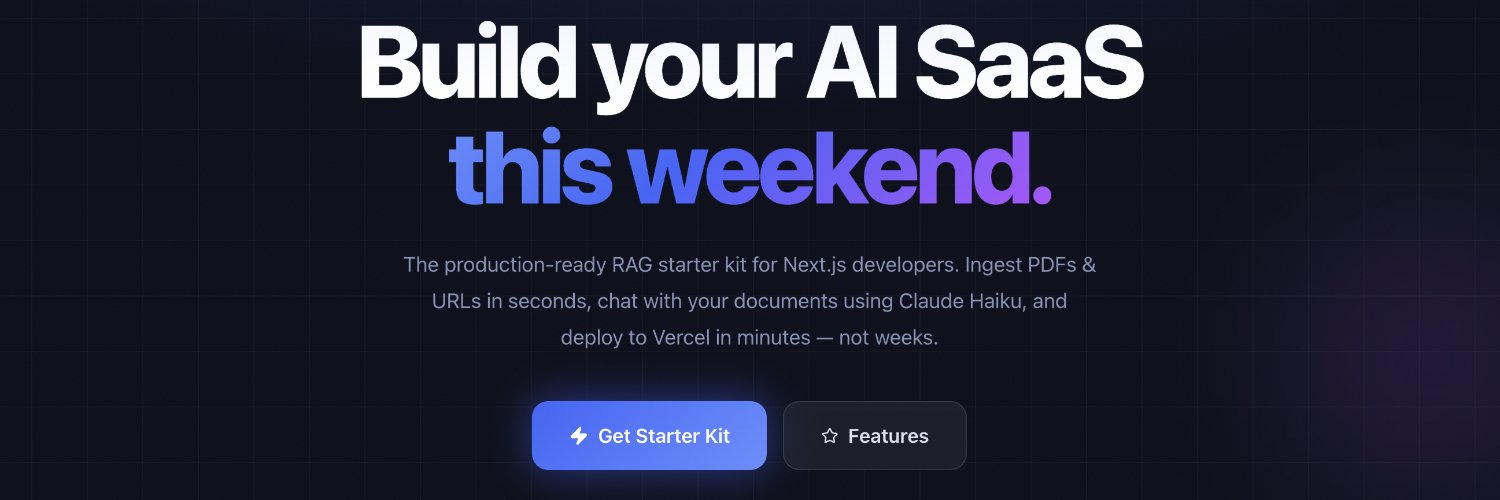
The annoying part of RAG is usually vector DB costs.
I forced 1024-dim embeddings instead of the default, which cut our Pinecone storage bill by ~33% with no real quality loss for most use cases.
https://t.co/WMIATDNIrY
I spent 3 weeks building a RAG app. You can do it in 1 command. 🚀
Not exaggerating. Three weeks. 😅
I wanted to build something simple: let people upload docs and chat with them. Classic RAG app. Every tutorial makes it look like a weekend build.
Here's what actually happened:
🧩 My chunking logic had an off-by-one bug - didn't crash, just quietly made every answer worse ⏳ My embedding provider rate-limited me mid-ingest, no retry logic, so half my docs silently never made it in 📡 My streaming broke because my backend and frontend spoke two different protocols - model was answering perfectly, UI just sat there frozen 🗂️ I hadn't namespaced my vector store properly, so two different use cases ended up sharing the same data
None of that was the fun part. None of it was "AI." It was plumbing. 🔧
So I built the shortcut I wish I had. 👇
FastRAG - the RAG starter kit you actually own
✅ Ingest PDFs & URLs (yes, even the messy JS-rendered pages)
✅ Embeddings via Voyage AI voyage-3.5
✅ Vector storage in Pinecone, namespaced correctly from day one
✅ Chat powered by Claude Haiku 4.5 - fast, cheap, streaming that actually works
✅ Full Next.js frontend included - upload flow, chat UI, source citations
Setup looks like this:
$ npx fastrag ingest ./docs
✓ 214 chunks embedded to Pinecone
✓ chat API live at /api/chat
That's it. The thing that ate 3 weeks of my life is now one command. ⚡
Why source code, not another SaaS subscription 💸
I didn't want to build a "RAG-as-a-service" you rent forever - stuck with someone else's rate limits, someone else's pricing hikes, someone else's roadmap. FastRAG is real code. You own it. Swap any piece. Ship it under your name.
Pricing - pay once, keep forever 🎯
💡 Starter - $19 - full source, Claude Haiku 4.5 + Voyage AI, Pinecone done right
🔥 Pro - $49 - everything above + multi-tenant dashboard, auth-ready, priority support
No subscriptions. No usage tax on your growth.
If you're building an AI SaaS right now 👀
You already know the wall: you get 80% through a RAG tutorial, and then it's "okay but in production I also need retries, and rate limiting, and namespacing, and streaming that doesn't silently break." This skips you straight past that wall.
Try the live demo first — see it ingest and answer for real before spending a dollar. 🎬
https://t.co/VAoqt94BK3
Building this in public 🛠️ — questions on the stack, pricing, or what's next, drop them below 👇
Checkout Bio for Fastrag 🚀
The RAG bugs that don't crash, they just quietly make your answers worse
Disclosure up front: I build a RAG starter kit, so take the plug at the end for what it is. Wanted to actually share the bugs, not just drop a link.
The ones that got me:
Chunking on the wrong boundary. Doesn't crash, just degrades retrieval a little. You notice it as "the model seems dumber today" way before you notice it as a chunking bug.
Rate limits mid ingest with no retry logic. Some percentage of your docs just never make it into the vector store and you find out when a user asks about something that should be there and gets nothing.
Streaming protocol mismatch. Model answers fine, frontend expects a different data format, so the UI just sits there. No error anywhere. Took me a full evening to realize the model was never the problem.
Skipping namespace planning until you actually need multi tenancy, then having to migrate data that is already mixed together.
None of these are model or prompt problems. They are infrastructure problems that look like model problems, which is what makes them slow to catch.
If anyone else has hit weirder ones, especially around eval drift, curious to hear them.
(If it is useful to see a working setup with this stuff already handled, I packaged it at https://t.co/VAoqt94BK3. No pressure either way, mostly just wanted to compare notes.)
.
.
.
.
.
#fyf #SaaSTools #viralvídeo #rag #claude
Did you like the product?
Checkout Bio for Fastrag 🚀
The RAG bugs that don't crash, they just quietly make your answers worse
Disclosure up front: I build a RAG starter kit, so take the plug at the end for what it is. Wanted to actually share the bugs, not just drop a link.
The ones that got me:
Chunking on the wrong boundary. Doesn't crash, just degrades retrieval a little. You notice it as "the model seems dumber today" way before you notice it as a chunking bug.
Rate limits mid ingest with no retry logic. Some percentage of your docs just never make it into the vector store and you find out when a user asks about something that should be there and gets nothing.
Streaming protocol mismatch. Model answers fine, frontend expects a different data format, so the UI just sits there. No error anywhere. Took me a full evening to realize the model was never the problem.
Skipping namespace planning until you actually need multi tenancy, then having to migrate data that is already mixed together.
None of these are model or prompt problems. They are infrastructure problems that look like model problems, which is what makes them slow to catch.
If anyone else has hit weirder ones, especially around eval drift, curious to hear them.
(If it is useful to see a working setup with this stuff already handled, I packaged it at https://t.co/VAoqt94BK3. No pressure either way, mostly just wanted to compare notes.)
.
.
.
.
.
#fyf #SaaSTools #viralvídeo #rag #claude
Did you like the product?
Things I got wrong building RAG pipelines, before I got them right
Posting this for the RAG builders in here, not as a pitch - just the actual failure modes I hit, in case it saves someone a few days.
1. Chunking bugs don't crash, they degrade
The scariest bugs in RAG aren't the ones that throw errors. An off-by-one in your splitting logic, or chunking on the wrong boundary (mid-sentence, mid-table-row), doesn't fail loudly. It just quietly returns worse retrieval. You'll see it as "the model seems dumber today" long before you see it as a bug in your pipeline. If your eval scores drift for no obvious reason, check your chunk boundaries before you touch the model.
2. Rate limits will hit you mid-ingest, and silently drop data if you're not ready
If you're batch-embedding a large doc set and your embedding provider throttles you, and you don't have retry-with-backoff built in from the start, you don't get an error - you get partial ingestion. Some percentage of your chunks just never made it into the vector store, and you won't find out until a user asks about content that "should" be there and gets nothing back.
3. Namespace isolation is a day-one decision, not a day-fifteen fix
If there's any chance you'll need multi-tenancy - separate customers, separate projects, separate anything - decide your namespacing strategy before you write your first upsert. Retrofitting namespace isolation after data from two contexts is already mixed in the same index is a genuinely painful migration.
4. Streaming protocol mismatches fail silently, not loudly
This one cost me a full evening: backend sending raw SSE, frontend expecting a specific data-stream format (the 0:"chunk"\n protocol some frameworks require). The model was responding perfectly. The UI just never rendered it. No error, no crash - just a chat window that looks broken when the actual generation is working fine. If your streaming "isn't working," check the wire format before you touch the prompt or the model.
5. Role-mapping mismatches between frameworks
human/ai vs user/assistant — every framework and every model provider names conversation roles slightly differently. Miss one mapping in your history reconstruction and your database looks correct while your actual conversation context is silently wrong. Worth a unit test on its own.
The pattern across all five
None of these are model problems. They're not prompt engineering, not retrieval-quality problems, not embedding-model choice problems. They're infrastructure correctness problems that show up as symptoms that look like model quality issues - which is exactly what makes them slow to diagnose. If something feels "off" in a RAG pipeline, I've learned to rule out the plumbing before I start tuning anything upstream.
I ended up packaging the fixes for all five into a starter kit (Claude Haiku 4.5 + Voyage AI voyage-3.5 + Pinecone + Cheerio, MIT licensed, source you own) - https://t.co/VAoqt94BK3 - if you want the working version instead of debugging it yourself. But honestly, even if you never touch it, hopefully this list saves you a few of the days it cost me.
Curious what else people have hit - especially around eval drift or multi-tenant vector store design. Drop it in the replies.
I spent 3 weeks building a RAG app. You can do it in 1 command. 🚀
Not exaggerating. Three weeks. 😅
I wanted to build something simple: let people upload docs and chat with them. Classic RAG app. Every tutorial makes it look like a weekend build.
Here's what actually happened:
🧩 My chunking logic had an off-by-one bug - didn't crash, just quietly made every answer worse ⏳ My embedding provider rate-limited me mid-ingest, no retry logic, so half my docs silently never made it in 📡 My streaming broke because my backend and frontend spoke two different protocols - model was answering perfectly, UI just sat there frozen 🗂️ I hadn't namespaced my vector store properly, so two different use cases ended up sharing the same data
None of that was the fun part. None of it was "AI." It was plumbing. 🔧
So I built the shortcut I wish I had. 👇
FastRAG - the RAG starter kit you actually own
✅ Ingest PDFs & URLs (yes, even the messy JS-rendered pages)
✅ Embeddings via Voyage AI voyage-3.5
✅ Vector storage in Pinecone, namespaced correctly from day one
✅ Chat powered by Claude Haiku 4.5 - fast, cheap, streaming that actually works
✅ Full Next.js frontend included - upload flow, chat UI, source citations
Setup looks like this:
$ npx fastrag ingest ./docs
✓ 214 chunks embedded to Pinecone
✓ chat API live at /api/chat
That's it. The thing that ate 3 weeks of my life is now one command. ⚡
Why source code, not another SaaS subscription 💸
I didn't want to build a "RAG-as-a-service" you rent forever - stuck with someone else's rate limits, someone else's pricing hikes, someone else's roadmap. FastRAG is real code. You own it. Swap any piece. Ship it under your name.
Pricing - pay once, keep forever 🎯
💡 Starter - $19 - full source, Claude Haiku 4.5 + Voyage AI, Pinecone done right
🔥 Pro - $49 - everything above + multi-tenant dashboard, auth-ready, priority support
No subscriptions. No usage tax on your growth.
If you're building an AI SaaS right now 👀
You already know the wall: you get 80% through a RAG tutorial, and then it's "okay but in production I also need retries, and rate limiting, and namespacing, and streaming that doesn't silently break." This skips you straight past that wall.
Try the live demo first — see it ingest and answer for real before spending a dollar. 🎬
https://t.co/VAoqt94BK3
Building this in public 🛠️ — questions on the stack, pricing, or what's next, drop them below 👇
Things I got wrong building RAG pipelines, before I got them right
Posting this for the RAG builders in here, not as a pitch - just the actual failure modes I hit, in case it saves someone a few days.
1. Chunking bugs don't crash, they degrade
The scariest bugs in RAG aren't the ones that throw errors. An off-by-one in your splitting logic, or chunking on the wrong boundary (mid-sentence, mid-table-row), doesn't fail loudly. It just quietly returns worse retrieval. You'll see it as "the model seems dumber today" long before you see it as a bug in your pipeline. If your eval scores drift for no obvious reason, check your chunk boundaries before you touch the model.
2. Rate limits will hit you mid-ingest, and silently drop data if you're not ready
If you're batch-embedding a large doc set and your embedding provider throttles you, and you don't have retry-with-backoff built in from the start, you don't get an error - you get partial ingestion. Some percentage of your chunks just never made it into the vector store, and you won't find out until a user asks about content that "should" be there and gets nothing back.
3. Namespace isolation is a day-one decision, not a day-fifteen fix
If there's any chance you'll need multi-tenancy - separate customers, separate projects, separate anything - decide your namespacing strategy before you write your first upsert. Retrofitting namespace isolation after data from two contexts is already mixed in the same index is a genuinely painful migration.
4. Streaming protocol mismatches fail silently, not loudly
This one cost me a full evening: backend sending raw SSE, frontend expecting a specific data-stream format (the 0:"chunk"\n protocol some frameworks require). The model was responding perfectly. The UI just never rendered it. No error, no crash - just a chat window that looks broken when the actual generation is working fine. If your streaming "isn't working," check the wire format before you touch the prompt or the model.
5. Role-mapping mismatches between frameworks
human/ai vs user/assistant — every framework and every model provider names conversation roles slightly differently. Miss one mapping in your history reconstruction and your database looks correct while your actual conversation context is silently wrong. Worth a unit test on its own.
The pattern across all five
None of these are model problems. They're not prompt engineering, not retrieval-quality problems, not embedding-model choice problems. They're infrastructure correctness problems that show up as symptoms that look like model quality issues - which is exactly what makes them slow to diagnose. If something feels "off" in a RAG pipeline, I've learned to rule out the plumbing before I start tuning anything upstream.
I ended up packaging the fixes for all five into a starter kit (Claude Haiku 4.5 + Voyage AI voyage-3.5 + Pinecone + Cheerio, MIT licensed, source you own) - https://t.co/VAoqt94BK3 - if you want the working version instead of debugging it yourself. But honestly, even if you never touch it, hopefully this list saves you a few of the days it cost me.
Curious what else people have hit - especially around eval drift or multi-tenant vector store design. Drop it in the replies.
@Guronnimo Not a Claude Code replacement- FastRAG is a production-ready RAG starter kit that helps you build AI apps faster with extra layer of your specified knowledge using PDFs and urls.
The annoying part of RAG is usually vector DB costs.
I forced 1024-dim embeddings instead of the default, which cut our Pinecone storage bill by ~33% with no real quality loss for most use cases.
https://t.co/WMIATDNIrY
I got tired of spending 40 hours setting up Pinecone + chunking + streaming UI every time I wanted to build a "chat with your docs" app.
So I turned it into a starter kit. Here's what's inside 🧵
https://t.co/WMIATDNIrY