17) “As @WmHaseltine has been championing for months upon months, the federal government must assist those in isolation, financially, as well as with medical supplies and shelter if necessary”
Great piece. https://t.co/2j7Urvd2hr
16) “If we are to control these variants before they become out of hand, we need to adjust public health policy accordingly. As the Chinese have done, we should extend quarantine requirements to three weeks. Of course, people cannot be out of work for three weeks without pay…”
15) In response to the growing concerns of variants, the Chinese government increased their required isolation period to three weeks in the past few months. This more than encompasses the 13.3-day duration the researchers observed from the B.1.1.7 variant. https://t.co/vc6RVvP8TS
14) “If the B.1.1.7 variant infects someone and they only quarantine for seven to ten days, they may go on to infect others thinking they are free of the virus.
13) “CDC recommends that infected people remain in quarantine for 14 days but only require seven or ten days of quarantine based on the patient’s individual circumstances.”
11) Respiratory viruses typically have shorter lifespans and must jump from host to host quickly to survive and spread, but this virus sticks around for a while. Longer infections mean the virus has the opportunity to spread to more people, and positive feedback loop continues.
10) The CDC state that B.1.1.7 transmits at 50% the rate that non-B.1.1.7 SARS-CoV-2 is capable. The virus is adjusting to our immune responses, and now, we see the B.1.1.7 capable of withstanding the human immune response over 60% longer than previous viruses.
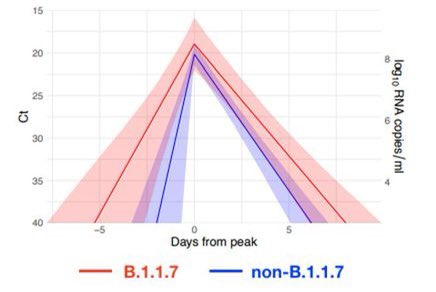
9) “The overall viral burden for those with B.1.1.7 was higher than their non-B.1.1.7 counterparts on average for a greater period of time.
The extended duration of B.1.1.7 is likely associated with its increased transmissibility.
8) “Additionally, peak viral concentrations for B.1.1.7 were slightly higher than non-B.1.1.7 patients. In other words, the B.1.1.7 patients experienced extended infections with more viral particles
7) These compare to a mean proliferation phase of 2.0 days, a mean clearance phase of 6.2 days, and a mean duration of infection of 8.2 days for non-B.1.1.7 virus.”
6) ““For individuals infected with B.1.1.7, the mean duration of the proliferation phase was 5.3 days, the mean duration of the clearance phase was 8.0 days, and the mean overall duration of infection was 13.3 days.
3) “That practice expanded to the recently begun 2020-2021 season, and Harvard University took the opportunity to genome sequence the basketball players’ samples for research purposes.
2) “The study was conducted in conjunction with the NBA. In Summer 2020, the NBA restarted their season after it was paused by the start of the Covid-19 pandemic. The players involved were isolated at Disneyworld resort and were administered daily Covid-19 testing.
INCREASE QUARANTINES? A study suggests that #B117 UK variant may remain in human hosts nearly 2x as long as non-B.1.1.7 #SARSCoV2, extending the potential contagious period from about 8 days to 13 days. This also helps explain great transmission of B117.🧵
https://t.co/bAh5cp46Jc
6) BC’s health chief initially took an ostrich approach to it all, thinking variants are no different. Then #P1 variant raged like a storm and she had to quickly backtrack and admit #P1 is more problematic.