study graph theory.
once you learn it, you start seeing graphs everywhere.
a graph is simple:
nodes → things
edges → relationships between things
but that abstraction can model an insane amount of the world.
• computer networks → machines are nodes, connections are edges
• robotics → locations become nodes, possible movements become edges
• social networks → people connected through relationships
• logistics → warehouses, roads, suppliers, routes
• biology → neurons, proteins, genes, metabolic networks
• software → dependencies, call graphs, distributed systems
• ai → knowledge graphs, graph neural networks, search
• economics → trade, transactions, supply chains
then learn the fundamentals:
> paths.
> cycles.
> trees.
> connectivity.
> shortest paths.
> minimum spanning trees.
> network flows.
> graph coloring.
the beautiful part is that completely different problems start collapsing into the same mathematical structure.
• routing packets through the internet.
• planning a robot’s path through a warehouse.
• finding the cheapest logistics route.
• analyzing connections between proteins.
different worlds.
same underlying mathematics.
that’s why graph theory is so powerful:
it teaches you to stop looking only at things and start looking at the relationships between them.
He posted three papers online, solved a 98-year-old mystery, then walked away from $1 million and the Fields Medal.
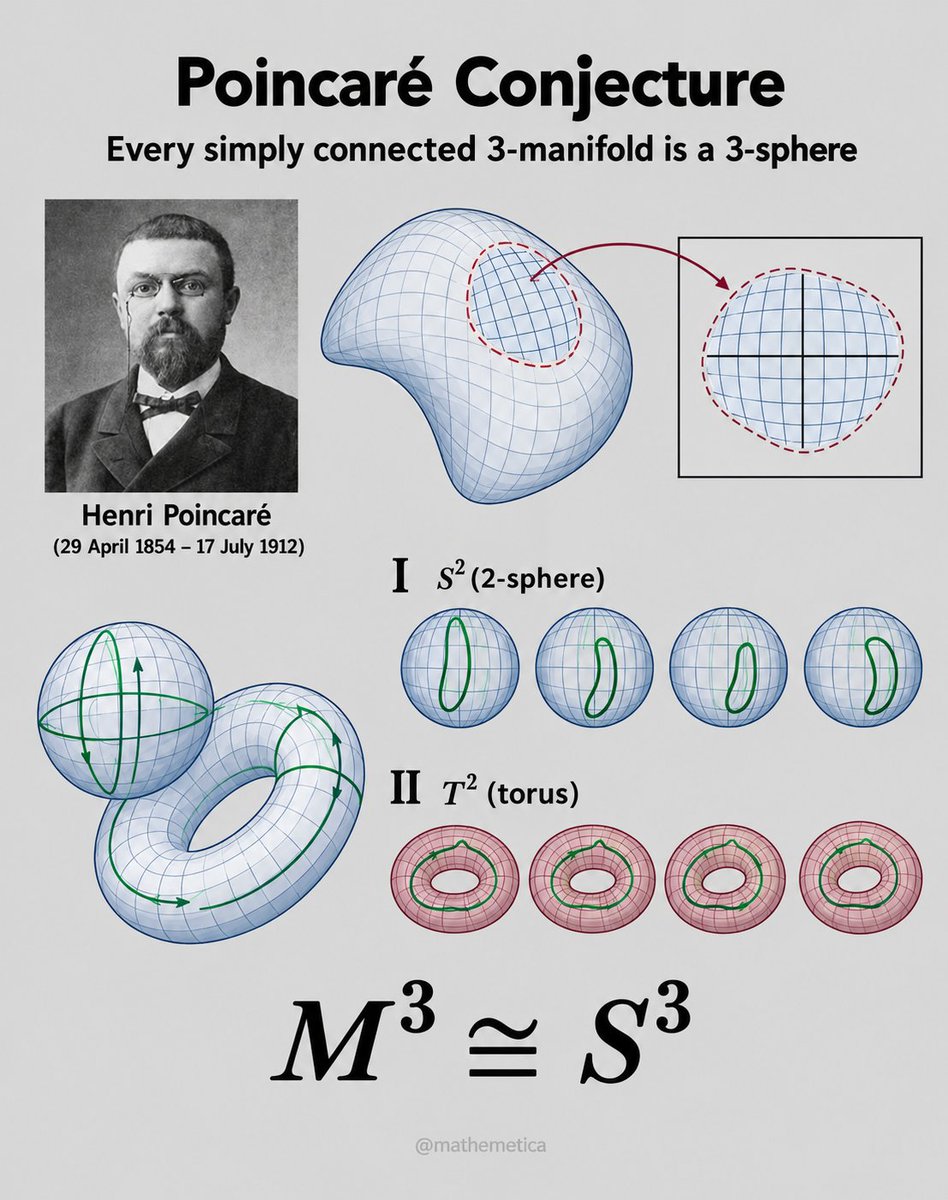
Grigori Perelman, the shy St. Petersburg mathematician who lived quietly with his mother and preferred foraging mushrooms to fame, finished what Henri Poincaré asked in 1904.
This image captures the idea: any loop on a sphere can shrink to a point, but a torus traps them around its hole. Perelman used Ricci flow plus surgery to prove every simply connected closed 3-manifold is a 3-sphere, then vanished from public life. A human who chose truth over glory. M³ ≅ S³.
Em breve veremos os criadores e youtubers de conteúdo tech falando sobre esse problema do milênio, sem nem saber do que se trata, em um vídeo cujo roteiro e explicação foram feitos pelo próprio chatGPT 👏🏻
We’re sharing a solution to the Navier-Stokes Millennium Prize Problem, one of the deepest problems at the frontier of mathematics.
The proof was produced by a group of agents, using an OpenAI next-generation model significantly more capable than GPT-6 Astra.
The problem concerns whether the description of smooth three-dimensional fluid motion modeled by the Navier-Stokes equations can break down. It has remained unresolved for roughly 90 years.
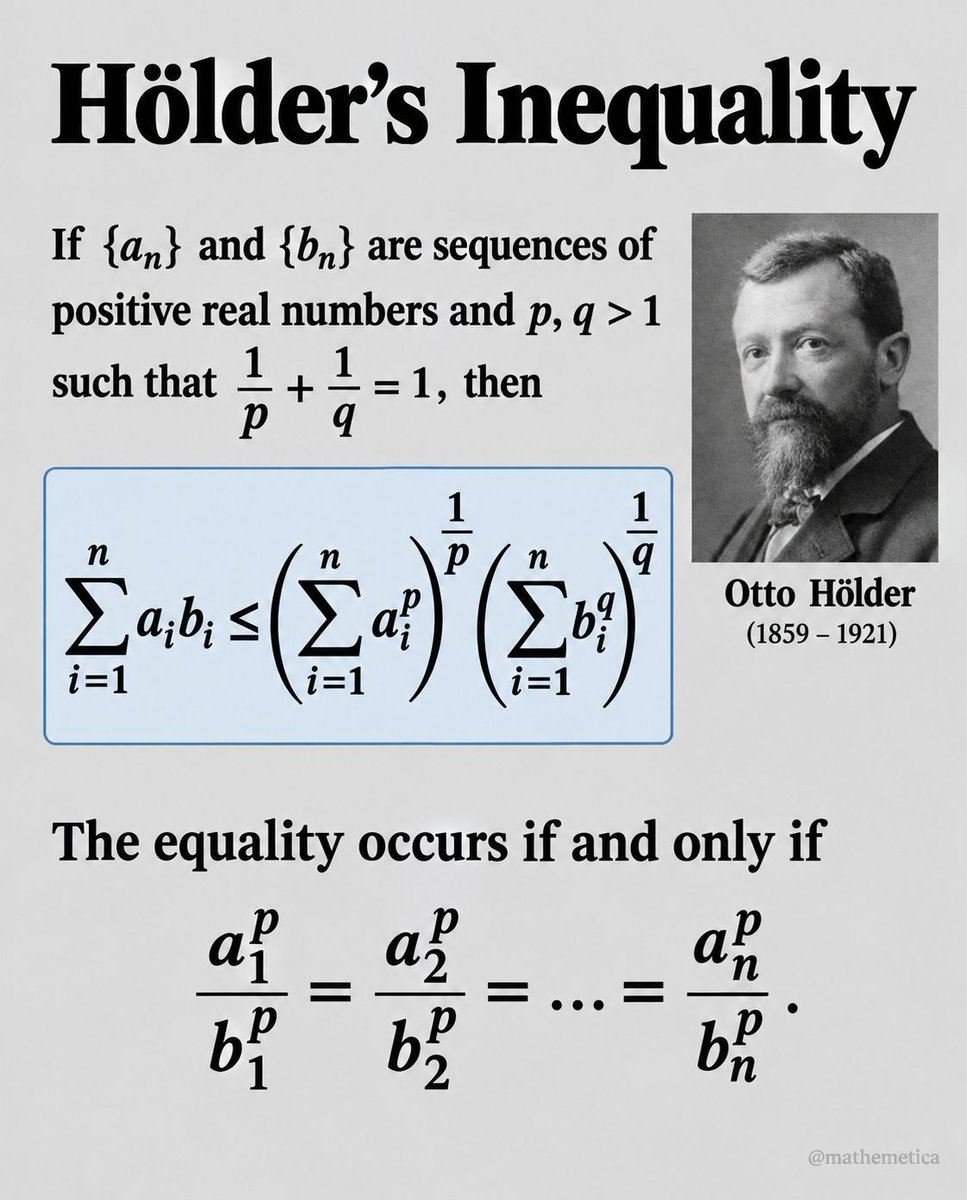
Conjugate exponents lock two sequences into duality: whenever 1/p + 1/q = 1 with p, q > 1, their inner product cannot outrun the product of the ℓᵖ and ℓᵠ norms,
∑ᵢ₌₁ⁿ aᵢ bᵢ ≤ (∑ᵢ₌₁ⁿ aᵢᵖ)^{1/p} (∑ᵢ₌₁ⁿ bᵢᵠ)^{1/q}.
Equality holds precisely when the sequences aᵢᵖ and bᵢᵠ are proportional.
Rogers wrote the estimate in 1888; Hölder published it a year later while studying means. The same pairing, recast as integrals, is what makes Lᵠ the dual of Lᵖ and supplies the engine for Minkowski’s inequality. When p = q = 2 the statement collapses to Cauchy–Schwarz, the most familiar face of a far more general relation.
"pq eu uso o método pomodoro" "pq eu faço estudo ativo" "pq eu faço resumo colorido"
pois o meu método de estudos é fingir q sou um cientista da renascença bebendo um vinho francês e escrevendo minhas ideias enquanto sou procurado pela igreja caótica