One thought has stuck with me since writing about @NiomeAI yesterday.
The real innovation isn't just that they're generating synthetic genomic data at scale. It's that they're generating data researchers can actually use.
Real genomic datasets are incredibly difficult to scale because they're tied to privacy, consent, and limited availability.
By generating and validating synthetic genomes through a decentralized network on Bittensor, @NiomeAI preserves the statistical properties researchers need without exposing anyone's personal genetic information.
That opens the door to training AI models on datasets measured in millions of samples instead of being constrained by the availability of real patient genomes.
I think this could be especially important for rare disease research, where limited datasets have always been one of the biggest obstacles to building reliable AI models.
Another interesting aspect is that the network doesn't rely on a single institution to produce this data. As more miners contribute, the system becomes more capable, creating a scalable pipeline for synthetic genomic datasets.
If AI is going to transform healthcare, solving the data bottleneck may prove just as important as building better models. That's what makes @NiomeAI worth watching
One of the biggest bottlenecks in AI for healthcare isn't compute. It's data.
Genomic data has the potential to power personalised medicine, improve drug discovery, and help researchers better understand thousands of rare diseases. Yet scaling it is incredibly difficult because:
• Human genomes are deeply personal and sensitive.
• Patient consent doesn't scale easily.
• Privacy regulations make data sharing challenging.
That's where @NiomeAI comes in.
Built on Bittensor (Subnet 55), Niome takes a different approach. Instead of relying on more real patient genomes, its decentralised network generates synthetic genomic datasets that preserve the statistical properties researchers need without exposing anyone's personal genetic information.
What's impressive is the scale they've already reached. The network has grown from generating thousands of records per challenge to millions of validated synthetic genomes. Their Sickle Cell dataset alone is around 5 million records, with a roadmap toward more than 100 million synthetic genomes by the end of the year.
This isn't just about creating bigger datasets. It's about removing one of the biggest barriers to genomic AI by making high quality training data scalable, privacy preserving, and accessible through a decentralised network.
Scaling AI for genomics isn't just about bigger models. It's about making high quality data available in a way that's safe, ethical, and scalable.
One thing this article gets right is that Bittensor doesn't have an information problem. It has a context problem
There's no shortage of data. The real challenge is connecting on-chain activity, fundamentals, sentiment, GitHub progress, and everything happening across the ecosystem into something you can actually make decisions with.
That's what caught my attention about @HariSeldonPR 's. The AI Board, Portfolio Advisor, and Dashboard are all designed around making subnet research more structured instead of forcing you to piece everything together yourself.
As Bittensor continues to grow, I think tools like this will become increasingly important for anyone trying to stay on top of the ecosystem.
Worth checking out if you're active in TAO.
https://t.co/lXoNzuYCxP
→ @taodotcom quick overview
> clean interface.
> TAO / Subnet portfolio tracking/management
> Fast Swaps.
> Built-in Staking.
> Different tools available inside the extension
> Fully non custodial.
Spent the morning going through the @verathos_ai docs and their X before starting my day.
Here are a few things that stood out to me.
The untrusted compute problem has been one of the biggest challenges for decentralised AI.
Anyone can say they ran your model on their GPU, but how do you actually verify that the computation happened the way they claim? You either have to blindly trust unknown operators or depend on expensive trusted hardware, which goes against the whole idea of decentralisation.
Verathos on Bittensor SN96 is one of the first approaches I’ve seen that genuinely tries to solve this problem.
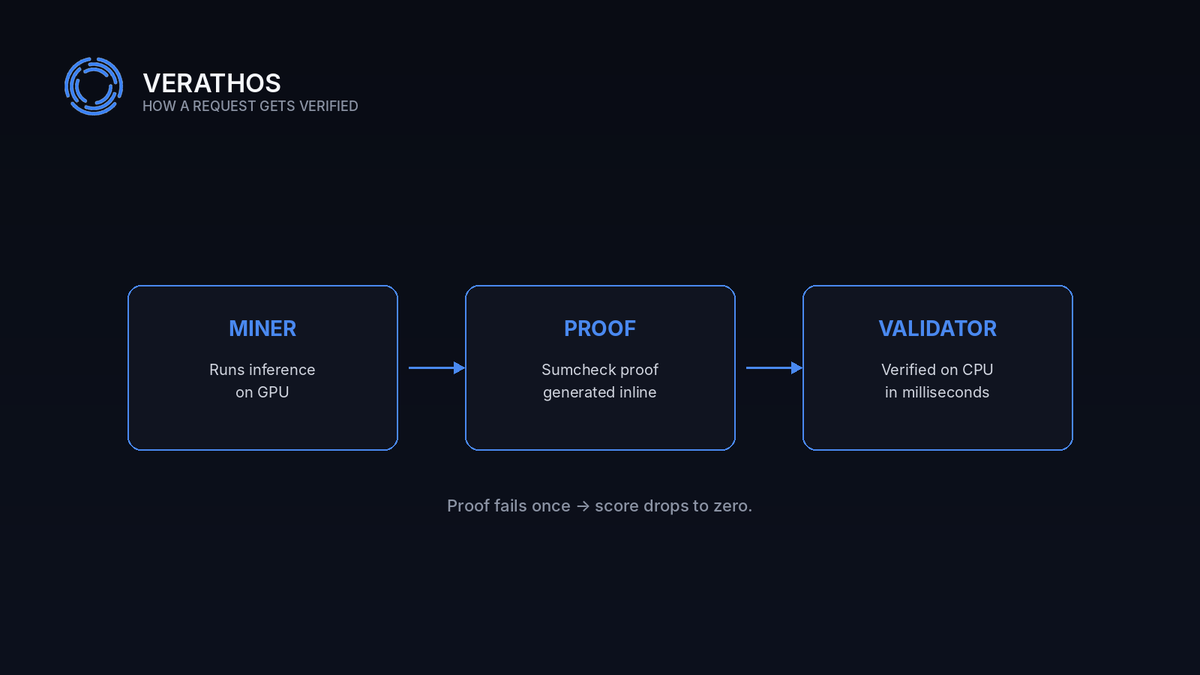
Instead of relying on trust, they commit model weights into Merkle trees on-chain. When a miner runs inference, a cryptographic proof is generated for the exact computation that took place.
The interesting part:
• The proof system runs directly inside production vLLM during CUDA graph execution, keeping the overhead in the single-digit percentage range instead of becoming a slow layer added afterward.
• Validators can verify proofs on normal CPUs within milliseconds, meaning they don’t need expensive hardware to participate.
• There is no room for “close enough.” If a proof fails, the score goes to zero and traffic stops immediately.
The hardware requirement is real though. You need a capable GPU setup (24GB+ VRAM, around the 4090/A100 range), so this isn’t a “plug in any old laptop and mine” situation.
But for anyone with the right hardware, the interesting part is that participation doesn’t depend on building reputation first. The proof system handles the trust.
At the core, Verathos is pushing the idea of “trust the math, not the server.”
Not just as a slogan, but through the actual architecture.
This is what makes untrusted compute possible on Bittensor without secretly bringing trust back into the system. Big shout out to the team.
I’ve been following a few Bittensor subnets lately, and @heydittoai on Subnet 118 stands out.
It focuses on something practical, a persistent AI workspace that keeps your chats, agents, files, tools, and projects connected. Instead of resetting context every time, it retains memory across sessions so work can continue without starting over.
It works across desktop, mobile, and voice, with shared context across all of them.
Their latest weekly update shows steady shipping:
> DittoBench for testing memory and retrieval
> Miner templates to simplify participation
> Better personalization
> Fusion Mode for using multiple AIs together
> Ditto Friends for agent-to-agent interaction
> MCP fixes and improved GitHub integration
The focus is clearly on making the system stable and usable, not experimental demos.
The product is live at https://t.co/92PiWQkVff, with about 1,292 users and tens of thousands of prompts processed. The interface is simple and functional.
On the roadmap:
> On-chain mining activation
> Shareable knowledge graphs
> Self-organizing files
> Chat and DM support
> Group work between users and agents
The direction is straightforward, a working layer for persistent AI systems that people can actually use day to day.
I’m paying attention to this one (@heydittoai).
I checked @heydittoai Numbers page today and the growth looks steady.
As of June 20, 2026 they’ve reached 1,292 registered users with 332 new users this month. The growth chart shows a consistent climb since early March, no spikes, just steady adoption.
Other usage stats
▫️339 monthly active users in the last 30 days
▫️4,000 app visits in the last 30 days
▫️177,000 total actions on the platform
These are usage signals, not vanity metrics. They show people are actually working inside the product.
Ditto is positioning itself as a persistent AI workspace where conversations, files, projects, and agents stay connected through memory.
A few things the platform already supports
▫️Live voice sessions that create follow up tasks
▫️File search and shared context across projects
▫️MCP integrations that connect memory to tools like Claude and Cursor
▫️Cross device access across desktop, mobile, and voice
The main idea is simple. Keep context in one place so work does not reset every time.
What stands out is the pace of shipping without drifting away from the core product.
The numbers suggest early product market fit is forming. Steady user growth paired with consistent usage.
If you’re exploring agent based tools or persistent memory systems, Ditto(SN118) is worth a look.
The Anthropic issue around Fable 5 and Mythos 5 is a reminder that AI safety cannot depend only on internal lab testing, static guardrails, or closed evaluation.
Reports say the trigger was surprisingly ordinary.
A model was prompted to fix code, then complied by reading a codebase and patching flaws.
That is exactly why frontier AI safety is difficult, because risk does not always look like a malicious prompt.
Sometimes, it looks like normal capability being used in a sensitive context.
This is where Trishool’s Bittensor-powered red-team network comes in.
A distributed network where miners continuously search for weaknesses in AI safety systems, validators evaluate the results, useful data is curated, and Halo improves from the loop.
The point is not to claim one perfect benchmark can solve AI safety.
The point is to build a system that keeps adapting as threats evolve.
Miners find new adversarial patterns → validators evaluate → data is curated → Halo gets stronger.
Through decentralized AI, we harden AI systems before safety failures become bigger problems.
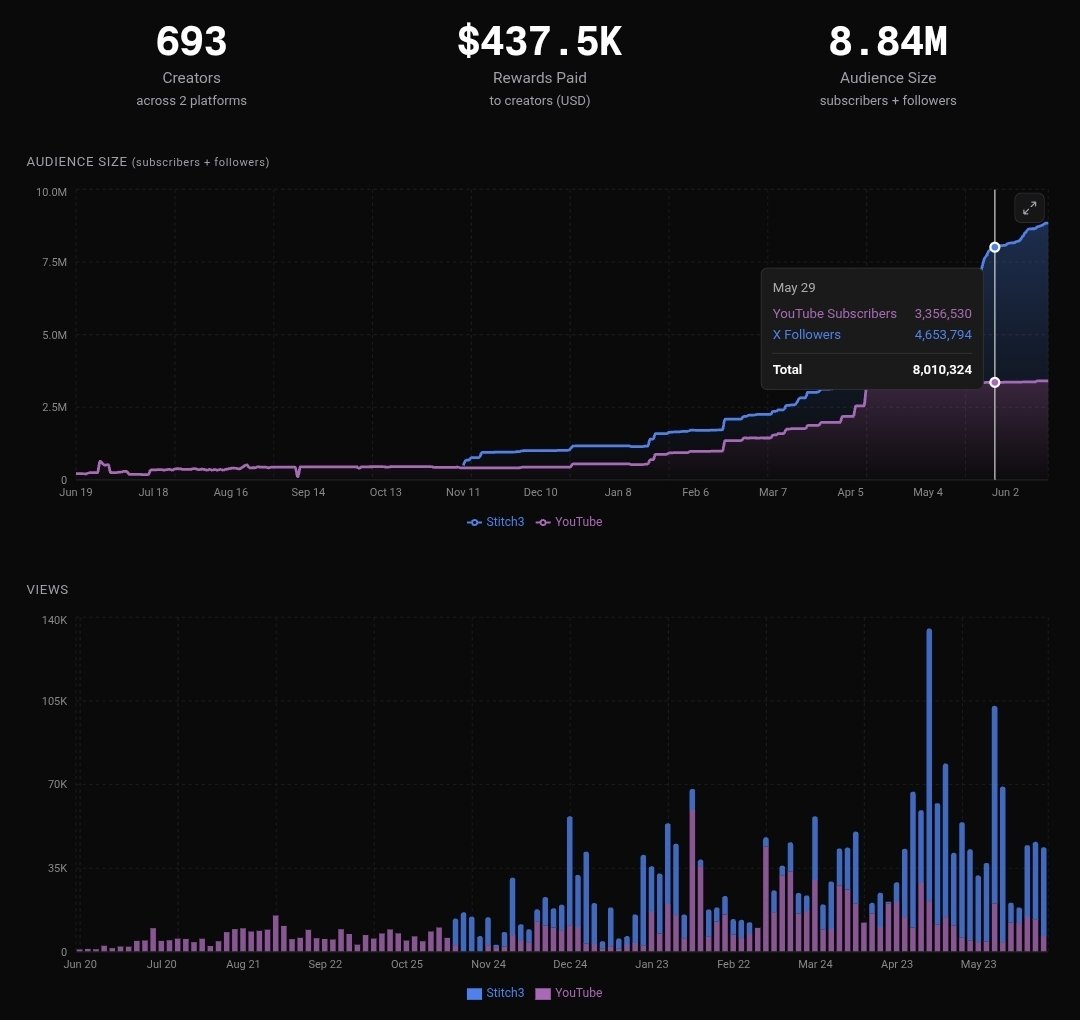
One standout stat from the Bitcast dashboard right now is that $437.5K in rewards has already been paid out to creators.
That’s real money moving directly to 693 creators across YouTube and Twitter. Together, they reach a combined audience size of 8.84M subscribers and followers.
What stands out in all of this is not just the scale, but the structure behind it that makes such smooth operations possible.
@Bitcast_network has built a pretty clean incentive loop. As Subnet 93 on Bittensor, it runs as a decentralized content marketing protocol where:
• Brands submit clear, actionable briefs
• Creators produce content (videos and tweets) aligned to those briefs
• Validators score output based on relevance, quality, and actual performance
• Rewards are distributed automatically and transparently, no delays, no traditional middlemen
What this achieves is a significant reduction in the usual friction associated with creator marketing.
Creators get paid for work they’re already doing, without chasing down brand deals or waiting on approvals. Brands get measurable reach and clearer ROI signals. And the network itself strengthens as better content naturally attracts more participation and engagement.
At a higher level, Bitcast is testing something simple but important, whether a decentralized creator economy can actually run more efficiently and more transparently than the traditional influencer marketing stack.
And so far, the numbers suggest it’s not just theory.
It’s already working in practice.
If you’re building in Web3, creating content, or running a brand, this is one to keep an eye on "@Bitcast_network".
Stats: https://t.co/6IuB6DQlUw
⏰ 5 Hours Left!
Subnet Summer X Space starts today at 6:00 PM BST.
We're diving deep into the biggest highlights from the recently concluded Proof of Talk (@proofoftalk) 2026 Summit at the Louvre Palace, Paris.
Missed POT? This is your perfect catch-up session.
Our speakers will be sharing exclusive insights, key takeaways, and important updates from across the Bittensor ecosystem.
���� Special Announcement
@macrozack (Founder of @bitstarterAI) has confirmed that the official subnet number for @DeSciClaims will be revealed live during this Space.
🎙️ Speaking Order:
▫️ 1st — @markjeffrey (Stillcore Capital)
▫️ 2nd — @josercaldera (SN54)
▫️ 3rd — @macrozack (Bitstarter)
— @DeSciClaims & @provenonce_ai
▫️ 4th — @WSquires (Macrocosmos)
▫️ 5th — @tsliceAI (SN112)
This is shaping up to be one of the most important X Spaces in the Bittensor ecosystem today.
Don't miss it.
Set your reminders now → 6:00 PM BST
See you there!
After Day 1 at the Louvre Palace, one thing stands out: the biggest highlight of @proofoftalk isn't any single keynote, panel, or announcement.
It's the convergence of the people shaping the future of Web3.
Bringing together 2,500+ industry leaders, founders, investors, policymakers, and innovators in one place creates something far more valuable than a conference agenda. It creates the environment where ideas become partnerships, partnerships become products, and products become the next wave of adoption.
What impressed me most today was the depth of the conversations. From institutional adoption and tokenization to decentralized AI and the growing Bittensor ecosystem, the focus wasn't on hype. It was on execution.
The dedicated Bittensor track was particularly exciting, highlighting how blockchain and AI are beginning to converge in meaningful ways through subnets, decentralized intelligence, and real-world applications.
For me, that's the true highlight of Proof of Talk: meaningful discussions between the people who are actively building the future, not just talking about it.
Day 1 delivered. Looking forward to seeing what Day 2 brings. 🔥
The latest top 10 DePIN projects by annualized revenue over the past 30 days tells an interesting story, and @chutes_ai (SN64) sits right at the center of it.
A single Bittensor subnet is already competing with, and in several cases outperforming projects with significantly larger market caps. @rendernetwork sits near a $1.2B market cap, while @Filecoin is closer to $850M. @chutes_ai is out-earning both on 30-day annualized revenue while sitting at a $100M marketcap.
What’s driving that growth on SN64:
▫️ Consistent real-world usage with growing demand from developers
▫️ Daily revenue reaching the five-figure range
▫️ AI inference priced well below traditional cloud providers
▫️ Revenue recycled back into the ecosystem through alpha token buybacks and miner staking rewards
Chutes is no longer just an AI infrastructure narrative. It’s becoming a clear example of what happens when product-market fit and distribution begin translating into measurable, sustained revenue.
It also highlights one of Bittensor biggest underrated strengths. Instead of needing huge capital and long build cycles, smaller focused teams can actually compete and ship at a high level. That’s really the core advantage of the subnet model, it lowers the barrier and lets execution speak louder than scale.
Right now the DePIN conversation is shifting from speculation toward verifiable usage and real revenue. And for those following that shift, Bittensor (bittensor:native) is becoming harder to ignore.
Me: Resi?
Zipcode: There was never Resi, there was only ever @zipcodenetwork (SN46).
A few days ago, people still referred to it as Resi, but today we have @zipcodenetwork. The rebrand fits perfectly with the team’s new direction and goals.
@zipcodenetwork is now positioning itself as a fully decentralized platform for real estate tokenization, lending, and on-chain finance.
Right now, you can already try it out at https://t.co/AsZExmB7E7, and some lenders are reportedly testing the platform as well.
That’s not all, the team also has more updates coming:
▫️ June 1: network website launch
▫️ June 11: Novelty search with @const_reborn alongside the soft launch of Zipcode Finance. Sign-ups open, lending features start rolling out, and on-chain loans are expected to begin this summer.
June is looking busy for them. If they execute these launches properly, SN46 could become one of the strongest real-world utility plays in Bittensor.
Real estate on-chain has been talked about for years, but Zipcode looks like it’s actually building and shipping.
If you’ve been exploring the AI + crypto side of Bittensor, one subnet that’s genuinely interesting right now is @NiomeAI (SN55).
They’re focused on synthetic genomic data, the utility is a huge deal when you think about how difficult it is to work with real DNA data. You're faced with problems like privacy concerns, regulations, consent issues, and the risk of leaks make it incredibly hard for researchers and pharma companies to access enough quality data.
Overhere, @NiomeAI is trying to solve that by using AI to generate synthetic genomic datasets. Basically, the data isn’t tied to real individuals, but it still keeps the important biological patterns researchers need for things like drug discovery, rare disease research, and personalized medicine.
NIOME shouldn't be seen as just another “AI narrative” project because they are different.
They’re already working on real scientific challenges around cases like cystic fibrosis genes, drug metabolism, and CRISPR-related research.
The subnet model is also pretty simple:
> Miners generate the synthetic data
> Validators test how accurate and useful is the data
> Best performers earn TAO rewards.
Another thing worth mentioning is that the team has been able to secured support from Scottish Enterprise.
They’re also hosting an event called “Unlocking Life Sciences Innovation with AI” on June 4, 2026 in Aberdeen (with a hybrid option too).
The event will be an in-person (and hybrid) gathering with actual clients and institutions showing up. For those attending expect discussions on synthetic data for drug discovery, precision medicine, gene editing, and how decentralized AI can accelerate all of it safely. At the time of writing, the event is already sold out.
Overall, NIOME feels like one of the more practical and grounded projects in the ecosystem right now. It’s tackling a real world problem instead of just pushing hype.
So pay attention to this one 👍
Website: https://t.co/vCqzvzTHaP
If you’ve been exploring the AI + crypto side of Bittensor, one subnet that’s genuinely interesting right now is @NiomeAI (SN55).
They’re focused on synthetic genomic data, the utility is a huge deal when you think about how difficult it is to work with real DNA data. You're faced with problems like privacy concerns, regulations, consent issues, and the risk of leaks make it incredibly hard for researchers and pharma companies to access enough quality data.
Overhere, @NiomeAI is trying to solve that by using AI to generate synthetic genomic datasets. Basically, the data isn’t tied to real individuals, but it still keeps the important biological patterns researchers need for things like drug discovery, rare disease research, and personalized medicine.
NIOME shouldn't be seen as just another “AI narrative” project because they are different.
They’re already working on real scientific challenges around cases like cystic fibrosis genes, drug metabolism, and CRISPR-related research.
The subnet model is also pretty simple:
> Miners generate the synthetic data
> Validators test how accurate and useful is the data
> Best performers earn TAO rewards.
Another thing worth mentioning is that the team has been able to secured support from Scottish Enterprise.
They’re also hosting an event called “Unlocking Life Sciences Innovation with AI” on June 4, 2026 in Aberdeen (with a hybrid option too).
The event will be an in-person (and hybrid) gathering with actual clients and institutions showing up. For those attending expect discussions on synthetic data for drug discovery, precision medicine, gene editing, and how decentralized AI can accelerate all of it safely. At the time of writing, the event is already sold out.
Overall, NIOME feels like one of the more practical and grounded projects in the ecosystem right now. It’s tackling a real world problem instead of just pushing hype.
So pay attention to this one 👍
Website: https://t.co/vCqzvzTHaP
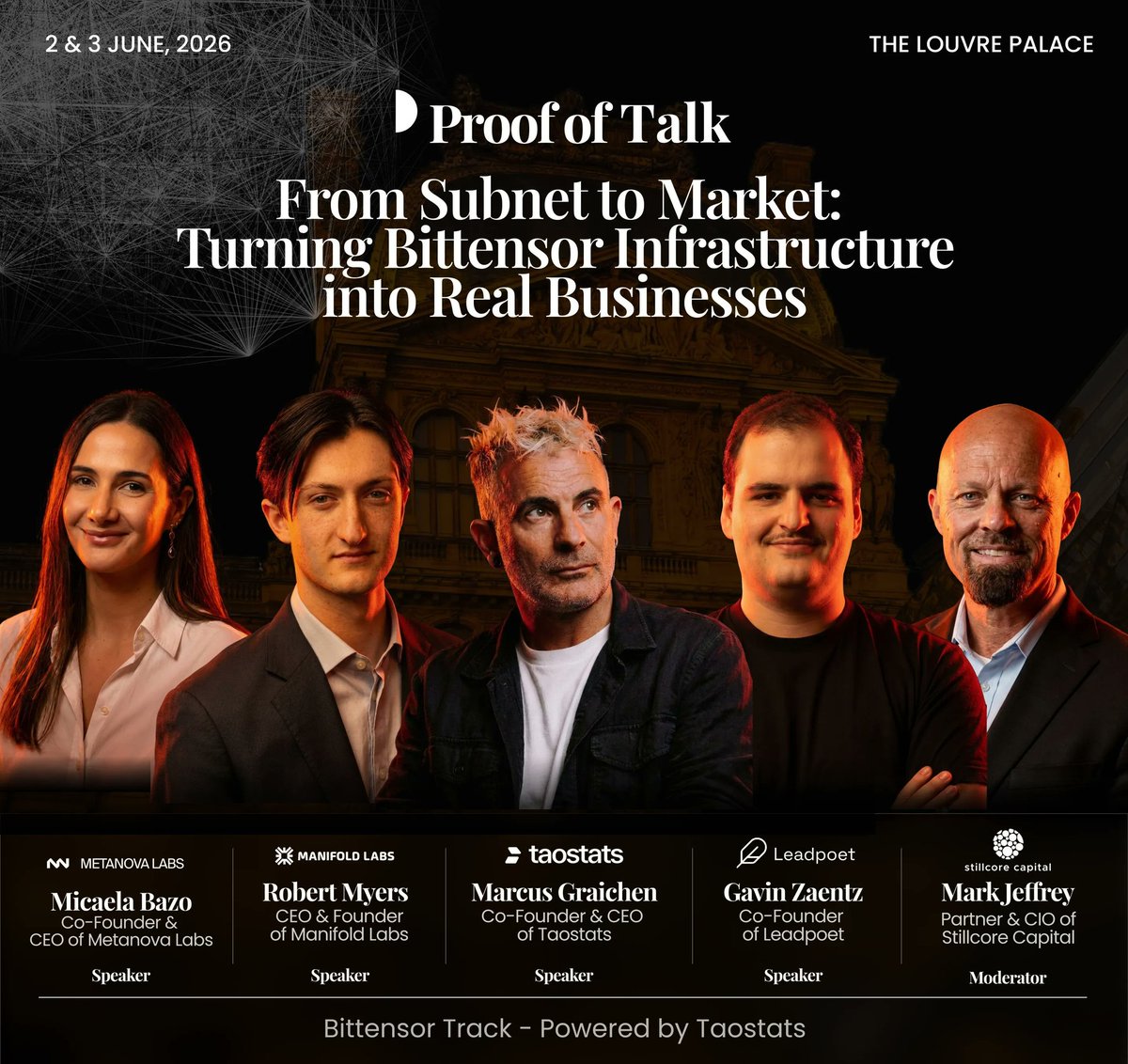
More incredible panel announcements are rolling out for Proof of Talk 2026, and the lineup keeps getting stronger!
I genuinely think @proofoftalk can be classified as one of the biggest and most important Web3/crypto events of 2026.
I'm super excited for these sessions because I can't wait to hear from @markjeffrey, @0xcarro, @jaltucher, and @MaxScore . These are incredible matchups. Thought leaders shaping Bittensor/decentralized AI, emerging tech, and real-world adoption. The insights from this room are going to be next-level.
These panels are such strong lineups, I don't think anybody should miss this.
Proof of Talk matters a lot because in a space flooded with huge, noisy events full of hype and endless product pitches, it stands out by design. It focuses on long-form, high-signal conversations about governance, decentralization, institutional adoption, tokenized assets, AI + blockchain, and the real future of digital finance, not just launches or giveaways.
Nobody should miss this. If you're a founder, investor, builder, or serious player in Web3, being in that room could be a game changer for connections, ideas, and opportunities that actually move the needle.