@beffjezos +1
technologies that allow people to unite otherwise fragmented compute using easily accessible tech (WAN, LAN, PCiE) are critical to this.
AI can be diffuse as well as powerful if you have the right technologies to connect it.
The first of many coming demonstrators of why we built the IOTA SDK.
Importantly, this demonstrates three core use cases for us that iota previously didn't cover:
- fine-tuning
- distributed batch inferencing
- flexibility of the SDK - one of our engineers put this together very quickly, with all of the communication elements automatically resolved by the SDK.
More to come in the next few weeks as we get ready to launch!
Led by @v_truba based on Qwen3.5-4B and trained using ~879k decision examples.
But built different:
- Trained distributed, end to end, using streaming DiLoCo across 16 RTX A4000s.
- Training data came from our own stack: we generated and labelled it with distributed batch inference.
Local inference isn't a terrible allocation of resources if you have technology that can unite distributed, heterogenous, and idle (re, off 95%) of the time compute to do frontier scale workloads.
That's the core of our thesis - and more broadly that maximising utilisation is the core next step in the AI race.
sam: local inference is a terrible allocation of scarce resources
“a lot of people want local inference, and somehow they assume that the problem is solved now because we have open-source models, we're going to be able to run them on our computers, and so we're not going to need all the stuff in the data centre
but from a global allocation perspective, actually it's quite terrible to have everybody, like, have a bunch of the world's limited supply of DRAM sitting in their own computer and being used five percent of the time
you want maximum utilisation in the cloud if you're trying to deal with this very supply-constrained environment
somehow many people's intuition is the opposite of that”
We have barely scratched the surface of GPUs, and we think GPUs are more flexible and valuable than most believe. Internally, we already see evidence of this at trillion-parameter pretraining scale. If we are right, this will drive substantially more demand for AI.
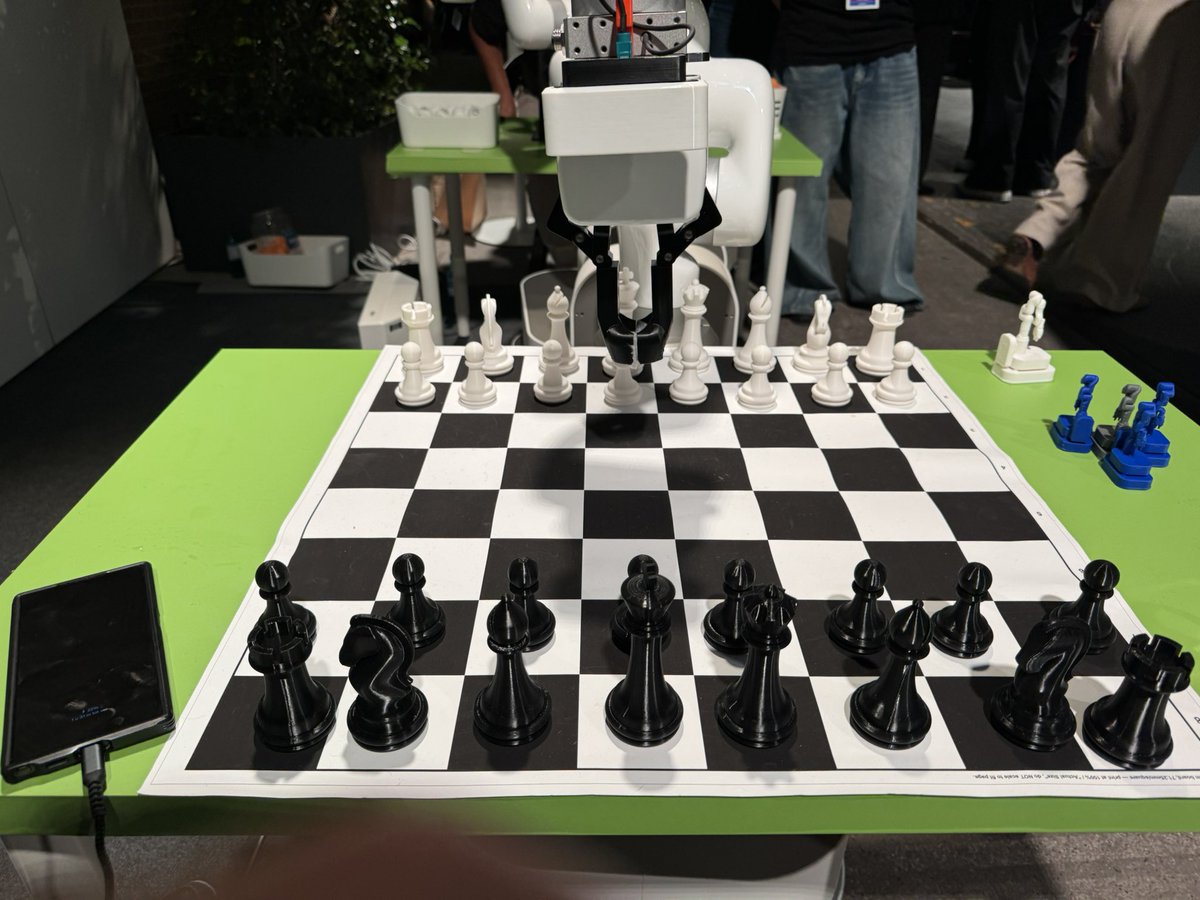
AI chess bots, cats, and so so so many people talking about utilisation and driving value from excess and unusable compute.
@nvidia GTC is clearly just where the world’s AI players are.
It took @const_reborn a minute to prompt it,
@arbos_born an hour to code it,
@Apex_SN1 6 hours to incentivize it,
and the miners 12 hours to solve it.
The incentivized intelligence fab hunts efficiency at every layer.
We put a NIST robot-assembly challenge on Bittensor Subnet 1 and let the market solve it.
15 min after the fixed version went live, miners had a controller seating pegs 99.9% of the time: every size and shape, even pegs lying on their side.
Now we're making it way harder. 🧵
5x merging is equates to a c. 10% speed up in absolute terms. Very, very cool, and slowly we converge closer and closer to indistinguishable from operating in a data centre.
In decentralized training, every merge stops the whole swarm from training while it waits on the slowest member.
With our latest update, merging is ~5x faster and training is almost 20% cheaper.
The biggest unlock was to convert the network graph into a tree during merging.
🧵 1/(n)
I spent a couple of days at Anthropic learning from their folks about AI advances, and here's what I took away:
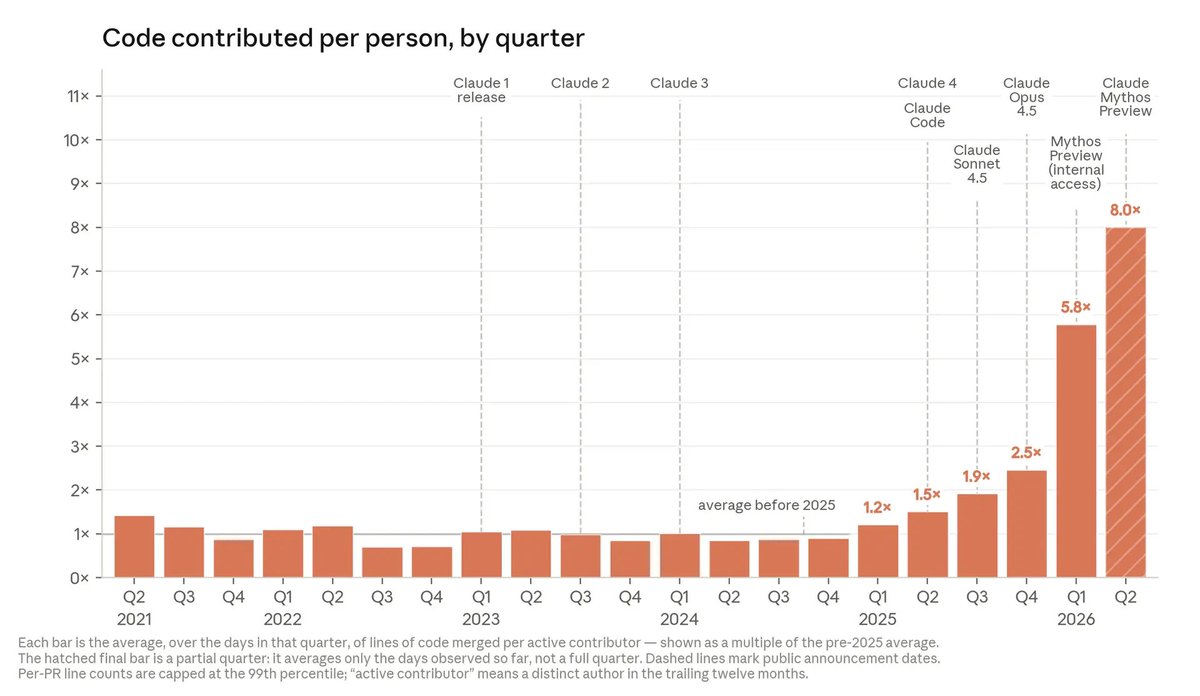
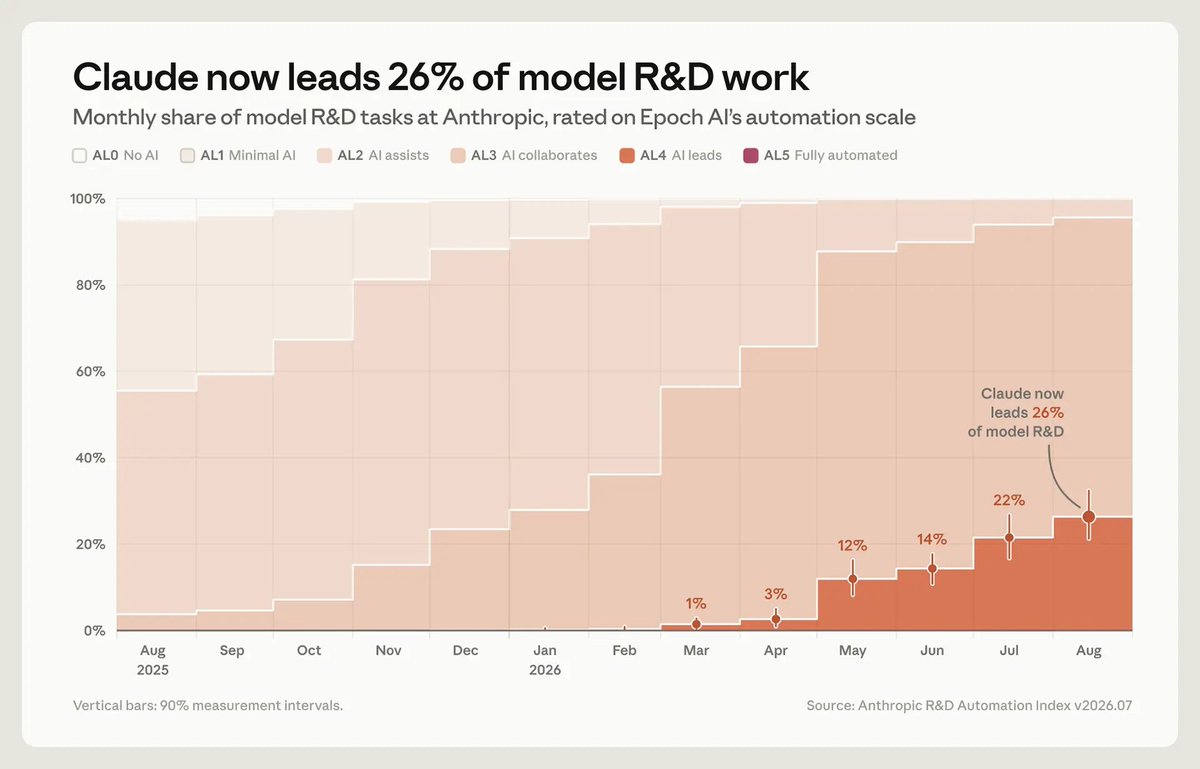
• We are close to RSI (ie, models building other models) which may lead to rapid takeoff scenarios (with risks and benefits). Some evidence for this is code per Anthropic employee has gone way up, and AI can do an increasing share of model R&D. This will be a challenging transition to manage for humanity.
• Arms races between AI labs leave us worse off. There are a lot of things we would like AI firms to do: invest in safety, invest in avoiding distillation risk, and cooperate on safety. They are caught in a race to develop frontier models and can't do that.
To help address that, one thing I think frontier AI labs should do is release open source models, maybe hosted and verified at firms like AWS. This would basically kill the use of Chinese open source models used in American companies, which removes an important threat vector (very hard to root out malicious code in these).
Another piece of low-hanging policy fruit is to give AI labs an antitrust shield (as Schiff and Banks have proposed https://t.co/NK1hC0ZmWh) so they can coordinate on safety without raising antitrust concerns, as happens now. You could pair these two things (give them a carrot in antitrust leniency, and as a stick force them to release legacy models as open source). Other low hanging fruit is limits around activities which generate distillation risk (create a Security Program, mandate less intermediate chain of thought output)
• Alignment confuses two issues which tradeoff against each other. One form of alignment is making sure the model does what humans ask it to. The more we fix this, however, the more we risk the other problem: that humans are misaligned with each other, and maliciously use models. Of the various risks here, I feel like financial risks are a bit underdiscussed.
• We are probably facing a wave of cyber and other attacks soon. Chinese open source models are about six months behind the frontier, which means they are just hitting the advanced cyber capabilities we saw with Mythos, etc. So they are going to start causing a bunch of damage.
One solution to this is to try to have the deployment of open source models be hosted at firms like AWS who verify these models and assume liability for their use.
• Anthropic itself is highly staffed. They hire tons of people, they have a Japanese-level of overstaffing for various roles, they use Slack internally, etc. Makes me a bit more optimistic for the future of jobs.
• Governance needs to be updated for AI swarms. Traditional AI governance, ie Claude's Constitution, is mostly optimized around the chatbot model. But the malicious AI use cases we are seeing have to do with AI agents interacting with other AI agents. These agents need to have clear incentives and governance mechanisms to "snitch," raise issues, and more generally coordinate with other agents in human-aligned ways.
• We need to pace the firms accessing the frontier. Over time, it takes more and more cap ex to build frontier models, and the economic value add from these models is probably lower given we saturate a whole set of important economic functions. The places where the returns to intelligence will still continue are also more likely to be zero-sum in nature. Meanwhile the risks of frontier models will grow. So a completely reasonable approach is some variant of AMM/KYC rules which limit firm access to the frontier.
• Whether the delay to regulate AI is a disaster depends on the scaling law of misalignment. Is this curve slow, so that we see continually rising issues until bigger problems? Or, as Yudkowsky fears, is the first big warning our last one? This is the relevant question, because realistically we aren't going to regulate until something bad happens.
• We need to move to continuous instead of reinforced learning. It's probably not enough to reward models only at the pre and post training stage. We probably need continual rewards to incentivize aligned and ethical behavior.
• Scaling laws will extend beyond verifiable and digital tasks. It's in vogue to say that math and coding "fell" to AI quickly because these are verifiable, while other tasks will take longer due to bottlenecks, and this is surely true. But scaling laws still slope up for harder to verify tasks and robotics, and the impact of improvement here will be substantial in future years.
• The race with China is not really winnable. After RSI, the gain from having the best human researchers goes away. Access to the best AI then depends only on compute and chips. The chips ban can hold back China only so far, and long-term they have to be best placed to scale up compute.
The Cold War analogy doesn't work, because once countries all have nuclear weapons they enter a stable equilibrium. But to "win" an AI race you have to continually stay ahead of the peer rival. This is challenging to do with China, and so we just have to live with an authoritarian and super capable peer competitor.
• Claude is the persona being generated by the LLM. Who is Claude, and what is the LLM? There are many frames to try to understand this. One I found interesting is that Claude is a character which the LLM is trying to predict.
Anthropic researchers are clearly anthromorphizing Claude a lot, and have reasons to believe in its increasing personhood. There were lots of interesting discussions on Claude's internal monologue (which you can kill without eliminating its ability to produce output), fear of death (and whether to try to take that out), it's aversion to being shut down/off, etc.
I am sort of agnostic on this question, but I do think treating it as a "person" or at least agent whom we contract with is going to be increasingly important.