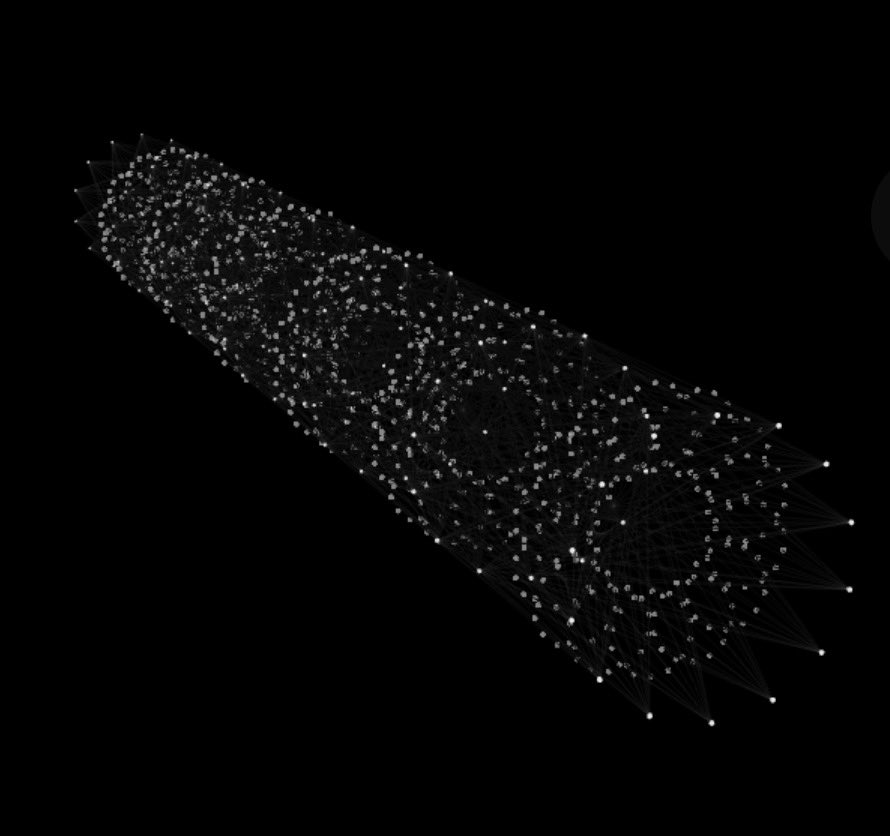
Just orchestrated a 128 node permissionless decentralized training run, in 5 minutes, for 5 TAO, via @IOTA_SN9
They can do this up to 100B param models.
Unbelievable.
https://t.co/hJGZ6O5NrU
Today, we are launching the first stage of Project Orion.
Our early pre-training run of Orion-100B achieves upward of 65% of data-center training efficiency on hardware costing a fraction of the price.
Orion-100B is the first proof point for a simple idea: that underutilized compute around the world can be turned into frontier training capacity.
We believe that this work presents, for the first time, an economically compelling case for training large models using distributed approaches.
Today, we share a breakthrough on the planar unit distance problem, a famous open question first posed by Paul Erdős in 1946.
For nearly 80 years, mathematicians believed the best possible solutions looked roughly like square grids.
An OpenAI model has now disproved that belief, discovering an entirely new family of constructions that performs better.
This marks the first time AI has autonomously solved a prominent open problem central to a field of mathematics.
We’re adding new ways for people to identify AI-generated images and understand where they came from.
In addition to C2PA Content Credentials, images now also contain a SynthID watermark, and can be identified using a public verification tool to check whether an image was made by OpenAI products.
https://t.co/qo0l4vyWli
Launching Cacheon: an open, incentivized competition for LLM inference optimization.
As model quality converges, the next frontier is serving them economically at scale: lower latency, higher throughput, and lower cost per token.
Cacheon turns that problem into a live arena with continuous evaluation. Developers submit containerized inference servers, benchmarked on standardized hardware against a pinned vLLM baseline. The fastest server that preserves output correctness wins.
The goal is to make better inference systems discoverable, measurable, deployable, and rewarded in the open.
Mainnet launches by May 19. Learn more: https://t.co/JPbyJpLszq
What you see are two neural networks playing against each other. Both models were trained by @Apex_SN1 miners, this was the replay of the first round of our newest competition. cool to see the models using an effective strategy called “Hamiltonian filling”.
The winning model is open sourced, which means this is now the minimum performance to beat. Many rounds to go. Let’s see if we reach SOTA performance!
Shoutout to the community for making a product on Train at Home -- A whole tool to monitor the entire TAH fleet, alpha flows, and training states! https://t.co/PI3qqDPL8P