The Remnant
Three millennia ago, Isaiah was told that most people never listen or change. His mission was to ‘take care of’ the small number who still could—‘the Remnant.’
A century ago, Albert Jay Nock added that serious work is done not by trying to move the mob but by aiding the outliers, exceptional souls who see clearly and act nobly.
In our time, those who refuse to follow today's shameless false prophets make up our modern Remnant, a precious few who may be known or unknown, vocal or quiet, celebrated or destined to ‘rest in unvisited graves.’ Are you one of them?
@MoreCoase@pocket_aces7777@susyq969 Pierre wimped out and now Art…I mean Mark is driving the bus. Hard to believe Justin could be worsted but… Canada needs to find its Donald and fast. Or even its Nigel. Are we looking at you, Danielle? Shake the box, please, ma’am, before it’s too late.
@DailySignal Pierre wimped out and now Art…I mean Mark is driving the bus. Hard to believe Justin could be worsted but… Canada needs to find its Donald and fast. Or even its Nigel. Are we looking at you, Danielle? Shake the box, please, ma’am, before it’s too late.
@rrbelloff News' and 'Entertainment' are no longer separate buckets (if they ever were). And both are really just delivery vectors for the real purpose: advertising.
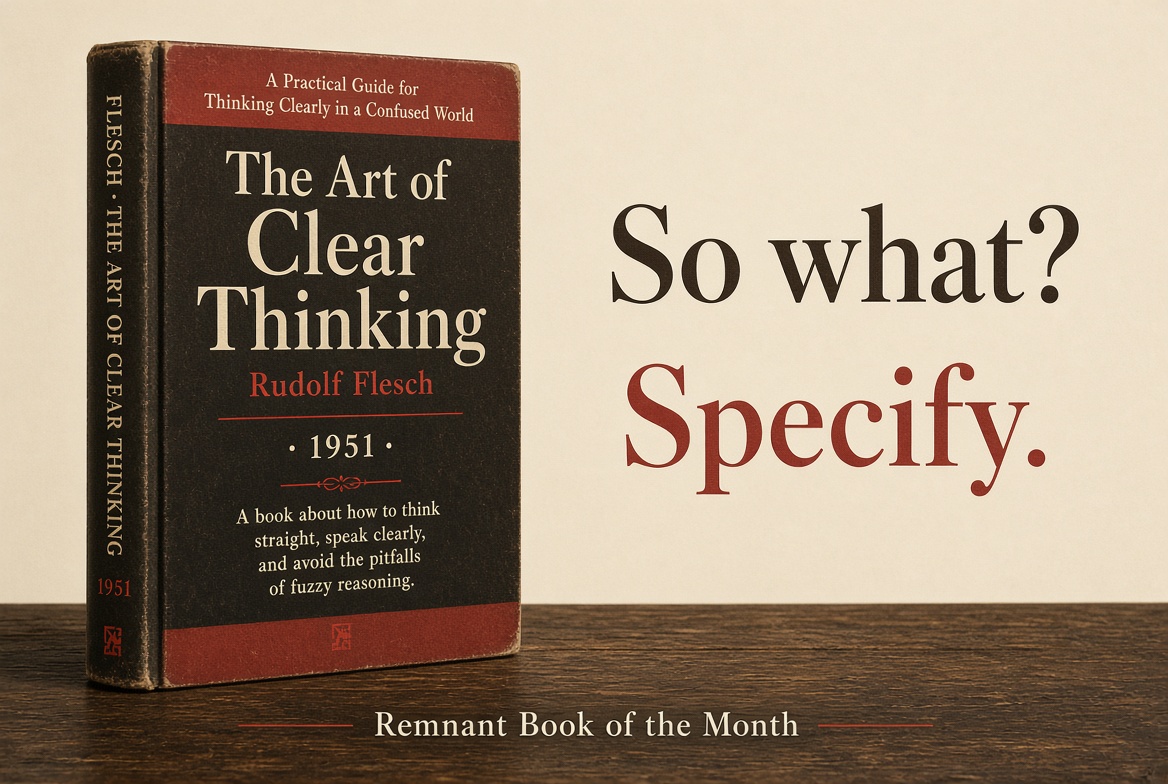
Remnant Book of the Month — September: The Art of Clear Thinking (Rudolf Flesch, 1951)
In this big little book, Rudolf Flesch boiled down the army of phony argument killers to just two: So what? And Specify.
'So what?'
False claims mostly rest on irrelevancies. Even a true claim can be beside the point. To force a sophist to give good reasons disarms his logical fallacies--red herrings, ad hominem attacks, appeals to emotion, etc. 'This rock star drives a Lexus?' 'That actress votes Democrat?' So what? How does fame produce experts on cars or foreign policy?
'Specify.'
When forced to supply facts, examples, data, etc, vague words, generalities, and abstractions crash and burn. 'Everybody loves Durtee Soap with its miracle ingredient Lodahocum'? Specify. Who's 'everybody'? Compared to which other brands? And what the hell is Lodahocum?
75 years ago Rudolf Flesch distilled the complexity of logical fallacies into plain English. His PhD thesis on what makes writing vivid and easy to read led him to view language and thought as two sides of the same coin. His big little book, The Art of Clear Thinking, remains a timeless tool for those who want to see and say things, in Plato's immortal phrase, as they really are.
Do your future self a favor this month. Find it. Read it.
Remnant Book of the Month — September: The Art of Clear Thinking (Rudolf Flesch, 1951)
In this big little book, Rudolf Flesch boiled down the army of phony argument killers to just two: So what? And Specify.
'So what?'
False claims mostly rest on irrelevancies. Even a true claim can be beside the point. To force a sophist to give good reasons disarms his logical fallacies--red herrings, ad hominem attacks, appeals to emotion, etc. 'This rock star drives a Lexus?' 'That actress votes Democrat?' So what? How does fame produce experts on cars or foreign policy?
'Specify.'
When forced to supply facts, examples, data, etc, vague words, generalities, and abstractions crash and burn. 'Everybody loves Durtee Soap with its miracle ingredient Lodahocum'? Specify. Who's 'everybody'? Compared to which other brands? And what the hell is Lodahocum?
75 years ago Rudolf Flesch distilled the complexity of logical fallacies into plain English. His PhD thesis on what makes writing vivid and easy to read led him to view language and thought as two sides of the same coin. His big little book, The Art of Clear Thinking, remains a timeless tool for those who want to see and say things, in Plato's immortal phrase, as they really are.
Do your future self a favor this month. Find it. Read it.
Many lack the serenity to accept the things they cannot change. Others lack the courage to change the things they can. Most lack the wisdom to see the difference. The remaining fragment is the Remnant, who are destined as if by Tolstoy's God to see the truth but wait.
@spencerpratt Intelligence + Judgment = Wisdom. Intelligence - Judgment = Folly. Smarts are everywhere today, but sense is always in short supply. At best you can keep the flame alive til sanity returns. Thanks for being part of that great effort.
https://t.co/SvY0xtls4Q
Many lack the serenity to accept the things they cannot change. Others lack the courage to change the things they can. Most lack the wisdom to see the difference. The remaining fragment is the Remnant, who are destined as if by Tolstoy's God to see the truth but wait.
The price of food has fallen, in real terms, for roughly two centuries. That fact alone demolishes most of what politicians tell you about markets.
Walk into a 1900 American household and a family spent close to 40% of its income on food. By 2019, the USDA recorded that figure at 9.5%. The calories got cheaper. The variety exploded. The quality improved. No central planner directed this. No five-year ministry of wheat coordinated the result.
What produced it? Capital accumulation and the price system. Cyrus McCormick's mechanical reaper in the 1830s cut harvest labor by 95%. Fritz Haber and Carl Bosch synthesized atmospheric nitrogen into fertilizer after 1909, effectively feeding half the planet on soil that would otherwise lie exhausted. Norman Borlaug's dwarf wheat varieties in the 1960s doubled yields across Mexico and India. Each innovation required saved capital, entrepreneurial risk, and the honest price signals that told farmers what to grow and investors where to deploy resources.
Governments, of course, ran hard in the opposite direction. American farm subsidies under the 1933 Agricultural Adjustment Act paid farmers to destroy crops while people went hungry during the Depression. That actually happened. Washington torched hogs and plowed under cotton to prop up prices.
The market rewarded productivity and passed the gains to you. The state confiscated those gains and handed them to lobbyists.
The Remnant Hall of Fame
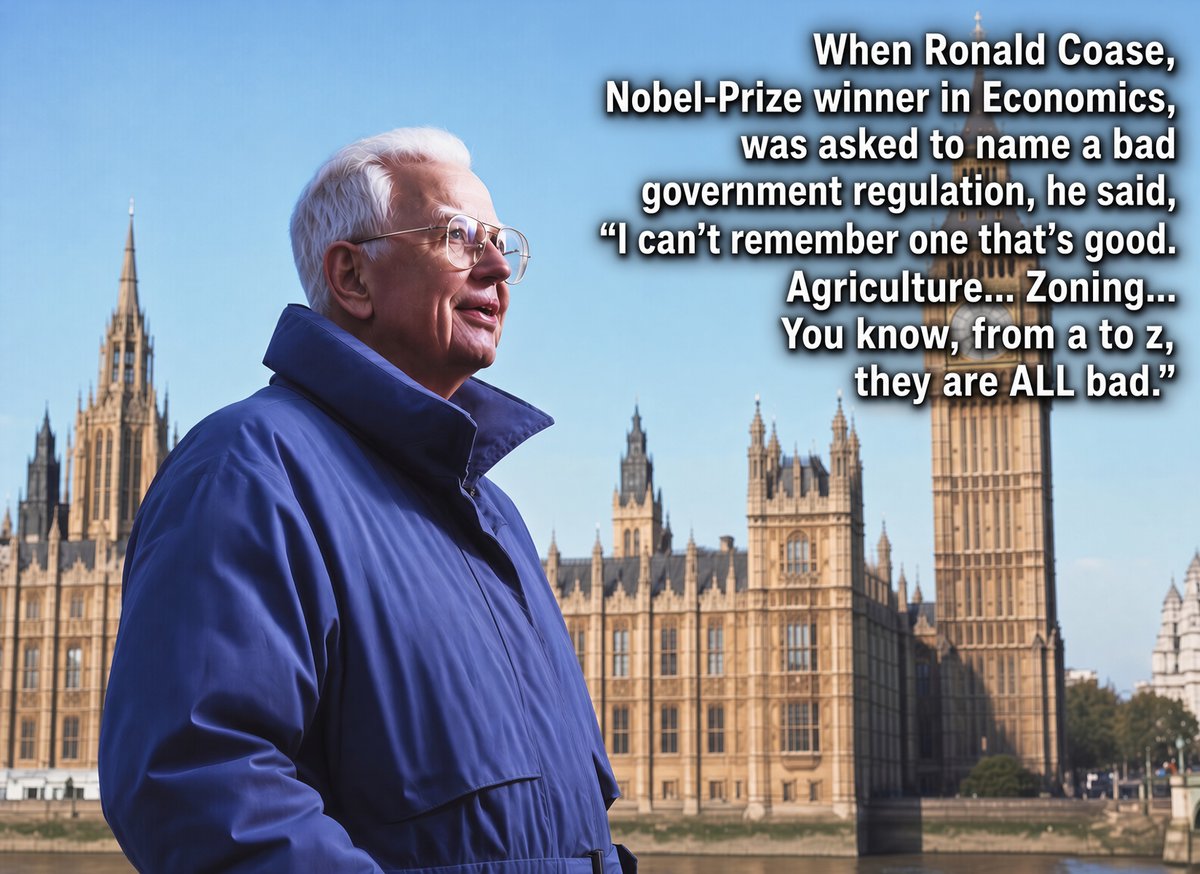
Ronald Coase, a stubborn original thinker from England, won the Nobel Prize in Economics in 1991. Along the way he rewrote the book on the nature of the firm, bureaucratic meddling in free markets, externalities and the social costs of transactions.
He once stood up to the entire economics faculty of the University of Chicago--including fellow future Nobellists Milton Friedman and George Stigler--and won.
When asked to name a government regulation that was bad, he said, 'I can’t remember one that’s good... From agriculture to zoning, you know, a to z, they are all bad.'
Ronald Coase typifies the modern Remnant who protect the fire of freedom from the frequent cloudbursts threatening to snuff it out.
Many lack the serenity to accept the things they cannot change. Others lack the courage to change the things they can. Most lack the wisdom to see the difference. The remaining fragment is the Remnant, who are destined as if by Tolstoy's God to see the truth but wait.
@MarkChangizi People who believe and practice First Principles like these--justice, courage, freedom, duty, love of wisdom--have long been called, by better men than I, The Remnant.
@1MichaelSperber People who believe and practice First Principles like these--justice, courage, freedom, duty, love of wisdom--have long been called, by better men than I, The Remnant.