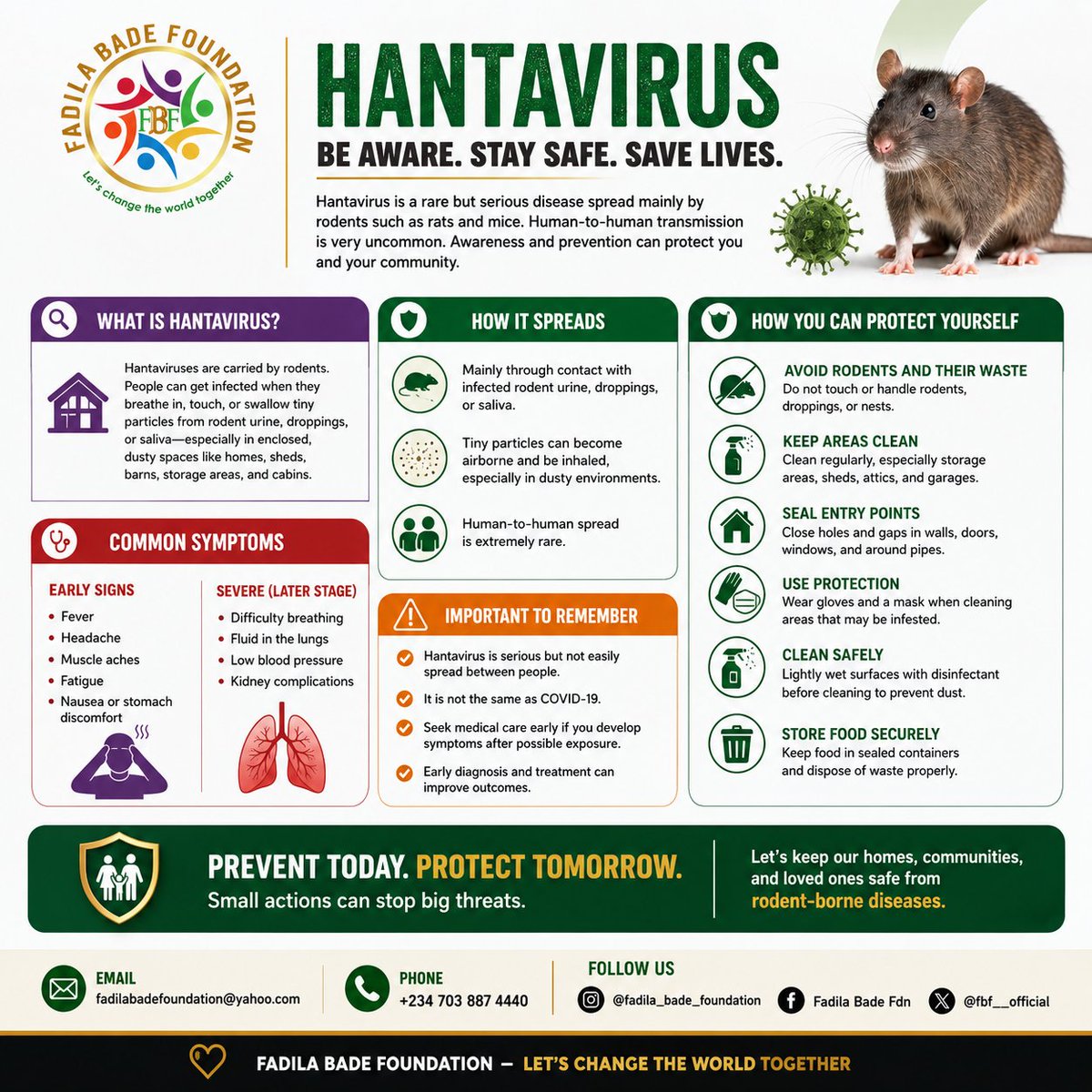
✔ Keep your surroundings clean
✔ Avoid contact with rodent waste
✔ Seal entry points in homes and storage areas
✔ Use protective gear when cleaning dusty spaces
Stay informed. Stay protected. Together, we can build healthier communities.
— Fadila Bade Foundation
Hantavirus is rare, but awareness can save lives.
Rodent exposure in dirty or poorly ventilated areas can increase the risk of infection. Knowing the symptoms early and maintaining clean environments are important steps toward prevention.
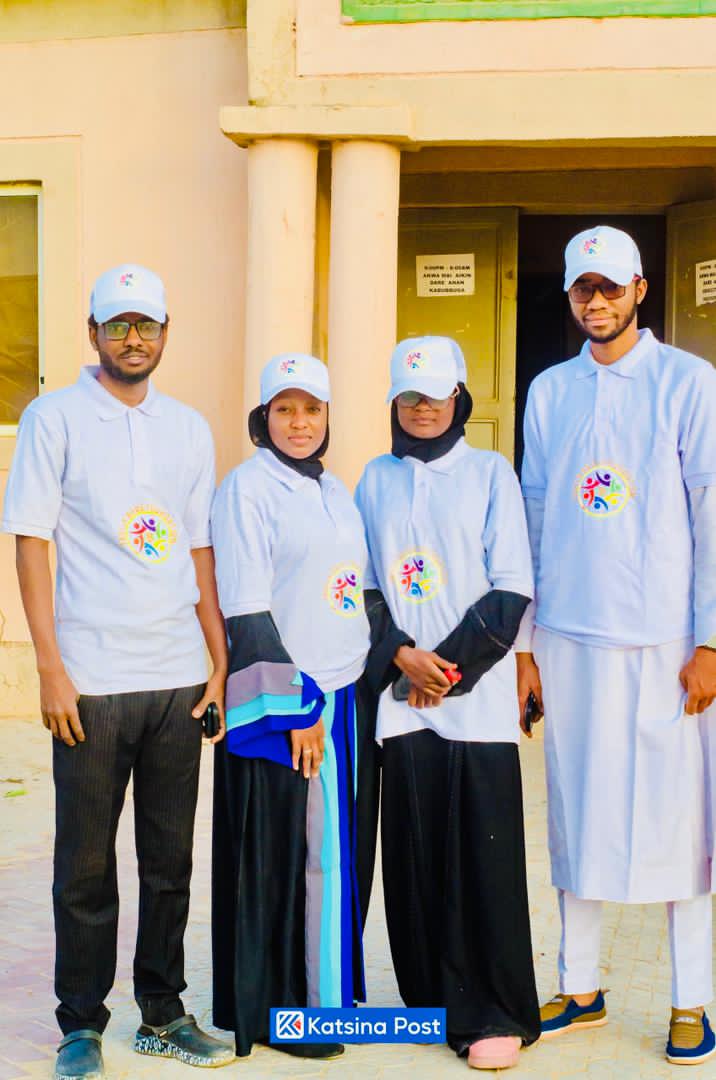
Eid Mubarak from all of us. May this season strengthen our shared commitment to peace, safety, and inclusive communities.
#eidmubarak2026#cleenfoundation
Rise, Shine, and Make an Impact. 🌿
May your morning be as bright as the smiles we see in our communities. Let’s make today count!
Fadila Bade Foundation (FBF)
4️⃣ Right Time: Follow the exact schedule prescribed by your doctor.
5️⃣ Right Route: Ensure you know if it’s to be swallowed, applied, or dropped.
Stay safe, stay healthy.
Safety first! 💊 Your health is your highest priority.
When administering medication at home, always remember the 5 Rights:
1️⃣ Right Patient: Never share prescriptions.
2️⃣ Right Drug: Check the label twice.
3️⃣ Right Dose: Use proper measuring tools (not kitchen spoons!).
4️⃣ Right Time: Follow the exact schedule prescribed by your doctor.
5️⃣ Right Route: Ensure you know if it’s to be swallowed, applied, or dropped.
Stay safe, stay healthy.
Today we join the world to celebrate International Women’s Day 2026. At FBF, our mission is rooted in the belief that when you support a woman, you lift an entire nation.
To the women of Katsina, Zamfara, and beyond—we see you, we honor you, and we are with you.
#IWD2026
Road Safety Tips That Can Help Reduce Accidents 🚦
Every day, road accidents claim thousands of lives globally.
Many of these accidents are preventable.
Here are simple habits that save lives.
1. Avoid speeding.
Speed reduces your reaction time and increases the severity of crashes.
Even a few seconds gained from speeding is never worth risking lives.
2. Never drive under the influence.
Alcohol and drugs impair judgment, coordination, and reaction time.
Driving impaired puts you, your passengers, and everyone else on the road in danger.
3. Wear your seatbelt — every time.
Seatbelts are one of the most effective safety measures in vehicles.
They significantly reduce the risk of serious injury during crashes.
4.Avoid phone use while driving.
Texting, calling, or checking notifications distracts your attention from the road.
A few seconds of distraction can cause a life-changing accident.
5. Follow traffic signals and road signs.
Traffic lights, speed limits, and road signs exist to maintain order and safety on the road.
Ignoring them increases accident risk.
6. Maintain a safe following distance.
Tailgating reduces the time you have to react if the car in front stops suddenly.
A safe rule: keep at least a 2–3 second distance.
7. Ensure your vehicle is roadworthy.
Regularly check:
– Brakes
– Tires
– Headlights
– Indicators
– Mirrors
Mechanical failure is a common cause of accidents.
8. Be cautious in bad weather.
Rain, fog, and poor visibility increase accident risk.
Slow down, turn on headlights, and increase following distance.
9. Watch out for pedestrians and cyclists.
Always slow down near crossings, schools, and residential areas.
Pedestrians are among the most vulnerable road users.
10. According to the World Health Organization, road traffic injuries are a leading cause of death worldwide.
In countries like Nigeria, safer driving habits can significantly reduce preventable crashes.
11. Road safety is everyone’s responsibility.
Drivers.
Passengers.
Pedestrians.
Cyclists.
A few careful decisions can save lives.
This Ramadan, your kindness is their Iftar. 🌙✨
The Fadila Bade Foundation (FBF) is on a mission to provide nutritious meals to those in need throughout this holy month. Every plate counts. Every donation matters.
This intervention focused on elderly women and displaced families, providing essential Iftar support. Their prayers and smiles are the greatest reward for our team’s dedication.
Under the leadership of Hajiya Fadila Sale Bade, we continue to serve the most vulnerable.
Katsina: Ramadan Feeding Project 3.0 is in full swing! 🌙🏥
Our Project Manager, Yusuf Suleiman Nataala, led the Fadila Bade Foundation (FBF) team to Turai Yar’adua Maternal & Child Hospital. We were honored to provide Iftar meals to 150 patients and vulnerable families.
As March begins, we are more committed than ever to supporting our vulnerable mothers, children, and displaced families. 🥘❤️
Let’s make this month count.
Marching Forward with Compassion! 📍
Happy New Month from all of us at Fadila Bade Foundation (FBF)! 🕊️
On this 12th day of Ramadan, we reflect on the success of our Feeding Project 3.0 so far.
150 Smiles at Turai Yar’adua Hospt.!
In the spirit of compassion, the Fadila Bade Foundation (FBF) successfully flagged off our Ramadan Feeding Support 3.0 in Katsina.
We provided Iftar meals to 150 vulnerable patients and their families, ensuring no one breaks their fast alone
5 “Weird” Body Signs That Are Actually Normal 👇
Not every symptom is a problem.
Sometimes your body is just… doing its job.
Let’s break this down.
You wake up briefly at night, then fall back asleep
1. If you wake up for a few seconds or minutes at night and then drift back to sleep, that’s usually normal.
These are called micro-awakenings.
2. Sleep happens in cycles (light sleep → deep sleep → REM).
It’s common to briefly wake up between cycles, you just don’t always remember it.
3. It becomes a concern only if:
– You can’t fall back asleep
– You wake up gasping or choking
– You feel exhausted every morning
Otherwise? Your sleep system is working as designed.
You get brain fog when you’re hungry
4. Ever notice you can’t focus when you haven’t eaten?
That’s not laziness.
That’s biology.
5. Your brain runs mainly on glucose (sugar from food).
When blood sugar drops, concentration dips.
You may feel:
– Irritable
– Slow
– Lightheaded
– Mentally cloudy
6. Once you eat, clarity often returns.
That’s your body saying: “Fuel low. Please refill.”
If brain fog happens even when you’re well-fed, then it’s worth checking further.
You poop regularly — even if it’s not daily 💩
7. Contrary to popular belief, you don’t have to poop every single day to be healthy.
Normal can range from 3 times a day to 3 times a week.
8. What matters more is:
✔️ It’s consistent for you
✔️ It’s not painful
✔️ There’s no blood
✔️ You’re not straining excessively
Comfort + consistency > frequency.
9. Sudden major changes, persistent constipation, or chronic diarrhea should be checked.
But “not daily” doesn’t automatically mean unhealthy.
You don’t always pee immediately after drinking water
10. Some people think if you drink water, you must urinate right away.
Not true.
Your kidneys regulate fluid balance carefully.
11. If your body needs hydration, it holds onto water.
If you’ve had excess fluid, it releases it.
That timing depends on:
– How hydrated you already are
– Weather (heat increases fluid loss)
– Physical activity
– Salt intake
12. Unless you have pain, burning, swelling, or extreme changes in urination patterns, this variation is normal.
Your kidneys are smart filters.
You sometimes crave bitter foods
13. Bitter taste isn’t “bad.”
It actually has digestive benefits.
Bitter foods can stimulate:
– Saliva production
– Stomach acid release
– Bile flow
All of which support digestion.
14. In many cultures (including in Nigeria), bitter vegetables and herbs are part of traditional diets for this reason.
Your cravings sometimes reflect what your body tolerates or responds well to though they’re not perfect signals.
Not every body quirk is a red flag.
But here’s the rule:
👉 Persistent
👉 Severe
👉 Sudden changes
👉 Painful symptoms
Those deserve medical attention.
Listen to your body but don’t panic at normal biology.