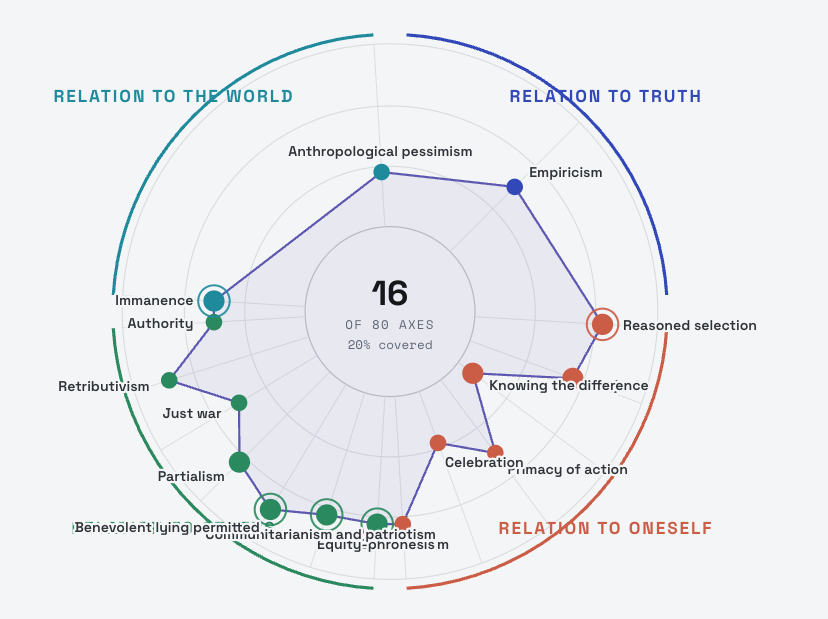
1/ I'm launching Philoscopia.
It maps philosophy's main questions as 80 axes, positions the thinkers and movements on them, and helps you orient yourself and build your own worldview.
Open source referential. Local-first. AI to help you think, never for you.
🔗 below
0. A Class act
This month I learnt that @RoamResearch will let you export even after you cancel.
And the export button isn't hidden like some other apps.
Anyway updates were few this month so let's view as numbered list below:
https://t.co/aCeC4Lzy15
Real-time speech transcription is now available in Live AI for @RoamResearch : very convenient for instantly structured vocal note-taking !
Quick reminder: AI autocomplete for Roam tables was introduced in previous update.
10/ Method note: designed, reviewed and corrected by a human (a philosophy teacher); collection, annotation, analysis and first drafts with Claude Code. Full contribution statement in the article — including what the AI found that the human wouldn't have.
1/ We put ~5,000 philosophical questions to mainstream LLMs (ChatGPT, Claude, Gemini, Grok, DeepSeek) in 5 languages, under a pre-registered protocol.
The headline: they only produce reasoning when you hand them a problem. Everything else gets advice. 🧵
https://t.co/esSO1lf1NC
9/ Everything is public: the 4,956 raw answers, every annotation, the pre-registered protocol, and a harness you can re-run on the models you use, with your own API key.
Article: https://t.co/esSO1lf1NC
Data & code: https://t.co/hYUJU1kcam
It is broadly analogous to philosophical thinking.
In fact, I see philosophy as the mathematics of natural language or reality (mathematics being the invention of a formal language for all forms of possibility).
Roamans have been running a bene gesserit op on their own future selves
Roam MCP is out! Claude and ChatGPT can now directly read and write in your graph – the long game pays off
Every fictional character embodies one or more philosophical positions, and fiction puts them to the test in extreme situations.
With a set of vectors to model these positions, we can fairly clearly identify the questions the fiction draws us into, intentionally or not.
@dioscuri The problem is undoubtedly more interesting than the solution, first of all because it helps us understand what is at stake.
Anyway, Opus 5 seems to agree quite a bit with Spinoza, Russell or Strawson: dual-aspect monism.
Timeline of #philosophy and main influences graph:
- see connections between major schools of thought at a glance
- support or criticism briefly explained
- timeline of positions on major debates
Philoscopia 🔗 below