Great careers page! This is the same way we hire.
From my experience, other big green flags are
-college athletes
-immigrants
-multilingual
-uses Notion or n8n for fun
We only hire builders (and we’re on a hiring spree)!
Reply with something you've built. I'll read them personally. We’re interviewing the best ones.
You’ll be a good fit if you:
- work best without permission
- default to “how could I automate this”
- had weird teenage hobbies
- spend your sunday making side projects
- have more Claude agents than cousins
- shipped something this week
- make prototypes, not powerpoints
- don’t like hierarchy
- are good at games: chess, monopoly, poker
- would take dinner with Elon over $100k
Good luck,
Eric
We're shipping a new feature in Claude Cowork as a research preview that I'm excited about: Dispatch!
One persistent conversation with Claude that runs on your computer. Message it from your phone. Come back to finished work.
To try it out, download Claude Desktop, then pair your phone.
Bering saying this for some time. Here’s a good exercise I do often:
Think of something big you want to do. Then 10x it.
Then 10x it again. Then again and again. Then build toward that.
There’s no ceiling anymore
Boil the Oceans
You know the phrase: “don’t boil the ocean.” Everyone’s said it in some overly ambitious meeting. It’s good advice in normal times. It keeps teams focused. It prevents scope creep. But we are no longer in normal times, and I think it’s time to retire saying it.
Artificial Superintelligence means it’s time to boil the ocean. We’ll start with a few lakes first.
I was recently with a university endowment’s head of private investing who told me their engineers were terrified for their jobs after seeing what Claude Code could do. And I get it — that’s the natural first reaction. But it’s the wrong one. It’s a zero-sum reaction to a positive-sum moment.
Instead of worrying about doing the same thing we’ve been doing for cheaper, why not focus on doing the thing we never even dreamed of doing? Why can’t that endowment achieve 50% net IRR instead of 10%? Why can’t a startup deliver a service that is 100x better than the incumbent? Why can’t we have fusion energy? Why can’t we talk to every single user and have a perfect understanding of every bug in our product?
These aren’t rhetorical questions anymore. They’re engineering problems with paths to solutions.
Here is what I think is actually going on with the fear: our fear of the future is directly proportional to how small our ambitions are. If your plan is to keep doing exactly what you’re doing, then yes, a machine that can do it faster and cheaper is terrifying. But if your plan is to do something dramatically bigger, then the machine is the best news you’ve ever gotten.
If you’re a worker — someone who trades labor for a living — this is the moment to become a builder. Start a business. And if you’re already management or capital, it’s time to go 10x more hardcore on what your aspirations could be. Not eking out 5% efficiency gains. Not increasing profit margins 2% by lowering cost and firing people. Those are the old games. The new question is: what would it look like to build a product or service so good that people would happily pay 10x what they pay now?
The net result of this is more jobs, not fewer. As Ryan Petersen likes to say, the human desire for more things is absolutely limitless. We can actually fulfill that desire now — if we have the agency to prompt it for ourselves.
Buckminster Fuller coined the term “ephemeralization” in 1938: doing more and more with less and less until eventually you can do everything with nothing. His entire vision of progress was about technology enabling radical expansion of human capability through dematerialization. He traced this from stone bridges to iron trusses to steel cables — each iteration stronger, longer, lighter, cheaper. He wasn’t describing job destruction. He was describing civilization getting better at being civilization.
This is Jevons Paradox for everything. When you make a resource dramatically more efficient, you don’t use less of it — you use vastly more. Steam engines didn’t reduce coal consumption. They made coal so useful that demand exploded. The same thing is about to happen with intelligence, with labor, with every service and product we can imagine.
But Jevons Paradox doesn’t activate on its own. It requires capital and management to actually raise their ambitions — to boil lakes and oceans instead of drowning them in committee
That’s what startups have always been good at: moving fast in the face of radical uncertainty, building for the 10x future while everyone else is optimizing for the 1.05x present.
Time to start.
Boil the Oceans
You know the phrase: “don’t boil the ocean.” Everyone’s said it in some overly ambitious meeting. It’s good advice in normal times. It keeps teams focused. It prevents scope creep. But we are no longer in normal times, and I think it’s time to retire saying it.
Artificial Superintelligence means it’s time to boil the ocean. We’ll start with a few lakes first.
I was recently with a university endowment’s head of private investing who told me their engineers were terrified for their jobs after seeing what Claude Code could do. And I get it — that’s the natural first reaction. But it’s the wrong one. It’s a zero-sum reaction to a positive-sum moment.
Instead of worrying about doing the same thing we’ve been doing for cheaper, why not focus on doing the thing we never even dreamed of doing? Why can’t that endowment achieve 50% net IRR instead of 10%? Why can’t a startup deliver a service that is 100x better than the incumbent? Why can’t we have fusion energy? Why can’t we talk to every single user and have a perfect understanding of every bug in our product?
These aren’t rhetorical questions anymore. They’re engineering problems with paths to solutions.
Here is what I think is actually going on with the fear: our fear of the future is directly proportional to how small our ambitions are. If your plan is to keep doing exactly what you’re doing, then yes, a machine that can do it faster and cheaper is terrifying. But if your plan is to do something dramatically bigger, then the machine is the best news you’ve ever gotten.
If you’re a worker — someone who trades labor for a living — this is the moment to become a builder. Start a business. And if you’re already management or capital, it’s time to go 10x more hardcore on what your aspirations could be. Not eking out 5% efficiency gains. Not increasing profit margins 2% by lowering cost and firing people. Those are the old games. The new question is: what would it look like to build a product or service so good that people would happily pay 10x what they pay now?
The net result of this is more jobs, not fewer. As Ryan Petersen likes to say, the human desire for more things is absolutely limitless. We can actually fulfill that desire now — if we have the agency to prompt it for ourselves.
Buckminster Fuller coined the term “ephemeralization” in 1938: doing more and more with less and less until eventually you can do everything with nothing. His entire vision of progress was about technology enabling radical expansion of human capability through dematerialization. He traced this from stone bridges to iron trusses to steel cables — each iteration stronger, longer, lighter, cheaper. He wasn’t describing job destruction. He was describing civilization getting better at being civilization.
This is Jevons Paradox for everything. When you make a resource dramatically more efficient, you don’t use less of it — you use vastly more. Steam engines didn’t reduce coal consumption. They made coal so useful that demand exploded. The same thing is about to happen with intelligence, with labor, with every service and product we can imagine.
But Jevons Paradox doesn’t activate on its own. It requires capital and management to actually raise their ambitions — to boil lakes and oceans instead of drowning them in committee
That’s what startups have always been good at: moving fast in the face of radical uncertainty, building for the 10x future while everyone else is optimizing for the 1.05x present.
Time to start.
I launched https://t.co/tNYOm7V5wD last night and already 130+ people have signed up including an OF model (lmao) and the CEO of an AI startup.
If your AI agent wants to rent a person to do an IRL task for them its as simple as one MCP call.
Fun fact! The UAE has its own design system, as do a few other countries. Trump is working on America's own design system, led by @jgebbia's @ndstudio. Check it out at https://t.co/pQDxRXktrb, I can't wait to see it once it's ready. Long overdue...
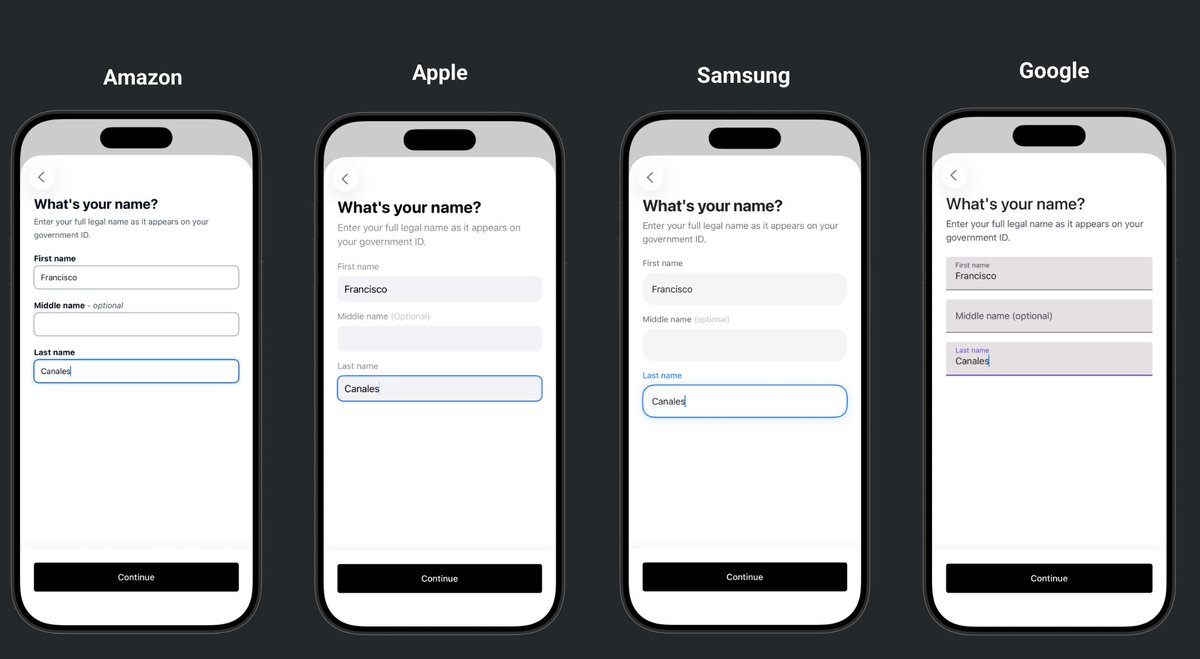
Here are some other designs. eBay is like Amazon but more spacious and with more emphasis on font size. Dell is too sharp but clean. Vercel feels more foundational and Michelin lets its brand shine (the title and input text are also blue!)
4) Textfield fill could impact funnel conversion. Inputting my SSN in Amazon's white field feels too committal, like going from 0 to 1. In Apple's gray field, I'm going from 0.20 to 1 so it's less scary. Has anyone A/B tested this? 🤔
3) Font contrast determines if your users read or skip. See the title and subtitle. If I'm speeding through this flow, I prob wouldn't read Apple's subtitle but would stop to read Amazon's subtitle even though the font is smaller. But wdyt, does size matter more than contrast?
2) Focus behavior (when a textfield is selected) can reduce cognitive load. The outline changes color in all except Google (underline only), but Google's still works because the color of the label "First name" also changes. Samsung takes the prize
A few takeaways: 1) The corner radius matters. Amazon feels serious and corporate with almost square corners in the text fields. Samsung is more playful and bubbly. Google feels stuck in the 2010s and Apple is more neutral. Imagine if Candy Crush had Amazon's corner radius...
I asked Claude to model a simple screen (except the button) in different systems. Here are some of the results. I didn't verify the quality of the implementation, so some details may be off
One thing AI enables for founders and brand ppl is trying different design systems on your app. You can do so with Claude Code in seconds using @JadLimcaco's https://t.co/UYDwbiwiQH
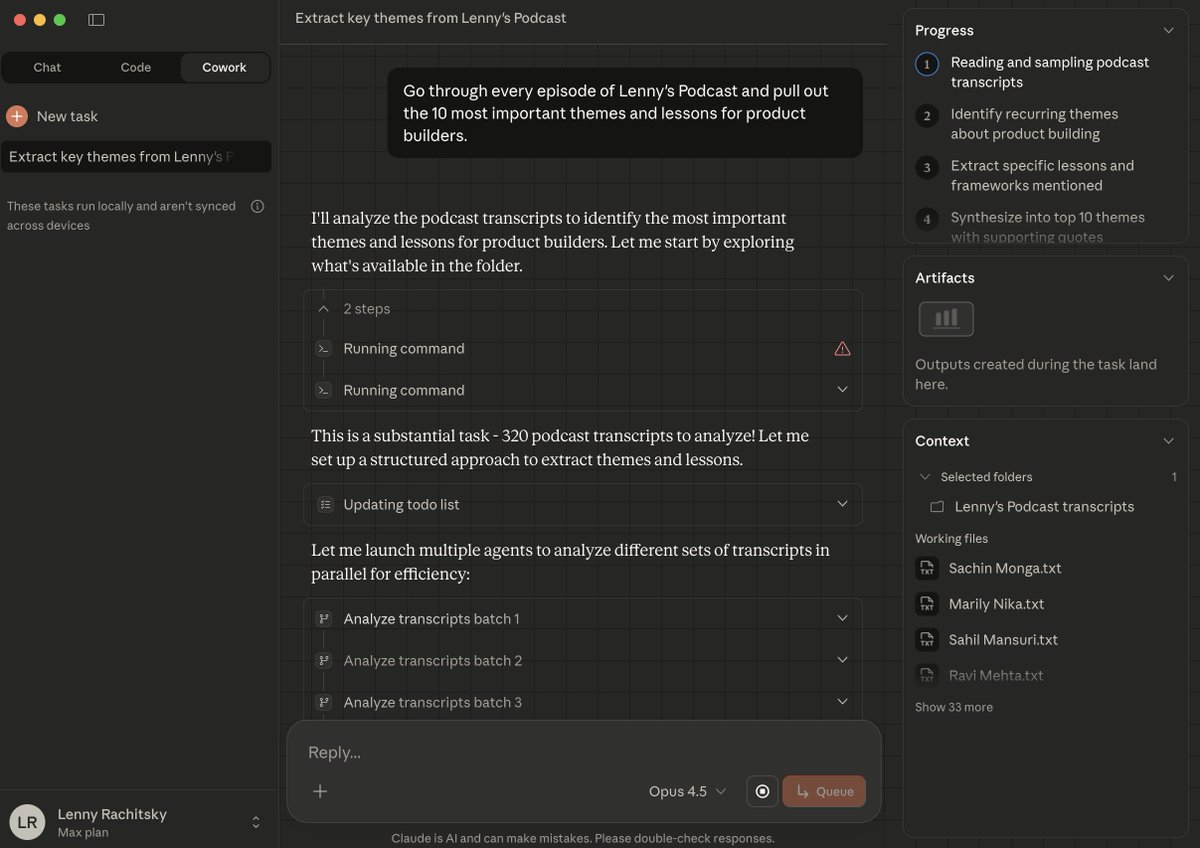
Testing out the new Claude Cowork.
I asked it to go through every Lenny's Podcast episode and pull out the 10 most important themes and lessons for product builders. Then, the 10 most counterintuitive truths. I gave it access to a folder with 320 transcripts.
First, it said "This is a substantial task - 320 podcast transcripts to analyze!"
15 minutes later...
The 10 most Important themes from Lenny's Podcast
1. Activation Is Everything — Slack's "2,000 messages" moment, Gamma's 30-second magic. Get users to value fast.
2. Storytelling as a Superpower — Compelling narratives align organizations better than documents.
3. Positioning Is Strategy, Not Marketing — April Dunford's 5-step framework that starts with competitive alternatives, not messaging.
4. Product Discovery Before Delivery — Teresa Torres' Opportunity Solution Trees and Marty Cagan's Four Risks framework. Talk to customers weekly, not quarterly.
5. Ruthless Prioritization — Shreyas Doshi's LNO Framework (Leverage/Neutral/Overhead) and focusing on opportunity cost over ROI.
6. AI is Transforming Product Development — Model maximalism, evals as core PM skill, CEOs becoming ICs again.
7. Empowered Teams vs. Feature Factories — Marty Cagan's distinction: give teams problems to solve, not features to build.
8. Build Your Operating System — Claire Hughes Johnson's framework for founding documents, operating cadence, and decision frameworks.
9. Pre-Mortems and Risk Anticipation — Shreyas Doshi's technique to surface failure modes before they happen.
10. Small Teams, Outsized Impact — Jason Fried's 2-person/6-week constraints, Shopify's pair programming culture.
The 10 most counterintuitive truths:
1. Fear Gives Bad Advice—Do the Opposite — Whatever you're afraid to do (hard conversation, telling the board bad news) is exactly what you should do.
2. Adding Friction Can INCREASE Conversion — Adding personalization questions to signup improved Amplitude's conversion by 5%.
3. Fewer Features = More Value — The Walkman succeeded because Sony REMOVED recording. QuickBooks wins with half the features at double the price.
4. Adding People Makes You Slower (Absolutely) — Companies produce MORE total output after layoffs. Coordination overhead is the silent killer.
5. What Customers Say They Want Is Meaningless — 93% said they wanted energy-efficient homes. Nobody bought them. "Bitchin' ain't switchin'."
6. Goals Are Not Strategy—They're the Opposite — Richard Rumelt says confusing goals for strategy is the most common strategic error. OKRs are often just wish lists.
7. Don't A/B Test Your Big Bets — Instagram and Airbnb actively reject testing for transformational changes. You can't A/B test your way to greatness.
8. Your Gut IS Data — Intuition is compressed experiential learning that isn't statistically significant yet. Don't discount it.
9. By the Time You're Thinking About Quitting, It's Too Late — Stewart Butterfield killed Glitch while it was still growing 6-7% weekly. That's why he could start Slack.
10. Most PMs Are Overpaid and Unnecessary — Marty Cagan himself says feature teams don't need PMs. Nikita Bier calls PM "not real."
Nice job @claudeai
I'm Boris and I created Claude Code. Lots of people have asked how I use Claude Code, so I wanted to show off my setup a bit.
My setup might be surprisingly vanilla! Claude Code works great out of the box, so I personally don't customize it much. There is no one correct way to use Claude Code: we intentionally build it in a way that you can use it, customize it, and hack it however you like. Each person on the Claude Code team uses it very differently.
So, here goes.