🚨🚨 $IRDM Iridium - FCC Docket 0523-EX-CN-2026
Iridium Satellite LLC is requesting a twenty-four-month experimental license beginning July 1, 2026, to enable space-to-space communication between its satellite constellation and a hosted payload on the SCV Joyful Julia satellite, operated by D-Orbit. The primary goal of this mission is to test the INN5 payload, which will demonstrate in-orbit software technologies and image acquisition. This payload features two Iridium modems to facilitate data transmission. During the experiment, the payload will stay powered off until commanded to activate for sessions lasting approximately one hour. Iridium clarifies that its standard operating parameters will remain unchanged and that this specific license is required because its existing authorization does not cover communication between space stations. The request includes an official confirmation from the Italian government regarding the necessary filings with the International Telecommunications Union. Kara Azocar is listed as the emergency contact for the project.
🔗 https://t.co/5QS6V1ZFUD.
🚨🚨 $IRDM Iridium - FCC Docket 0523-EX-CN-2026
Iridium Satellite LLC is requesting a twenty-four month experimental license beginning July 1, 2026, to enable space-to-space communication between its satellite constellation and a specific hosted payload. This payload, known as INN5, is located on the SCV Joyful Julia satellite operated by D-Orbit and authorized by the Italian government. The mission aims to demonstrate in-orbit software and image acquisition technologies using two Iridium model 9603 modems.
The INN5 payload will typically remain powered off, activating for roughly one hour at a time via ground station commands to perform tests and downlink data through the Iridium network. Iridium states that its existing space station operating parameters will remain unchanged during the experiment. The experimental license is necessary because Iridium’s current Part 25 license does not cover space-to-space communications. The document also includes an official letter from the Italian Administration confirming that the necessary regulatory filings for the INN5 satellite have been submitted to and published by the International Telecommunications Union.
🔗 https://t.co/tQ4V1SIOor.
🚨🚨 $SPCX SpaceX - FCC Docket SAT-MOD-20230207-00021
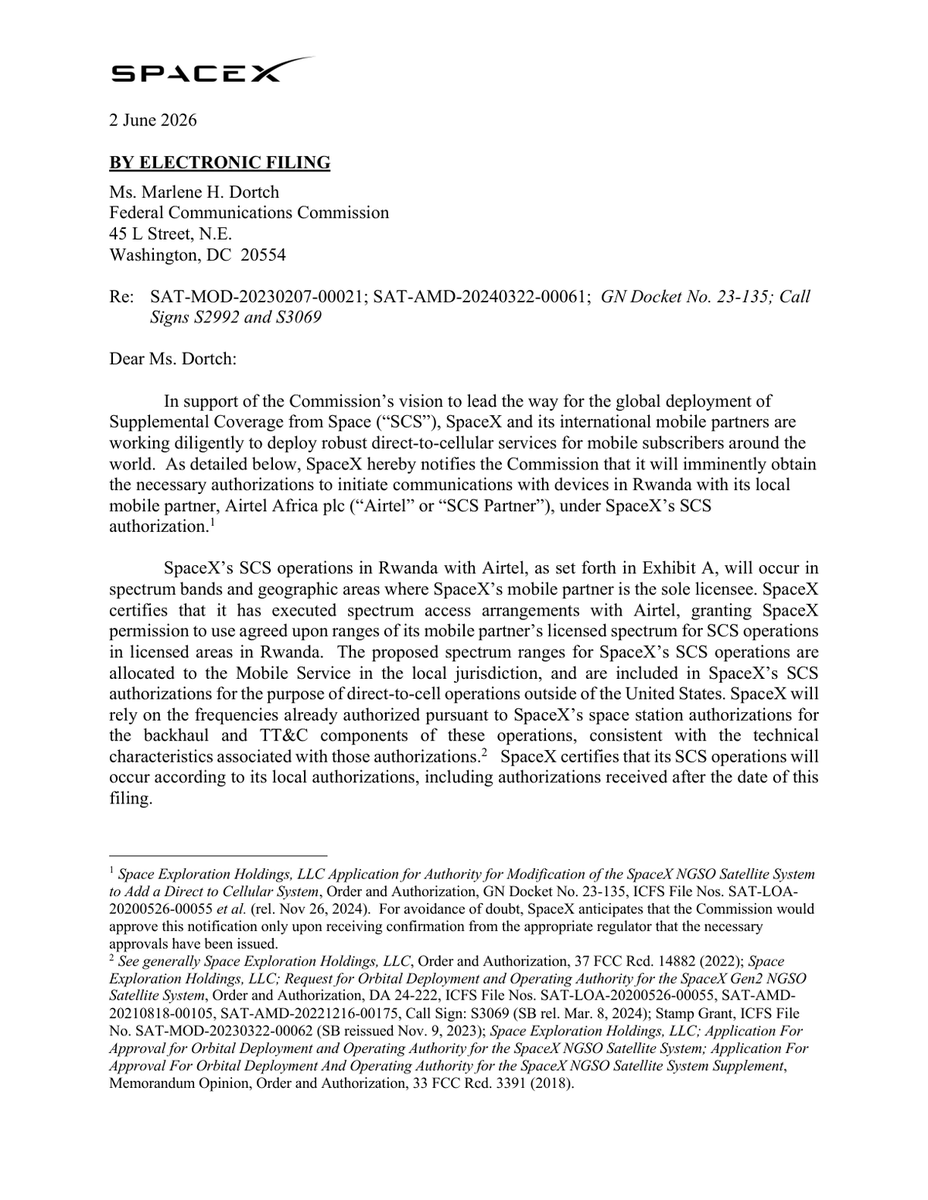
In a letter to the FCC dated June 2, 2026, SpaceX notified the commission of its plan to launch direct-to-cellular services in Rwanda. Partnering with Airtel Africa plc, SpaceX will provide supplemental coverage from space using Airtel’s licensed spectrum. The operations will utilize specific frequency ranges for uplinks and downlinks where Airtel is the sole licensee. SpaceX confirms that it has secured the necessary agreements and will comply with local regulatory requirements to ensure its services do not cause harmful interference to other users. The company will operate on a non-interference, unprotected basis and has established a 24/7 contact system to address any potential technical issues. These operations are part of a broader effort to deploy global satellite-to-mobile connectivity. SpaceX will use its existing authorized frequencies for backhaul and control functions while awaiting final confirmation from Rwandan regulators.
🔗 https://t.co/kTDgvq6Qst
🚨🚨 $JOBY Joby Aero - FCC Docket 0130-EX-CM-2026
Leann Nguyen sent a formal request for information to Brian Higgins regarding application file number 0130-EX-CM-2026. The communication outlines several technical issues and missing details that must be resolved before the application can be processed. Specifically, the applicant must correct mixed-up antenna approval numbers and is instructed not to delete locations directly but to request such changes in the modification description.
The request further asks for specific data on any new locations, including coordinates, operating radii, and flight levels. Explicit clarification is required regarding the flight level for a site in Concord, California, and an explanation of the differences between two specific antennas located in Santa Cruz, California.
All requested information must be uploaded to the FCC website using reference number 102685 rather than sent via email reply. This response is due within 30 days of June 2, 2026. Failure to provide these details within the timeframe may lead to the dismissal of the application and the forfeiture of the filing fee according to federal regulations.
🔗 https://t.co/qqtPIDqRgG.
🚨🚨 Blue Origin - FCC Docket SAT-LOA-20260120-00033
Blue Origin submitted an ex parte filing to the Federal Communications Commission regarding a meeting held on May 26, 2026. During this meeting, representatives from Blue Origin discussed an active satellite application with FCC staff. The conversation focused on two main technical and regulatory points. First, Blue Origin provided an overview of its plan to remove E-band omnidirectional antennas from its system design, opting instead to use Ka-band omnidirectional antennas. The company described the intended functionality and benefits of these Ka-band antennas. Second, Blue Origin discussed its request for a waiver of the standard blanket licensing requirements for its user terminals. This correspondence, dated June 1, 2026, was submitted by Kaitlyn Mahoney, the company's Senior Managing Counsel, to formalize the details of the presentation for the public record.
🔗 https://t.co/hoD9apW0dK
🚨🚨 $JOBY Joby Aero - FCC Docket 0591-EX-CN-2026
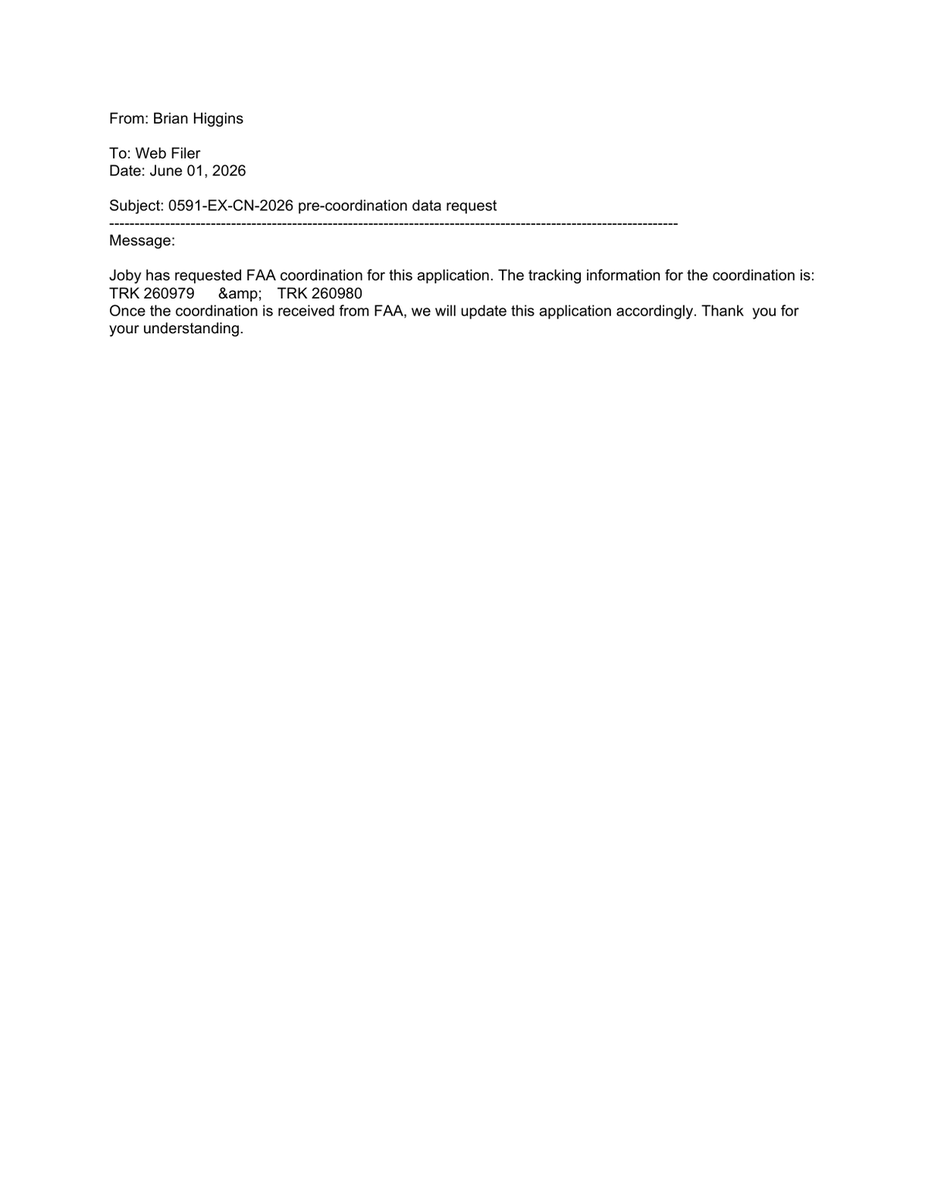
On June 1, 2026, Brian Higgins sent a message to Web Filer regarding a pre-coordination data request for application 0591-EX-CN-2026. The communication states that Joby has initiated the coordination process with the FAA, which is currently identified by tracking numbers TRK 260979 and TRK 260980. The application will be updated accordingly once the necessary coordination is received from the FAA.
🔗 https://t.co/FOch1CC11t.
🚨🚨 Blue Origin - FCC Docket 0778-EX-ST-2026
On June 1, 2026, OET Systems Administration notified Nicole Walters at Blue Origin that an experimental license application has been approved. The filing is identified by call sign WZ9XMP and file number 0778-EX-ST-2026. This license is currently in effect and is scheduled to expire on December 2, 2026. The notification explains that the grant can be viewed through the OET Experimental Licensing Branch Electronic Filing Site. This was an automated message, and no reply is required.
🔗 https://t.co/CDCyvEK2k6.
🚨🚨 Blue Origin - FCC Docket 0778-EX-ST-2026
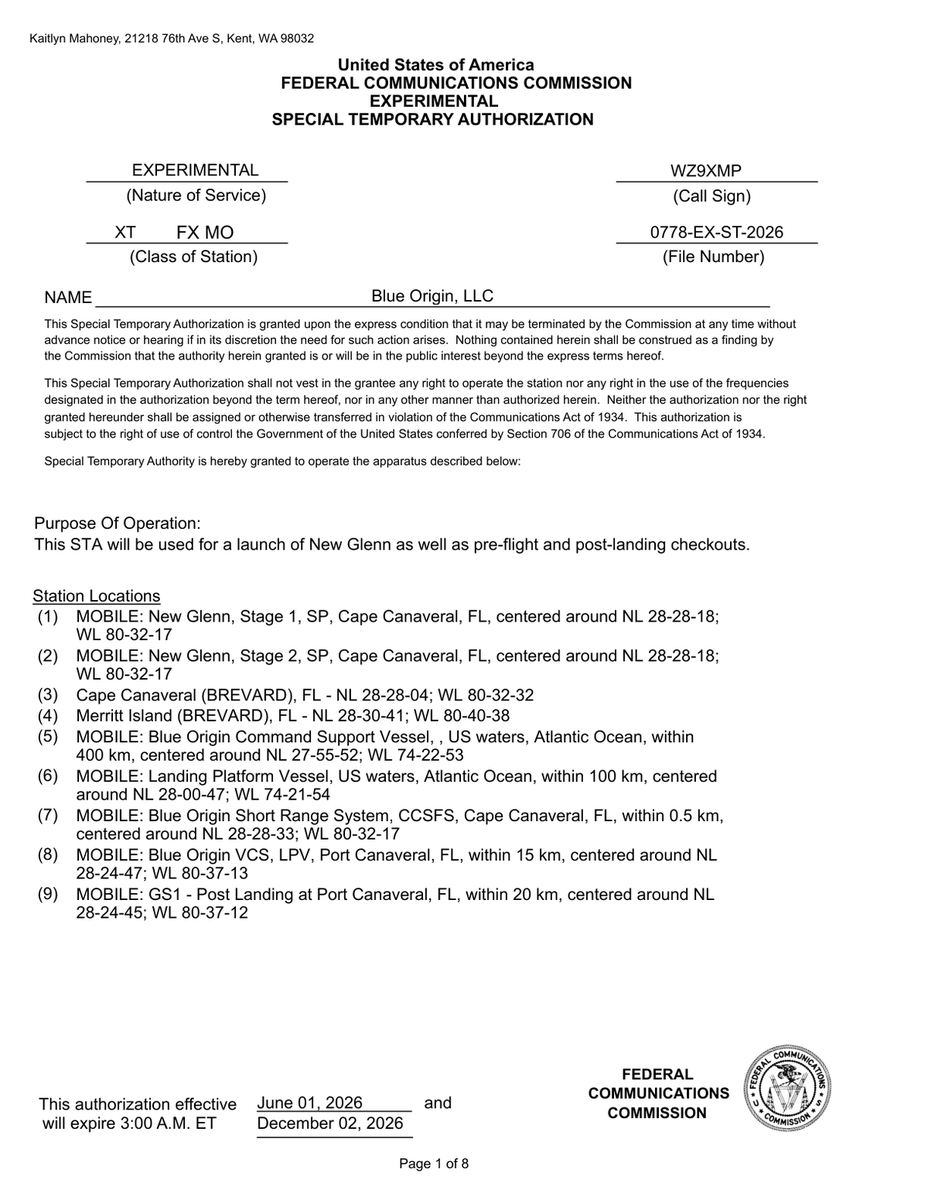
This document is a Special Temporary Authorization (STA) granted by the FCC to Blue Origin, LLC for experimental operations related to the launch of their New Glenn vehicle. The STA, call sign WZ9XMP, covers pre-flight, launch, and post-landing checkouts. It specifies authorized frequencies, power levels, emission designators and locations of operation including Cape Canaveral and adjacent Atlantic Ocean waters. The authorization is effective from June 1, 2026, and expires on December 2, 2026, or upon completion of the launch. It details specific conditions for the use of certain frequency bands, limitations on bandwidth, and coordination requirements with NASA for potential conflicts with Artemis missions. The STA may be terminated by the FCC at any time.
🔗 https://t.co/9bkQtE3k0S.
🚨🚨 $JOBY Joby Aero - FCC Docket 0591-EX-CN-2026
Joby Aero, Inc. requests a two-year experimental radio license from the FCC to test new flight technology, specifically uncrewed aircraft, in the 5030-5091 MHz band. The proposed operations will aid in the development of this technology. Joby states that FCC equipment certification is not available for hardware compatible with its aircraft, necessitating experimental authority. Flight tests will last approximately one hour, occur during daylight hours, and reach a maximum altitude of 15,000 feet. Joby will monitor channels and suspend transmissions if interference is detected. Joby also requests an exemption from station identification requirements under Section 5.115, as the equipment cannot transmit the required information.
🔗 https://t.co/iVs1Akj8D6.
🚨🚨 $JOBY Joby Aero - FCC Docket 0130-EX-CM-2026
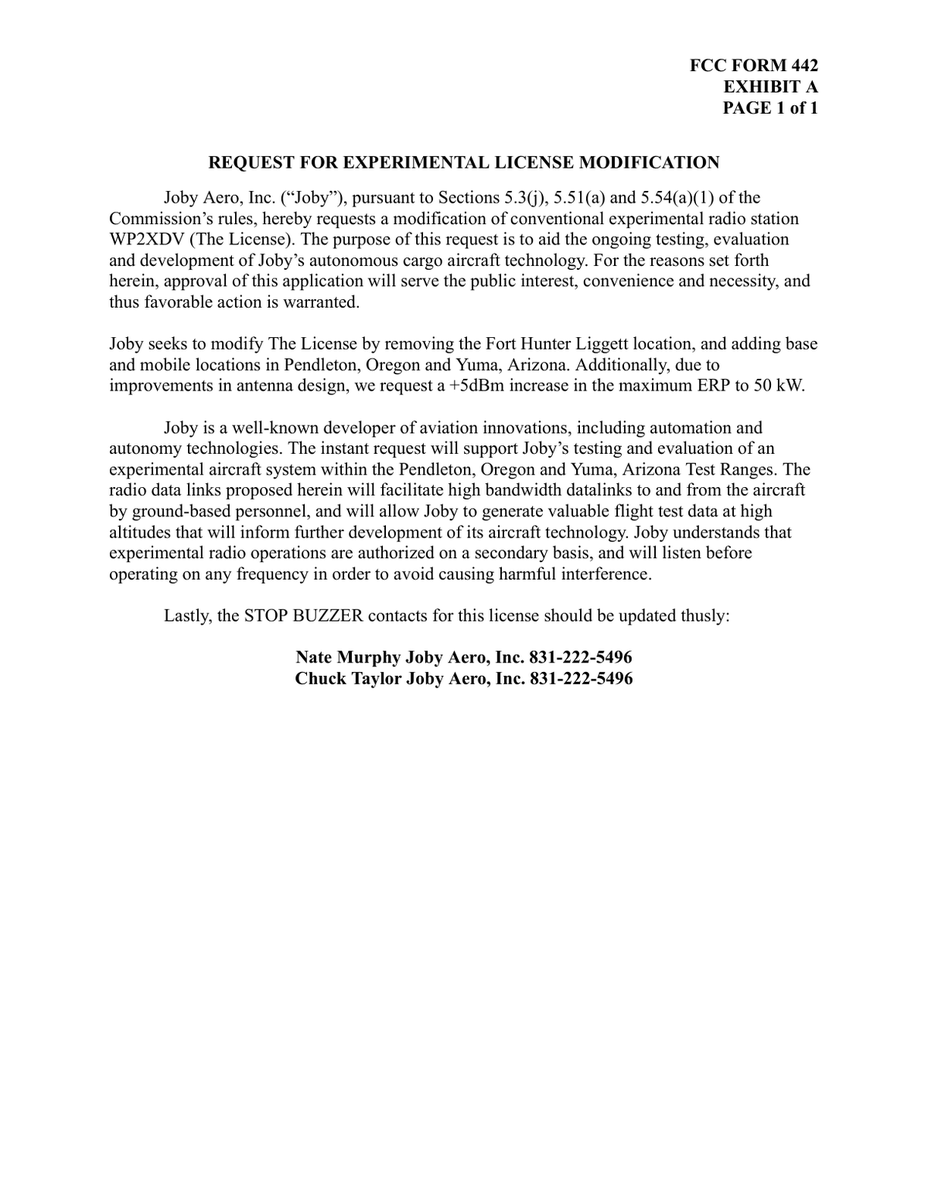
Joby Aero, Inc. requests a modification to its experimental radio station license WP2XDV. The modification seeks to remove the Fort Hunter Liggett location and add base and mobile locations in Pendleton, Oregon and Yuma, Arizona. Additionally, they request a +5dBm increase in the maximum ERP to 50 kW due to antenna design improvements. This request supports the ongoing testing, evaluation, and development of Joby's autonomous cargo aircraft technology, specifically within the Pendleton and Yuma Test Ranges. The radio data links will facilitate high bandwidth communication between the aircraft and ground personnel, generating valuable flight test data. The company also requests updates to the STOP BUZZER contacts, changing them to Nate Murphy and Chuck Taylor.
🔗 https://t.co/SrbmseTRCz.
🚨🚨 Blue Origin - FCC Docket SAT-LOA-20260310-00118
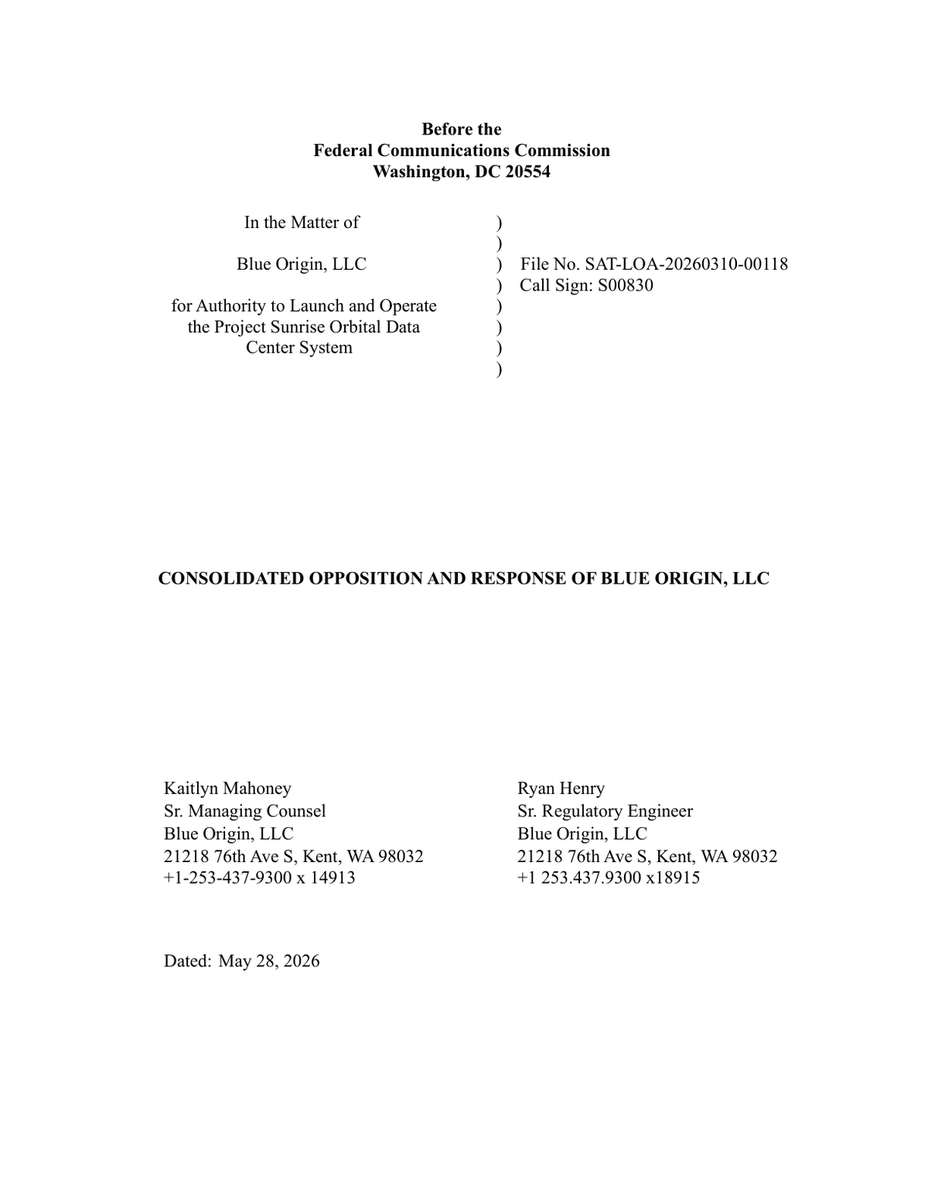
Blue Origin, LLC submits a consolidated opposition and response to comments filed against its application for authority to launch and operate its Project Sunrise orbital data center system. Blue Origin argues that the opposing comments mischaracterize the regulatory framework, raise issues outside the FCC's jurisdiction, or rely on speculative assertions. They request the FCC to grant their application, highlighting the benefits of orbital data centers, including constant solar power, passive radiative cooling, and independence from terrestrial resources. Blue Origin contends that the FCC possesses sufficient authority to grant the application and that requested waivers are consistent with precedent. They commit to mitigating impacts to optical astronomy and compliance with existing rules. They state the public interest favors the application, as it advances American leadership in space and AI.
🔗 https://t.co/qED6B5UfOP
🚨🚨 $SPCX Space Exploration - FCC Docket 0075-EX-CM-2026
This document is an experimental radio station construction permit and license issued by the Federal Communications Commission (FCC) to Space Exploration Holdings, LLC. The license authorizes the use and operation of radio transmitting facilities for radio communications in accordance with the licensee's experimental program. It specifies frequencies, authorized power, and emission designators for mobile non-geostationary operations. Special conditions include conjunction warning protocols, NTIA non-interference basis, restrictions near FAA facilities and NASA TDRSS, power limits, and contact information for interference issues. The authorization is for experimental purposes only, prohibiting commercial activities and limiting operations to 99 satellites with one user terminal each. Operations are subject to cessation if they cause harmful interference to NASA. The license expires March 1, 2028.
🔗 https://t.co/G17m0IRI1Y.
🚨🚨 $SPCX Space Exploration - FCC Docket 0921-EX-ST-2026
This document is a Special Temporary Authorization (STA) granted by the FCC to Space Exploration Technologies Corp (SpaceX) for experimental operations. It allows SpaceX to test Falcon 9 and Falcon Heavy launch vehicle systems at their McGregor, Texas facility. The authorization is effective from June 1, 2026, to December 2, 2026. The STA specifies frequency bands (2090 MHz, 2211 MHz, 2232.5 MHz, 2247.5 MHz, 2255.5 MHz, 2272.5 MHz, 2370.5 MHz, 2382.5 MHz) and power limits for these operations. It also includes special conditions such as the requirement for non-interference with other stations, coordination with the Aerospace and Flight Test Radio Coordinating Council (AFTRCC) for Aeronautical and Fixed frequencies, and coordination with the local Society of Broadcast Engineers Frequency Coordinator for 2090 MHz. All operations are limited to ground-based transmissions and should not be used for flight testing or launch operations. Future launch requests using the 2200-2290 MHz band are subject to per-launch coordination with federal agencies.
🔗 https://t.co/xdo7iIUoOA.
🚨🚨 $GSAT globalstar - FCC Docket 0080-EX-TU-2026
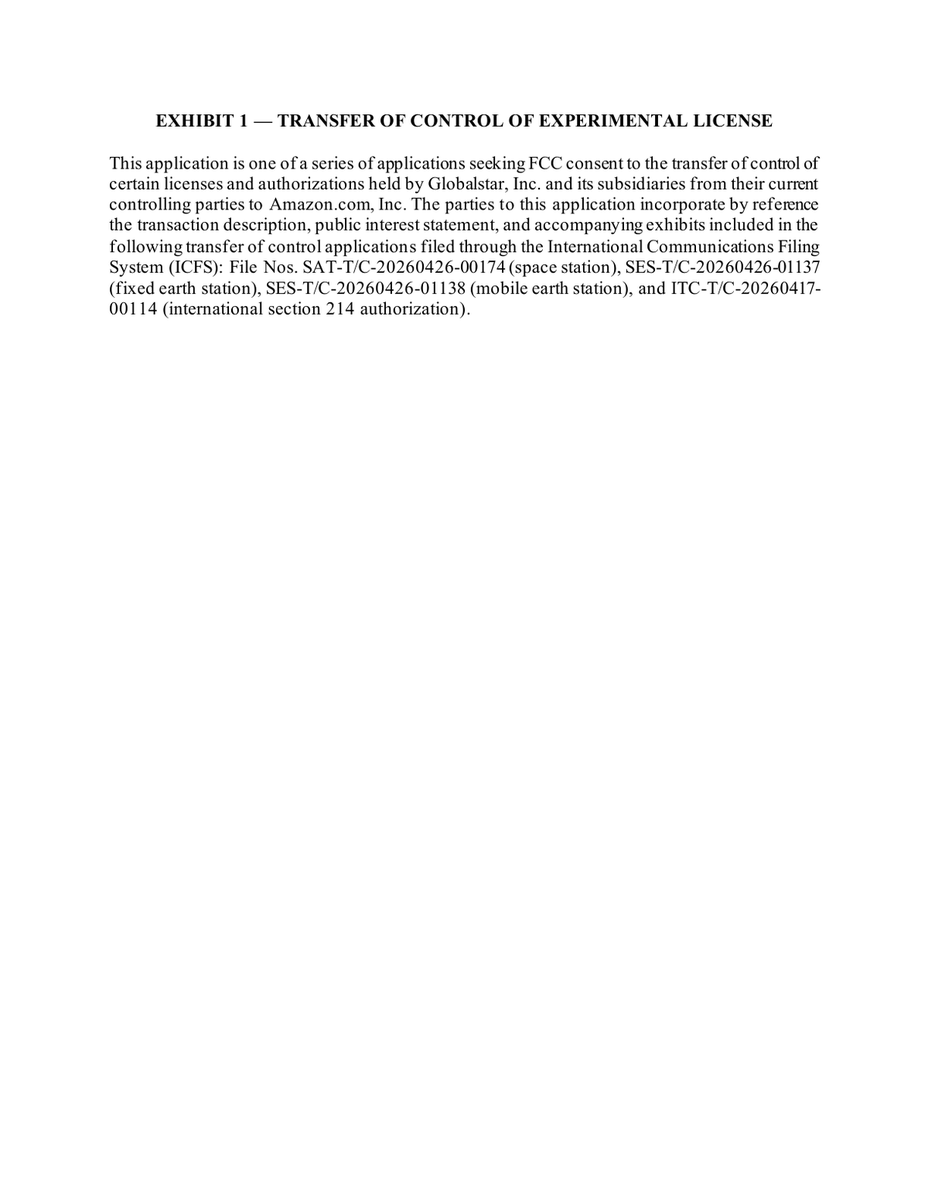
This is an application seeking FCC consent for the transfer of control of an experimental license held by Globalstar, Inc. and its subsidiaries to https://t.co/ACcgLIOc0r, Inc. The application incorporates by reference the transaction description, public interest statement, and accompanying exhibits included in other transfer of control applications. These filings were submitted through the International Communications Filing System (ICFS) under File Nos. SAT-T/C-20260426-00174 (space station), SES-T/C-20260426-01137 (fixed earth station), SES-T/C-20260426-01138 (mobile earth station), and ITC-T/C-20260417-00114 (international section 214 authorization).
🔗 https://t.co/XOSM1gk09w.
🚨🚨 $GSAT globalstar - FCC Docket 0079-EX-TU-2026
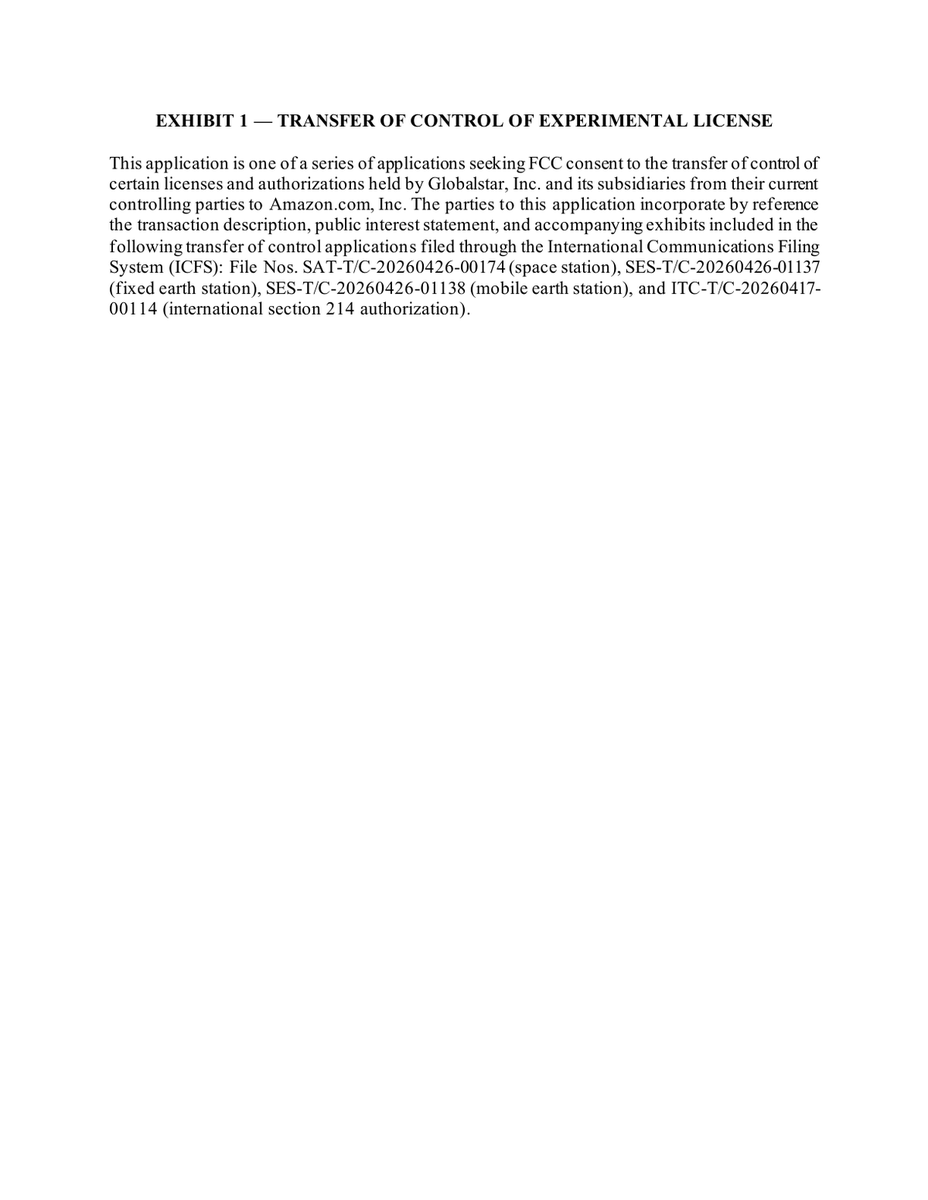
This is an application seeking FCC consent for the transfer of control of an experimental license held by Globalstar, Inc. and its subsidiaries to https://t.co/ACcgLIOc0r, Inc. The application incorporates by reference the transaction description, public interest statement, and accompanying exhibits included in other transfer of control applications filed through the International Communications Filing System (ICFS). These filings include space station, fixed earth station, mobile earth station, and international section 214 authorization transfer applications.
🔗 https://t.co/oiRRTiyWqj.
🚨🚨 $ASTS AST Spacemobile - FCC Docket SAT-MOD-20260105-00005
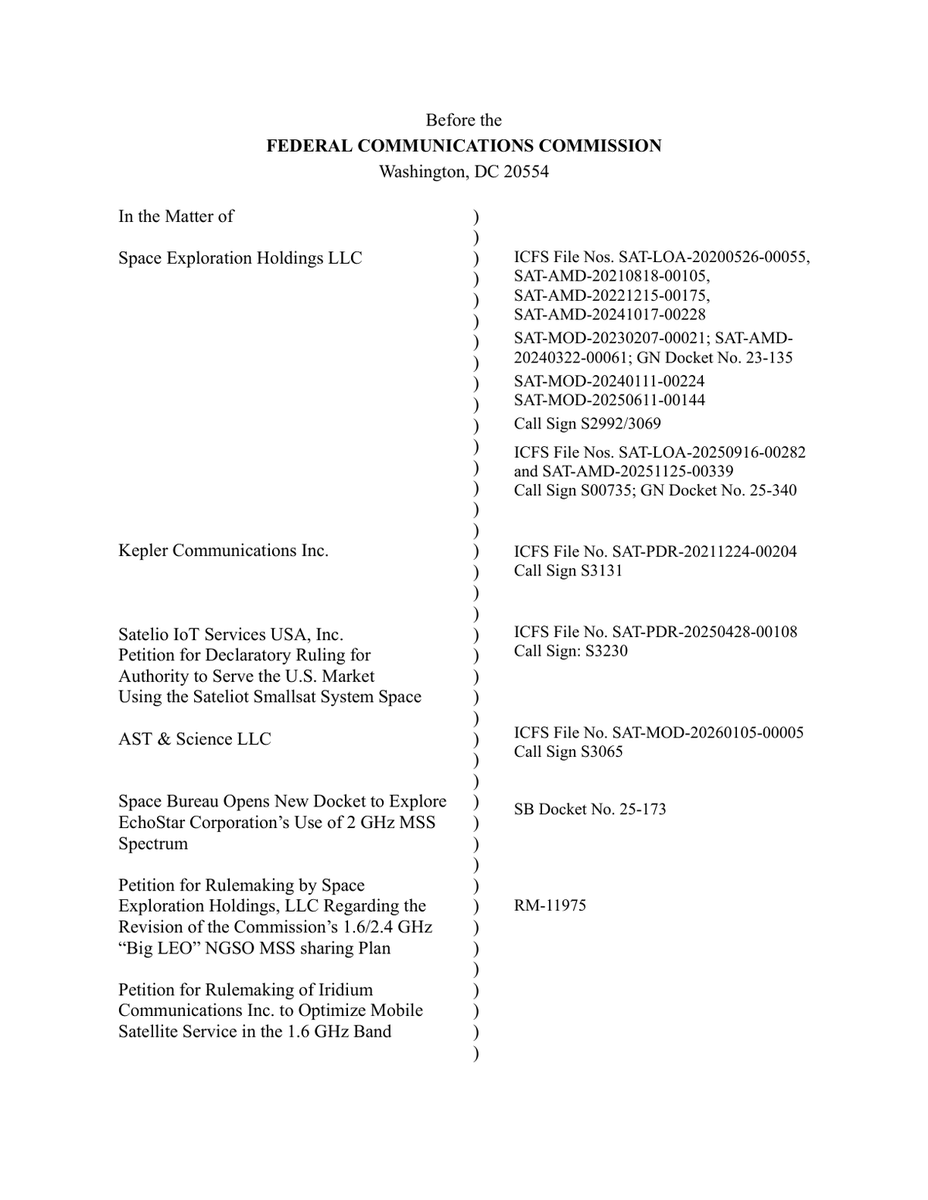
Satelio IoT Services USA, Inc. requests Commission review of the Space Bureau's Order dismissing its Petition for Declaratory Ruling with prejudice. Sateliot seeks U.S. market access for its small satellite constellation, operating in the 2 GHz MSS band to provide narrowband, 3GPP standards-based, satellite-enabled Internet of Things services to terrestrial mobile network operators. The application argues that the Bureau's Order conflicts with the SmallSat Order's rejection of per se exclusion of small satellite proposals and ignores the requirements of Section 25.122(c)(9) of the Commission’s rules. The application claims the Bureau failed to engage with Sateliot's system-specific technical showing, and requests the Commission to reverse the dismissal, accept the Petition for filing, and require a compatibility evaluation, or alternatively, grant the Petition subject to appropriate conditions to ensure non-interference.
🔗 https://t.co/9RAcfPFilp
🚨🚨 Lynk - FCC Docket 0388-EX-CR-2026
This document is a Federal Communications Commission (FCC) experimental radio station construction permit and license granted to Lynk Global, Inc. It authorizes the company to use and operate radio transmitting facilities for radio communications according to their application. The license is effective from June 1, 2026, and expires on June 1, 2028. The permit specifies operating frequencies, emission designators, and power limits for mobile stations located in the United States and territories, as well as for NGSO satellites at a specific altitude and inclination. Special conditions include waiving station identification requirements, collision risk mitigation protocols, potential for interference from other stations, bandwidth limitations, designated points of communication (Lynk Towers 5 and 6 Satellites), the need for foreign earth stations to obtain appropriate licenses, and consent requirements from Cellular licensees for operations in the 824-849 MHz and 869-894 MHz bands. The document also provides a point of contact to terminate transmissions if interference occurs.
🔗 https://t.co/zmYN9sinPe.
🚨🚨 $ASTS AST Spacemobile - FCC Docket 26-78
AST & Science, LLC (AST SpaceMobile) submits comments to assist the FCC's assessment of competition in the communications marketplace, particularly for satellite communications, mobile wireless, and cross-platform services. AST SpaceMobile is focused on delivering high-speed cellular broadband connectivity via everyday handsets, partnering with mobile network operators (MNOs) to extend coverage to underserved areas. The company highlights its use of International Mobile Telecommunications (IMT) and Mobile Satellite Service (MSS) for direct-to-device (D2D) connectivity, and supports the FCC's efforts to modernize space regulations and ensure spectrum efficiency. They also advocate for addressing satellite market access reciprocity issues, given the international nature of satellite operations and the barriers U.S. operators face abroad. The company emphasizes the importance of a supportive regulatory environment to promote innovation and competition in the satellite industry.
🔗 https://t.co/k7ExJl56CF
🚨🚨 $ASTS AST Spacemobile - FCC Docket 19-116
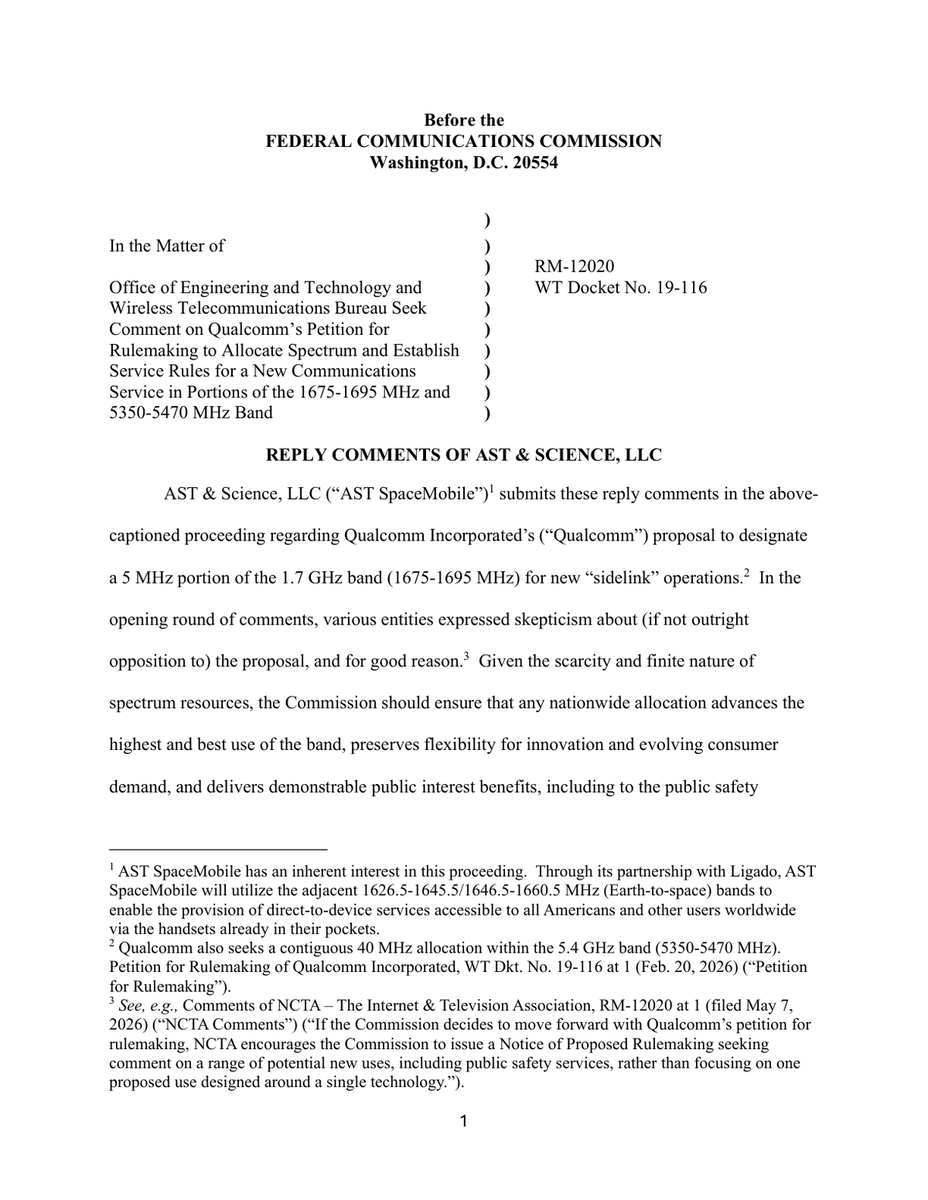
AST SpaceMobile submits reply comments regarding Qualcomm's proposal to allocate spectrum for new sidelink operations in the 1675-1695 MHz and 5350-5470 MHz bands. AST SpaceMobile opposes Qualcomm's proposal, arguing that the 1675-1680 MHz band should be auctioned this year for Supplemental Coverage from Space (SCS) and D2D services, providing broader benefits than Qualcomm’s narrow sidelink proposal. They contend that sidelink's benefits are not unique and can be achieved through existing D2D capabilities. AST SpaceMobile further argues that Qualcomm's proposal, while framed around public safety, also includes secondary, non-public safety users, and lacks support from commercial wireless carriers. They cite concerns that sidelink could interfere with critical data transmission for environmental monitoring.
🔗 https://t.co/TgkvtdNQkV
🚨🚨 $IRDM Iridium - FCC Docket 0539-EX-CN-2026
This document describes an experimental radio station construction permit and license issued by the Federal Communications Commission (FCC) to Iridium Satellite LLC. The authorization, call sign WQ2XMT, allows operation of radio transmitting facilities for experimental radio communications, in accordance with Sec. 5.3(j) of the Commission's Rules. The license is effective from May 20, 2026, until June 01, 2027. Operation is subject to special conditions, including occupied bandwidth limitations and potential interference from other stations. The mobile station operates in LEO orbit at 780 km altitude, inclination 86.4 degrees, and uses frequencies within the 1618.725-1626.5 MHz band.
🔗 https://t.co/0NO0LajJE6.