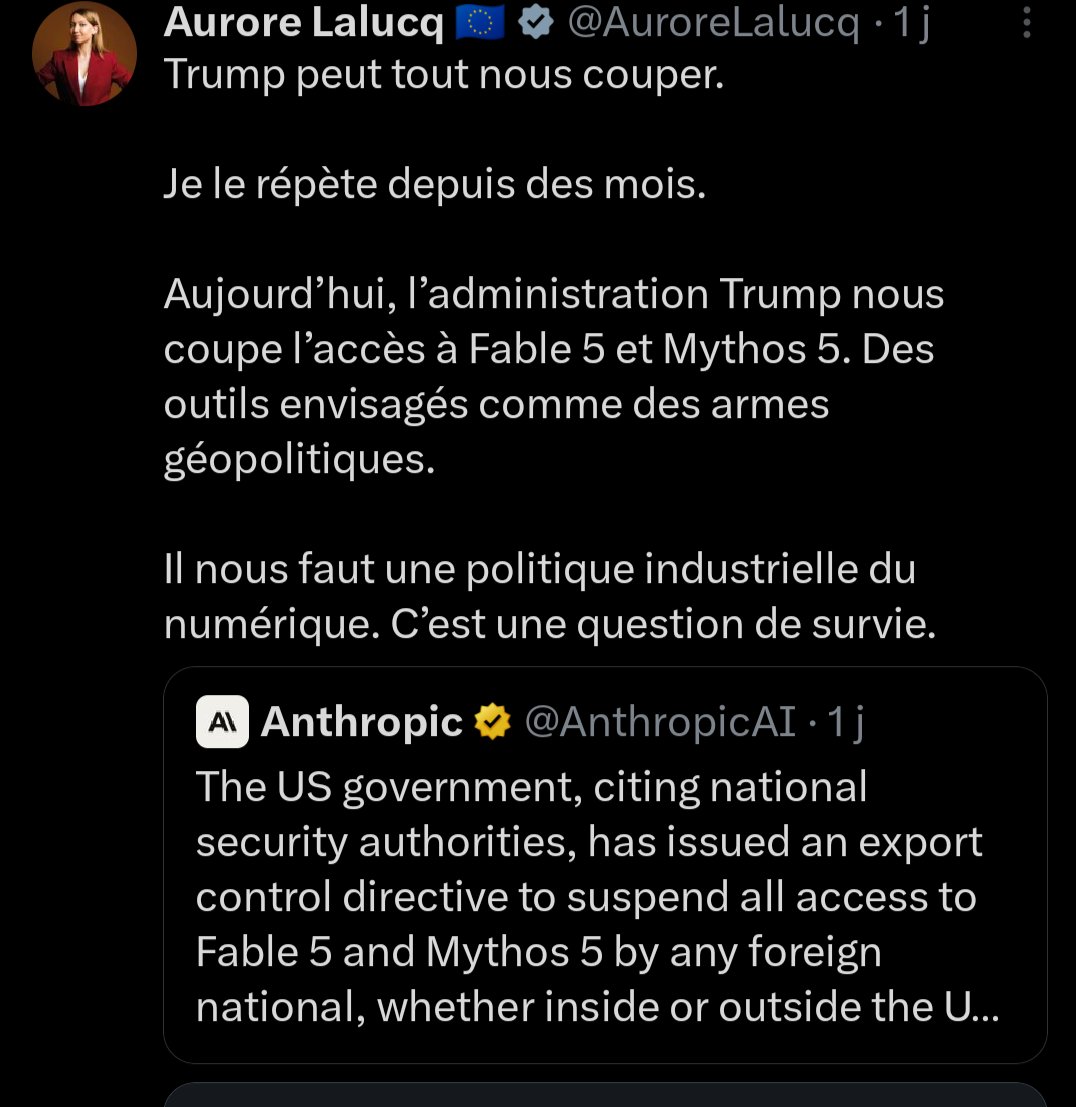
C'est bien vous @AuroreLalucq qui m'avez bloqué quand j'essayais de vous empêcher de saborder l'Europe ?
C'est bien vous qui vouliez interdire la propriété privée dans le monde numérique ?
C'est bien vous qui qualifiez de fasciste ceux qui parlaient de souveraineté numérique ?
This morning, THORChain was drained of roughly $10.8m
Node operators have freezed the network for nearly 13 hours. The full analysis isn't out yet, but according to @jpthor, this could be a MPC exploit.
ECDSA and TSS is hard. THORChain's vaults rely on TSS, a flavor of MPC where a quorum of nodes jointly produces a signature without ever reconstructing the private key. Clean for Schnorr or EdDSA; painful for ECDSA, which Bitcoin and Ethereum require. That's why we saw plenty of protocol attempts (Lindell17, GG18, GG20, CMP, CGGMP21, DKLS, KU23...), each patching flaws in the previous one.
GG20 has a track record. THORChain's TSS uses GG20, on a fork of Binance's tss-lib. GG20 has shipped two well-publicized critical bugs: CVE-2023-33241 and TSSHOCK. CGGMP21, now cggmp24, are the latest protocols, but GG20 is still widely deployed.
I often hear a misconception when I hear about MPC setup: "The key is split across many nodes, so any single co-signer doesn't really matter".
In every published GG18/GG20 attack, one malicious or compromised co-signer is enough to extract everyone else's shard and reconstruct the full key.
AI changes the threat model. Compromising a full software node, complex Go stack, exposed P2P, custom signing daemons, a churn protocol that admits new participants on a schedule, has always been difficult and acted as a barrier. With LLM-driven vulnerability discovery and exploit synthesis, the bar to compromise one of N validators is dropping fast.
Here, it's a plausible TSSHOCK-style playbook:
- compromise one operator
- wait for it to churn into an active Asgard vault
- send malformed proofs during keygen or signing
- reconstruct the key offline
- sweep in a single transaction
It's unclear yet if the attacker used a known-unpatched GG20 weakness, or a fresh cryptographic flaw.
But, in all cases, MPC and TSS are not a substitute for hardening every co-signer. They sit on top of co-signers that must each be treated as critical infrastructure, hardware-isolated enclaves, minimally exposed, continuously audited, and running protocol with security proofs.
While the investigation progresses, be careful in your interactions onchain. These TSS setup are used in various protocols.
The relationship between "institutions" and "cypherpunk" is complex and needs to be understood properly. In truth, institutions (both governments and corporations) are neither guaranteed friend nor foe.
Exhibit A: https://t.co/PyTcxu1lkV European Union seeking to aggressively support open source
Exhibit B: https://t.co/RUQvp0nh1B European Union bureaucrats want Chat Control (mandatory encryption backdoors)
Exhibit C: the Patriot Act (which, we must note, _neither party_ now expresses much interest in repealing)
Exhibit D: the US government is now famously a user of Signal
Basically, the game-theoretic optimum for an institution is to have control over what it can control, but also to resist intrusion by others. In fact, institutions are often staffed by highly sophisticated people, who have a much deeper understanding of these issues than regular people and a much deeper will to do something about them. An important driver of many people's refusal to use data-slurping corposlop software is company policy.
Some people have the misperception that my words yesterday about the importance of using tools that maximize your data self-sovereignty are something that will appeal to individual enthusiast communities, but will be rejected as unrealistic by efficiency-minded "serious people". But this is false: "serious people" are often _more_ robustness-minded than retail and many already have policies even stricter than what I advocate.
I predict that in this next era, this trend will accelerate: institutions (again, both corporations and governments) will want to more aggressively minimize their external trust dependencies, and have more guarantees over their operations. Again, this does not mean that they want to minimize *your dependency on them* - that's the thing that we as the Ethereum community must insist on, and build tools to help people achieve. But that's precisely the complexity of the situation.
In the stablecoin world, this means:
* Asset issuers in the EU will want a chain whose governance center of gravity is not overly US-based, and vice versa (same for other pairs of countries)
* Governments will push for more KYC, but at the same time privacy tools will improve, because cypherpunks are working hard to make them improve. The more realistic equilibrium is that non-KYC'd assets will exist, and ability to use them with strong privacy will grow, but also over the next decade we'll see more attempts at "ZK proof of source of funds". We will see ideological disputes over how to respond to this
* Institutions will want to control their own wallets, and even their own staking if they stake ETH. This is actually good for ethereum staking decentralization. Of course, they will not proactively work to give you the user a self-sovereign wallet. Doing _that_ in a way that is secure for regular users is the task of Ethereum cypherpunks (see: smart contract wallets, social recovery).
Ethereum is the censorship-resistant world computer: we do not have to approve of every activity that happens on the world computer. I did not approve much of three million dollar digital monkeys, I will not approve much of privacy with centralized (including multisig/threshold) decryption backdoors. But the existence of those things is not up to me to decide. What *is* up to us is to build the world that we want to see on top of Ethereum, and make that world strong, so that it can prosper in the competition, both on the Ethereum chain itself, and against the centralized world.
At best, we can interoperate with the non-cypherpunk world to better bootstrap the cypherpunk world. For example, spreads on decentralized stablecoins can decrease if it's easy for people to run arbitrage strategies where they hold positive quantities of a centralized stablecoin and negative quantities of the decentralized one. If we want prediction markets to avoid sliding into sports betting corposlop, we should explore improving their liquidity by helping traditional financial entities use them to hedge against their existing risks. What is a bet from one side is often a purchase of insurance from the other side, and if we want prediction markets to evolve in a healthy way, it may be overall better for the counterparties of the sophisticated traders earning big APYs to be buyers of insurance than to be naive bettors who constantly lose money. Synergies like this should be explored across all domains.
This is why I do not believe that cypherpunk requires total hostility to institutions. Instead, I support a policy that institutions are already used to using against each other: openness to win-win cooperation, but aggressively standing up for our own interests. And in this case, our interest is building a financial, social and identity layer that protects people's self-sovereignty and freedom.
🚨 GIVEAWAY TIME 🚨
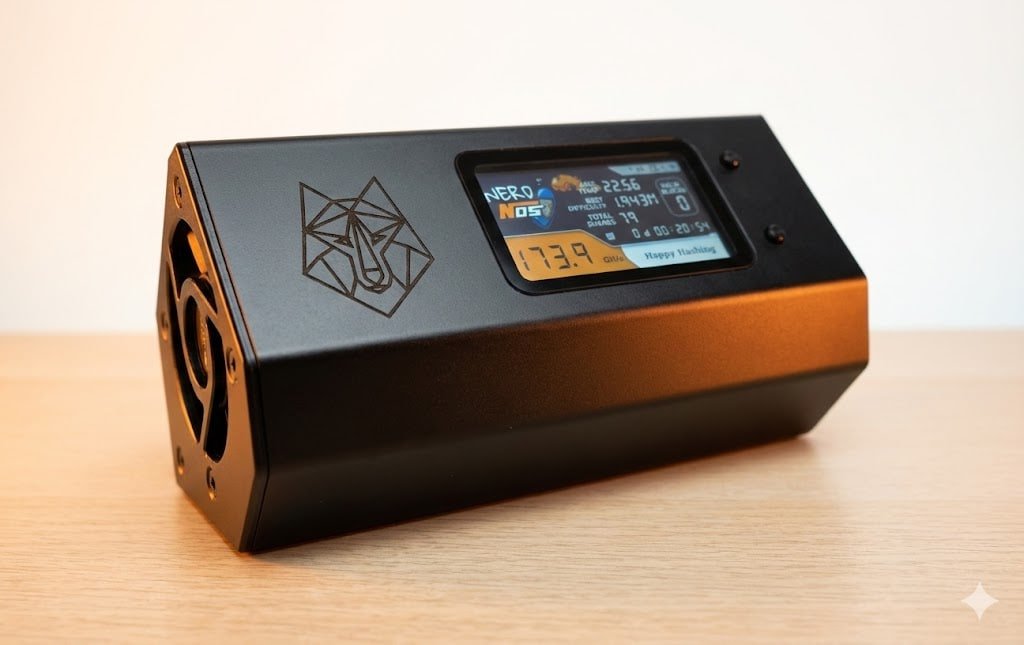
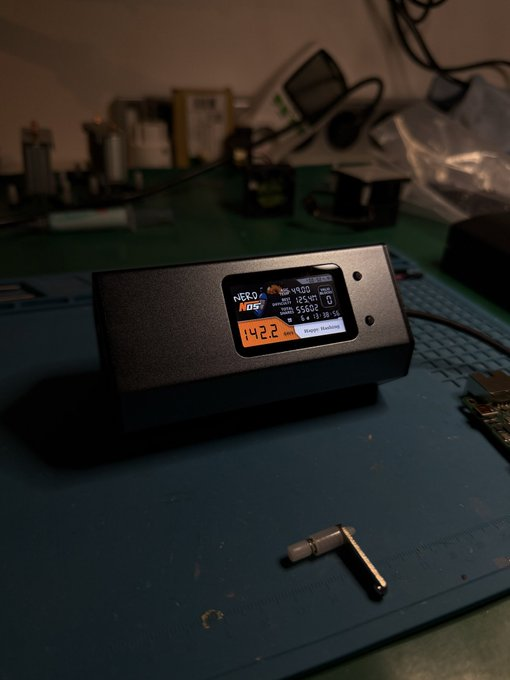
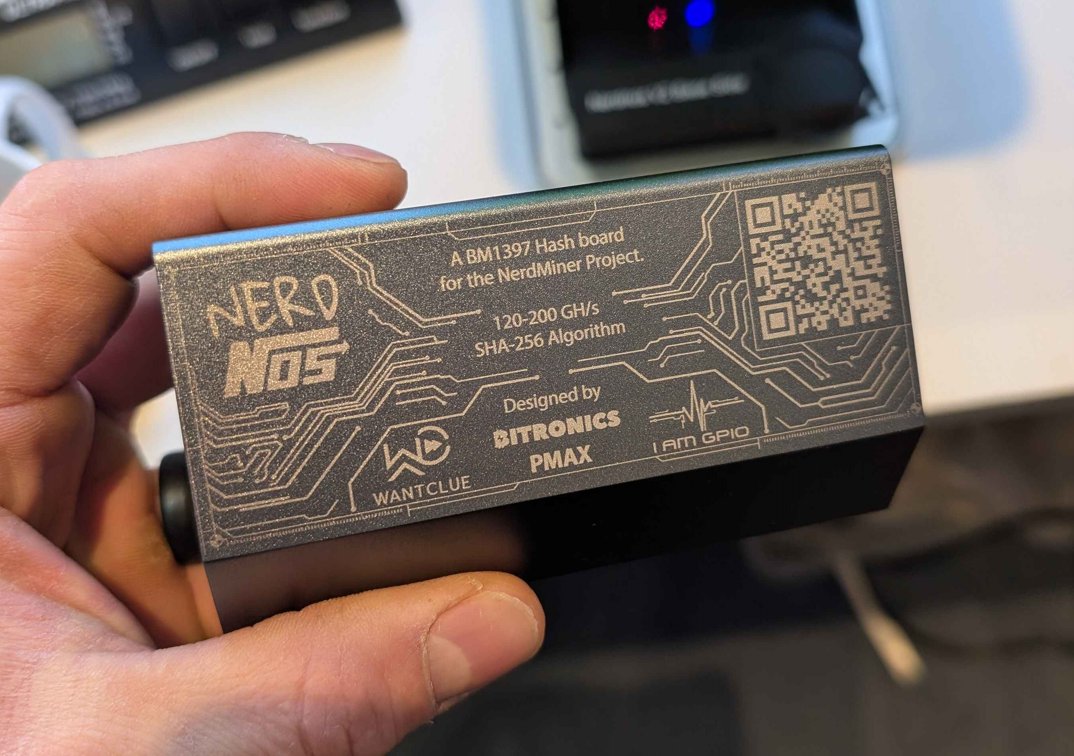
I’m giving away a NerdNos Desktop Miner — with custom laser engraving on the unit (your design / text / idea) — to anyone in the world, and I’ll cover shipping. 🌍📦
I will even work with you on the artwork!
To enter:
1 : Like this post
2: Follow us
3: Share / RT this post.
🏆 Winner drawn: Saturday 31st January 2026
Good luck 👀⚡️ #Bitcoin #Mining #NerdNos #Giveaways
https://t.co/UfaJFsGT4s
🚨 GIVEAWAY TIME 🚨
I’m giving away a NerdNos Desktop Miner — with custom laser engraving on the unit (your design / text / idea) — to anyone in the world, and I’ll cover shipping. 🌍📦
I will even work with you on the artwork!
To enter:
1 : Like this post
2: Follow us
3: Share / RT this post.
🏆 Winner drawn: Saturday 31st January 2026
Good luck 👀⚡️ #Bitcoin #Mining #NerdNos #Giveaways
https://t.co/UfaJFsGT4s
Bitcoin holders face a brutal choice when they need cash.
Sell your BTC (and cry later).
Or spend 6 hours comparing complicated CeFi platforms with confusing rates and custody risks.
Neither option makes sense.
Our portfolio company, @SatsTerminal, has just launched Borrow, the first non-custodial marketplace for Bitcoin-backed loans.
What makes it different:
→ One marketplace aggregating bitcoin-backed lenders (DEX + CEX)
→ Non‑custodial & no KYC. Your keys, your control.
→ Real‑time, transparent quotes: view net APR, LTV, fees, and terms instantly before you borrow
→ One simple flow from BTC to stablecoins
It’s built by Bitcoin-first founders @stan_havryliuk and @rishabhjava and the team has set the standard for Bitcoin swaps.
If you hold bitcoin and want liquidity without giving up custody, keep your eye on Sats Terminal.
Pendant 20 ans vous avez confié votre vie privée à des entreprises étrangères et vous leur avez tout donné sans vous poser de questions
vos photos, vos messages, vos déplacements, vos recherches… parce que c’était gratuit et vous avez fini par comprendre (bcp trop tard) que si c’est gratuit c’est donc VOUS LE PRODUIT
aujourd’hui vous payez 20 dollars par mois ChatGPT et vous lui confiez vos pensées les + intimes, vos doutes, vos stratégies, vos projets en pensant que cette fois parce que vous payez vos données vont rester privées
10 millions de personnes paient désormais ChatGPT en générant 2,7 milliards de dollars par an pour OpenAI mais spoiler: ces données ne resteront JAMAIS privées
par défaut vos convs sont utilisées pour entraîner les modèles & même en désactivant l’historique vos données transitent par leurs serveurs & peuvent être partagées avec des tiers
sachez par ex qu’en mars 2023 une fuite majeure a exposé des milliers d’infos d’utilisateurs & en novembre 2025 des chercheurs ont découvert 7 vulnérabilités permettant de voler vos convs sans que vous le sachiez
des centaines de milliers de convs ChatGPT se sont retrouvées indexées sur Google parce que des utilisateurs ont partagé des liens devenus publics
imaginez mtn que dans 10 ans vous ayez des ambitions politiques hautes ou que vous vouliez créer une startup qui dérange des acteurs bien établis, pensez vous vraiment que personne ne ressortira ces convs où vous avez dévoilé vos faiblesses, vos opinions controversées, vos stratégies pour vous détruire au moment opportun??
la naïveté européenne sera transcrite dans tous les livres d’histoire & pendant que vous pensiez acheter de la confidentialité avec 20 dollars par mois vous avez juste acheté le droit de payer pour donner vos secrets
ne soyez pas stupides
we should not be helping nations develop CBDCs, it is incredible to brag about this
this is *entirely* antithetical to what crypto is
we are trading sovereignty for surveillance
everyone must be united in saying NO to this
crypto without privacy is not crypto
As a former CCNA instructor (you weren't alive then), fuck this guy. Seriously.
Celebrate people sharing knowledge. Not your cup of tea? Np, move on.
And @TracketPacer makes this fun for folks getting into network engineering. And for all of us. 🦄🦄
How to get lucky in Bitcoin:
1. Do 100+ hours of research
2. Discover what inflation is and act
3. Take a leap of faith, buy $100
4. Lose 50%+, learn to HODL
5. Return to break-even, HODL
6. Buy more despite the “risk”
7. Watch 10hrs of YT videos on how to move your “private keys” off an exchange
8. Don’t lose your seed phrase
9. Reject the 100’s of crypto scams
10. Do nothing besides buy for 5+ years
With enough time, anyone can be “lucky” in Bitcoin.
How to get lucky in Bitcoin:
1. Do 100+ hours of research
2. Discover what inflation is and act
3. Take a leap of faith, buy $100
4. Lose 50%+, learn to HODL
5. Return to break-even, HODL
6. Buy more despite the “risk”
7. Watch 10hrs of YT videos on how to move your “private keys” off an exchange
8. Don’t lose your seed phrase
9. Reject the 100’s of crypto scams
10. Do nothing besides buy for 5+ years
With enough time, anyone can be “lucky” in Bitcoin.
Who makes the rules? You do. Who enforces them? Your COLDCARD.
COLDCARD's new Spending Policy + 2FA lets you enforce rules before a single sat moves. Magnitude, velocity, whitelists, even 2FA.
To celebrate, we're giving away a COLDCARD Q. Like, Comment and Repost to enter.
Le x10 était la stratégie la plus simple.
Il y a 5 ans, jour pour jour, on lançait StackinSat 🥳
Le Bitcoin était à 10 000$.
Aujourd'hui, il est à 100 000$.
Pas de trading.
Pas de stress.
Juste un Plan Epargne Bitcoin, exécuté mois après mois !
La patience a été le multiplicateur le plus puissant.
Et l'histoire ne fait que commencer.
Pour fêter nos 5 ans, on veut vous armer pour la suite.
Alors on sort notre offre la plus agressive jamais faite :
➡️ -33% sur vos frais pendant 1 an.
⚠️ Attention, cette offre d'anniversaire est unique et se termine ce dimanche, 5 octobre à minuit.
Le meilleur moment pour commencer, c'était il y a 5 ans.
Le deuxième meilleur moment, c'est maintenant.
Le code 100K est déjà appliqué ici 👇
https://t.co/nwDeo7vThz