🚗 El Instituto Tecnológico de Hermosillo (ITH) inauguró la mañana de este viernes un cargador para automóviles eléctricos que estará disponible para uso de la comunidad estudiantil.
Más información: https://t.co/wKrVQ4k3xO
#ProyectoPuente
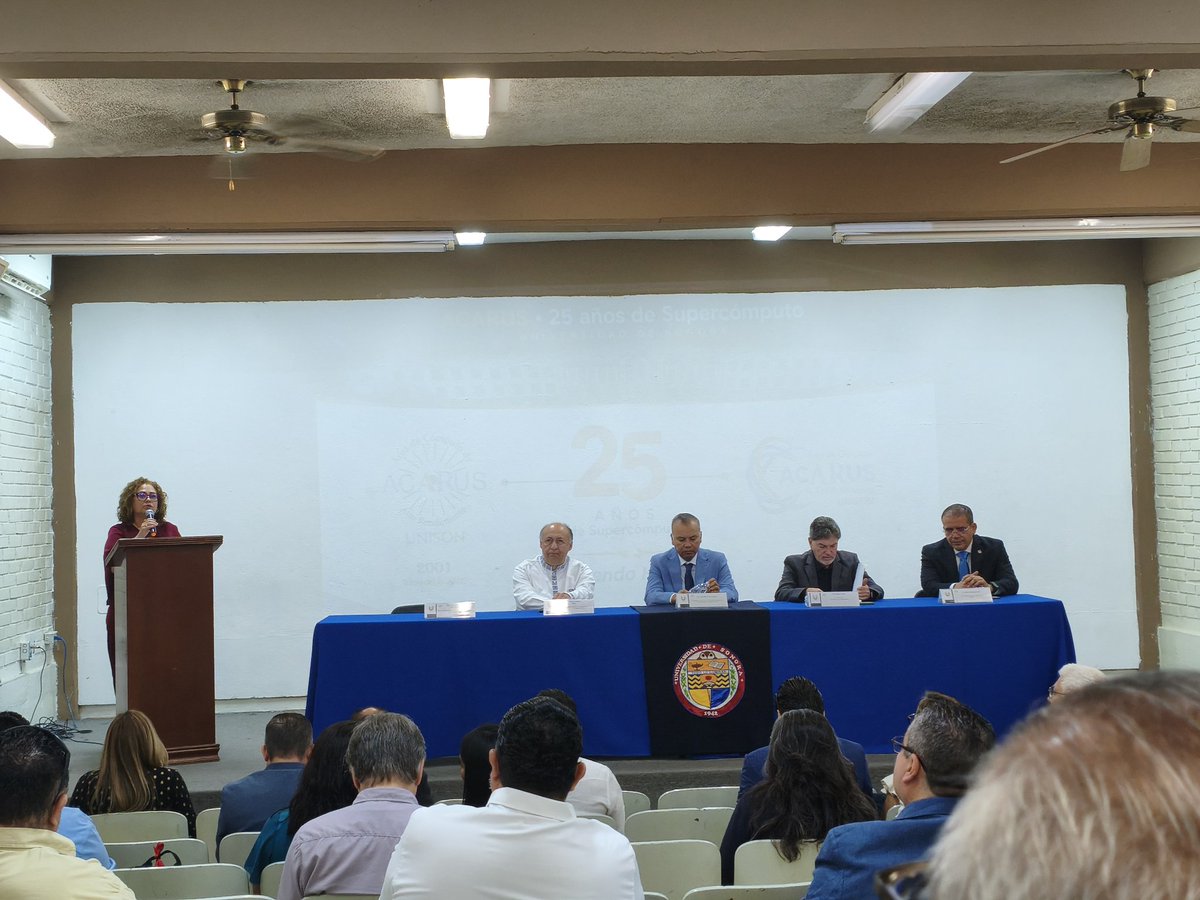
Arranca el ACARUS Summit 2026. Muchas felicidades por estos 25 años en los que la @soyunison ha logrado tener el equipo de supercómputo más importante del país.
Revista Lationamericana de Estudios Educativos, Vol 56, No 2 (2026)
Educación en la era de la inteligencia artificial generativa: desafíos éticos y filosóficos
https://t.co/cNwAdPYtsE
Hace un tiempo charlé, junto con varios colegas, con el Dr. Alberto Ramírez Martinelli sobre el origen de las Inteligencias Artificiales Generativas.
Hoy sale el video publicado de esas entrevistas... en el siguiente tweet agrego los enlaces
https://t.co/5Jo3ZpRxLE
Esta es mi intervención sobre las IAs generadoras de texto, el video comienza en el segundo donde inicio esta parte... pero pueden verlo completo con las intervenciones de varias autoridades en el tema
y en el siguiente tweet el link a la publicación...
El periodista Rafael Cano Franco, director fundador de esta casa editorial, fue uno de los profesionales de la comunicación más reconocidos de Sonora.
Nuestras condolencias para familiares y amigos.
Descanse en paz el Maestro Cano.
Space jellyfish alert!
Starlink 17-36 from SLC-4E in California on April 29, 2026 at 7:37:50 PM PDT could produce a space jellyfish. This occurs when a rocket and its expanding exhaust plumes are illuminated by the sun and observers are in local darkness.
The rocket will enter sunlight 00m00s after launch.
See a detailed prediction for your location: https://t.co/KIadNi37so
Information as of 2026-04-29 13:52 UTC
Daniel Estrada Neri, Kevin Soto Ramírez y Aarón Velez Coronado, alumnos de Ingeniería en Sistemas de Información e integrantes del laboratorio @CSIPro_Dev de la Universidad de Sonora ganaron el primer lugar en el 2do Datatón de Sonora en la categoría de Educación. ¡Felicidades!
Andre, Sebastian, Gael, Diego y Frida, alumnos de Ingeniería en Sistemas de Información de la Universidad de Sonora presentaron su Dashboard sobre Seguridad pública en el estado, en el 2do Dataton de Sonora
Kevin, Daniel y Aaron, integrantes del laboratorio CSI de la Universidad de Sonora exponen su Dashboard sobre el crecimiento de la Educación en el estado, en el 2do Dataton de Sonora
Gael, Miguel, Jorge y Ángel Francisco del laboratorio CSI de la Universidad de Sonora presentan su Dashboard sobre Estrés Hídrico en el 2do Dataton de Sonora. @Rql_Torres
Recuerdo que cuando leí el paper de Paul Baran sobre una red distribuída me sorprendí de la elegancia y simplicidad del concepto... Favoreció mucho que Unix fuera introducido más o menos al mismo tiempo, un sistema operativo simple y robusto
In 1960, a young engineer walked into a room full of telecom executives and was asked if he even understood how a telephone worked.
His name was Paul Baran. A Polish immigrant at RAND, staring at an uncomfortable reality. The U.S. communications system looked strong on paper, but it had a fatal flaw. It was centralized. A handful of hubs carried the load, which meant a handful of well-placed strikes could take the whole thing down.
Baran didn't tweak the system. He reimagined it. Instead of sending a message as one continuous stream, he proposed breaking it into small chunks, routing those chunks across a distributed mesh, and reassembling them at the destination. No central control point, no single failure that could halt everything, just a network that could adapt and route around damage in real time.
The Air Force saw the potential immediately. AT&T saw something very different. Their entire business depended on dedicated circuits and tightly controlled infrastructure, and Baran's idea didn't just challenge that model, it ignored it. He sat through dozens of meetings explaining the math and answering the same questions over and over. The verdict came back. Impossible. Switches weren't fast enough, the architecture didn't make sense, they passed. And because they owned the wires, that decision stuck. The project was shelved and Baran moved on.
A few years later, ARPA had a different problem. They needed computers to talk to each other across long distances, and they weren't tied to the same assumptions. So they revisited Baran's work and built ARPANET. Message blocks became packet switching. The "impossible" design became the foundation of the internet. Baran never patented the idea and never made a dollar from it. The monopoly that rejected it didn't last forever either.
What stands out isn't just the invention. It's the role the Department of Defense played in getting it across the line. The DoD didn't just fund technology, it funded a different way of thinking. It backed ideas that looked risky, impractical, even wrong to incumbents, because the stakes demanded something more resilient than the status quo. The common thread is resilience. Systems built to keep operating under stress, not just perform well under ideal conditions.
The same shift is happening across enterprise tech right now. Centralized models are giving way to distributed intelligence, static systems are becoming adaptive and agent-driven, and Baran's fishnet is back, just running on GPUs and APIs instead of copper wires.
Baran didn't just solve a Cold War problem. He reframed how we think about networks entirely. The next wave of breakthroughs will come from people doing the same thing today, questioning the assumptions we've gotten comfortable with and designing for a world that doesn't behave the way we expect.
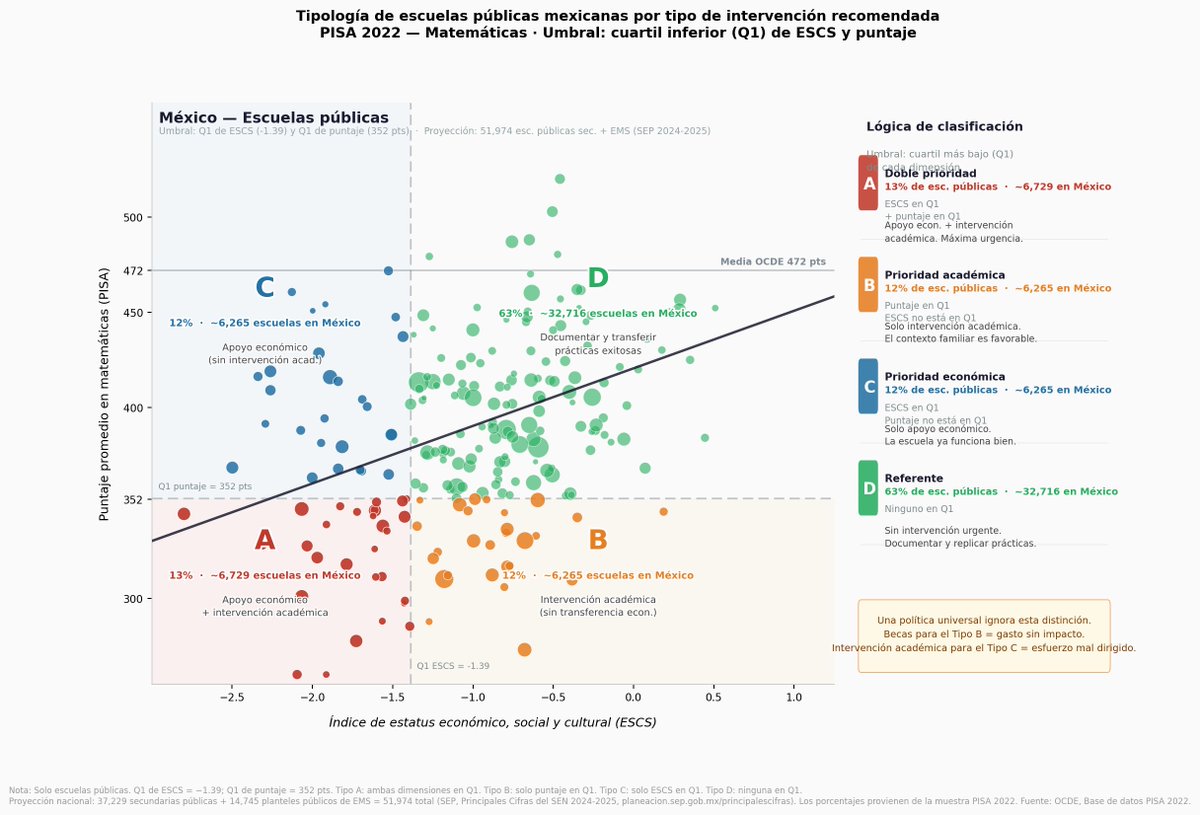
Podríamos identificar cuatro grupos:
A — Doble prioridad: contexto bajo Y resultados bajos. 13% (1er cuartil en ambos: ~6,700 escuelas). Necesitan atención integral.
B — Prioridad académica: contexto razonable, resultados bajos. 12% (~6,300). El problema, es lo que pasa adentro.