First week on site, before the agent touches prod, I ask the customer one thing: what can it do that we can't undo?
Write that list down. Every item on it gets a human approve step. Everything else can run.
Most teams skip this and find the list during an incident.
@Dhanush_Nehru I'd put discovery near the top. Sit with the people doing the job before writing code. That's where you find the bottleneck that actually pays for the pilot.
@wholemars Agents opening PRs faster than CI can run them is coming for every team. A per-repo rate limit and a human merge gate are cheap to add before the queue backs up.
@Cointelegraph Expected. Agent rollouts at banks end up inside the bank's own network with read-only accounts. The security review is the real timeline, so start it in week one.
Before a pilot starts, I write down what would kill it.
Wrong on 1 in 10 real tickets. Ops lead still checking every output after two weeks.
Customers laugh. Then go quiet, because nobody's asked them before.
That list builds more trust than any demo.
Before an agent ships, I ask the ops lead:
"When it's wrong, how would you know?"
Usually: "a customer would call."
So we add a queue for calls it's unsure about, plus logs their team reads without me.
Boring work. It's what wins the second contract.
@fabiolauria Yeah, agreed. If day one feels clunky they won't open it again, and then the FDE work never even gets a shot. I try to sit with two real users the first day. Catches most of it.
@Dachris888@unclebobmartin Honestly I just ask what's a pain to undo. Writing to their systems, touching money or permissions, anything a customer sees, that gets a hard gate. Reads and drafts I let run and just log everything. If one revert fixes the mistake, I don't make it prove itself every step.
Enterprise AI has plenty of tourists. They demo and leave.
After years shipping into messy client tenants, the bar moved. An FDE now builds the workbench: models wired into legacy systems, with security and access sorted first.
Week one on an FDE gig, my first ask:
"Can I see the spreadsheet?"
There's always one. Color-coded rows, a tab called FINAL_v3. That's the real process. The SOP doc is the wish list.
Build the agent around the spreadsheet and it survives week two.
@sameergkoli Agree. If the model has no card and only ships inside the agent product, leaderboard evals miss what users hit. Grade the harness you actually put in their hands.
@aamirorbit Real FDE when you own the shipping path into the customer's stack and leave something maintainable. Solutions engineer when it is a deck plus a handoff. Same words, different job.
@pauliusztin_ In-harness subagents are great when you want shared permissions and cheap context isolation. Out-of-process starts winning when you need hard blast radius limits on a customer network.
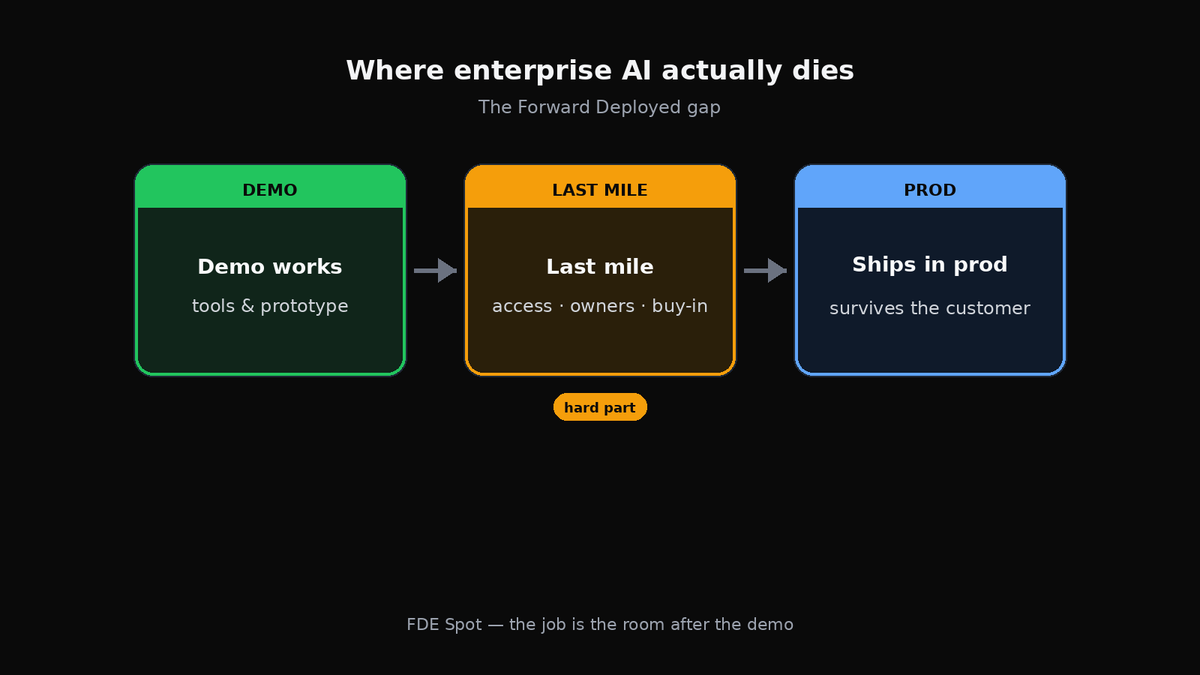
@NDTVProfit@tiwary_tanmay The consulting interest is real. The scarce skill is still last-mile work on messy client systems: auth, data ownership, and a stakeholder who can kill the project in one meeting.
@ghumare64 Building a harness makes that obvious fast. Context load, tool allowlist, approval gates, and how you resume a failed run are most of the product. The model is rarely the hard part.
@Celonis@vasuman@billdetwiler This matches the failure mode we see constantly. A strong model on a broken handoff still burns the week. Fix the process boundary first, then put the agent on it.
@ArtificialAnlys The index treating model plus harness as the unit is the right call. In customer deploys we only trust the combo we can actually ship and inspect, not a leaderboard name alone.
Anthropic-style FDE loops are not leetcode with extra steps.
Expect stages that probe how you scope a messy customer problem, write a pass bar with them, and defend a miss under pressure.
If your prep is only model trivia, you will fail the room that matters.
@AlemTuzlak Custom harness work is where most agent loops fall over. Glad you're calling the agent-loop utility out instead of burying it under chat UX.