The environmental movement of the last generation was partly organized around stopping things. But to save the planet we are going to have to build things at an unprecedented speed and scale. We need to make it easier, not harder, to build big, planet saving projects.
As a climate reporter, it’s been frustrating to watch the legislative debate. By focusing on $3.5T as a big number, it entirely misses the economic context of climate change.
The costs will be astronomical, the losses huge.
Old budgets are not a good baseline.
Here’s why:
🔶UNTITLED Festival Picks🔶
How can European cities adapt to and thrive in extreme heat caused by climate change? Read more about this immersive Festival session hosted by @julisikorska@fdesmarais @imaginari_es: https://t.co/rdd4L3OWCP
#Agenda4Transformation#ImagineUntitled
The phrase 'vaccine diplomacy' is a pretty tepid description for enabling life and futures to entire communities. What are you doing about stopping the next heart wrenching covid catastrophe that's unfolding in Nepal @USAmbNepal? #Vaccines4Nepal
"The time has come to voice our fears and be honest with wider society. Current net zero policies will not keep warming to within 1.5°C because they were never intended to. They were and still are driven...to protect business as usual, not the climate."
->
https://t.co/6OMZWTsU8D
The IMF and WB finally admit that staggering debt is an environmental disaster, forcing Global South to forgo investments in energy transition & resiliency.
But will they ever admit it’s the Global North that owes an ecological debt to the Global South? https://t.co/hlvPbGYJHA
The architect of the #ParisAgreement, Laurence Tubiana, warns that the EU-Mercosur trade deal in its current form "would send out a message that the #EU considers environmental and social concerns to be secondary to commercial gain." https://t.co/Wkx4FuJfhl via @EURACTIV
Decarbonising the US requires more state involvement and public production targets (incentives, penalties, and mandates) and financing mechanisms at both public and private scale. Read @drvox summary: https://t.co/iNZtcUuAEB. Full @rewiringamerica report: https://t.co/a0vEOGQie2
Seems like an opportune moment for new macroeconomic thinking to catalyse climate action—two pieces caught my eye this week: @drvox 's piece on @rewiringamerica report to decarbonise the US and @TheEconomist 's article on how macroeconomics is ready for a fundamental rethink
Traditional macroeconomic views are breaking apart due to Covid-19 and governments are already experimenting with radical approaches. Time for new mechanisms for public debt and financing to fuel climate investment? https://t.co/jcW17f8cNp
@do_you_cli_fi_ Thanks @do_you_cli_fi_ ! Nice resource and historical documentation :) It's empowering to see how cli-fi is becoming ever more mainstream.
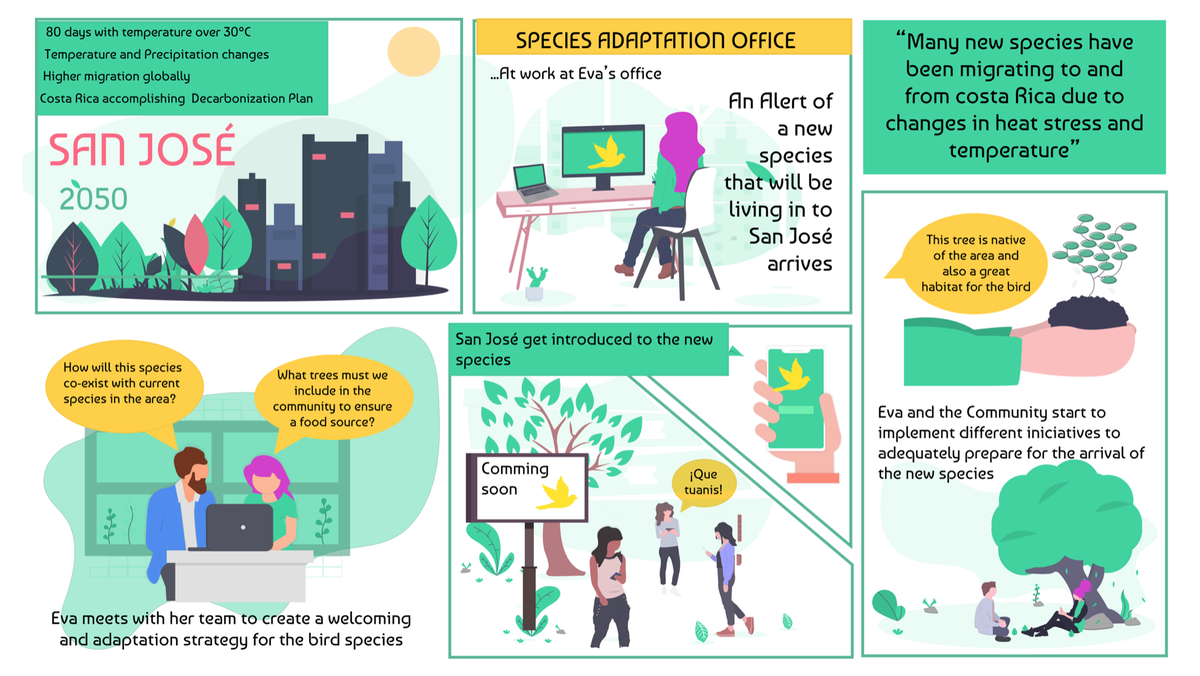
And I love this provocative future service for a 'Species Adaptation Office' within the Costa Rica government. Idea by my @CIIDnews summer school participants in Aug 2019. Can we change our attitudes to welcome all climate migrants, from species to people?
One of the most gut-wrenching parts of our climate era is migration. This article by @propublica@NYMag and @pulitzercenter is a much needed deep dive into possible implications for livelihoods, families (and our food supply). Make space to read this! https://t.co/y2m0Ydzkuu
Hatch is a concept for a 'welcome box' and accompanying digital service that weaves together organisations into a personalised welcome. Project by my @CIIDnews IDP students: Raphael Katz, Abhishek Kumar, Rina Shumylo, Juliana Lewis, and Sareena Avadhany https://t.co/fuScSoFhM7
Not so fun fact: Flooding in the U.S. disproportionately hurts POC & low-income communities AND urban flooding will only increase as climate change worsens, so join us as we #StopTheMoneyPipeline. #ActOnClimate
https://t.co/P1bQKFm2wb