@steshaw@smdiehl Incidentally, it’s sobering that Dedekind’s rigorous definition of the real numbers was only published 130 years ago. Before that we literally didn’t know what we were talking about, or calculating with.
@paulg A lesson we learned dealing with a large company: everyone will say the right things, smile & pretend to be onboard.
You'll then discover (only after significant resources) that there's an entire contingent of smiling people below the execs busy sabotaging your project.
In 2015 I formed a small group of engineers at Jane Street to rebuild the firm’s core trading system from the ground up, and we ended up cutting latency by two orders of magnitude. Some of the techniques we used, relevant for algorithmic trading systems and exchanges today:
Zero allocation: Whenever a program allocates memory for an object on the heap, the runtime pays a steep penalty in latency. The simplest solution is to avoid memory allocation entirely.
Jane Street famously uses OCaml, a strongly typed programming language that by default produces garbage collected by a dynamic collector. Most other firms use languages with manual memory management, but it was a strict part of Jane Street’s tech culture that all risk-sensitive code had to be written in OCaml. It took a collaborative effort across multiple groups within Jane Street’s technology org to create zero-allocation core libraries, combining the type safety of a functional programming language with the memory profile of a language like C.
We built the new main trading loop in this hybrid OCaml/C-style, producing zero new allocations in the critical path from tick to trade. In modern languages like Rust, it is substantially easier to achieve precise memory management while still benefiting from type safety and compile-time guarantees.
Kernel bypass: A primary goal of a low-latency trading system or exchange is to pull a network packet containing market data or order flow through the network card’s interface and into the program’s memory space as fast as possible. The standard Linux OS kernel uses slow abstractions to support a wide variety of network drivers, at the expense of the entire system’s end-to-end latency. When we started with an empty program that contained no business logic and only forwarded packets through when received, the end-to-end latency was already too slow.
To fix this issue, we employed a standard practice in the HFT industry in which we bypassed the OS’s kernel stack entirely by leveraging our network card vendors’ proprietary APIs to DMA packets straight from the NIC into memory. This technique brought our empty-packet-forwarding baseline into the latency regime we needed in order to build out the rest of the trading, risk, and protocol code.
Local IPC: Kernel bypass is necessary when reading routed packets off a network from a third party such as another exchange or client connection. When communicating between internal instead of external processes, the fastest transports avoid network stacks entirely.
Processes within the same box can transfer messages using shared memory or Unix domain sockets. This allowed us to continue with our familiar process boundaries for separable components without sacrificing significant performance. We had to write custom logic to emulate many of the features of network- and transport-layer protocols, with the result of creating a reusable, zero-overhead IPC mechanism.
Working on this problem was one of the most intellectually rewarding experiences of my early career. The above latency optimization techniques are fairly commonplace in the HFT trade but hard to learn outside the industry setting. Half of our team at Architect comes from Jane Street and other trading firms, and we value using our domain knowledge to build exchanges for the public rather than trading software that never leaves an HFT’s walls.
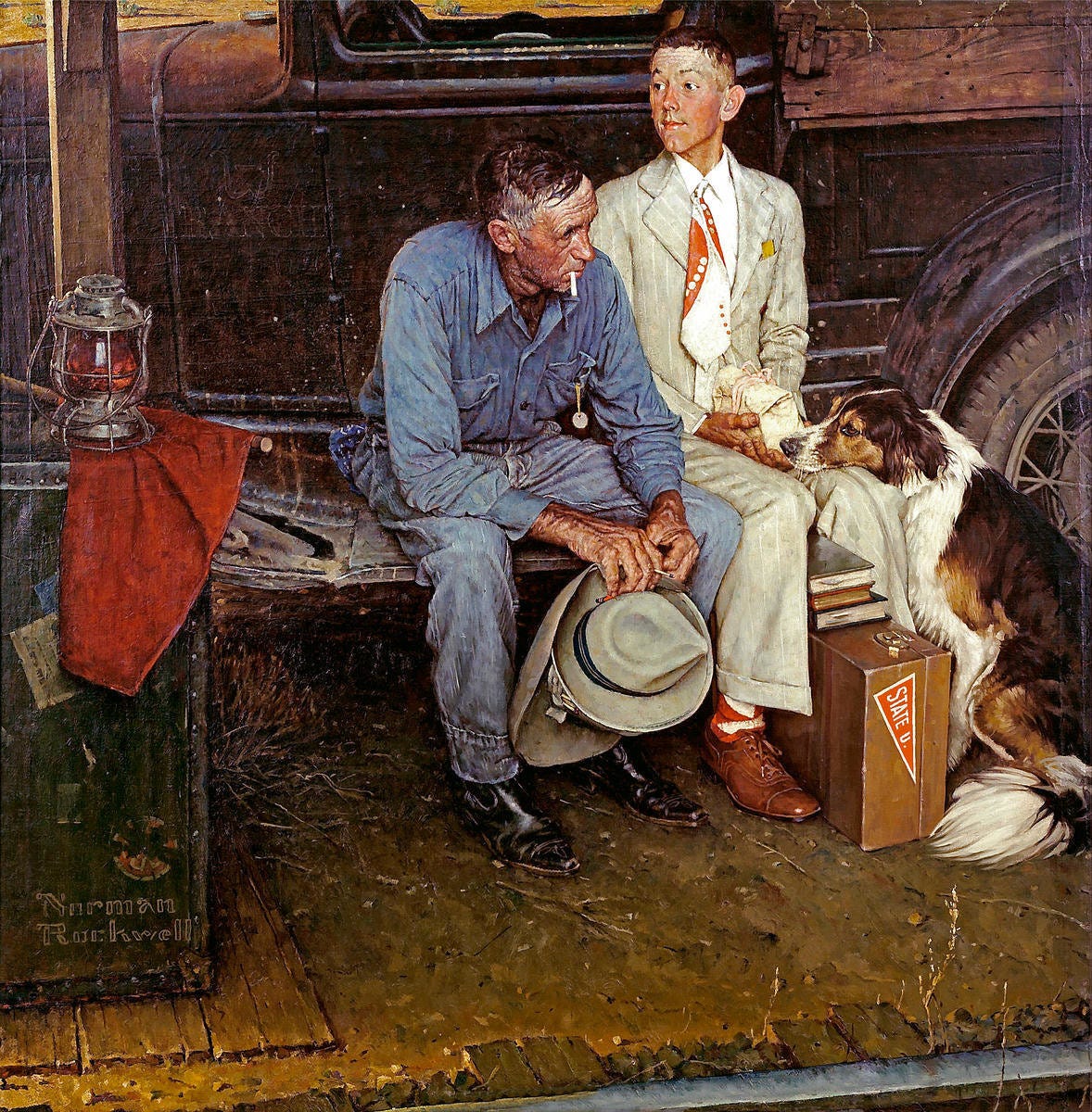
This is one of the most beloved paintings in America, and it puts its finger on something we all pass through, first as the child, and one day as the parent left behind...
The painting is Breaking Home Ties, by Norman Rockwell, on the cover of the Saturday Evening Post in 1954. A father and his teenage son sit side by side on the running board of a battered farm truck, waiting at a railway stop. A single track runs along the bottom of the picture. A ticket pokes from the boy's pocket. His suitcase is stacked with schoolbooks and wears a "State U" pennant. The train is coming to carry him off to college, away from home, for the first time in his life.
Everything is in the way they sit.
The son sits upright, scrubbed and dressed in his best, eyes fixed on the horizon, on the track, on the future rushing toward him. He is already half gone. For him that train is the beginning of everything.
His father sits beside him in worn work clothes and scuffed boots, looking the other way, down the line, as if he cannot bear to watch it arrive. The same train means the opposite thing to him. For the son it is the start of a life. For the father it is the day the house grows quieter, the chair at the table sits empty, and the person he built his world around walks out into a life that no longer has him at its centre.
Look at his hands. He is holding two hats. His own battered one, and resting on top of it, his son's crisp new one, held carefully together, because it is the last small thing he can still do for the boy...
And then the dog, its head laid in the son's lap, gazing up, refusing to look away. Rockwell knew exactly what that was for: "The father couldn't show how he felt about the boy's leaving," he said. "The dog did."
It has moved people for 70 years because every leaving is a beginning for one person and an ending for another. The child steps out into the world, as they should. And someone stays behind, watching them go, and loving them enough to let them go anyway...
The full story, which is a nice bit of algebra, is that any solution must take the form [a, b; 0, a] where a²=0 and ab + ba = 1.
So unless 1 = 0, you need noncommutativity and nilpotents. We therefore can’t do much better than 2x2 matrices as an extended ring of coefficients.
A mathematician spent two hours answering a question a child could ask. How many ways can you wrap a 4-dimensional sphere around a 3-dimensional one? The answer is two.
Waterloo filmed it. It is free
His point: the question takes one line to ask and the heaviest machine in topology to answer. π₄(S³) = Z/2. Two elements. That is the whole answer.
He is William Gollinger. The talk is Serre Spectral Sequence II, from a seminar literally called "We Promise This Applies to Physics."
Skip to Example 4. He does not draw anything. He runs the spectral sequence and kills terms until a single group with two elements is left standing.
No pictures. No intuition. One machine, cranked to the end.
Then he goes further. A fibration hands you an exact sequence in homotopy but not in cohomology. He shows the cohomology version exists anyway, inside a range set by connectivity. Gysin sequences. Steenrod squares. Transgression.
That machinery is not decoration. Steenrod squares and Eilenberg-MacLane spaces are how physicists classify anomalies and topological phases of matter.
The seminar name is a joke that turned out to be true.
Canton Foundation welcomes @Visa as a General Member.
Visa became a Super Validator earlier this year under CIP-0109, bringing one of the world's largest payment networks into the governance of infrastructure built for privacy-preserving, institutional-grade settlement.
That commitment now extends further with Visa joining as a General Member of Canton Foundation.
Recently I've flipped from being bullish to being bearish about AI.
I think I'm updating my bearishness to be more solidly bearish. Early thoughts (which I hope to be disproven in the next year or so, I would prefer progress) and my reasoning:
The whole 'it turns out if you keep training and scaling the models more they develop broad new capabilities in lots of domains' thesis is wrong (sorry Demis). The recent batch of models haven't got more general, they've got less general. This is most obvious in the fact that their language outputs have got much worse in comparison to e.g. o3. If they were gaining generalist capacities we would expect them to be describing their work in ever more graceful and comprehensive prose!
The image that was being shared as the AGI thesis (November 2025, Tomas Pueyo) was the spiky bubble that has a current spike or two out past human capabilities (e.g. on coding or math) but below human on other capabilities on the other spikes - the future prediction was that as the models scale/advance, every spike would grow bit by bit until the whole center encompasses the human capabilities, with super-superhuman on some spikes. I think it seems like what's actually happened in the last few models has been that the coding/math spike has grown, but leaving behind or even at the cost of the other spikes. The models are no better at some simple logic, language (and sometimes worse!).
This makes sense from a simple RL perspective; you can't RL something endlessly on one domain of tasks and expect it to improve on the other tasks. The fact that early LLMs did seem to improve generally was a byproduct of the written language corpus covering everything - that corpus is general, so training it on that gave the appearance of something generally intelligent and becoming more generally intelligent as it got better at replicating that corpus. But the actual logic and underlying ground truths behind the language aren't captured efficiently enough and weren't effectively RLd in - they top out at some point (I guess this happened around the time that there was the 'has scaling hit a wall' discussion in late 2024). Chain of thought was then a genuine breakthrough, along with web search, which plugged into that general LLM global-corpus intelligence to lead to post 2024 gains.
The AI companies have since worked out that coding works (and pays) really well (basically this is because the entire job is nearly perfectly recorded and exists as training data, and you can set up clear benchmarks and rewards). The recent models (and benchmarks) have been maxxing that and we've seen degradation on normal English use for that reason. This could still be transformative, leading to extremely powerful (and potentially dangerous, particularly in cyber security) models but it's not a pathway to AGI.
I'm probably at about 40% confidence about this. It fits my current observations of AI progress and has a basic explanatory model. It doesn't account for potential breakthroughs, which is a major reason for discounting.
To make some predictions, I guess if I'm right this will become broadly apparent and more widely acknowledged in the next year or two, as we see how the spikiness of models that keep getting released develops.
Maybe there will be efforts to concentrate on specific spikes e.g. health or law which require going back to earlier models and RLing on a different data set/with different rewards/benchmarks. Maybe those separate models can be linked together to give a more apparently general model. How capital intensive that is/the potential profitability will be a defining question. But I just don't see general abilities emerging atm, and I don't think we will any time soon. Good news - a whole industry of tackling important specific problems/sectors can open up!
Price action on $CC is painful. A lot of people are asking how come the BME not managing this. It’s important to understand that buy/sell can still move the price significantly esp when volume is low (I posted already we don’t do volume deals). Canton still needs a lot more awareness and we’re working on it.
At the end of the day, the thesis doesn’t change. Everything on @CantonNetwork requires burn. The network since inception burned already north of 9% of its total supply. These are coins that are never coming back. Just for comparison, ETH burned roughly 3.5% since inception. Other active chains less than a 1%.
That doesn’t change the pain with this move but I’m very confident that eventually when burn goes up as a result of real activity, there is no better alternative. I wrote about it before that relying on speculative buying is good short term and very bad long term.
We’re going to continue to execute.
All 16,777,216 possible RGB colours in one image, each exactly once (modulo Twitter compression).
Arranged by threading a Hilbert curve through the 256³ colour cube and unrolling it along a Hilbert curve filling the square. so nearby colours stay close.
No mammal has ever evolved green fur. Not one of roughly 6,400 species. Mammals make exactly two pigments, eumelanin for black and brown, pheomelanin for red and orange, and no combination of those gets you to green. The only mammal that looks green is a sloth, and that's algae growing on it.
So evolution solved the camouflage problem from the opposite end. Deer and boar are dichromats. They lack the long-wavelength cone, so orange and green land on the same channel. A tiger never needed green fur, because the animals it hunts cannot tell the two apart. John Fennell's team at Bristol ran this in simulation, and the tiger goes from garish to invisible the moment you remove one cone.
Which leaves the question Fennell flagged as still open. Why didn't deer evolve trichromatic vision? Spotting an ambush predator is the whole ballgame, and primates pulled off that upgrade tens of millions of years ago.
The answer is stranger than growing better eyes.
In Kanha and Mudumalai, chital deer spend their days directly underneath langur troops. Langurs are Old World monkeys, which means full trichromatic vision, sitting in the canopy, looking down at the forest floor. A 1989 study at Kanha found that of deer herds within 200 meters of a langur troop, 70% closed to within 25 meters. Chital reacted to langur alarm calls more often than langurs reacted to theirs.
The deer could not build the eyes. So they parked themselves under something that already had them.
The tiger's coat is tuned against the visual system of nearly every mammal in that forest. It fails against exactly one, and the deer worked out how to borrow it. The borrowing works well enough that people run the same play. When a burst of chital alarm calls goes up in an Indian reserve, every guide within earshot stops the jeep and starts looking for stripes.